
Pathophysiology of Otitis Media: Otitis media (OM) is an inflammatory disorder of the middle ear cavity that commonly develops following Eustachian tube dysfunction, often in association with an upper respiratory tract infection. It may involve accumulation of fluid, inflammation, and infection within the middle ear. The condition is particularly common in children because their Eustachian tubes are shorter, more horizontal, and less efficient at ventilation and drainage.
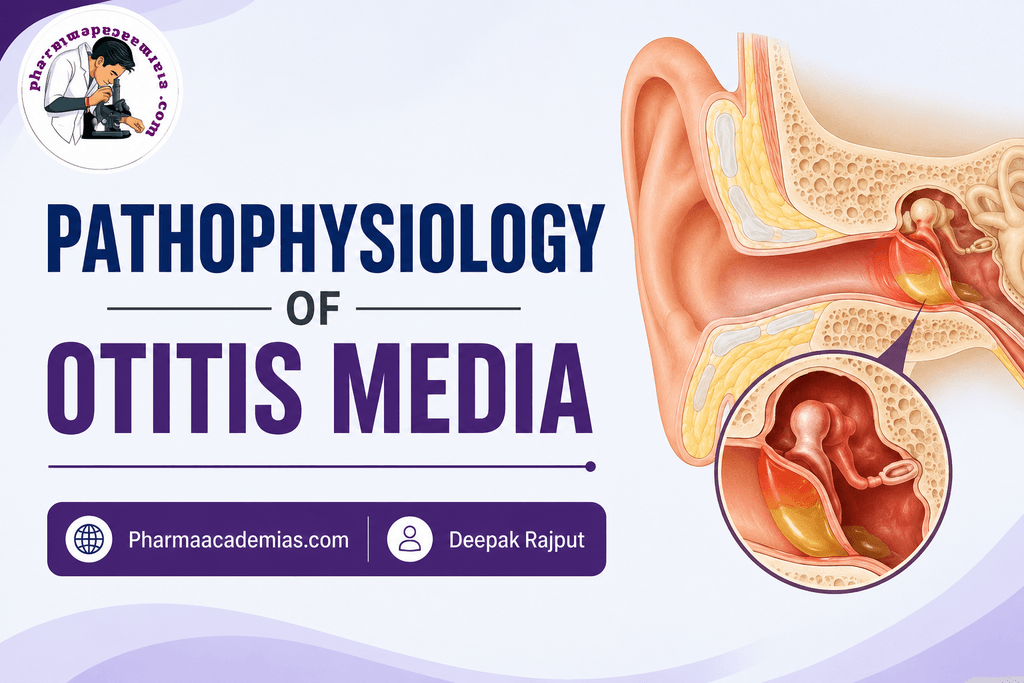
The pathophysiology can be understood as a sequence of events beginning with Eustachian tube dysfunction and progressing to middle-ear effusion, inflammation, infection, increased pressure, and impaired hearing.
1. Initiating Factors
Otitis media may be initiated by several factors, including:
- Upper respiratory tract infections
- Viral infections
- Allergic inflammation
- Enlarged adenoids
- Exposure to tobacco smoke
- Anatomical abnormalities of the Eustachian tube
- Immature Eustachian tube function in children
These factors can cause inflammation and swelling around the opening of the Eustachian tube.
2. Eustachian Tube Dysfunction
The Eustachian tube connects the middle ear with the nasopharynx. Under normal conditions, it opens periodically to:
- Ventilate the middle ear
- Equalize air pressure on both sides of the tympanic membrane
- Drain secretions from the middle ear into the nasopharynx
- Protect the middle ear from nasopharyngeal secretions and microorganisms
During an upper respiratory infection or allergic reaction, the mucosa surrounding the Eustachian tube becomes swollen.
Mucosal edema → narrowing/obstruction of Eustachian tube → reduced middle-ear ventilation
In children, the tube is shorter and more horizontally positioned, which makes dysfunction and movement of secretions or microorganisms from the nasopharynx into the middle ear easier.
3. Development of Negative Middle-Ear Pressure
When the Eustachian tube remains obstructed, fresh air cannot adequately enter the middle-ear cavity.
The oxygen and other gases already present in the middle ear are gradually absorbed into the surrounding blood vessels.
As a result:
Air absorption + failure of ventilation → negative pressure in the middle ear
The negative pressure causes the tympanic membrane to become retracted and encourages movement of fluid into the middle-ear cavity.
4. Formation of Middle-Ear Effusion
Negative pressure and inflammation stimulate the middle-ear mucosa.
This results in:
- Increased vascular permeability
- Fluid movement into the middle-ear cavity
- Increased mucus production
- Impaired drainage
Consequently, fluid begins to accumulate behind the tympanic membrane.
Negative pressure + inflammation + impaired drainage → middle-ear effusion
The accumulated fluid may initially be thin and serous but can become thicker and mucoid if the condition persists.
This stage is commonly associated with otitis media with effusion (OME).
5. Entry of Microorganisms
The accumulated fluid provides a favorable environment for the growth of microorganisms.
During an upper respiratory infection, microorganisms present in the nasopharynx may reach the middle ear through the dysfunctional Eustachian tube.
Common bacterial organisms associated with acute otitis media include:
- Streptococcus pneumoniae
- Haemophilus influenzae
- Moraxella catarrhalis
Respiratory viruses can also contribute to Eustachian tube dysfunction and inflammation.
Thus:
Nasopharyngeal infection → Eustachian tube dysfunction → microorganism migration → middle-ear infection
6. Activation of the Immune Response
Once microorganisms enter the middle-ear cavity, the body’s immune system recognizes them as foreign organisms.
This activates an inflammatory response involving:
- Neutrophils
- Macrophages
- Cytokines
- Other inflammatory mediators
These mediators increase blood flow and vascular permeability in the middle-ear mucosa.
As a result, the mucosa becomes:
- Red
- Swollen
- Thickened
- More secretory
7. Increased Exudate and Pus Formation
The inflammatory response causes further accumulation of fluid and cellular material.
The middle-ear fluid may contain:
- Bacteria
- Dead cells
- Neutrophils
- Proteins
- Inflammatory exudate
- Mucus
When bacterial infection is significant, the fluid may become purulent (pus-containing).
Inflammation + cellular infiltration + microbial growth → purulent middle-ear effusion
This further increases pressure within the middle-ear cavity.
8. Increased Middle-Ear Pressure
As fluid and inflammatory exudate accumulate in the closed middle-ear space, pressure increases.
This pressure acts on the tympanic membrane from the inside.
The tympanic membrane may become:
- Congested
- Red
- Thickened
- Bulging
- Less mobile
The stretching and inflammation of the tympanic membrane stimulate sensory nerve endings and contribute to ear pain (otalgia).
9. Tympanic Membrane Perforation
If the pressure becomes sufficiently high and inflammation is severe, the tympanic membrane may rupture.
This creates an opening through which infected fluid can drain into the external auditory canal.
Therefore:
Severe inflammation + increased middle-ear pressure → tympanic membrane rupture → discharge from the ear (otorrhea)
Following drainage, the pressure may decrease and pain can sometimes improve.
The perforation may heal spontaneously, although persistent or recurrent disease can result in a chronic perforation.
10. Impairment of Sound Transmission
The middle ear contains the three auditory ossicles:
- Malleus
- Incus
- Stapes
These structures normally transmit vibrations from the tympanic membrane to the inner ear.
When fluid accumulates in the middle ear, it interferes with the normal movement of the tympanic membrane and ossicles.
Therefore:
Middle-ear effusion → reduced membrane and ossicular mobility → decreased transmission of sound → conductive hearing loss
The hearing loss is generally mild to moderate and may resolve when the middle-ear fluid disappears.
11. Persistence of Inflammation
If Eustachian tube dysfunction persists, fluid may remain in the middle ear even after the acute infection has resolved.
Persistent fluid can become thick and sticky due to increased mucus production.
This may result in:
- Persistent conductive hearing loss
- A feeling of ear fullness
- Difficulty hearing speech
- Delayed speech and language development in some children when significant hearing impairment persists
Repeated episodes may also cause structural changes in the middle-ear system.
12. Recurrent and Chronic Otitis Media
Repeated episodes of infection or persistent Eustachian tube dysfunction may lead to recurrent or chronic otitis media.
Long-standing inflammation may cause:
- Thickening of the middle-ear mucosa
- Scarring
- Tympanic membrane retraction
- Tympanosclerosis
- Persistent perforation
- Ossicular damage
In some cases, abnormal skin growth called a cholesteatoma can develop, particularly in association with chronic retraction or perforation.
13. Possible Complications
Although most cases resolve without serious complications, infection may occasionally spread to surrounding structures.
Possible complications include:
Local complications
- Tympanic membrane perforation
- Persistent middle-ear effusion
- Chronic otitis media
- Ossicular damage
- Conductive hearing loss
- Cholesteatoma
Spread to nearby structures
- Mastoiditis – infection of the mastoid air cells
- Facial nerve involvement in severe cases
- Inner-ear involvement causing dizziness or sensorineural hearing problems
Rare intracranial complications
Severe untreated infection can rarely spread intracranially and may result in:
- Meningitis
- Brain abscess
- Other intracranial infections
In Simple Words
The key event in otitis media is Eustachian tube dysfunction. When the tube becomes blocked, the middle ear cannot ventilate or drain properly. Air is absorbed, producing negative pressure, which leads to fluid accumulation. Microorganisms can then enter and multiply in this fluid, causing inflammation and pus formation. Increasing pressure causes the tympanic membrane to become inflamed and bulge, producing ear pain. The accumulated fluid also interferes with the movement of the tympanic membrane and ossicles, resulting in temporary conductive hearing loss. If the condition persists or repeatedly occurs, it may produce chronic changes and complications.
Editorial Note
This article has been carefully researched and written by Deepak Rajput with a focus on accuracy, clarity, and evidence-based healthcare information. Pharmaacademias.com


