Pathophysiology of Congestive Heart Failure: Congestive heart failure (CHF) is a clinical condition in which the heart is unable to pump blood effectively enough to meet the body’s metabolic requirements, or can do so only at the expense of increased filling pressures. It may occur due to impaired contraction, impaired relaxation, or a combination of both.
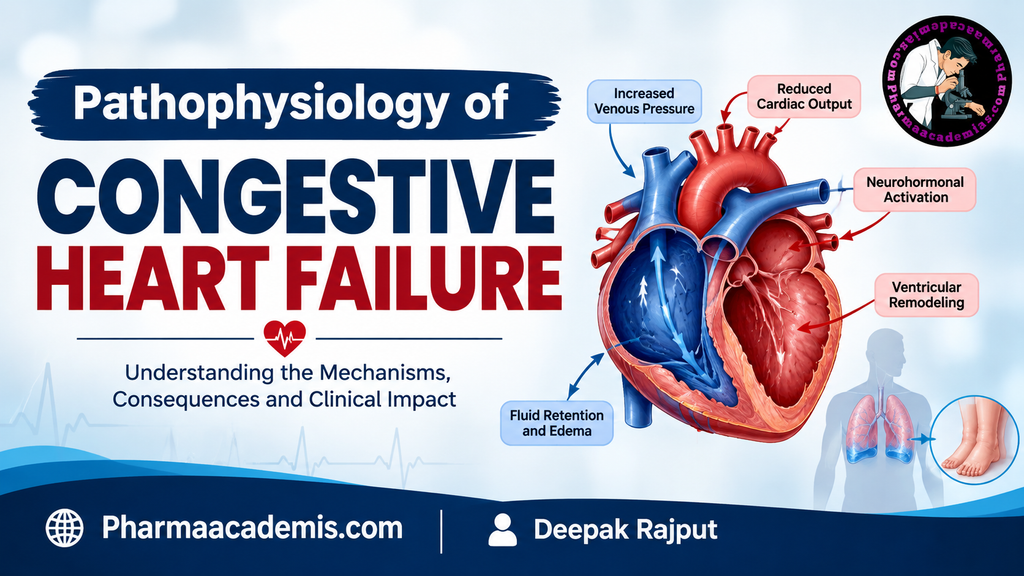
In congestive heart failure, the reduced pumping efficiency of the heart can decrease blood supply to body tissues and cause fluid accumulation in the lungs and other parts of the body. Common symptoms include breathlessness, fatigue, swelling of the legs, and reduced exercise tolerance.
Pathophysiology of Congestive Heart Failure
Congestive heart failure develops when structural or functional abnormalities of the heart impair its ability to fill with or pump blood. The major pathophysiological changes are described below.
1. Impairment of Cardiac Function
Heart failure may develop due to impaired contraction or impaired relaxation of the heart.
Systolic dysfunction: In this condition, the ventricles cannot contract effectively, resulting in reduced blood ejection during each heartbeat. This is commonly associated with a reduced left ventricular ejection fraction.
Diastolic dysfunction: In this condition, the ventricles become stiff or relax inadequately, preventing them from filling normally. As a result, ventricular filling pressures increase, even when the ejection fraction remains normal.
Both abnormalities can reduce the efficiency of cardiac function and contribute to the development of heart failure.
2. Reduction in Cardiac Output
When the heart cannot pump blood effectively, cardiac output may decrease. Cardiac output is the amount of blood pumped by the heart per minute and depends on heart rate and stroke volume.
Reduced cardiac output decreases the supply of oxygen and nutrients to body tissues. This may produce fatigue, weakness, reduced exercise tolerance, and poor perfusion of vital organs.
3. Activation of Compensatory Mechanisms
The body attempts to maintain blood pressure and organ perfusion by activating several compensatory mechanisms.
Sympathetic nervous system activation: Reduced cardiac output stimulates the sympathetic nervous system, increasing heart rate and myocardial contractility. It also causes vasoconstriction, which helps maintain blood pressure. However, prolonged sympathetic activation increases the workload and oxygen demand of the heart.
Renin-angiotensin-aldosterone system (RAAS) activation: Reduced renal blood flow and other signals stimulate the release of renin. This leads to the formation of angiotensin II, which causes vasoconstriction and stimulates aldosterone secretion. Aldosterone promotes sodium and water retention by the kidneys, increasing blood volume and cardiac filling pressures.
Initially, these mechanisms help maintain circulation. However, persistent activation increases the workload of the heart and promotes fluid accumulation, worsening heart failure.
4. Sodium and Water Retention
Reduced effective arterial circulation activates the kidneys’ sodium-retaining mechanisms. Increased aldosterone activity and other renal responses cause sodium and water retention.
The increased blood volume raises venous return and cardiac filling pressures. In a healthy heart, the additional blood may be pumped forward effectively. In a failing heart, however, the increased volume may worsen congestion because the heart cannot accommodate or pump the additional blood efficiently.
This results in fluid accumulation in the lungs, legs, ankles, and other tissues.
5. Increased Venous Pressure and Fluid Accumulation
As heart failure progresses, pressure may rise behind the affected ventricle, causing blood to accumulate in the venous circulation.
Left-sided heart failure: The left ventricle cannot pump blood efficiently into the systemic circulation or fill without elevated pressure. Pressure rises in the left atrium and pulmonary veins, forcing fluid into the lung interstitial tissue and, in more severe cases, into the alveoli. This causes pulmonary congestion and may produce breathlessness, cough, and orthopnoea.
Right-sided heart failure: The right ventricle cannot pump blood effectively into the pulmonary circulation. Pressure increases in the systemic veins, causing peripheral oedema, swelling of the ankles and legs, raised jugular venous pressure, and sometimes enlargement or congestion of the liver.
Left-sided heart failure can also lead to right-sided heart failure when elevated pulmonary pressures increase the workload of the right ventricle.
6. Ventricular Remodelling
Persistent cardiac stress activates hormonal and cellular pathways that cause structural changes in the heart, known as ventricular remodelling.
These changes may include enlargement of the heart chambers, thickening of the ventricular walls, changes in cardiac muscle cell size, and increased deposition of fibrous tissue.
Initially, some changes may help maintain cardiac function. However, prolonged remodelling can impair contraction and relaxation, increase ventricular stiffness, and worsen the progression of heart failure.
7. Progression of Heart Failure
As heart failure progresses, compensatory mechanisms become less effective and may contribute to further deterioration. Reduced cardiac output, increased filling pressures, sodium and water retention, and ventricular remodelling reinforce one another.
The heart becomes less efficient, fluid congestion increases, and the supply of oxygen to body tissues may become inadequate. In advanced cases, kidney and liver function may deteriorate, and severe pulmonary or systemic congestion may develop.
Conclusion
Congestive heart failure develops when impaired cardiac contraction or relaxation leads to reduced cardiac efficiency and increased filling pressures. The body activates the sympathetic nervous system and the renin-angiotensin-aldosterone system to maintain circulation. However, prolonged activation causes vasoconstriction, sodium and water retention, increased cardiac workload, and ventricular remodelling. These changes promote pulmonary and systemic congestion, progressively worsening the symptoms and severity of heart failure.
Editorial Note
This article has been carefully researched and written by Deepak Rajput with a focus on accuracy, clarity, and evidence-based healthcare information. Pharmaacademias.com