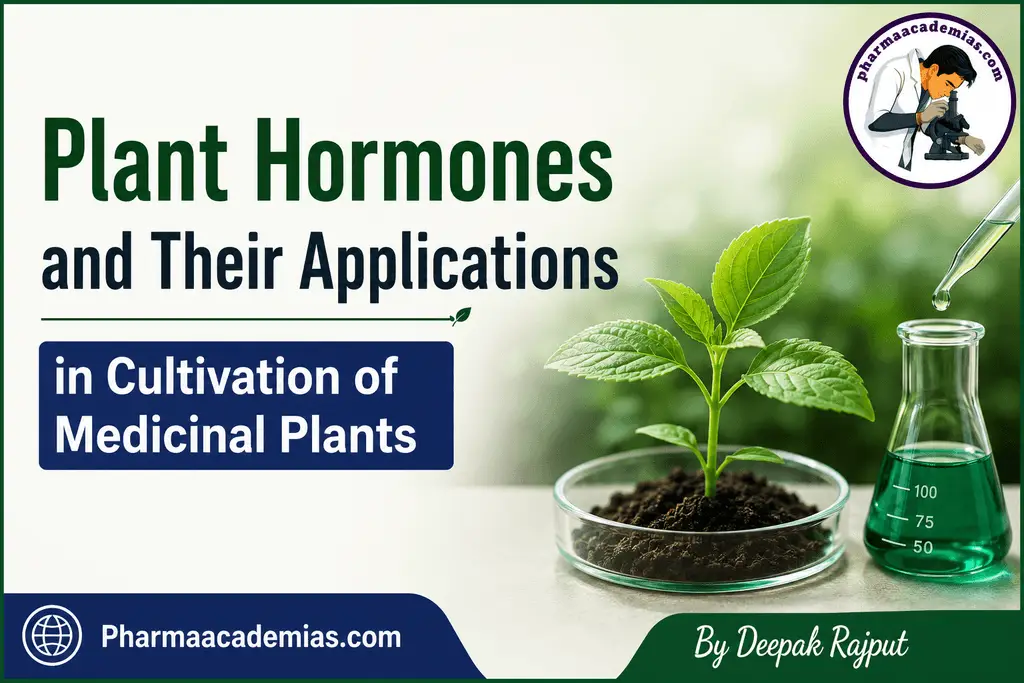
Plant Hormones and Their Applications: Plant growth and development are controlled by a group of naturally occurring chemical substances known as plant hormones or phytohormones. These hormones are produced in very small quantities within different parts of the plant and act as chemical messengers that regulate various physiological and biochemical processes. Unlike nutrients, which are required in relatively large amounts, plant hormones are effective even at extremely low concentrations. They coordinate growth by influencing cell division, cell elongation, differentiation, flowering, fruit development, seed germination, dormancy, senescence, and responses to environmental stimuli.
In medicinal plants, plant hormones play a particularly important role because they not only regulate plant growth but also influence the production of secondary metabolites, such as alkaloids, glycosides, flavonoids, terpenoids, tannins, and essential oils, which are responsible for the therapeutic properties of these plants. Proper application of plant hormones can increase biomass, improve the quality and yield of medicinal plant materials, enhance resistance to environmental stress, and promote the accumulation of active constituents.
Modern cultivation of medicinal plants extensively utilizes plant growth regulators to improve productivity, accelerate propagation, induce flowering, enhance rooting, and facilitate tissue culture techniques. Plant hormones are therefore considered essential tools in commercial cultivation, plant biotechnology, and pharmaceutical agriculture.
Definition of Plant Hormones
Plant hormones (Phytohormones) are naturally occurring organic compounds produced in minute quantities within plants that regulate growth, development, metabolism, and responses to environmental stimuli by acting as chemical messengers.
Some plant hormones are naturally synthesized by plants, while synthetic analogues known as plant growth regulators (PGRs) are commercially used in agriculture and medicinal plant cultivation.
Characteristics of Plant Hormones
Plant hormones possess several unique characteristics that distinguish them from other plant chemicals.
- They are produced in very small quantities.
- They regulate plant growth and development.
- They may be synthesized in one part of the plant and transported to another site of action.
- Different hormones may act synergistically or antagonistically.
- Their activity depends on concentration, plant species, developmental stage, and environmental conditions.
- They influence physiological rather than nutritional processes.
Classification of Plant Hormones
Plant hormones are broadly classified into five classical groups:
- Auxins
- Gibberellins
- Cytokinins
- Ethylene
- Abscisic Acid (ABA)
In addition, several recently recognized hormones include:
- Brassinosteroids
- Jasmonic acid
- Salicylic acid
- Strigolactones
Among these, the five classical hormones are most important in medicinal plant cultivation.
1. Auxins
Auxins were the first plant hormones to be discovered. They are primarily synthesized in the shoot apical meristems, young leaves, and developing seeds and are transported downward through the stem.
The principal natural auxin is Indole-3-acetic acid (IAA).
Common synthetic auxins include:
- Indole-3-butyric acid (IBA)
- Naphthalene acetic acid (NAA)
- 2,4-Dichlorophenoxyacetic acid (2,4-D)
Auxins primarily regulate cell elongation and root development.
Physiological Functions of Auxins
Auxins stimulate:
- Cell elongation
- Root initiation
- Vascular tissue differentiation
- Apical dominance
- Fruit development
- Delay in leaf abscission
- Tropic responses such as phototropism and geotropism
Auxins also influence wound healing and callus formation in tissue culture.
Applications in Cultivation of Medicinal Plants
Auxins are widely used in medicinal plant cultivation for vegetative propagation.
They are applied to stem cuttings to stimulate rapid root formation, increasing the survival rate of propagated plants.
Examples include:
- Tinospora cordifolia (Guduchi)
- Mentha species (Mint)
- Coleus forskohlii
- Stevia rebaudiana
Auxins are also used in plant tissue culture to induce callus formation, which serves as the starting material for micropropagation and production of secondary metabolites.
Synthetic auxins such as NAA are used to improve rooting efficiency and establish healthy nursery plants.
2. Gibberellins
Gibberellins are growth-promoting hormones synthesized mainly in young leaves, developing seeds, and shoot tips. The most widely used gibberellin is Gibberellic Acid (GA₃). These hormones primarily promote stem elongation and seed germination.
Physiological Functions of Gibberellins
Gibberellins stimulate:
- Stem elongation
- Cell division
- Seed germination
- Breaking of seed dormancy
- Flowering
- Fruit growth
- Enzyme production during germination
They also enhance mobilization of stored food reserves within seeds.
Applications in Cultivation of Medicinal Plants
Many medicinal plants possess dormant seeds that germinate poorly under normal conditions.
Treatment with gibberellic acid helps:
- Break seed dormancy
- Improve germination percentage
- Accelerate seedling establishment
- Promote uniform plant growth
Examples include:
- Withania somnifera (Ashwagandha)
- Rauwolfia serpentina
- Digitalis purpurea
Gibberellins are also used to increase stem growth and biomass in commercially cultivated medicinal plants.
3. Cytokinins
Cytokinins are synthesized mainly in root tips and transported upward through the xylem. The principal natural cytokinin is Zeatin.
Common synthetic cytokinins include:
- Kinetin
- Benzylaminopurine (BAP)
- Thidiazuron (TDZ)
Cytokinins primarily promote cell division.
Physiological Functions of Cytokinins
Cytokinins stimulate:
- Cell division
- Shoot initiation
- Lateral bud growth
- Delay of leaf senescence
- Chlorophyll synthesis
- Nutrient mobilization
They also regulate organ formation during tissue culture.
Applications in Cultivation of Medicinal Plants
Cytokinins are extensively used in micropropagation of medicinal plants.
They stimulate multiple shoot formation, allowing rapid multiplication of elite medicinal plant varieties.
Examples include:
- Aloe vera
- Bacopa monnieri (Brahmi)
- Centella asiatica (Gotu Kola)
- Rauwolfia serpentina
Cytokinins also prolong leaf longevity, increasing photosynthetic activity and biomass production.
4. Ethylene
Ethylene is the only gaseous plant hormone. Unlike other hormones, it diffuses rapidly through plant tissues and the atmosphere.
Ethylene is produced in:
- Ripening fruits
- Senescent tissues
- Injured plants
- Flowers
- Leaves
Physiological Functions of Ethylene
Ethylene regulates:
- Fruit ripening
- Leaf abscission
- Flower senescence
- Seed germination
- Root hair formation
- Stress responses
It also influences wound healing after mechanical injury.
Applications in Cultivation of Medicinal Plants
Ethylene is mainly used to synchronize fruit ripening and harvesting in medicinal plants producing medicinal fruits or seeds.
It also facilitates uniform harvesting of certain crops.
Ethylene-producing compounds such as ethephon are commercially used where synchronized maturation is required.
5. Abscisic Acid (ABA)
Abscisic acid is often called the stress hormone of plants. It is synthesized in mature leaves, roots, and developing seeds. ABA plays a major role in helping plants survive adverse environmental conditions.
Physiological Functions of Abscisic Acid
ABA regulates:
- Seed dormancy
- Bud dormancy
- Stomatal closure
- Water conservation
- Drought tolerance
- Stress adaptation
It inhibits excessive plant growth under unfavorable conditions.
Applications in Cultivation of Medicinal Plants
Abscisic acid improves survival of medicinal plants under:
- Drought
- Salinity
- Heat stress
It reduces water loss by closing stomata and enhances stress tolerance in field-grown medicinal crops.
ABA also regulates seed storage and maintains dormancy until favorable germination conditions arise.
Newly Recognized Plant Hormones
Although the five classical hormones are most widely studied, several newer plant hormones also contribute significantly to medicinal plant cultivation.
Brassinosteroids
Brassinosteroids promote:
- Cell expansion
- Vascular differentiation
- Stress tolerance
- Photosynthesis
They improve plant growth and increase resistance against environmental stress.
Jasmonic Acid
Jasmonic acid is involved in:
- Plant defense
- Wound healing
- Insect resistance
- Production of secondary metabolites
In medicinal plants, jasmonic acid often enhances the synthesis of alkaloids, flavonoids, and terpenoids.
Salicylic Acid
Salicylic acid regulates:
- Disease resistance
- Systemic acquired resistance
- Stress tolerance
- Antioxidant activity
Its application improves plant immunity against pathogens.
Strigolactones
Strigolactones regulate:
- Root architecture
- Branching
- Symbiotic interactions
- Nutrient uptake
These hormones contribute to healthier root systems and improved nutrient absorption.
Applications of Plant Hormones in Cultivation of Medicinal Plants
Plant hormones are widely utilized to improve both the quantity and quality of medicinal plant production.
1. Root Induction: Auxins such as IBA and NAA promote rapid root formation in stem cuttings, increasing propagation success.
2. Seed Germination: Gibberellic acid breaks seed dormancy and improves germination in medicinal plants with hard or dormant seeds.
3. Micropropagation: Auxins and cytokinins are used together in tissue culture to produce disease-free planting material through rapid multiplication.
4. Biomass Production: Gibberellins and cytokinins enhance vegetative growth, resulting in increased biomass available for medicinal use.
5. Enhancement of Secondary Metabolites: Certain plant hormones stimulate the biosynthesis of important medicinal compounds such as:
- Alkaloids
- Flavonoids
- Glycosides
- Essential oils
- Terpenoids
Jasmonic acid is particularly effective in increasing secondary metabolite production.
6. Stress Management: ABA, salicylic acid, and brassinosteroids improve plant tolerance to:
- Drought
- Salinity
- Temperature extremes
- Oxidative stress
This increases crop survival and productivity.
7. Uniform Flowering and Fruiting: Gibberellins and ethylene regulate flowering and fruit development, ensuring synchronized harvesting.
8. Conservation of Rare Medicinal Plants: Plant hormones play a vital role in tissue culture and micropropagation programs for conserving endangered medicinal plant species through rapid clonal multiplication.
Summary of Major Plant Hormones
| Plant Hormone | Major Function | Application in Medicinal Plant Cultivation |
| Auxins | Cell elongation, root formation | Rooting of cuttings, callus induction, vegetative propagation |
| Gibberellins | Stem elongation, seed germination | Breaking seed dormancy, increasing plant height and biomass |
| Cytokinins | Cell division, shoot formation | Micropropagation, multiple shoot induction, delaying senescence |
| Ethylene | Fruit ripening, senescence | Uniform fruit ripening and synchronized harvesting |
| Abscisic Acid (ABA) | Stress tolerance, dormancy | Drought resistance, water conservation, seed dormancy regulation |
Importance of Plant Hormones in Medicinal Plant Cultivation
The use of plant hormones provides several advantages, including:
- Increased crop productivity.
- Faster plant propagation.
- Improved rooting and seed germination.
- Enhanced production of bioactive phytochemicals.
- Greater resistance to environmental stress.
- Uniform growth and flowering.
- Production of disease-free planting material.
- Conservation of endangered medicinal species.
- Improved quality and consistency of herbal raw materials.
Conclusion
Plant hormones are essential regulators of plant growth, development, and adaptation to environmental conditions. The five classical phytohormones—auxins, gibberellins, cytokinins, ethylene, and abscisic acid—play distinct yet interconnected roles in controlling physiological processes such as cell division, cell elongation, root initiation, flowering, fruit ripening, seed germination, and stress responses. In the cultivation of medicinal plants, these hormones are widely applied to improve propagation, enhance biomass production, increase the synthesis of therapeutically important secondary metabolites, and strengthen plant resistance to biotic and abiotic stresses. Furthermore, plant hormones are indispensable in plant tissue culture and micropropagation, enabling rapid multiplication and conservation of valuable medicinal species. The judicious use of plant growth regulators, combined with sound agricultural practices, significantly enhances the quality, yield, and commercial value of medicinal plants, thereby supporting the pharmaceutical, herbal, and biotechnology industries.
Editorial Note
This article has been carefully researched and written by Deepak Rajput with a focus on accuracy, clarity, and evidence-based healthcare information. Pharmaacademias.com