United States Pharmacopeia: The quality, purity, safety, and effectiveness of medicines are essential requirements in every healthcare system. In order to maintain uniform standards for drugs and pharmaceutical preparations, official reference books known as pharmacopoeias are developed by recognized scientific and regulatory organizations. These pharmacopoeias establish standards that help ensure that medicines available to the public are safe, effective, and of consistent quality.
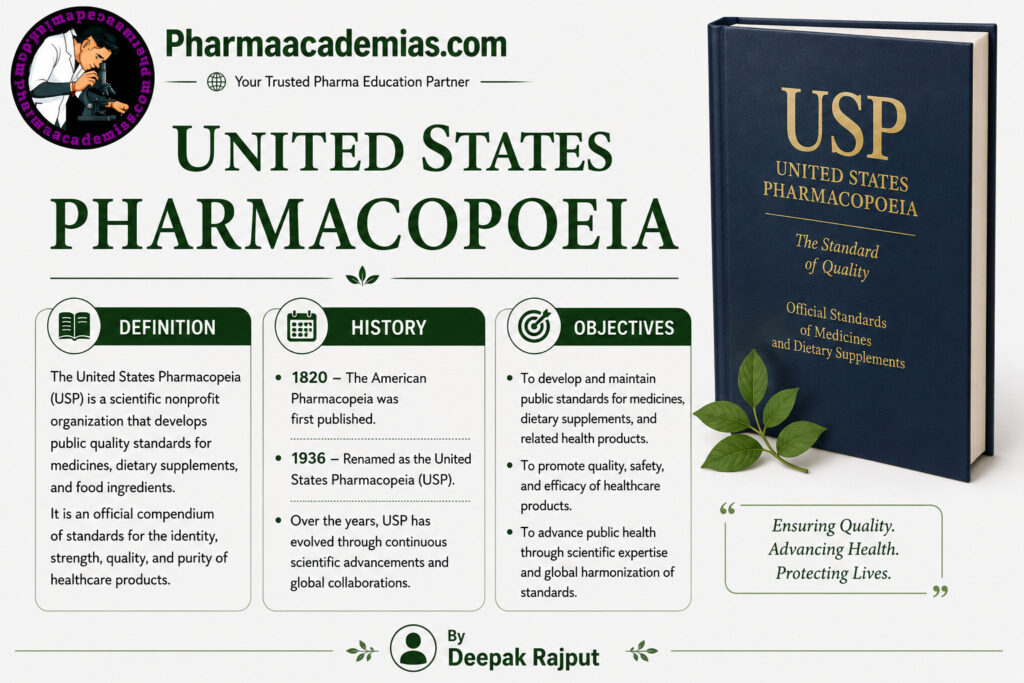
Among the most respected and widely recognized pharmacopoeias in the world is the United States Pharmacopeia (USP). The USP is an official compendium that provides legally enforceable standards for drugs, pharmaceutical ingredients, dosage forms, dietary supplements, biologics, and healthcare products in the United States.
The United States Pharmacopeia plays a major role in pharmaceutical sciences, drug regulation, quality assurance, public health protection, and pharmaceutical manufacturing. It serves as a scientific authority for setting standards related to identity, strength, purity, quality, packaging, labeling, and storage of medicines.
The USP is not only important within the United States but is also recognized internationally because many countries and pharmaceutical industries refer to USP standards for quality control and drug manufacturing.
Definition of United States Pharmacopeia
The United States Pharmacopeia may be defined as:
“An official compendium of standards for drugs, pharmaceutical substances, dosage forms, dietary supplements, and healthcare products recognized in the United States.”
It contains monographs and general chapters that describe specifications and analytical methods necessary to ensure medicine quality and safety.
History of United States Pharmacopeia
Early Development
Before the establishment of the USP, medicines used in the United States varied greatly in quality and composition because there were no standardized formulations or testing methods. Different physicians and pharmacists prepared medicines according to their own practices, resulting in inconsistency and poor quality control.
To address this problem, a group of physicians met in Washington, D.C., in 1820 and established the first United States Pharmacopeia. The purpose was to create standardized formulations and quality standards for medicines used throughout the country.
The first edition of the USP was published in 1820 and included standards for commonly used medicinal substances. It became one of the earliest national pharmacopoeias in the world.
Growth and Scientific Advancement
As pharmaceutical sciences advanced, the USP expanded its scope to include:
- Synthetic drugs
- Biological products
- Antibiotics
- Vaccines
- Biotechnology-derived products
- Dietary supplements
- Herbal medicines
In 1906, the Pure Food and Drug Act gave legal recognition to USP standards. Later, the Federal Food, Drug, and Cosmetic Act of 1938 further strengthened its authority.
The USP gradually evolved into a highly scientific and internationally respected organization responsible for establishing advanced pharmaceutical standards.
United States Pharmacopeial Convention (USP Convention)
The United States Pharmacopeia is published by the United States Pharmacopeial Convention, commonly known as USP.
The USP Convention is a nonprofit scientific organization dedicated to improving global health through public standards and related programs.
The organization collaborates with:
- Scientists
- Pharmacists
- Physicians
- Regulatory agencies
- Pharmaceutical industries
- Academic institutions
to continuously revise and improve pharmaceutical standards.
Objectives of United States Pharmacopeia
The USP was developed with several important objectives aimed at protecting public health and ensuring medicine quality.
Establishment of Drug Standards: The primary objective of USP is to establish official standards for the identity, purity, strength, and quality of medicines and pharmaceutical ingredients.
Protection of Public Health: By ensuring high-quality medicines, the USP helps protect patients from substandard, adulterated, or contaminated products.
Promotion of Uniformity: USP standards promote consistency in pharmaceutical manufacturing, testing, packaging, labeling, and storage.
Support for Regulatory Authorities: Regulatory agencies such as the U.S. Food and Drug Administration use USP standards for quality assurance and drug regulation.
Advancement of Pharmaceutical Science: USP encourages scientific research and development of advanced analytical methods for pharmaceutical evaluation.
Contents of United States Pharmacopeia
The USP contains extensive scientific information regarding drugs and healthcare products.
Its contents generally include:
- Drug monographs
- General chapters
- Analytical methods
- Reference standards
- Reagents and solutions
- Biological assays
- Microbiological tests
- Pharmaceutical dosage forms
- Dietary supplement standards
The USP is often published together with the National Formulary (NF), and together they are known as USP–NF.
USP–NF
The USP and National Formulary are combined into a single publication called USP–NF.
- USP mainly contains standards for active pharmaceutical ingredients and dosage forms.
- NF mainly includes standards for pharmaceutical excipients, additives, and formulation ingredients.
The combined USP–NF serves as an official legal standard in the United States.
Structure of USP Monographs
Each monograph in USP provides detailed scientific standards for a pharmaceutical substance or preparation.
A typical monograph includes:
- Official title
- Molecular formula
- Molecular weight
- Chemical structure
- Definition
- Description
- Solubility
- Identification tests
- Purity tests
- Assay methods
- Impurity limits
- Packaging requirements
- Storage conditions
- Labeling instructions
These standards help ensure consistent quality of medicines.
General Chapters in USP
In addition to monographs, USP contains general chapters describing analytical and quality control procedures.
These include:
- Chromatography
- Spectroscopy
- Dissolution testing
- Sterility testing
- Microbial limit testing
- Uniformity testing
- Stability studies
These methods are widely used in pharmaceutical quality control laboratories.
Role of USP in Drug Standardization
Quality Assurance: USP standards ensure that medicines contain the correct amount of active ingredients and are free from harmful impurities.
Detection of Adulteration: The USP provides sophisticated analytical methods to detect contamination, substitution, and adulteration of pharmaceutical products.
Harmonization of Standards: USP collaborates with international organizations to harmonize pharmaceutical standards globally.
Guidance for Pharmaceutical Industries
Pharmaceutical companies use USP standards during:
- Drug manufacturing
- Quality control
- Product development
- Regulatory submissions
USP and Herbal Medicines
In recent years, the USP has expanded its focus to include herbal medicines and dietary supplements.
Herbal monographs in USP include information regarding:
- Botanical identification
- Active constituents
- Purity standards
- Contaminant limits
- Assay methods
Examples of herbal products covered include:
- Ginseng
- Garlic
- Ginkgo
- Echinacea
- Turmeric
- Cranberry
The USP helps ensure the safety and quality of herbal supplements widely used by consumers.
Importance of United States Pharmacopeia
The USP is extremely important in pharmacy, medicine, pharmaceutical industries, and healthcare systems worldwide.
Legal Importance: USP standards are legally recognized in the United States under federal law.
Pharmaceutical Manufacturing: USP standards guide pharmaceutical companies in producing safe and effective medicines.
Educational Importance: USP serves as a valuable educational resource for pharmacy students, researchers, analysts, and healthcare professionals.
International Recognition: Many countries recognize USP standards because of their scientific reliability and global acceptance.
Public Confidence: USP quality verification increases public trust in medicines and healthcare products.
USP Reference Standards
USP develops highly purified reference substances known as USP Reference Standards.
These are used in:
- Analytical testing
- Assay procedures
- Quality control
- Validation studies
Reference standards help ensure accuracy and consistency in pharmaceutical analysis.
USP Verification Programs
USP also operates verification programs for:
- Dietary supplements
- Pharmaceutical ingredients
- Healthcare products
Products meeting USP standards may display the USP Verified Mark, indicating compliance with quality standards.
Limitations of USP
Despite its importance, the USP has certain limitations.
Maintaining updated standards for rapidly developing pharmaceutical products is challenging. Advanced analytical techniques recommended by USP may also require expensive instruments and skilled personnel.
In herbal medicines, natural variability of plant constituents makes complete standardization difficult.
Role of USP in Modern Pharmaceutical Sciences
Modern pharmaceutical sciences rely heavily on USP standards for quality assurance, regulatory compliance, and drug development.
USP supports advancements in:
- Biotechnology
- Biologics
- Gene therapy
- Personalized medicine
- Advanced analytical chemistry
The organization continuously updates standards according to scientific and technological progress.
Difference Between USP and Other Pharmacopoeias
USP differs from other pharmacopoeias mainly in its regulatory framework and global influence.
For example:
- Indian Pharmacopoeia (IP) is official in India.
- British Pharmacopoeia (BP) is official in the United Kingdom.
- European Pharmacopoeia applies to European countries.
- USP is official in the United States but recognized internationally.
Although the objectives are similar, differences may exist in analytical methods, monograph formats, and acceptance criteria.
Conclusion
The United States Pharmacopeia is one of the world’s most important and scientifically advanced pharmacopoeias. It provides official standards for drugs, pharmaceutical substances, dosage forms, dietary supplements, and healthcare products.
By ensuring the identity, purity, strength, and quality of medicines, the USP plays a critical role in public health protection and pharmaceutical quality assurance. Its standards guide pharmaceutical industries, regulatory agencies, researchers, pharmacists, and healthcare professionals throughout the world.
The USP has greatly contributed to the advancement of pharmaceutical sciences and continues to evolve with modern scientific and technological developments. Its role in ensuring safe, effective, and high-quality medicines makes it an indispensable part of global healthcare systems.