
British Herbal Pharmacopoeia: The increasing use of herbal medicines throughout the world created a strong need for proper quality standards, authentication methods, and scientific evaluation of medicinal plants. Herbal drugs often show variations in quality due to differences in geographical origin, cultivation methods, harvesting conditions, storage, and processing techniques. Therefore, official standards became essential to ensure the safety, purity, efficacy, and consistency of herbal medicines.
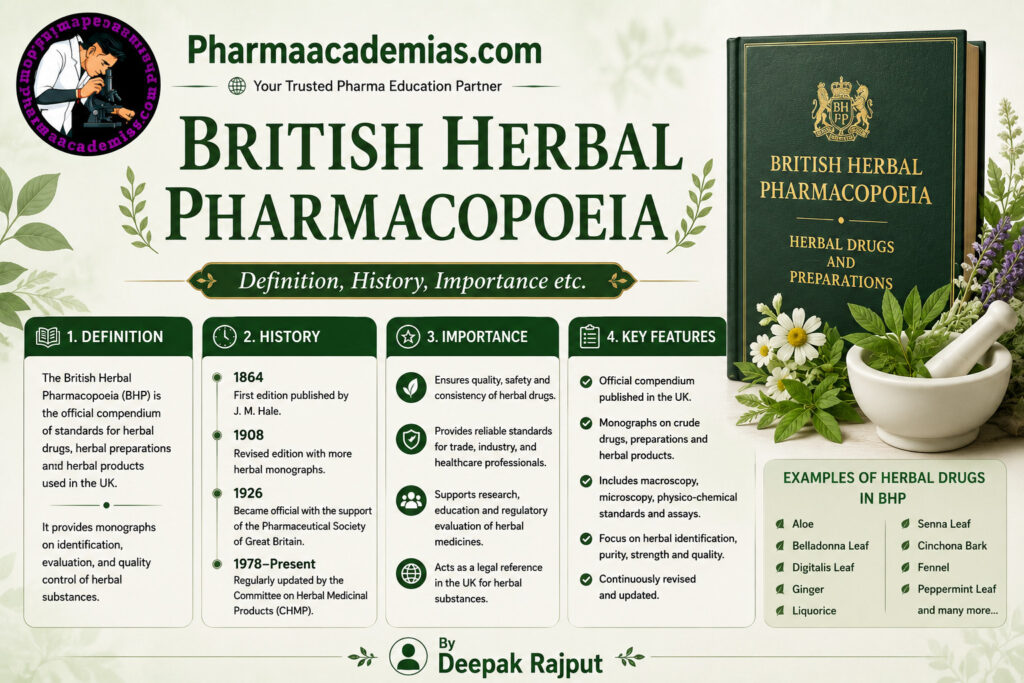
The British Herbal Pharmacopoeia (BHP) is one of the most important herbal pharmacopoeias developed for the standardization and scientific evaluation of herbal drugs. It provides detailed monographs and quality standards for medicinal plants used in herbal medicine.
The British Herbal Pharmacopoeia serves as a scientific and authoritative reference for herbal practitioners, pharmacists, researchers, manufacturers, and regulatory authorities. It includes comprehensive information regarding identification, purity, chemical constituents, therapeutic uses, dosage, and quality control of herbal drugs.
The pharmacopoeia played a major role in promoting scientific herbal medicine and integrating traditional herbal knowledge with modern pharmaceutical standards.
Definition of British Herbal Pharmacopoeia
The British Herbal Pharmacopoeia may be defined as:
“An official reference book containing standards and monographs for herbal drugs and medicinal plant preparations used in herbal medicine.”
It provides scientifically validated information regarding herbal substances and ensures their quality, safety, and therapeutic effectiveness.

History of British Herbal Pharmacopoeia
The history of herbal medicine in Britain dates back many centuries. Traditional herbal remedies were widely used before the development of synthetic medicines. However, with the advancement of pharmaceutical sciences, there was an increasing demand for scientific standardization of herbal medicines.
To fulfill this need, the British Herbal Medicine Association (BHMA), now known as the National Institute of Medical Herbalists and associated herbal organizations, contributed significantly toward the development of herbal pharmacopoeial standards.
The first edition of the British Herbal Pharmacopoeia was published in 1971 by the British Herbal Medicine Association. It was developed to provide reliable standards for medicinal plants commonly used in Western herbal medicine.
Subsequent editions were published to include additional medicinal plants, revised standards, and updated scientific information. The pharmacopoeia gradually became an important reference source in herbal medicine practice and education.
The BHP contributed greatly to the modernization and scientific validation of herbal therapeutics in the United Kingdom and other countries.
Objectives of British Herbal Pharmacopoeia
The British Herbal Pharmacopoeia was developed with several important objectives.
One of its primary aims is to establish official standards for herbal drugs and medicinal plant preparations. Herbal medicines are naturally variable in composition, and standardization helps maintain consistent quality and therapeutic efficacy.
Another important objective is to ensure the safety and purity of herbal medicines. The pharmacopoeia provides methods for detecting adulteration, contamination, and substitution of herbal materials.
The BHP also aims to promote rational and scientific use of herbal medicines by providing evidence-based information regarding therapeutic uses, dosage, contraindications, and pharmacological actions.
Additionally, the pharmacopoeia serves as an educational and research resource for pharmacists, herbal practitioners, students, and pharmaceutical industries involved in herbal medicine.
Contents of British Herbal Pharmacopoeia
The British Herbal Pharmacopoeia contains detailed monographs for numerous medicinal plants used in herbal medicine. Each monograph includes scientifically organized information about the herbal drug.
The information provided generally includes:
- Official name of the herb
- Botanical name
- Family
- Synonyms
- Description of the plant
- Geographical source
- Part used
- Macroscopic characters
- Microscopic characters
- Chemical constituents
- Identification tests
- Purity standards
- Pharmacological actions
- Therapeutic indications
- Dosage
- Contraindications and precautions
The monographs are designed to assist in the proper identification and quality evaluation of herbal drugs.
Structure of Herbal Monographs in BHP
Botanical Information
Each monograph begins with the botanical name and family of the medicinal plant. Correct botanical identification is extremely important because many plants possess similar common names but different chemical compositions and pharmacological properties.
The monograph may also include synonyms and vernacular names to avoid confusion.
Description and Identification
Detailed macroscopic and microscopic descriptions are provided to ensure accurate identification of herbal materials. Macroscopic characters include size, shape, color, odor, taste, and texture of the plant part.
Microscopic features such as trichomes, stomata, fibers, starch grains, and calcium oxalate crystals are described for authentication purposes.
Chemical Constituents
The pharmacopoeia includes information regarding important active chemical constituents such as:
- Alkaloids
- Glycosides
- Flavonoids
- Volatile oils
- Tannins
- Saponins
- Resins
- Terpenoids
These constituents are responsible for the therapeutic effects of herbal drugs.
Therapeutic Uses
The monographs describe the medicinal uses of herbal drugs based on traditional usage and scientific evidence. The pharmacological actions and indications are carefully documented.
Dosage and Administration
Recommended dosage ranges and methods of administration are provided for safe therapeutic use.
Standards for Purity
The BHP establishes purity standards and tests to detect:
- Adulteration
- Foreign matter
- Excess moisture
- Ash values
- Contaminants
These standards help maintain quality and consistency of herbal medicines.
Importance of British Herbal Pharmacopoeia
The British Herbal Pharmacopoeia holds great importance in herbal medicine and pharmacognosy.
Standardization of Herbal Drugs
One of the greatest contributions of the BHP is the scientific standardization of medicinal plants and herbal preparations. Standardization ensures uniform quality, purity, and therapeutic activity.
Prevention of Adulteration
Adulteration is a major problem in herbal medicine. The BHP provides identification methods and purity standards to prevent substitution and contamination.
Scientific Validation of Herbal Medicine
The pharmacopoeia bridges traditional herbal medicine with modern scientific research. It promotes evidence-based use of medicinal plants.
Support for Herbal Practitioners
The BHP serves as an important guide for herbal practitioners by providing accurate information regarding herbal drug usage, dosage, contraindications, and therapeutic applications.
Educational Importance
Pharmacy students, pharmacognosists, researchers, and academicians use the BHP as a reference source for studying medicinal plants and herbal drug evaluation.
Industrial Importance
Pharmaceutical and herbal industries use pharmacopoeial standards during manufacturing and quality control of herbal products.
Examples of Herbal Drugs Included in BHP
The British Herbal Pharmacopoeia includes monographs for many medicinal plants used in Western herbal medicine.
Examples include:
- Peppermint
- Chamomile
- Senna
- Valerian
- Ginger
- Liquorice
- Echinacea
- Ginseng
- Hawthorn
- St. John’s Wort
These herbs are widely used for gastrointestinal disorders, inflammation, anxiety, infections, cardiovascular diseases, and immune support.
Relationship Between BHP and Other Pharmacopoeias
The British Herbal Pharmacopoeia complements other national and international pharmacopoeias such as:
- British Pharmacopoeia (BP)
- European Pharmacopoeia
- United States Pharmacopeia (USP)
- Indian Pharmacopoeia (IP)
- Chinese Pharmacopoeia
While conventional pharmacopoeias focus largely on synthetic and allopathic medicines, the BHP specifically emphasizes herbal drugs and medicinal plant preparations.
Limitations of British Herbal Pharmacopoeia
Despite its importance, the BHP has certain limitations.
The chemical composition of herbal drugs may vary due to environmental and seasonal factors, making complete standardization difficult.
Some herbal medicines still lack sufficient clinical evidence regarding safety and efficacy.
The pharmacopoeia also requires periodic revision to include newly discovered medicinal plants and updated scientific data.
Role of BHP in Modern Herbal Medicine
The British Herbal Pharmacopoeia has contributed significantly to the modernization of herbal medicine. It encouraged the scientific evaluation of medicinal plants and promoted quality assurance in herbal therapeutics.
Today, with the growing global demand for herbal products, the importance of pharmacopoeial standards has increased further. The BHP continues to influence herbal drug research, manufacturing, regulation, and education.
The pharmacopoeia also supports the integration of herbal medicine into evidence-based healthcare systems.
Conclusion
The British Herbal Pharmacopoeia is an important reference work dedicated to the standardization and scientific evaluation of herbal medicines. It provides comprehensive monographs and quality standards for medicinal plants used in herbal therapy.
By ensuring authenticity, purity, safety, and consistency of herbal drugs, the BHP plays a vital role in protecting public health and promoting rational herbal medicine use. It bridges traditional herbal knowledge with modern pharmaceutical science and remains a valuable resource for pharmacists, herbal practitioners, researchers, students, and pharmaceutical industries.
The British Herbal Pharmacopoeia continues to contribute significantly to the advancement of pharmacognosy and herbal medicine throughout the world.