
Alkaloids are a highly significant class of naturally occurring nitrogen-containing organic compounds that are predominantly found in plants. They are typically basic in nature due to the presence of one or more nitrogen atoms, usually incorporated within a heterocyclic ring structure. These compounds are widely recognized for their potent pharmacological and physiological effects, which make them extremely valuable in modern medicine as well as traditional herbal systems.
Many well-known therapeutic agents such as morphine (analgesic), atropine (anticholinergic), quinine (antimalarial), reserpine (antihypertensive), caffeine (central nervous system stimulant), and nicotine are classic examples of alkaloids. Because of their powerful biological activity and clinical importance, the identification and detection of alkaloids play a crucial role in pharmacognosy, phytochemistry, herbal drug standardization, and crude drug evaluation.
In pharmaceutical and laboratory practice, alkaloids are commonly identified using qualitative chemical tests that depend on their ability to react with specific reagents and form distinctive precipitates or color changes. These tests are widely used in preliminary phytochemical screening, quality control of herbal drugs, and pharmacognostic studies.
Principle of Tests for Identification of Alkaloids
The identification of alkaloids is primarily based on their basic chemical nature. Alkaloids behave as weak organic bases and therefore readily react with acids to form water-soluble salts. This property is utilized during the extraction process, where the powdered crude drug is treated with dilute hydrochloric acid or sulfuric acid to convert alkaloids into their soluble forms.
Once extracted, the acidic solution containing alkaloidal salts is filtered to remove insoluble plant material. The clear filtrate is then subjected to different chemical reagents. These reagents typically contain heavy metal ions or complex-forming substances that interact with alkaloids to produce insoluble complexes or precipitates of characteristic colors.
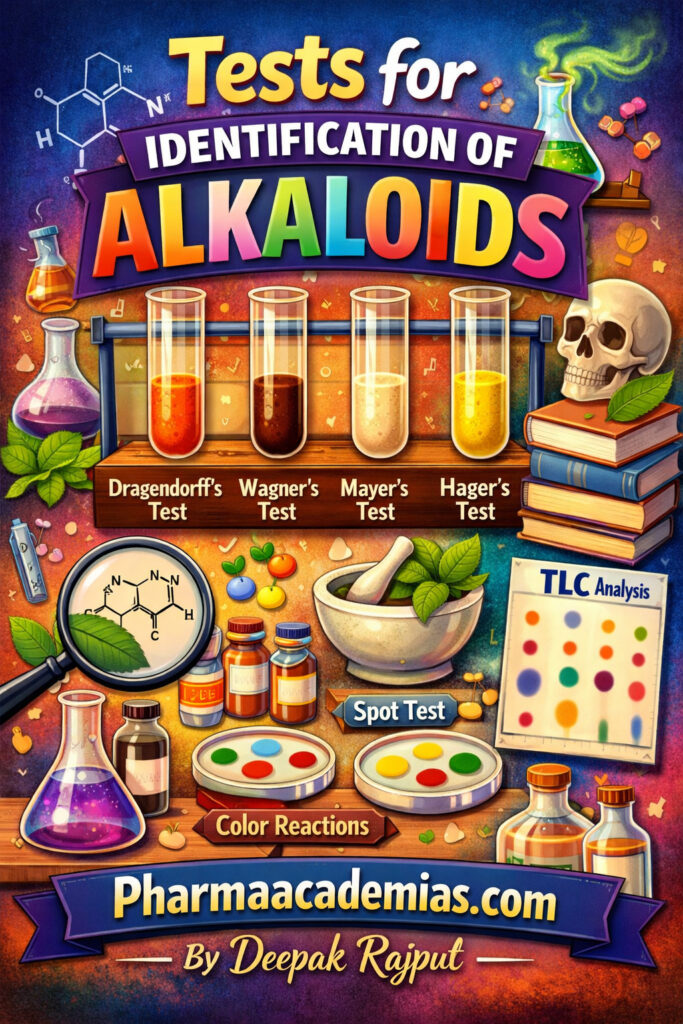
The formation of such precipitates or color changes serves as a qualitative confirmation of the presence of alkaloids in the given sample. This principle forms the basis of most classical alkaloid identification tests used in pharmacognosy laboratories.
General Tests for Identification of Alkaloids
A number of standard chemical tests are employed for the general detection of alkaloids in plant extracts and crude drugs. These tests are simple, rapid, and highly reliable.
Dragendorff’s Test
Dragendorff’s test is regarded as one of the most sensitive and widely used tests for detecting alkaloids. In this method, the acidic extract is treated with Dragendorff’s reagent, which consists of potassium bismuth iodide solution.
When alkaloids are present, they react with this reagent to produce an orange, orange-red, or reddish-brown precipitate. This occurs due to the formation of an insoluble bismuth-alkaloid complex. The intensity of the precipitate often reflects the concentration of alkaloids present in the sample. Because of its high sensitivity and clear visual result, Dragendorff’s test is frequently used in pharmacognosy practical examinations and research laboratories.
Mayer’s Test
Mayer’s test is another classical and widely accepted method for the identification of alkaloids. In this test, the acidic filtrate is treated with Mayer’s reagent, which is a solution of potassium mercuric iodide.
The presence of alkaloids is indicated by the formation of a cream-colored, pale yellow, or white precipitate. This reaction takes place because alkaloids form an insoluble complex with the mercuric iodide component of the reagent. Mayer’s test is particularly useful due to its simplicity, reliability, and clear observation, making it a commonly performed test in academic and practical settings.
Wagner’s Test
Wagner’s test is another important qualitative test used for alkaloid detection. In this procedure, the acidic extract is treated with Wagner’s reagent, which contains iodine dissolved in potassium iodide solution.
A reddish-brown or brown precipitate is formed in the presence of alkaloids. This occurs due to the formation of insoluble iodine-alkaloid complexes. Wagner’s test is often used as a confirmatory test along with other general tests to ensure accurate identification of alkaloids in plant extracts.
Hager’s Test
Hager’s test is a simple yet effective method for detecting alkaloids. In this test, the acidic extract is treated with Hager’s reagent, which is a saturated aqueous solution of picric acid.
The presence of alkaloids is indicated by the formation of a yellow crystalline precipitate. This is due to the formation of insoluble alkaloidal picrate salts. Hager’s test is particularly useful in herbal drug analysis and pharmacognostic screening, where quick detection of alkaloids is required.
Tannic Acid Test
In the tannic acid test, a solution of tannic acid is added to the acidic extract containing alkaloids.
The formation of a buff-colored or pale precipitate confirms the presence of alkaloids. This reaction occurs because alkaloids form insoluble complexes known as alkaloidal tannates. Although this test is less commonly used compared to others, it still holds importance in qualitative analysis.
Specific Tests for Particular Alkaloids
In addition to general tests, certain alkaloids require specific chemical tests for their identification. These tests are particularly useful when confirming the presence of a specific alkaloid in a crude drug.
For instance, purine alkaloids such as caffeine are identified by the Murexide test. In this test, the sample is treated with nitric acid and then exposed to ammonia vapors, resulting in the development of a purple or violet color, which confirms the presence of caffeine.
Similarly, tropane alkaloids such as atropine and hyoscyamine can be identified using the Vitali–Morin test. In this method, treatment with nitric acid followed by alcoholic potassium hydroxide produces a violet coloration, indicating the presence of tropane alkaloids.
These specific tests provide greater accuracy and specificity in identifying individual alkaloids within complex plant matrices.
Importance of Tests for Identification of Alkaloids
The identification tests for alkaloids play a vital role in various pharmaceutical and research applications. They are extensively used in preliminary phytochemical screening to detect the presence of active constituents in medicinal plants.
These tests are also essential for authentication of crude drugs, ensuring that the correct plant material is used. In addition, they help in the detection of adulteration and substitution, which is a common issue in herbal drug markets.
Furthermore, alkaloid identification is a crucial step in the standardization and quality control of herbal formulations, ensuring safety, efficacy, and consistency. Before performing advanced techniques such as chromatography or spectroscopic analysis, these qualitative tests provide a quick and reliable indication of alkaloid presence.
Conclusion
The tests for identification of alkaloids are fundamental tools in pharmacognosy and phytochemistry. These tests are based on the ability of alkaloids to form insoluble precipitates and characteristic color reactions when treated with specific reagents.
General tests such as Dragendorff’s, Mayer’s, Wagner’s, Hager’s, and tannic acid tests are widely used for initial detection, while specific tests like the Murexide and Vitali–Morin tests are used for confirming particular alkaloids.
A thorough understanding of these tests is essential for students and professionals in B.Pharm, D.Pharm, nursing, pharmaceutical sciences, and herbal drug research, as they form the foundation for further studies in drug analysis and natural product chemistry.