
Traditional Pharmacopoeias: The quality, safety, and efficacy of medicines are extremely important in healthcare systems throughout the world. In order to ensure that medicinal substances meet standardized requirements, official books known as pharmacopoeias are published by governments or authorized scientific bodies. A pharmacopoeia serves as an official compendium containing standards and specifications for drugs, pharmaceutical substances, herbal medicines, dosage forms, and pharmaceutical preparations.
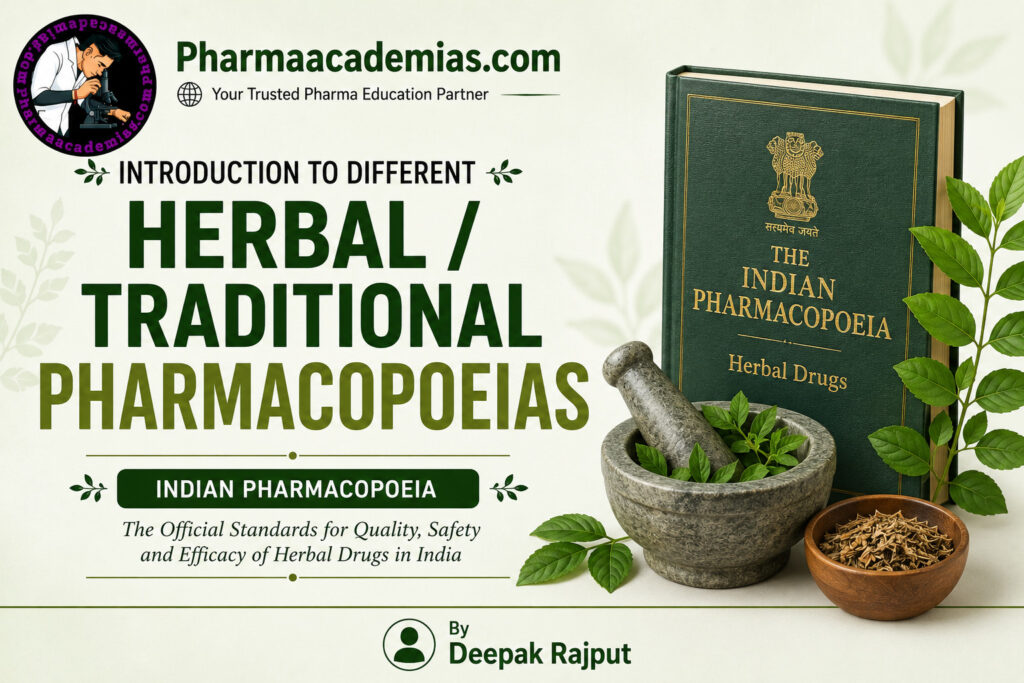
The word “pharmacopoeia” is derived from the Greek words “pharmakon” meaning drug and “poieo” meaning to make. Thus, a pharmacopoeia may be defined as an officially recognized book that provides detailed information regarding the identity, purity, strength, preparation, tests, storage, and uses of drugs and medicines.
Traditional and herbal pharmacopoeias are particularly important because herbal medicines contain complex natural constituents, and their quality may vary due to geographical, environmental, and processing conditions. Standardization through pharmacopoeias helps prevent adulteration, contamination, and misuse of medicinal substances.
Different countries have developed their own pharmacopoeias according to their healthcare systems, medicinal practices, and regulatory requirements. In India, where traditional systems such as Ayurveda, Siddha, and Unani have been practiced for centuries, pharmacopoeias play a crucial role in standardizing herbal and conventional medicines.
Among these, the Indian Pharmacopoeia is the official pharmacopoeia of India and serves as an authoritative standard for drugs manufactured and marketed within the country.
Herbal and Traditional Pharmacopoeias
Introduction to Herbal Pharmacopoeias
Herbal pharmacopoeias are official compilations containing standards and specifications for medicinal plants, herbal drugs, herbal formulations, and natural products. These pharmacopoeias provide detailed information regarding:
- Botanical identity
- Morphological and microscopic characters
- Chemical constituents
- Purity standards
- Methods of analysis
- Storage conditions
- Therapeutic uses
The importance of herbal pharmacopoeias has increased significantly due to the growing global use of herbal medicines and traditional healthcare systems.
Traditional pharmacopoeias preserve ancient medicinal knowledge while integrating modern scientific methods for quality control and standardization.
Major Herbal and Traditional Pharmacopoeias
Different countries and healthcare systems maintain various pharmacopoeias for herbal and traditional medicines.
Some important pharmacopoeias include:
- Indian Pharmacopoeia (IP)
- Ayurvedic Pharmacopoeia of India (API)
- British Pharmacopoeia (BP)
- United States Pharmacopeia (USP)
- Chinese Pharmacopoeia
- European Pharmacopoeia
- Japanese Pharmacopoeia
- Unani Pharmacopoeia of India
- Siddha Pharmacopoeia of India
- Homoeopathic Pharmacopoeia
These pharmacopoeias provide official standards to ensure consistency, safety, and efficacy of medicinal substances.
Indian Pharmacopoeia (IP)
The Indian Pharmacopoeia (IP) is the official and legally recognized pharmacopoeia of India. It contains standards for drugs and pharmaceutical substances manufactured, sold, and used in India. The Indian Pharmacopoeia serves as a comprehensive reference book for maintaining the quality, purity, strength, and consistency of medicines.
The standards prescribed in the Indian Pharmacopoeia are legally enforceable under the Drugs and Cosmetics Act, 1940 and Rules, 1945.
The Indian Pharmacopoeia includes:
- Drug monographs
- Standards for pharmaceutical substances
- Dosage forms
- Biological products
- Vaccines
- Antibiotics
- Herbal products
- Excipients
- Analytical methods
The pharmacopoeia plays a major role in protecting public health by ensuring that medicines meet prescribed quality standards.
History of Indian Pharmacopoeia
Before independence, India mainly followed the British Pharmacopoeia for drug standards. However, after independence, the need for an independent national pharmacopoeia was strongly recognized.
In 1946, the Government of India established the Indian Pharmacopoeial Committee under the chairmanship of Sir R.N. Chopra to prepare an Indian pharmacopoeia suitable for the country’s needs.
The first edition of the Indian Pharmacopoeia was published in 1955 by the Government of India. It included standards for pharmaceutical substances commonly used in India.
Subsequent editions were published periodically to incorporate new drugs, updated analytical methods, and revised standards.
Important editions include:
- First Edition – 1955
- Second Edition – 1966
- Third Edition – 1985
- Fourth Edition – 1996
- Fifth Edition – 2007
- Sixth Edition – 2010
- Seventh Edition – 2014
- Eighth Edition – 2018
- Ninth Edition – 2022
The pharmacopoeia is revised regularly to keep pace with advancements in pharmaceutical science and technology.
Indian Pharmacopoeia Commission (IPC)
The Indian Pharmacopoeia is published by the Indian Pharmacopoeia Commission under the Ministry of Health and Family Welfare, Government of India.
The IPC was established in 2004 at Ghaziabad, Uttar Pradesh, to function as an autonomous institution responsible for:
- Publication and revision of the Indian Pharmacopoeia
- Development of drug standards
- Reference standard maintenance
- Pharmacovigilance activities
- Quality assurance of medicines
The IPC collaborates with scientific institutions, pharmaceutical industries, regulatory authorities, and healthcare professionals for continuous improvement of pharmacopoeial standards.
Objectives of Indian Pharmacopoeia
The major objectives of the Indian Pharmacopoeia include:
Standardization of Drugs: The IP establishes official standards for identity, purity, strength, and quality of drugs and pharmaceutical products.
Ensuring Drug Safety and Efficacy: By maintaining strict quality standards, the pharmacopoeia helps ensure that medicines are safe and therapeutically effective.
Prevention of Adulteration: The pharmacopoeia provides tests and analytical methods to detect adulteration, impurities, and contamination in drugs.
Guidance for Pharmaceutical Industries: The IP serves as an important reference for pharmaceutical manufacturers, quality control laboratories, pharmacists, researchers, and regulatory authorities.
Harmonization with International Standards: The Indian Pharmacopoeia aims to harmonize its standards with international pharmacopoeias such as USP, BP, and European Pharmacopoeia.
Contents of Indian Pharmacopoeia
The Indian Pharmacopoeia contains detailed monographs and appendices related to pharmaceutical substances and preparations.
Its contents generally include:
Drug Monographs
Each monograph provides detailed information regarding:
- Official name
- Chemical formula
- Molecular weight
- Category
- Description
- Solubility
- Identification tests
- Purity tests
- Assay methods
- Storage conditions
- Labeling requirements
General Notices
General notices explain the rules and requirements applicable throughout the pharmacopoeia.
Appendices
The appendices describe:
- Analytical techniques
- Reagents and solutions
- Chromatographic methods
- Microbiological tests
- Sterility tests
- Limit tests
- Instrumental methods
Dosage Forms: The IP includes standards for tablets, capsules, injections, ointments, syrups, suspensions, and other dosage forms.
Herbal and Natural Products: Modern editions of the IP also contain monographs for herbal drugs and phytopharmaceutical products.
Importance of Indian Pharmacopoeia: The Indian Pharmacopoeia is highly important in pharmaceutical sciences and healthcare systems.
Quality Control of Medicines: The IP ensures that medicines marketed in India maintain consistent quality and therapeutic effectiveness.
Legal Significance: Standards prescribed in the IP are legally recognized under Indian drug laws.
Support for Pharmaceutical Industry: The pharmacopoeia guides manufacturers in maintaining Good Manufacturing Practices (GMP) and quality assurance.
Educational Importance: The IP serves as an essential reference for pharmacy students, teachers, researchers, analysts, and healthcare professionals.
Public Health Protection: By ensuring medicine quality and safety, the pharmacopoeia protects the public from substandard and adulterated drugs.
Herbal Drugs in Indian Pharmacopoeia
With the growing use of herbal medicines, the Indian Pharmacopoeia has increasingly incorporated herbal monographs and phytopharmaceutical standards.
Herbal drug monographs generally include:
- Botanical name
- Family
- Geographical source
- Macroscopic characters
- Microscopic characters
- Chemical constituents
- Identification tests
- Purity standards
- Assay methods
- Storage conditions
Examples of herbal drugs included in pharmacopoeial standards include:
- Ashwagandha
- Senna
- Isabgol
- Neem
- Tulsi
- Turmeric
- Aloe
- Ginger
These standards help ensure authenticity, purity, and quality of herbal medicines.
Relationship Between Indian Pharmacopoeia and Traditional Systems of Medicine
India possesses rich traditional medical systems such as Ayurveda, Siddha, Unani, and Homeopathy. To standardize medicines used in these systems, separate pharmacopoeias have also been developed.
These include:
- Ayurvedic Pharmacopoeia of India
- Siddha Pharmacopoeia of India
- Unani Pharmacopoeia of India
- Homoeopathic Pharmacopoeia of India
These pharmacopoeias complement the Indian Pharmacopoeia by providing standards specifically for traditional medicines.
Limitations of Indian Pharmacopoeia
Despite its importance, the Indian Pharmacopoeia faces certain challenges:
- Continuous updating is required due to rapid development of new drugs.
- Standardization of herbal medicines is difficult because of natural variability.
- Advanced analytical techniques may be expensive for smaller laboratories.
- Quality control of complex herbal formulations remains challenging.
Conclusion
The Indian Pharmacopoeia is the official standard book for drugs and pharmaceutical substances in India. It plays a crucial role in ensuring the quality, purity, safety, and efficacy of medicines used in healthcare. From conventional pharmaceutical products to herbal medicines, the pharmacopoeia provides scientifically validated standards essential for pharmaceutical manufacturing, quality control, research, and regulation.
The development of herbal and traditional pharmacopoeias reflects the growing importance of natural medicines and traditional healthcare systems. With increasing global interest in herbal therapeutics, the Indian Pharmacopoeia and related traditional pharmacopoeias continue to contribute significantly to public health, pharmaceutical sciences, and drug standardization.