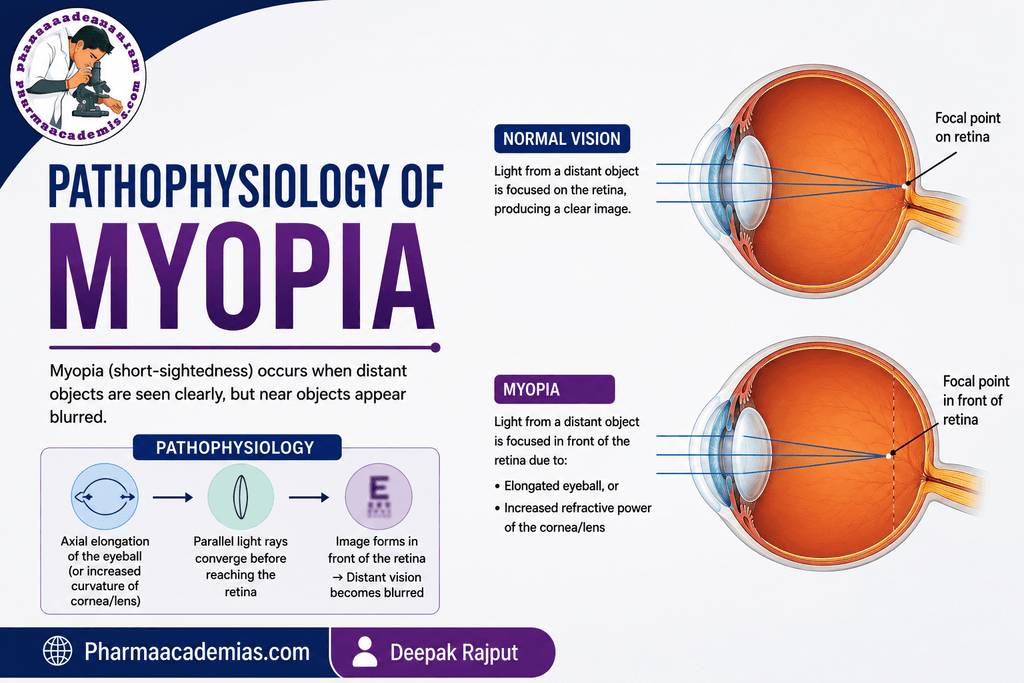
Pathophysiology of Myopia: Myopia (short-sightedness) is a refractive error in which a person can see nearby objects clearly, but distant objects appear blurred. In myopia, light rays from a distant object are focused in front of the retina rather than directly on the retina.
Step 1: Normal Refraction of Light
Normally, light entering the eye passes through the:
Cornea → Aqueous humor → Lens → Vitreous humor → Retina
The cornea and lens refract (bend) the incoming light so that the rays are focused precisely on the retina.
Normal eye:
Light rays → Retina → Clear image
Step 2: Development of Myopia
In myopia, there is a mismatch between the optical power of the eye and the axial length of the eyeball.
The most common structural abnormality is excessive axial length of the eyeball.
In other words, the distance from the cornea to the retina becomes too long for the eye’s optical power.
Step 3: Excessive Axial Elongation
The eye normally has a specific axial length that allows light to focus on the retina.
When the eyeball becomes elongated from front to back, the retina is positioned farther behind the normal focal point.
Therefore, parallel light rays entering the eye converge before reaching the retina.
Step 4: Increased Refractive Power
Myopia can also occur when the optical power of the eye is too strong relative to its axial length.
This can result from excessive curvature or refractive power of the cornea or lens.
Therefore, myopia can broadly result from:
A. Excessive axial length
or
B. Excessive refractive power
or
C. A combination of both
Axial elongation is particularly important in common childhood and adolescent myopia.
Step 5: Focusing of Light in Front of the Retina
This is the key pathological feature of myopia.
In a normal eye:
Light → Focuses on retina → Clear image
In myopia:
Light → Focuses in front of retina → Diverges before reaching retina → Blurred image
Because the image is not focused properly on the photoreceptor layer, the brain receives a blurred visual signal.
Step 6: Why Near Objects Appear Clear
When a myopic person looks at a nearby object, the incoming light rays are more divergent.
Because of this, the rays can be brought into focus on the retina without requiring as much optical adjustment.
Therefore:
Near object → Divergent rays → Focus can fall on retina → Relatively clear vision
This is why myopia is called short-sightedness.
Step 7: Blurred Distance Vision
When viewing a distant object, the light rays entering the eye are approximately parallel.
In a myopic eye, these rays are focused in front of the retina.
As a result, distant objects appear blurred.
Common symptoms include:
- Difficulty seeing distant objects clearly
- Difficulty reading distant signs
- Blurred classroom board or presentations
- Squinting to see distant objects
- Eye strain
- Headache in some individuals
Step 8: Role of Accommodation
Accommodation is the ability of the lens to change its shape to focus on near objects.
In myopia, accommodation is generally not the primary cause of the refractive error.
The main problem is that the eye’s optical system focuses distant light too far forward.
Therefore, the person can often see nearby objects without needing the same degree of accommodation as a person with normal distance vision.
Step 9: Role of Genetics and Environmental Factors
Myopia is influenced by both genetic and environmental factors.
Children with myopic parents have an increased likelihood of developing myopia.
Environmental factors can also influence its development, particularly during childhood and adolescence.
Factors associated with myopia development or progression include:
- Prolonged near-work activities
- High educational demands
- Limited time spent outdoors
- Genetic susceptibility
These factors may influence abnormal growth and elongation of the eyeball.
Step 10: Progressive Myopia
In some individuals, particularly children and adolescents, the eyeball continues to elongate.
This causes increasing myopia.
Step 11: High or Pathological Myopia
When myopia becomes very severe, particularly when associated with substantial axial elongation, it may be termed highmyopia.
Excessive elongation of the eyeball can stretch and damage ocular tissues.
Potential complications include:
- Retinal degeneration
- Retinal tears or detachment
- Myopic macular changes
- Choroidal abnormalities
- Increased risk of glaucoma
- Increased risk of other vision-threatening complications
Therefore, severe myopia requires appropriate ophthalmic monitoring.
Step 12: Correction of Myopia
Myopia is corrected by using a concave (diverging) lens.
The concave lens causes incoming light rays to diverge slightly before entering the eye.
This allows the eye’s optical system to bring the rays into focus on the retina.
Without correction:
Parallel rays → Focus in front of retina → Blurred image
With concave lens:
Parallel rays → Concave lens → Appropriate divergence → Eye → Focus on retina → Clear image
One-Line Summary
Myopia occurs when the eye is too long or its optical power is too strong relative to its length, causing incoming light from distant objects to focus in front of the retina instead of directly on it, resulting in blurred distance vision.
Editorial Note
This article has been carefully researched and written by Deepak Rajput with a focus on accuracy, clarity, and evidence-based healthcare information. Pharmaacademias.com