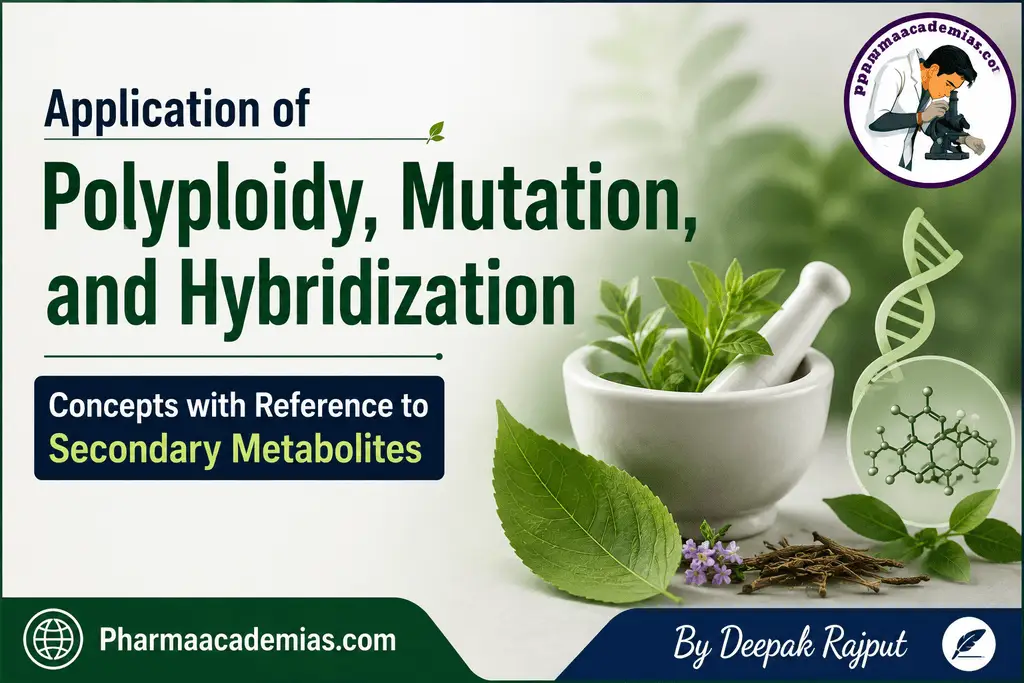
Application of Polyploidy: Medicinal plants are one of the most valuable natural resources because they produce a wide variety of secondary metabolites, such as alkaloids, glycosides, flavonoids, tannins, terpenoids, saponins, essential oils, phenolic compounds, and steroids. Unlike primary metabolites, which are directly involved in the growth and survival of plants, secondary metabolites are not essential for basic life processes but play important roles in plant defense against pathogens, insects, herbivores, and environmental stress. These compounds are also responsible for the therapeutic properties of medicinal plants and form the basis of numerous pharmaceutical drugs, herbal medicines, cosmetics, and nutraceuticals.
The increasing demand for medicinal plants and plant-derived drugs has created a need to develop plant varieties that produce higher yields of valuable secondary metabolites. Traditional cultivation methods alone are often insufficient to meet this demand because the concentration of active constituents varies depending on genetics, environmental conditions, and cultivation practices. Therefore, plant breeders and biotechnologists use various genetic improvement techniques such as polyploidy, mutation breeding, and hybridization to develop superior medicinal plant varieties with improved biomass, enhanced resistance to diseases, and increased production of secondary metabolites.
These techniques alter the genetic makeup of plants, thereby influencing the biochemical pathways responsible for the synthesis of secondary metabolites. As a result, improved medicinal plant varieties can be produced that contain higher concentrations of therapeutically important compounds while maintaining good agronomic characteristics.
Secondary Metabolites
Before understanding the applications of polyploidy, mutation, and hybridization, it is important to understand what secondary metabolites are.
Secondary metabolites are specialized organic compounds produced by plants that are not directly involved in normal growth, development, or reproduction but provide ecological advantages such as defense against herbivores, pathogens, insects, and environmental stresses.
These compounds possess significant medicinal value and are widely used in the pharmaceutical industry.
Major classes of secondary metabolites include:
- Alkaloids
- Glycosides
- Flavonoids
- Terpenoids
- Tannins
- Saponins
- Essential oils
- Phenolic compounds
- Steroids
Examples include:
| Secondary Metabolite | Medicinal Plant | Therapeutic Use |
| Morphine | Papaver somniferum | Analgesic |
| Quinine | Cinchona | Antimalarial |
| Atropine | Atropa belladonna | Anticholinergic |
| Vincristine | Catharanthus roseus | Anticancer |
| Digoxin | Digitalis purpurea | Cardiotonic |
| Curcumin | Curcuma longa | Anti-inflammatory |
| Menthol | Mentha species | Cooling agent |
| Reserpine | Rauwolfia serpentina | Antihypertensive |
The quantity of these compounds can be significantly increased through genetic improvement techniques.
Polyploidy
Polyploidy is the condition in which a plant possesses more than two complete sets of chromosomes.
Normally, plants are diploid (2n), containing two sets of chromosomes. In polyploid plants, chromosome numbers increase to:
- Triploid (3n)
- Tetraploid (4n)
- Hexaploid (6n)
- Octaploid (8n)
Polyploidy occurs naturally in many plant species but can also be induced artificially using chemicals such as colchicine or oryzalin, which inhibit spindle fiber formation during cell division, resulting in chromosome doubling.
Types of Polyploidy
Autopolyploidy: Autopolyploidy occurs when chromosome sets increase within the same species.
Example: A diploid plant (2n) becomes tetraploid (4n).
Allopolyploidy: Allopolyploidy occurs when chromosomes from two different species combine through hybridization followed by chromosome doubling.This produces fertile hybrids possessing characteristics of both parent species.
Effects of Polyploidy on Medicinal Plants
Polyploid plants generally exhibit:
- Larger leaves
- Larger flowers
- Increased stem thickness
- Greater biomass
- Enhanced stress tolerance
- Increased cell size
- Higher concentrations of secondary metabolites
These changes occur because additional chromosome sets increase gene dosage and metabolic activity.
Application of Polyploidy in Increasing Secondary Metabolites
Polyploidy is widely used in medicinal plant improvement because it often enhances the production of active constituents.
Increased Alkaloid Production: Tetraploid medicinal plants frequently accumulate higher concentrations of alkaloids.
Example: Tetraploid Datura stramonium produces increased levels of atropine and scopolamine.
Increased Essential Oil Content: Polyploidy increases glandular tissue development, leading to higher essential oil production.
Examples:
- Peppermint (Mentha piperita)
- Lemongrass (Cymbopogon citratus)
Enhanced Biomass: Larger leaves and stems provide greater quantities of medicinal raw materials.
Examples:
- Ashwagandha (Withania somnifera)
- Aloe vera
Improved Stress Resistance: Polyploid medicinal plants tolerate drought, salinity, and diseases better than diploid plants.This contributes to stable secondary metabolite production under adverse environmental conditions.
Mutation Breeding
A mutation is a sudden, permanent, and heritable change in the genetic material (DNA or chromosomes) of an organism.
Mutation breeding intentionally induces mutations to develop plants with desirable characteristics.
Unlike polyploidy, which changes chromosome number, mutations alter specific genes or chromosome structures.
Types of Mutations
Spontaneous Mutations
These occur naturally without human intervention.
Induced Mutations
These are produced artificially using physical or chemical mutagens.
Mutagens Used in Plant Breeding
Physical Mutagens
Examples include:
- Gamma rays
- X-rays
- Ultraviolet radiation
- Fast neutrons
Chemical Mutagens
Examples include:
- Ethyl Methane Sulfonate (EMS)
- Sodium azide
- Nitrous acid
These agents create changes in DNA that may alter secondary metabolite synthesis.
Application of Mutation in Secondary Metabolite Production
Mutation breeding helps develop medicinal plants possessing improved chemical composition.
Increased Alkaloid Content: Mutations affecting biosynthetic enzymes can increase alkaloid production.
Example: Improved varieties of Catharanthus roseus with higher vincristine and vinblastine content.
Increased Essential Oils: Mutant varieties may produce greater quantities of volatile oils.
Examples:
- Mentha
- Ocimum
Disease Resistance: Disease-resistant mutants remain healthier and continue producing medicinal compounds even under pathogen attack.
Higher Biomass: Certain mutations improve vegetative growth, resulting in increased harvestable material.
Improved Quality: Mutations may reduce undesirable compounds while increasing therapeutically valuable constituents.
Hybridization
Hybridization is the process of crossing two genetically different plants to combine desirable traits into a single improved variety. The resulting offspring are called hybrids. Hybridization is one of the oldest and most successful methods of plant breeding.
Types of Hybridization
Intervarietal Hybridization: Crossing between different varieties of the same species.
Interspecific Hybridization: Crossing between different species within the same genus.
Intergeneric Hybridization: Crossing between different genera.This is relatively uncommon because of genetic incompatibility.
Objectives of Hybridization
Hybridization aims to:
- Increase yield
- Improve disease resistance
- Enhance drought tolerance
- Increase secondary metabolite production
- Improve plant quality
- Develop early-maturing varieties
Application of Hybridization in Medicinal Plants
Hybridization combines desirable genes from both parents.
Increased Secondary Metabolite Production: Hybrids may accumulate higher concentrations of medicinal compounds than either parent.
Examples include:
- Higher alkaloid-producing hybrids
- Improved essential oil-producing hybrids
Improved Biomass: Hybrid vigor (heterosis) often produces larger plants with increased leaf, root, or stem yield.
Enhanced Disease Resistance: Disease-resistant hybrids reduce crop losses and maintain consistent production of secondary metabolites.
Better Adaptability: Hybrids tolerate environmental stresses such as drought, salinity, and temperature extremes more effectively.
Uniform Crop Quality: Commercial hybrids produce consistent medicinal raw materials suitable for pharmaceutical industries.
Comparison of Polyploidy, Mutation, and Hybridization
| Feature | Polyploidy | Mutation | Hybridization |
| Basic Principle | Increase chromosome number | Change DNA or genes | Crossing two genetically different plants |
| Method | Chromosome doubling using colchicine or oryzalin | Physical or chemical mutagens | Controlled pollination |
| Genetic Change | Entire chromosome sets | Specific genes or chromosomes | Combination of parental genes |
| Main Objective | Increase biomass and metabolite production | Develop new useful traits | Combine desirable characters |
| Effect on Secondary Metabolites | Often increases production | May increase or modify metabolite pathways | Produces superior high-yield hybrids |
| Examples | Datura, Mentha | Catharanthus, Mentha | Digitalis, Mentha hybrids |
Importance in Medicinal Plant Improvement
Modern medicinal plant breeding uses these techniques to achieve several goals.
These include:
- Higher production of alkaloids, glycosides, flavonoids, terpenoids, and essential oils.
- Increased yield of medicinal plant materials.
- Improved pharmaceutical quality.
- Better resistance to pests and diseases.
- Greater tolerance to environmental stress.
- Uniformity of cultivated medicinal plants.
- Conservation of rare medicinal species through breeding programs.
- Reduced production costs for herbal industries.
Advantages of Polyploidy, Mutation, and Hybridization
These breeding techniques provide several important advantages:
- Increase the concentration of active medicinal constituents.
- Improve plant growth and biomass.
- Enhance disease and pest resistance.
- Increase tolerance to drought, salinity, and other environmental stresses.
- Produce uniform and high-quality medicinal plant varieties.
- Improve commercial productivity and profitability.
- Support the pharmaceutical industry by ensuring a reliable supply of medicinal raw materials.
Limitations
Despite their benefits, these techniques also have certain limitations.
- Polyploid plants may exhibit reduced fertility.
- Mutations are random and many induced mutations may be undesirable.
- Hybridization can be time-consuming and may require several generations to stabilize desirable traits.
- Some hybrids may lose vigor in subsequent generations.
- Specialized knowledge and controlled breeding conditions are often required.
Conclusion
The application of polyploidy, mutation, and hybridization has become an integral part of modern medicinal plant improvement programs. These genetic techniques enhance the biosynthesis of secondary metabolites, including alkaloids, glycosides, flavonoids, terpenoids, tannins, and essential oils, which are responsible for the therapeutic efficacy of medicinal plants. Polyploidy increases chromosome number, leading to greater biomass and often higher metabolite production. Mutation breeding introduces heritable genetic changes that can improve the quality and quantity of bioactive compounds, while hybridization combines desirable traits from different plant varieties or species to develop superior cultivars with enhanced yield, disease resistance, and metabolite content. Together, these approaches contribute significantly to the sustainable production of high-quality medicinal plants, supporting the pharmaceutical, herbal medicine, and biotechnology industries by ensuring a consistent supply of effective plant-derived raw materials.
Editorial Note
This article has been carefully researched and written by Deepak Rajput with a focus on accuracy, clarity, and evidence-based healthcare information. Pharmaacademias.com