
Pathophysiology of Anosmia: Anosmia is the complete loss of the sense of smell. It may be temporary or permanent and can occur because of obstruction of the nasal passages, damage to the olfactory receptors, injury to the olfactory nerve, or disorders affecting the brain’s olfactory pathways.
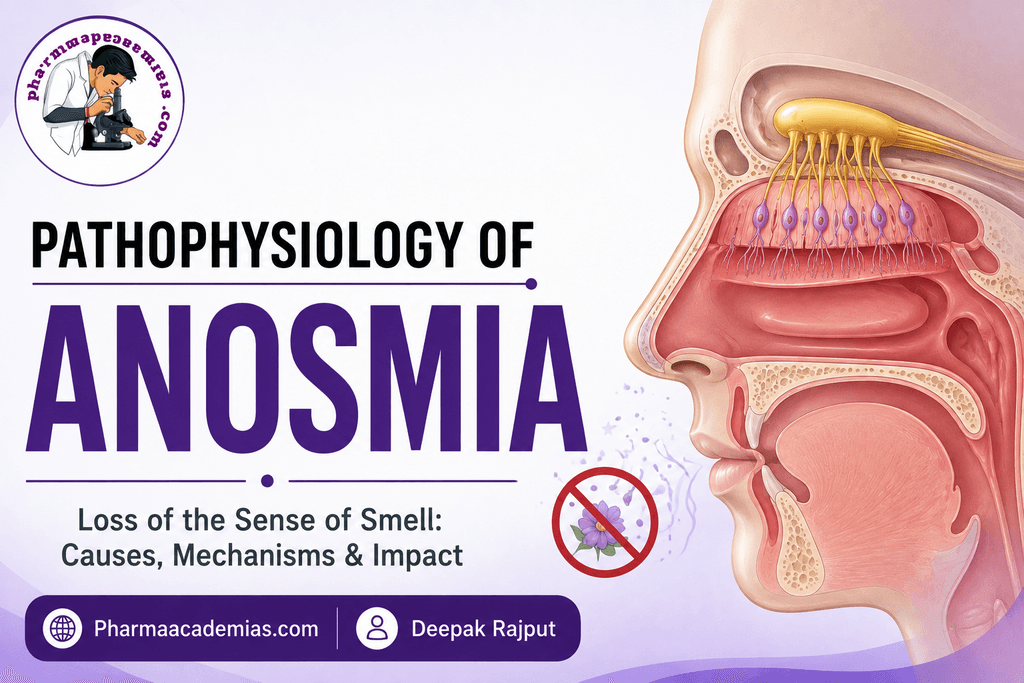
The sense of smell is important not only for detecting odors but also for taste perception, detection of smoke or gas, appetite, and environmental awareness.
Normal Physiology of Smell
The sense of smell begins when odor-producing molecules enter the nasal cavity during breathing.
The main steps are:
Odor molecules → nasal cavity → olfactory epithelium → olfactory receptor neurons → olfactory nerve (CN I) → olfactory bulb → olfactory tract → olfactory cortex
Olfactory Epithelium
The olfactory epithelium is located mainly in the upper part of the nasal cavity. It contains specialized olfactory receptor neurons.
When odor molecules dissolve in the mucus covering the olfactory epithelium, they bind to receptors on the cilia of olfactory receptor neurons.
This produces an electrical signal that travels through the olfactory nerve (cranial nerve I) to the olfactory bulb.
The brain then processes these signals and identifies the specific odor.
Pathophysiology of Anosmia
Anosmia can develop when any major step in the olfactory pathway is disrupted.
The mechanism can be broadly divided into:
- Conductive anosmia
- Sensorineural/peripheral anosmia
- Central anosmia
1. Conductive Anosmia
In conductive anosmia, odor molecules cannot reach the olfactory epithelium even though the olfactory receptors themselves may remain functional.
Common causes include:
- Nasal congestion
- Common cold
- Allergic rhinitis
- Nasal polyps
- Deviated nasal septum
- Chronic rhinosinusitis
- Nasal tumors
Mechanism
Nasal obstruction/inflammation
↓
Reduced movement of odor molecules toward olfactory epithelium
↓
Reduced stimulation of olfactory receptors
↓
Reduced olfactory nerve signaling
↓
Loss or reduction of smell
This type of anosmia may improve when the underlying obstruction is treated.
2. Sensorineural/Peripheral Anosmia
In this type, the problem occurs at the level of the olfactory receptor neurons or olfactory nerve.
Possible causes include:
- Viral infections
- Head trauma
- Exposure to certain toxic substances
- Neurodegenerative disorders
- Age-related degeneration
Damage to olfactory receptor neurons reduces their ability to detect and transmit odor signals.
Mechanism
Damage to olfactory receptor neurons
↓
Reduced receptor response to odor molecules
↓
Reduced electrical signaling
↓
Reduced transmission through olfactory nerve
↓
Impaired perception of smell
3. Central Anosmia
Central anosmia occurs when the central olfactory pathways or brain regions responsible for processing smell are damaged.
Potential causes include:
- Traumatic brain injury
- Brain tumors
- Stroke
- Neurodegenerative diseases
- Certain neurological disorders
The olfactory nerve may transmit signals normally, but the brain may be unable to properly process or recognize them.
Step-by-Step Pathophysiology
Step 1: Damage or obstruction occurs
Anosmia may begin because of:
Nasal obstruction → receptor not adequately exposed
or
Receptor/nerve damage → impaired signal generation
or
Brain pathway damage → impaired signal processing
Step 2: Reduced stimulation of olfactory receptors
Normally, odor molecules stimulate olfactory receptor neurons. If odor molecules cannot reach the receptors or the receptors are damaged:
Odor molecules fail to adequately activate olfactory receptors.
Step 3: Reduced nerve impulses
Normally activated receptor neurons generate electrical signals that travel through the olfactory nerve.
Damage to these neurons or the nerve results in:
Reduced/absent olfactory nerve impulses
Step 4: Reduced transmission to the brain
Olfactory signals normally travel to the olfactory bulb and then through the olfactory tract to higher brain regions.
Damage anywhere along this pathway can interfere with transmission.
Step 5: Impaired odor perception
The brain normally interprets incoming olfactory signals and identifies different smells.
When adequate signals do not reach or are not properly processed by the brain:
Causes of Anosmia
Nasal and sinus causes
- Common cold
- Allergic rhinitis
- Chronic sinusitis
- Nasal polyps
- Deviated nasal septum
- Nasal obstruction
Infectious causes
- Viral respiratory infections
- Other infections affecting the upper respiratory tract
Neurological causes
- Head injury
- Stroke
- Neurodegenerative disorders
- Brain tumors
Other causes
- Aging
- Certain medications
- Exposure to toxic chemicals
- Congenital absence or dysfunction of the olfactory system
Clinical Features of Anosmia
The main symptom is:
Complete inability to smell
Other associated problems may include:
- Reduced ability to taste or appreciate flavors
- Reduced appetite
- Difficulty detecting spoiled food
- Inability to detect smoke or gas leaks
- Reduced quality of life
- Changes in food preferences
Patients often describe food as tasting “bland” because a significant component of flavor comes from the sense of smell.
Anosmia and Taste
Anosmia can be confused with loss of taste.
The basic taste sensations—sweet, salty, sour, bitter, and umami—are primarily detected by taste receptors on the tongue and oral cavity.
However, smell contributes substantially to the perception of flavor.
Therefore:
Anosmia → loss of retronasal smell → reduced flavor perception → food may seem tasteless or bland
Complications and Importance
Persistent anosmia can have several consequences:
- Reduced enjoyment of food
- Changes in appetite
- Nutritional problems in some individuals
- Reduced ability to detect smoke
- Reduced ability to detect natural gas or other odors
- Reduced quality of life
Anosmia may also occasionally be an early symptom of certain neurological disorders, particularly when it occurs without an obvious nasal cause.
Summary
Anosmia is the complete loss of the sense of smell caused by disruption of the olfactory pathway. It can occur because odor molecules cannot reach the olfactory epithelium, because olfactory receptor neurons or the olfactory nerve are damaged, or because the central olfactory pathways cannot properly process the signals. The resulting reduction or absence of olfactory signaling produces an inability to perceive odors and may also significantly reduce the perception of food flavor.
Editorial Note
This article has been carefully researched and written by Deepak Rajput with a focus on accuracy, clarity, and evidence-based healthcare information. Pharmaacademias.com