Skip to content
Pharmaacademias
  • Home
  • CoursesExpand
    • B.Pharm Old Syllabus Notes (Archive)Expand
      • SEM-I oldExpand
        • Human Anatomy and Physiology-IExpand
          • Unit 1
          • Unit 2
          • Unit 3
          • Unit 4
          • Unit 5
        • Pharmaceutical AnalysisExpand
          • Unit 1
          • Unit 2
          • Unit 3
          • Unit 4
          • Unit 5
        • Pharmaceutics – 1Expand
          • Unit 1
          • Unit 2
          • Unit 3
          • Unit 4
          • Unit 5
        • Pharmaceutical Inorganic ChemistryExpand
          • Unit 1
          • Unit 2
          • Unit 3
          • Unit 4
          • Unit 5
        • Remedial BiologyExpand
          • Unit 1
          • rb Unit 2
      • SEM-IIExpand
        • Human Anatomy and Physiology – IIExpand
          • Unit 1
          • Unit 2
          • Unit 3
          • Unit 4
          • Unit 5
        • BiochemistryExpand
          • Unit 1
          • Unit 2
          • Unit 3
          • Unit 4
          • Unit 5
        • PathophysiologyExpand
          • Unit 1
          • Unit 2
          • Unit 3
          • Unit 4
          • Unit 5
        • Pharmaceutical Organic Chemistry IExpand
          • poc1 Unit 1
      • SEM-IIIExpand
        • Pharmaceutical Organic Chemistr IIExpand
          • Unit 1
          • Unit 2
          • Unit 3
          • Unit 4
          • Unit 5
        • Physical Pharmaceutics IExpand
          • Unit 1
          • Unit 2
          • Unit 3
          • Unit 4
          • Unit 5
        • Pharmaceutical MicrobiologyExpand
          • Unit 1
          • Unit 2
          • Unit 3
          • Unit 4
          • Unit 5
        • Pharmaceutical EngineeringExpand
          • Unit 1
          • Unit 2
          • Unit 3
          • Unit 4
          • Unit 5
        • Universal human values and professional ethicsExpand
          • value Unit 1
      • SEM-IVExpand
        • Pharmaceutical Organic Chemistry IIIExpand
          • POC 3 Unit 1
          • POC 3 Unit 2
        • Medicinal Chemistry – IExpand
          • Unit 1
        • Physical Pharmaceutics – IIExpand
          • Unit 1
          • pp2 Unit 2
        • Pharmacology-1Expand
          • Unit 1
          • Unit 2
          • Unit 3
          • Unit 4
          • Unit 5
        • Pharmacognosy and Phytochemistry – IExpand
          • Unit 1
          • Unit 2
          • Unit 3
          • Unit 4
          • Unit 5
      • SEM-VExpand
        • Medicinal Chemistry IIExpand
          • mc2 Unit 1
        • Industrial Pharmacy IExpand
          • Unit 1
          • Unit 2
          • BIP Unit 3
          • BIP Unit 4
        • Pharmacology-IIExpand
          • Unit 1
          • Unit 2
          • colo2 Unit 3
        • Pharmacognosy & Phytochemistry IIExpand
          • Unit 1
          • Unit 2
          • cog Unit 3
        • Pharmaceutical JurisprudenceExpand
          • Unit 1
          • Unit 2
          • Unit 3
          • juris Unit 4
      • SEM-VIExpand
        • Medicinal Chemistry IIIExpand
          • MC III Unit 1
        • Herbal Drug TechnologyExpand
          • Unit 1
          • HDT Unit 2
        • Biopharmaceutics & PharmacokineticsExpand
          • kinet Unit 1
          • Kinet Unit 2
        • Pharmaceutical BiotechnologyExpand
          • Unit 1
          • Unit 2
          • biotech Unit 3
        • Pharmaceutical Quality AssuranceExpand
          • Unit 1
      • SEM- VIIExpand
        • Instrumental Method of AnalysisExpand
          • lysis Unit 1
          • Unit 3
          • Unit 4
          • Unit 5
        • Industrial Pharmacy-IIExpand
          • IP 2 Unit 1
        • Pharmacy PracticeExpand
          • Unit 1
          • pp Unit 2
        • Novel Drug Delivery SystemExpand
          • Unit 1
          • ndds Unit 2
      • SEM-VIIIExpand
        • Biostatistics and Research MethodologyExpand
          • Unit 1
        • PharmacovigilanceExpand
          • Unit-1
          • Unit 2
          • Unit 3
          • vigi Unit 4
        • Social and Preventive PharmacyExpand
          • Social Unit 1
    • B.Pharm New PCI Syllabus 2026Expand
      • SEM-1 newExpand
        • Basics of Python Programming for Pharmaceutical SciencesExpand
          • Unit 1
          • Python Unit 2
        • General PharmacyExpand
          • Unit 1
          • Unit 2
          • Unit 3
        • Healthcare Psychology and Communication SkillsExpand
          • Unit 1
          • Unit 2
          • Unit 3
        • Human Anatomy, Physiology and Pathophysiology IExpand
          • Unit 1
          • Unit 2
          • Unit 3
          • Unit 4
          • new HAP Unit 5
        • Introduction to PharmacognosyExpand
          • Unit 1
          • Unit 2
          • Unit 3
          • ITP Unit 4
        • Pharmaceutical Inorganic and Analytical ChemistryExpand
          • Unit 1
          • Unit 2
          • new ana Unit 3
    • D.PharmaExpand
      • PharmaceuticsExpand
        • Chapter 1
        • Chapter 2
        • Chpater 3
        • Chpater 4
        • dceu Chapter 5
      • Pharmaceutical ChemistryExpand
        • Chapter 1
        • Chapter 2
        • Chapter 3
        • Chapter 4
        • Chapter 5
        • dchem Chapter 6
      • PharmacognosyExpand
        • Chapter 3
        • Chapter 1
        • Chapter 2
        • Chapter 4
        • cogno Chapter 5
      • Human Anatomy and PhysiologyExpand
        • Chapter 1
        • Chapter 2
        • Chapter 3
        • Chapter 4
        • Chapter 5
        • Chapter 6
        • Chapter 7
        • Chapter 8
        • Chapter 9
        • Chapter 10
        • Chapter 11
        • Chapter 12
        • Chapter 13
        • Chapter 14
        • Chapter 15
      • Social PharmacyExpand
        • Chapter 1
        • Chapter 2
        • Chapter 3
        • sp Chapter 4
      • PharmacologyExpand
        • Chapter 1
        • Chapter 2
        • Chapter 3
        • Chapter 4
        • Chapter 5
        • Chapter 6
        • Chapter 7
        • Chapter 8
        • Chapter 9
        • Chapter 10
        • Chapter 11
        • Chapter 12
        • Chapter 13
      • Community pharmacy and managementExpand
        • Chapter 1
        • Chapter 2
        • Chapter 3
        • Chapter 5
        • Chapter 6
        • Chapter 7
        • cpm Chapter 8
      • Biochemistry & Clinical PathologyExpand
        • Chapter 1
        • Chapter 2
        • Chapter 3
        • Chapter 4
        • Chapter 5
        • Chapter 6
        • Chapter 7
      • PharmacotherapeuticsExpand
        • Chapter 1
        • the Chapter 2
      • Hospital and Clinical PharmacyExpand
        • Chapter 1
        • Chapter 2
        • hcp Chapter 3
      • Pharmacy law and EthicsExpand
        • Chapter 1
        • Chapter 2
    • M.PharmExpand
      • Pharmacology Branch
    • Pharm DExpand
      • Human Anatomy & Physiology (D)Expand
        • Unit 1
        • Unit 2
        • Unit 3
        • hap Unit 4 (D)
        • Unit 5
        • Unit 6
        • Unit 7
        • Unit 8
        • Unit 9
        • Unit 10
        • Unit 11
        • Unit 12
        • hap Unit 13
    • DMLTExpand
      • dmlt 1 yearExpand
        • Anatomy and Physiology
  • Study MaterialExpand
    • Practicals
    • Notes pdf
    • Previous year papers
    • Books
  • Blog
  • Jobs
  • Syllabus
Pharmaacademias
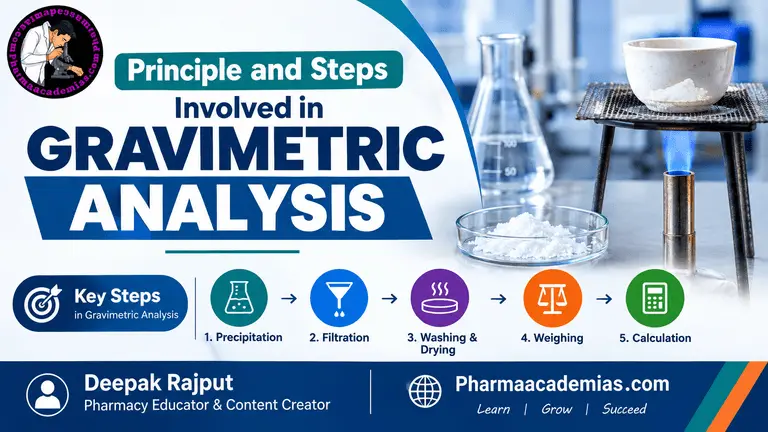
  • Principle and Steps Involved in Gravimetric Analysis
    new ana Unit 3 | Home

    Principle and Steps Involved in Gravimetric Analysis

    ByDeepak Rajput September 2, 2026September 3, 2026

    Principle and Steps Involved in Gravimetric Analysis: Gravimetric analysis is a classical quantitative analytical technique in which the amount or concentration of an analyte is determined by measuring the mass of a pure compound containing the analyte. It is one of the most accurate methods of quantitative analysis because the final measurement is based directly…
    Read More Principle and Steps Involved in Gravimetric AnalysisContinue

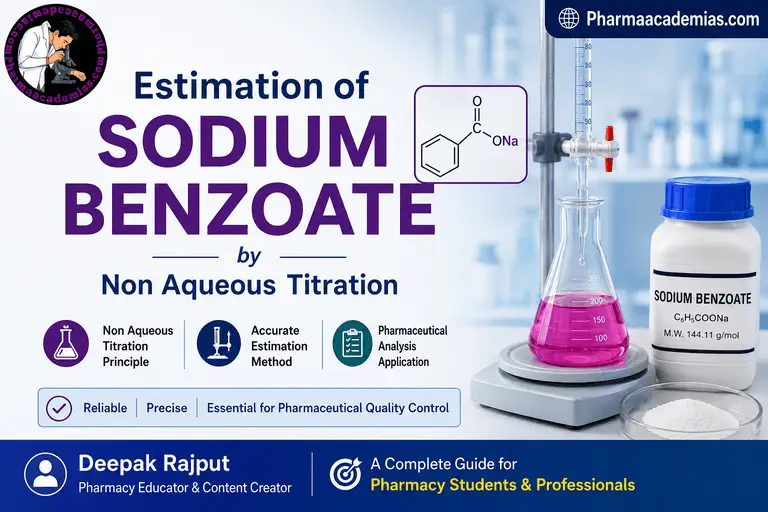
  • Estimation of Sodium Benzoate
    new ana Unit 3 | Home

    Estimation of Sodium Benzoate

    ByDeepak Rajput September 2, 2026September 3, 2026

    Estimation of Sodium Benzoate: Sodium benzoate (C₆H₅COONa) is the sodium salt of benzoic acid and is widely used as a preservative in pharmaceutical preparations, foods, and beverages. It can be estimated by acid-base titration. Since sodium benzoate is the salt of a weak acid and strong base, it reacts with a strong acid such as…

    Read More Estimation of Sodium BenzoateContinue

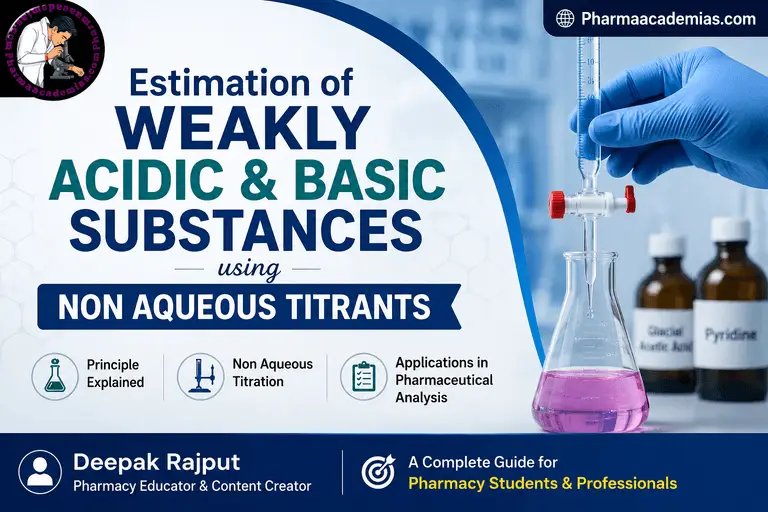
  • Estimation of Weakly Acidic and Basic Substances
    new ana Unit 3 | Home

    Estimation of Weakly Acidic and Basic Substances Using Non-Aqueous Titrants

    ByDeepak Rajput September 2, 2026September 3, 2026

    Estimation of Weakly Acidic and Basic Substances: Non-aqueous titration is an acid-base titration carried out in a solvent other than water. It is especially useful for the estimation of weakly acidic and weakly basic pharmaceutical substances that cannot be titrated accurately in aqueous media. In water, weak acids and bases may undergo incomplete ionization, resulting…

    Read More Estimation of Weakly Acidic and Basic Substances Using Non-Aqueous TitrantsContinue

  • Preparation and Standardization of Acidic and Basic Titrants
    new ana Unit 3 | Home

    Preparation and Standardization of Acidic and Basic Titrants

    ByDeepak Rajput September 2, 2026September 3, 2026

    Preparation and Standardization of Acidic and Basic Titrants: In volumetric analysis, a titrant is a solution of known concentration that is used to determine the concentration of an unknown solution. Acidic and basic titrants are commonly used in acid-base titrations. Before use, the concentration of a titrant must be accurately determined by standardization against a…

    Read More Preparation and Standardization of Acidic and Basic TitrantsContinue

  • Non-Aqueous Titrations
    new ana Unit 3 | Home

    Non-Aqueous Titrations: Types of solvents used, acidimetric and alkalimetric titration

    ByDeepak Rajput September 2, 2026September 3, 2026

    Non-Aqueous Titrations: Non-aqueous titration is a volumetric analytical method in which the titration is carried out in a solvent other than water. It is particularly useful for the assay of weak acids, weak bases, and substances that are poorly soluble in water. In aqueous titration, weak acids or bases may not ionize sufficiently to give…

    Read More Non-Aqueous Titrations: Types of solvents used, acidimetric and alkalimetric titrationContinue

  • Boots Flu Jab 2026
    Home | Blog

    Boots Flu Jab 2026: Price, Eligibility, Booking, Side Effects

    ByDeepak Rajput September 1, 2026September 3, 2026

    Boots Flu Jab 2026 is a seasonal influenza vaccination service available at participating Boots pharmacies in the UK. Eligible people may be able to receive the NHS flu vaccine free of charge, while private vaccination may also be available for people who do not qualify for NHS vaccination. This guide explains the Boots flu jab…

    Read More Boots Flu Jab 2026: Price, Eligibility, Booking, Side EffectsContinue

  • Eco-Pharmacognosy in Sustainable Conservation of Endangered Medicinal Plants
    Unit 2 | Home

    Eco-Pharmacognosy in Sustainable Conservation of Endangered Medicinal Plants

    ByDeepak Rajput September 1, 2026September 3, 2026

    Eco-Pharmacognosy in Sustainable Conservation of Endangered Medicinal Plants: Eco-pharmacognosy is an emerging approach that combines the principles of pharmacognosy, ecology, biodiversity conservation, and sustainable utilization of medicinal plants. It focuses on understanding medicinal plants in relation to their natural habitats, ecological requirements, harvesting practices, chemical constituents, and sustainable use. Medicinal plants such as Kutki (Picrorhiza…

    Read More Eco-Pharmacognosy in Sustainable Conservation of Endangered Medicinal PlantsContinue

  • Ex-situ and In-situ Conservatio
    Unit 2 | Home

    Ex-situ and In-situ Conservation and Strategies for Value Addition of Medicinal Plants

    ByDeepak Rajput September 1, 2026September 3, 2026

    Ex-situ and In-situ Conservation: Medicinal plants are an important source of therapeutic agents, traditional medicines, nutraceuticals, cosmetics, and pharmaceutical raw materials. Plants such as Withania somnifera (Ashwagandha), Azadirachta indica (Neem), Rauvolfia serpentina (Sarpagandha), Aloe vera, Ocimum sanctum (Tulsi), and Phyllanthus species have significant medicinal and economic value. However, increasing demand, habitat destruction, overharvesting, climate change,…

    Read More Ex-situ and In-situ Conservation and Strategies for Value Addition of Medicinal PlantsContinue

  • Application of Polyploidy
    Unit 2 | Home

    Application of Polyploidy, Mutation, and Hybridization

    ByDeepak Rajput September 1, 2026September 3, 2026

    Application of Polyploidy: Medicinal plants are one of the most valuable natural resources because they produce a wide variety of secondary metabolites, such as alkaloids, glycosides, flavonoids, tannins, terpenoids, saponins, essential oils, phenolic compounds, and steroids. Unlike primary metabolites, which are directly involved in the growth and survival of plants, secondary metabolites are not essential…

    Read More Application of Polyploidy, Mutation, and HybridizationContinue

  • Plant Hormones and Their Applications
    Home | Unit 2

    Plant Hormones and Their Applications in Cultivation of Medicinal Plants

    ByDeepak Rajput August 31, 2026September 3, 2026

    Plant Hormones and Their Applications: Plant growth and development are controlled by a group of naturally occurring chemical substances known as plant hormones or phytohormones. These hormones are produced in very small quantities within different parts of the plant and act as chemical messengers that regulate various physiological and biochemical processes. Unlike nutrients, which are…

    Read More Plant Hormones and Their Applications in Cultivation of Medicinal PlantsContinue

Page navigation

Previous PagePrevious 1 2 3 4 5 6 … 218 Next PageNext
  • About Pharmaacademias
  • Contact Us
  • Disclaimer
  • Privacy Policy
  • Terms and Conditions

© 2026 Pharmaacademias - WordPress Theme by Kadence WP

  • Home
  • Courses
    • B.Pharm Old Syllabus Notes (Archive)
      • SEM-I old
        • Human Anatomy and Physiology-I
          • Unit 1
          • Unit 2
          • Unit 3
          • Unit 4
          • Unit 5
        • Pharmaceutical Analysis
          • Unit 1
          • Unit 2
          • Unit 3
          • Unit 4
          • Unit 5
        • Pharmaceutics – 1
          • Unit 1
          • Unit 2
          • Unit 3
          • Unit 4
          • Unit 5
        • Pharmaceutical Inorganic Chemistry
          • Unit 1
          • Unit 2
          • Unit 3
          • Unit 4
          • Unit 5
        • Remedial Biology
          • Unit 1
          • rb Unit 2
      • SEM-II
        • Human Anatomy and Physiology – II
          • Unit 1
          • Unit 2
          • Unit 3
          • Unit 4
          • Unit 5
        • Biochemistry
          • Unit 1
          • Unit 2
          • Unit 3
          • Unit 4
          • Unit 5
        • Pathophysiology
          • Unit 1
          • Unit 2
          • Unit 3
          • Unit 4
          • Unit 5
        • Pharmaceutical Organic Chemistry I
          • poc1 Unit 1
      • SEM-III
        • Pharmaceutical Organic Chemistr II
          • Unit 1
          • Unit 2
          • Unit 3
          • Unit 4
          • Unit 5
        • Physical Pharmaceutics I
          • Unit 1
          • Unit 2
          • Unit 3
          • Unit 4
          • Unit 5
        • Pharmaceutical Microbiology
          • Unit 1
          • Unit 2
          • Unit 3
          • Unit 4
          • Unit 5
        • Pharmaceutical Engineering
          • Unit 1
          • Unit 2
          • Unit 3
          • Unit 4
          • Unit 5
        • Universal human values and professional ethics
          • value Unit 1
      • SEM-IV
        • Pharmaceutical Organic Chemistry III
          • POC 3 Unit 1
          • POC 3 Unit 2
        • Medicinal Chemistry – I
          • Unit 1
        • Physical Pharmaceutics – II
          • Unit 1
          • pp2 Unit 2
        • Pharmacology-1
          • Unit 1
          • Unit 2
          • Unit 3
          • Unit 4
          • Unit 5
        • Pharmacognosy and Phytochemistry – I
          • Unit 1
          • Unit 2
          • Unit 3
          • Unit 4
          • Unit 5
      • SEM-V
        • Medicinal Chemistry II
          • mc2 Unit 1
        • Industrial Pharmacy I
          • Unit 1
          • Unit 2
          • BIP Unit 3
          • BIP Unit 4
        • Pharmacology-II
          • Unit 1
          • Unit 2
          • colo2 Unit 3
        • Pharmacognosy & Phytochemistry II
          • Unit 1
          • Unit 2
          • cog Unit 3
        • Pharmaceutical Jurisprudence
          • Unit 1
          • Unit 2
          • Unit 3
          • juris Unit 4
      • SEM-VI
        • Medicinal Chemistry III
          • MC III Unit 1
        • Herbal Drug Technology
          • Unit 1
          • HDT Unit 2
        • Biopharmaceutics & Pharmacokinetics
          • kinet Unit 1
          • Kinet Unit 2
        • Pharmaceutical Biotechnology
          • Unit 1
          • Unit 2
          • biotech Unit 3
        • Pharmaceutical Quality Assurance
          • Unit 1
      • SEM- VII
        • Instrumental Method of Analysis
          • lysis Unit 1
          • Unit 3
          • Unit 4
          • Unit 5
        • Industrial Pharmacy-II
          • IP 2 Unit 1
        • Pharmacy Practice
          • Unit 1
          • pp Unit 2
        • Novel Drug Delivery System
          • Unit 1
          • ndds Unit 2
      • SEM-VIII
        • Biostatistics and Research Methodology
          • Unit 1
        • Pharmacovigilance
          • Unit-1
          • Unit 2
          • Unit 3
          • vigi Unit 4
        • Social and Preventive Pharmacy
          • Social Unit 1
    • B.Pharm New PCI Syllabus 2026
      • SEM-1 new
        • Basics of Python Programming for Pharmaceutical Sciences
          • Unit 1
          • Python Unit 2
        • General Pharmacy
          • Unit 1
          • Unit 2
          • Unit 3
        • Healthcare Psychology and Communication Skills
          • Unit 1
          • Unit 2
          • Unit 3
        • Human Anatomy, Physiology and Pathophysiology I
          • Unit 1
          • Unit 2
          • Unit 3
          • Unit 4
          • new HAP Unit 5
        • Introduction to Pharmacognosy
          • Unit 1
          • Unit 2
          • Unit 3
          • ITP Unit 4
        • Pharmaceutical Inorganic and Analytical Chemistry
          • Unit 1
          • Unit 2
          • new ana Unit 3
    • D.Pharma
      • Pharmaceutics
        • Chapter 1
        • Chapter 2
        • Chpater 3
        • Chpater 4
        • dceu Chapter 5
      • Pharmaceutical Chemistry
        • Chapter 1
        • Chapter 2
        • Chapter 3
        • Chapter 4
        • Chapter 5
        • dchem Chapter 6
      • Pharmacognosy
        • Chapter 3
        • Chapter 1
        • Chapter 2
        • Chapter 4
        • cogno Chapter 5
      • Human Anatomy and Physiology
        • Chapter 1
        • Chapter 2
        • Chapter 3
        • Chapter 4
        • Chapter 5
        • Chapter 6
        • Chapter 7
        • Chapter 8
        • Chapter 9
        • Chapter 10
        • Chapter 11
        • Chapter 12
        • Chapter 13
        • Chapter 14
        • Chapter 15
      • Social Pharmacy
        • Chapter 1
        • Chapter 2
        • Chapter 3
        • sp Chapter 4
      • Pharmacology
        • Chapter 1
        • Chapter 2
        • Chapter 3
        • Chapter 4
        • Chapter 5
        • Chapter 6
        • Chapter 7
        • Chapter 8
        • Chapter 9
        • Chapter 10
        • Chapter 11
        • Chapter 12
        • Chapter 13
      • Community pharmacy and management
        • Chapter 1
        • Chapter 2
        • Chapter 3
        • Chapter 5
        • Chapter 6
        • Chapter 7
        • cpm Chapter 8
      • Biochemistry & Clinical Pathology
        • Chapter 1
        • Chapter 2
        • Chapter 3
        • Chapter 4
        • Chapter 5
        • Chapter 6
        • Chapter 7
      • Pharmacotherapeutics
        • Chapter 1
        • the Chapter 2
      • Hospital and Clinical Pharmacy
        • Chapter 1
        • Chapter 2
        • hcp Chapter 3
      • Pharmacy law and Ethics
        • Chapter 1
        • Chapter 2
    • M.Pharm
      • Pharmacology Branch
    • Pharm D
      • Human Anatomy & Physiology (D)
        • Unit 1
        • Unit 2
        • Unit 3
        • hap Unit 4 (D)
        • Unit 5
        • Unit 6
        • Unit 7
        • Unit 8
        • Unit 9
        • Unit 10
        • Unit 11
        • Unit 12
        • hap Unit 13
    • DMLT
      • dmlt 1 year
        • Anatomy and Physiology
  • Study Material
    • Practicals
    • Notes pdf
    • Previous year papers
    • Books
  • Blog
  • Jobs
  • Syllabus
Search