
Eco-Pharmacognosy in Sustainable Conservation of Endangered Medicinal Plants: Eco-pharmacognosy is an emerging approach that combines the principles of pharmacognosy, ecology, biodiversity conservation, and sustainable utilization of medicinal plants. It focuses on understanding medicinal plants in relation to their natural habitats, ecological requirements, harvesting practices, chemical constituents, and sustainable use.
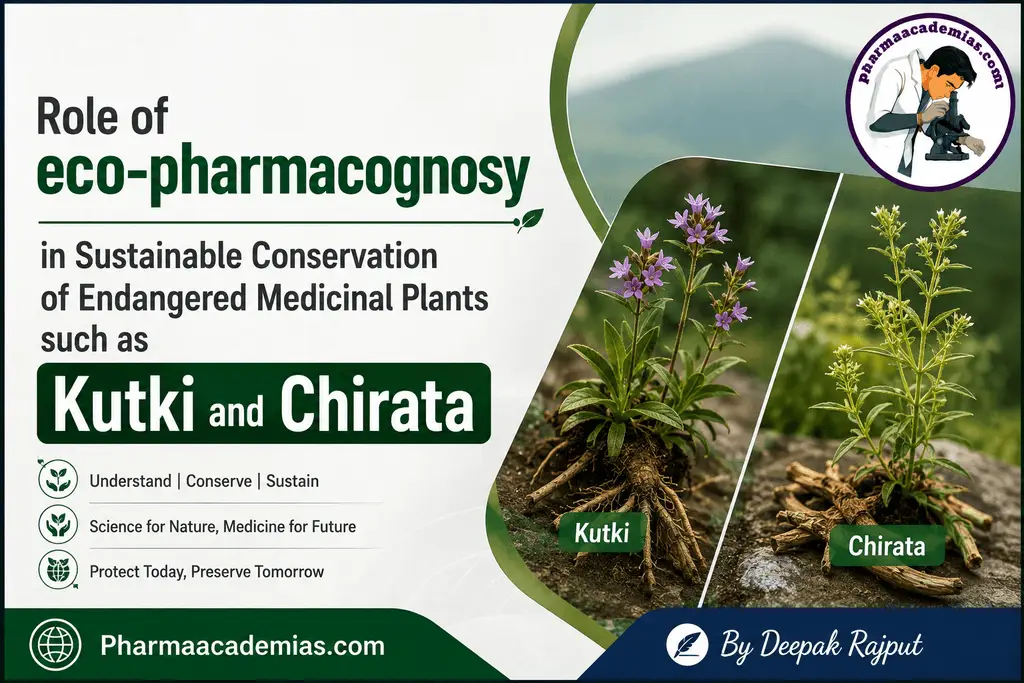
Medicinal plants such as Kutki (Picrorhiza kurroa) and Chirata (Swertia chirata) are valuable medicinal resources but face increasing pressure due to overharvesting, habitat loss, climate change, and unsustainable collection. Eco-pharmacognosy provides a scientific framework for conserving these plants while ensuring their continued medicinal and economic utilization.
1. Concept of Eco-Pharmacognosy
Eco-pharmacognosy studies medicinal plants from an ecological and pharmacognostical perspective.
It considers:
- Natural distribution of medicinal plants
- Habitat and environmental requirements
- Plant identification and authentication
- Sustainable collection
- Conservation of biodiversity
- Phytochemical variation
- Effect of environmental factors on active constituents
- Cultivation and propagation
- Sustainable utilization
- Protection of traditional knowledge
Basic principle
Conserve the medicinal plant and its ecosystem while ensuring sustainable availability of its medicinal constituents.
2. Importance of Eco-Pharmacognosy
Traditional pharmacognosy mainly focuses on the identification, evaluation, chemical constituents, and medicinal uses of natural drugs.
Eco-pharmacognosy extends this concept by asking:
Where does the plant grow? → Why is it declining? → How should it be harvested? → How can it be cultivated? → How can its medicinal quality be maintained? → How can the species and ecosystem be conserved?
Therefore, eco-pharmacognosy helps establish a balance between:
Medicinal plant utilization ↔ Conservation ↔ Ecological sustainability
3. Kutki (Picrorhiza kurroa)
Botanical name: Picrorhiza kurroa Royle ex Benth.
Family: Plantaginaceae
Common names
- Kutki
- Katuka
- Kutki root
Distribution: Kutki is a high-altitude Himalayan medicinal plant. It occurs mainly in alpine and sub-alpine regions.
Medicinal importance
The rhizomes and roots are traditionally used for various medicinal purposes, particularly in traditional systems of medicine.
Important phytoconstituents include:
- Picroside I
- Picroside II
- Kutkin
- Other iridoid glycosides
These constituents contribute significantly to its pharmacological and commercial importance.
4. Conservation Problems of Kutki
Kutki populations are threatened by several factors:
4.1 Overharvesting: The medicinally valuable underground parts are collected from wild populations. Destructive collection can kill the plant and prevent natural regeneration.
4.2 Habitat Loss: Infrastructure development, agricultural expansion, grazing, and other land-use changes can reduce suitable habitats.
4.3 Slow Natural Regeneration: Slow growth and regeneration can make recovery difficult after intensive harvesting.
4.4 Climate Change
Changes in:
- Temperature
- Snow cover
- Rainfall
- Altitudinal distribution
may alter the suitable habitat of Himalayan medicinal plants.
4.5 Commercial Demand: Increasing demand for Kutki as a medicinal raw material increases pressure on wild populations.
5. Role of Eco-Pharmacognosy in Kutki Conservation
5.1 Habitat Assessment: Eco-pharmacognosy helps identify the ecological conditions required for Kutki growth, including:
- Altitude
- Temperature
- Soil characteristics
- Moisture
- Associated vegetation
- Light conditions
This information helps identify suitable areas for in-situ conservation and cultivation.
5.2 Sustainable Harvesting: Instead of indiscriminately removing the entire plant, eco-pharmacognosy promotes scientifically developed harvesting practices.
Important considerations include:
- Appropriate harvesting season
- Appropriate plant age
- Harvesting intensity
- Rotation periods
- Leaving sufficient plants for regeneration
This helps maintain natural populations.
5.3 Cultivation of Kutki: Cultivation can reduce dependence on wild populations.
Eco-pharmacognosy supports:
Wild collection → Scientific cultivation → Sustainable supply
Cultivation programs should maintain the phytochemical quality of cultivated material so that substitution of wild material does not compromise medicinal efficacy.
5.4 Propagation and Tissue Culture: Modern propagation techniques can help produce large numbers of plants.
Approaches include:
- Seed propagation
- Vegetative propagation
- Micropropagation
- Tissue culture
Micropropagation is particularly useful for rapidly multiplying genetically valuable material.
5.5 Phytochemical Standardization: Environmental conditions can influence secondary metabolite production.
Therefore, eco-pharmacognosy connects:
Ecological conditions → Phytochemical profile → Medicinal quality
Monitoring marker compounds such as picrosides can help ensure that cultivated and conserved populations maintain acceptable medicinal quality.
6. Chirata (Swertia chirata)
Botanical name: Swertia chirata (Roxb.) Buch.-Ham. ex Wall.
Family: Gentianaceae
Common name: Chirata/Chirayata
Distribution: Chirata is a medicinal herb associated primarily with the Himalayan region and is traditionally collected from wild populations.
Medicinal importance
Chirata is widely recognized in traditional medicine, particularly for its bitter principles.
Important phytoconstituents include:
- Amarogentin
- Swertiamarin
- Mangiferin
- Other xanthones and secoiridoids
The bitter constituents contribute significantly to its medicinal and commercial importance.
7. Conservation Problems of Chirata
7.1 Excessive Wild Collection: The plant is commonly harvested from natural populations. Uncontrolled collection can substantially reduce regeneration.
7.2 Habitat Destruction: Loss and degradation of Himalayan habitats can reduce naturally occurring Chirata populations.
7.3 Unsustainable Harvesting: Collection before adequate seed production can interfere with natural regeneration.
7.4 Market Demand: Commercial demand for Chirata creates continued pressure on wild populations.
7.5 Climate and Environmental Changes: Changes in temperature, rainfall, land use, and other ecological factors may influence its distribution and regeneration.
8. Role of Eco-Pharmacognosy in Chirata Conservation
8.1 Ecological Documentation
Eco-pharmacognosy helps document:
- Distribution
- Population density
- Habitat characteristics
- Associated plant species
- Regeneration status
Such information is essential for developing conservation programs.
8.2 Sustainable Collection
Collectors can be trained to:
- Avoid destructive harvesting
- Harvest at appropriate maturity
- Maintain seed-producing plants
- Avoid harvesting entire populations
- Follow rotational collection practices
8.3 Cultivation: Encouraging farmers to cultivate Chirata can reduce dependence on wild resources.Cultivation also provides an alternative source of income for local communities.
8.4 Seed Conservation: Seeds from healthy populations can be collected and maintained under appropriate conservation conditions.
Seed-based conservation can support:
- Nursery production
- Restoration programs
- Reintroduction
- Maintenance of genetic diversity
8.5 Phytochemical Quality Control: Cultivated Chirata should be evaluated for characteristic compounds such as swertiamarin and amarogentin.
This helps ensure that cultivated material remains pharmacognostically and chemically acceptable.
9. In-situ Conservation through Eco-Pharmacognosy
Eco-pharmacognosy supports the conservation of Kutki and Chirata within their natural habitats.
Important measures include:
- Identification of natural populations.
- Mapping of important medicinal plant habitats.
- Establishment of medicinal plant conservation areas.
- Protection of natural populations.
- Prevention of destructive harvesting.
- Monitoring population size.
- Monitoring natural regeneration.
- Protection of associated ecosystems.
- Community participation.
- Periodic assessment of conservation status.
10. Ex-situ Conservation
When natural populations become critically reduced, ex-situ conservation becomes important.
Methods include:
Botanical gardens: Living collections can be maintained for research and conservation.
Seed banks: Seeds can be preserved for future propagation where seed storage biology permits.
Field gene banks: Living plants can be maintained under managed conditions.
Tissue culture: Micropropagation can produce large numbers of plants.
Cryopreservation: Appropriate plant tissues can be stored for long-term genetic conservation.
11. Role of Phytochemical Studies
One of the most important contributions of eco-pharmacognosy is understanding how environmental factors influence phytochemical production.
For example:
Altitude + soil + temperature + moisture + sunlight → Secondary metabolite production
Therefore, conservation should not focus only on the number of plants. It should also preserve chemically valuable populations.
This is particularly important for Kutki and Chirata because their medicinal value is associated with specific bioactive constituents.
12. Sustainable Harvesting Model
A sustainable harvesting system can be represented as:
Population assessment
↓
Determine sustainable harvest level
↓
Select appropriate harvesting season
↓
Train collectors
↓
Harvest without destroying regeneration
↓
Post-harvest management
↓
Population monitoring
↓
Adjust harvesting practices
This approach ensures that harvesting does not exceed the plant’s natural ability to regenerate.
13. Community Participation
Local communities are important stakeholders in medicinal plant conservation.
Eco-pharmacognosy promotes:
- Training of local collectors
- Sustainable harvesting education
- Cultivation by local farmers
- Community-managed conservation areas
- Fair economic returns
- Documentation of traditional knowledge
- Benefit-sharing mechanisms
When local communities receive economic benefits from sustainable cultivation and conservation, they have greater incentives to protect medicinal plant resources.
14. Value Addition and Conservation
Value addition can indirectly support conservation.
Instead of selling raw Kutki or Chirata at low prices, local communities can be encouraged to develop:
- Properly dried raw material
- Graded material
- Standardized powders
- Standardized extracts
- Herbal formulations
- Quality-certified products
This can increase economic returns while reducing the need for excessive collection.
However, commercialization must be accompanied by sustainable sourcing and quality control.
15. Authentication and Prevention of Adulteration
Overexploitation of endangered medicinal plants may increase the risk of adulteration and substitution.
Eco-pharmacognosy supports accurate identification through:
- Macroscopic evaluation
- Microscopic evaluation
- Physicochemical evaluation
- Phytochemical profiling
- Chromatographic fingerprinting
- DNA-based authentication where appropriate
Accurate authentication ensures that genuine medicinal plants are used and reduces unnecessary pressure caused by poor-quality or adulterated material.
16. Comparison of Eco-Pharmacognostic Approaches for Kutki and Chirata
| Aspect | Kutki | Chirata |
| Botanical name | Picrorhiza kurroa | Swertia chirata |
| Family | Plantaginaceae | Gentianaceae |
| Major medicinal material | Rhizome/root | Whole herb/aerial parts |
| Important constituents | Picrosides, kutkin | Amarogentin, swertiamarin, xanthones |
| Major conservation concern | Destructive collection of underground parts | Excessive wild collection |
| Major strategy | Cultivation, propagation, habitat protection | Cultivation, seed conservation, sustainable harvesting |
| Ex-situ approaches | Tissue culture, field collections, germplasm conservation | Seed conservation, cultivation, field collections |
| Eco-pharmacognostic focus | Habitat + sustainable rhizome production + phytochemical quality | Habitat + regeneration + sustainable collection + phytochemical quality |
17. Integrated Eco-Pharmacognostic Conservation Strategy
An effective strategy for endangered medicinal plants can be represented as:
Identification and authentication
↓
Ecological assessment
↓
Population monitoring
↓
In-situ conservation
↓
Ex-situ conservation
↓
Scientific cultivation and propagation
↓
Sustainable harvesting
↓
Phytochemical standardization
↓
Value addition
↓
Community participation and benefit sharing
↓
Continuous monitoring
Conclusion
Eco-pharmacognosy plays an important role in the sustainable conservation of endangered medicinal plants such as Kutki (Picrorhiza kurroa) and Chirata (Swertia chirata). It integrates pharmacognostic knowledge with ecology, conservation biology, phytochemistry, sustainable harvesting, cultivation, biotechnology, and community participation.
For Kutki, special attention should be given to the conservation of natural Himalayan habitats, prevention of destructive rhizome harvesting, cultivation, propagation, and maintenance of phytochemical quality. For Chirata, sustainable wild collection, protection of natural populations, seed conservation, cultivation, regeneration, and phytochemical standardization are particularly important.
Ultimately, eco-pharmacognosy follows the principle:
“Conserve the species, protect its habitat, maintain its medicinal quality, and utilize it sustainably.”
This integrated approach can help ensure that valuable medicinal plants remain available for future generations while supporting biodiversity conservation and the livelihoods of local communities.
Editorial Note
This article has been carefully researched and written by Deepak Rajput with a focus on accuracy, clarity, and evidence-based healthcare information. Pharmaacademias.com