Principle and Steps Involved in Gravimetric Analysis: Gravimetric analysis is a classical quantitative analytical technique in which the amount or concentration of an analyte is determined by measuring the mass of a pure compound containing the analyte. It is one of the most accurate methods of quantitative analysis because the final measurement is based directly on mass rather than on an instrumental signal.

In gravimetric analysis, the substance to be determined is usually converted into a sparingly soluble precipitate of known composition. The precipitate is separated from the solution, purified, dried or ignited to a constant mass, and accurately weighed. From its mass and chemical composition, the amount of the original analyte is calculated using stoichiometric relationships.
Principle of Gravimetric Analysis
The fundamental principle of gravimetric analysis is:
A known amount of analyte is converted quantitatively into a pure, stable compound of known chemical composition, which is isolated and weighed. The mass of the compound is then used to calculate the amount of analyte present.
For example, chloride ions can be determined gravimetrically by precipitating them as silver chloride (AgCl).
Chemical reaction
Ag+ + Cl− → AgCl↓
The precipitated AgCl is filtered, washed, dried and weighed.
Since the chemical composition of AgCl is known, the amount of chloride present can be calculated from the mass of AgCl obtained.
General relationship

Therefore, gravimetric analysis involves two important concepts:
- Conversion of the analyte into a suitable weighing form
- Calculation of the analyte from the mass of that weighing form
Types of Gravimetric Analysis
Gravimetric analysis can broadly be classified into the following types:
1. Precipitation Gravimetry: The analyte is converted into a sparingly soluble precipitate, which is separated, dried or ignited, and weighed.
Example: Determination of chloride as AgCl.
Cl− + Ag+ → AgCl↓
2. Volatilization Gravimetry: The analyte or a product formed from it is converted into a volatile substance. The amount is determined either by measuring the loss in mass or by collecting and weighing the volatile product.
Example: Determination of water in a sample by heating.
3. Electrogravimetry: The analyte is deposited quantitatively on an electrode by electrolysis. The electrode is weighed before and after deposition.
Example: Determination of copper by depositing metallic copper on a cathode.
4. Thermogravimetric Analysis: The change in mass of a substance is measured as it is heated under controlled conditions. This method is commonly used to study decomposition, dehydration and thermal stability.
Steps Involved in Gravimetric Analysis
The major steps involved in precipitation gravimetric analysis are described below.
1. Preparation of the Sample Solution
The sample containing the analyte is first converted into a suitable solution.
The sample may be:
- Dissolved in water
- Dissolved in a suitable acid
- Treated with other reagents to remove interfering substances
- Diluted to an appropriate volume
The analyte must be present in a form that can undergo a quantitative reaction with the precipitating reagent.
Example
If chloride is to be determined, the sample is dissolved so that chloride ions are present in solution.
2. Adjustment of Experimental Conditions
Before precipitation, the conditions of the solution are adjusted appropriately.
Important factors include:
- pH
- Temperature
- Concentration of the analyte
- Concentration of precipitating reagent
- Rate of reagent addition
- Stirring
- Presence of interfering ions
Correct control of these conditions is essential for obtaining a pure and easily filterable precipitate.
3. Addition of the Precipitating Reagent
A suitable reagent is added to convert the analyte into a sparingly soluble compound.
For example, chloride ions can be precipitated by adding silver nitrate.
AgNO3 + Cl− → AgCl↓ + NO3−
The precipitating reagent should ideally produce:
- A highly insoluble compound
- A pure precipitate
- A precipitate of known composition
- A precipitate that can be easily filtered and washed
- A precipitate that can be dried or ignited without decomposition
4. Digestion or Aging of the Precipitate
After precipitation, the mixture is often allowed to stand, usually at an appropriate temperature.
This process is called digestion or aging.
During digestion, small precipitate particles tend to combine and form larger crystals. This improves the physical properties of the precipitate.
Advantages of digestion
- Produces larger particles
- Improves filterability
- Reduces adsorption of impurities
- Helps produce a purer precipitate
- Reduces the surface area of the precipitate
For example, freshly formed precipitates may be very fine and difficult to filter. Digestion helps convert them into larger, more easily handled particles.
5. Filtration
The precipitate is separated from the mother liquor by filtration.
Depending on the precipitate, filtration may be carried out using:
- Filter paper
- Gooch crucible
- Sintered-glass crucible
- Other suitable filtration devices
The filtration apparatus must be appropriate for the particle size of the precipitate.
Care should be taken to ensure that none of the precipitate is lost during transfer or filtration.
6. Washing of the Precipitate
The precipitate retained on the filter is washed with a suitable washing liquid.
The purpose of washing is to remove:
- Soluble impurities
- Excess precipitating reagent
- Adsorbed ions
- Mother liquor
Important point
The washing liquid should not dissolve or chemically alter the precipitate.
For some precipitates, pure water may not be ideal because it can cause peptization or dissolution. Therefore, a suitable electrolyte-containing washing solution may be used when required.
7. Drying or Ignition
After filtration and washing, the precipitate must be converted into a stable weighing form.
There are two major possibilities:
A. Drying: The precipitate is heated at a suitable temperature to remove:
- Moisture
- Solvent
- Volatile substances
The precipitate is then cooled and weighed.
B. Ignition: Some precipitates are heated strongly to convert them into a stable compound with known composition.
For example, a hydroxide precipitate may be converted into an oxide upon ignition.
The temperature must be carefully controlled because excessive heating may cause decomposition or loss of the analyte.
8. Cooling in a Desiccator
After drying or ignition, the crucible containing the precipitate is allowed to cool in a desiccator.
A desiccator protects the dried material from:
- Atmospheric moisture
- Dust
- Carbon dioxide
- Other atmospheric contaminants
Cooling in a desiccator is important because weighing a hot crucible can give inaccurate results and may damage the balance.
9. Weighing
The cooled crucible containing the dried or ignited precipitate is accurately weighed.
The mass of the empty crucible is also known.
Therefore:
Mass of precipitate = Mass of crucible + precipitate − Mass of empty crucible
The weighing should be performed using an analytical balance.
10. Heating to Constant Weight
The precipitate is generally heated, cooled and weighed repeatedly until a constant mass is obtained.
Constant weight
Constant weight means that further drying or ignition produces no significant change in mass.
This is important because residual moisture or volatile substances can produce an incorrect result.
A typical sequence is:
Heat → Cool in desiccator → Weigh → Repeat
until the difference between successive weights is within the accepted limit.
Calculation in Gravimetric Analysis
Once the mass of the weighing form is known, the amount of analyte can be calculated using stoichiometry.
Gravimetric Factor
A useful term in gravimetric calculations is the gravimetric factor (GF).

Therefore:
Mass of analyte = Mass of weighing form × GF
Example: Determination of Chloride as AgCl
Suppose a sample produces 0.287 g of AgCl.
The reaction is:
Ag+ + Cl− → AgCl
Molar mass of AgCl ≈ 143.32 g/mol
Atomic mass of Cl ≈ 35.45 g/mol
Therefore:
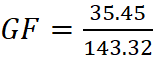
Thus:
Mass of Cl = 0.287 × 0.2474
Mass of Cl ≈ 0.0710g
Therefore, approximately 0.071 g of chloride is present in the sample.
Requirements of a Good Gravimetric Reaction
For accurate gravimetric analysis, the reaction should ideally satisfy the following conditions:
1. Quantitative reaction: The analyte should be converted almost completely into the weighing form.
2. High purity: The precipitate should contain minimal impurities.
3. Known composition: The chemical composition of the final weighing form must be definite and known.
4. Low solubility: The precipitate should be sufficiently insoluble so that only a negligible amount remains dissolved.
5. Easy filtration: The precipitate should preferably form relatively large particles that can be separated easily.
6. Stability: The final weighing form should be chemically and thermally stable.
7. High molar mass: A relatively high molar mass of the weighing form is desirable because it generally reduces the relative effect of weighing errors.
Factors Affecting Precipitate Formation
The quality of the precipitate has a major influence on the accuracy of gravimetric analysis.
Important factors include:
1. Temperature: Temperature affects solubility, crystal growth and precipitation rate.
2. Concentration: Very high concentrations may cause rapid precipitation and formation of very small particles.
3. Rate of Addition: The precipitating reagent should generally be added slowly with continuous stirring.
4. pH: Many precipitation reactions are strongly affected by pH. An incorrect pH can result in incomplete precipitation or formation of unwanted compounds.
5. Digestion: Proper digestion improves crystal size and purity.
6. Presence of Interfering Ions: Other ions may precipitate along with the analyte or become incorporated into the precipitate.
Sources of Error in Gravimetric Analysis
Although gravimetric analysis can be highly accurate, several errors can affect the result.
1. Incomplete precipitation: If some analyte remains in the solution, the measured mass will be too low.
2. Loss of precipitate: Loss during filtration, washing or transfer produces a negative error.
3. Coprecipitation: Impurities may become associated with the desired precipitate.
4. Post-precipitation: Another substance may precipitate after the desired precipitate has formed.
5. Incomplete washing: Residual soluble impurities increase the measured mass.
6. Excessive washing: Some precipitates may partially dissolve during washing.
7. Incomplete drying: Residual moisture produces an artificially high mass.
8. Decomposition during heating: Excessive heating may alter the chemical composition of the weighing form.
9. Absorption of atmospheric moisture: A hygroscopic precipitate may gain mass while being handled or weighed.
10. Incorrect weighing: Errors in weighing, balance calibration or handling of the crucible can affect the final result.
Advantages of Gravimetric Analysis
- High accuracy can be achieved under controlled conditions.
- It does not necessarily require expensive instruments.
- The basic procedure is relatively simple.
- It is based on fundamental chemical and stoichiometric relationships.
- It can serve as a reference method for some analytical determinations.
- It is useful for teaching fundamental principles of quantitative analysis.
- The final measurement is based directly on mass.
Limitations of Gravimetric Analysis
- The procedure can be time-consuming.
- It often requires careful precipitation, filtration, washing and drying.
- Very small quantities of analyte may be difficult to determine accurately.
- Interfering substances can cause significant errors.
- The method requires careful control of experimental conditions.
- Some precipitates are difficult to filter or purify.
- It is less convenient than many modern instrumental techniques for routine high-throughput analysis.
Applications of Gravimetric Analysis
Gravimetric methods have been used for the determination of various substances, including:
| Analyte | Common weighing form |
| Chloride | AgCl |
| Sulfate | BaSO₄ |
| Nickel | Ni(DMG)₂ |
| Calcium | CaC₂O₄ or a suitable derived weighing form |
| Magnesium | Mg₂P₂O₇ after suitable treatment |
| Silica | SiO₂ |
| Water | Determined by mass loss in suitable procedures |
Conclusion
Gravimetric analysis is a classical quantitative analytical method based on the accurate measurement of mass. The analyte is converted into a pure, stable compound of known composition, which is separated, washed, dried or ignited, cooled and weighed. The mass obtained is then related to the original amount of analyte through stoichiometric calculations.
The accuracy of the method depends mainly on complete precipitation, purity of the precipitate, prevention of precipitate loss, proper washing, conversion to a stable weighing form, and obtaining constant weight. Despite being relatively time-consuming compared with instrumental methods, gravimetric analysis remains an important technique in pharmaceutical analysis, analytical chemistry, quality control, and chemical education.
Editorial Note
This article has been carefully researched and written by Deepak Rajput with a focus on accuracy, clarity, and evidence-based healthcare information. Pharmaacademias.com