Composition and Functions of Blood: Blood is a specialized fluid connective tissue that continuously circulates through the cardiovascular system. It is essential for maintaining life because it connects almost every organ and tissue of the body with one another. Blood transports oxygen from the lungs to tissues, carries carbon dioxide from tissues back to the lungs, distributes nutrients absorbed from the gastrointestinal tract, transports hormones and other chemical messengers, removes metabolic waste products, participates in immune defense, helps control body temperature, and contributes to the maintenance of fluid, electrolyte, and acid–base balance.
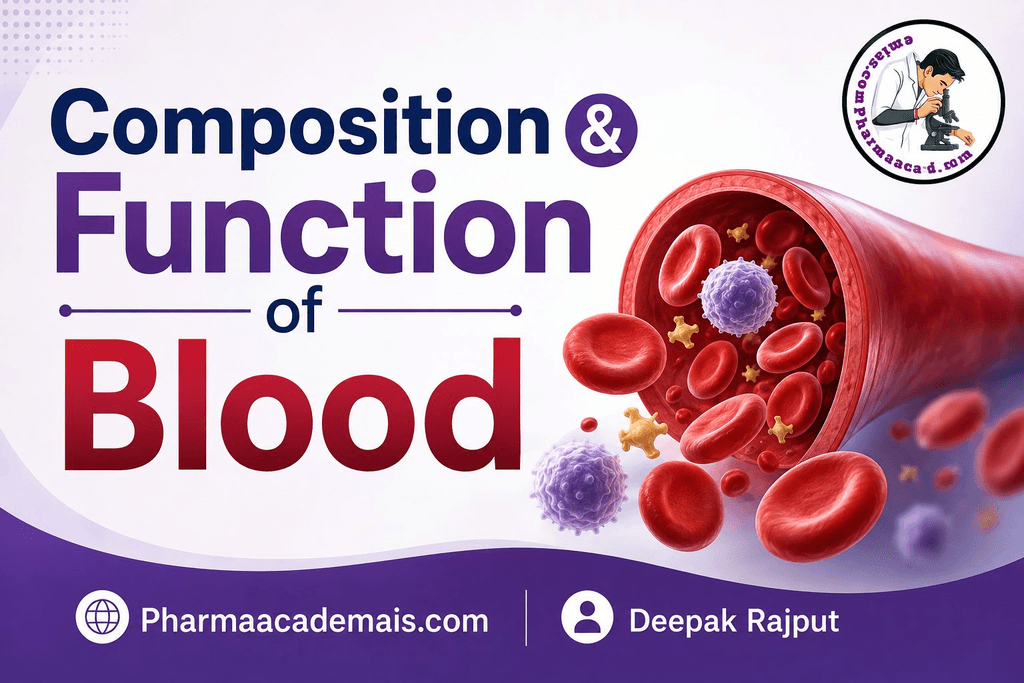
In an average adult, blood accounts for approximately 7–8% of total body weight, and the total blood volume is usually around 5–6 litres, although it varies with body size, sex, age, and physiological condition. Blood is continuously circulated by the pumping action of the heart through arteries, arterioles, capillaries, venules, and veins.
Blood is composed of two major components:
- Plasma – the liquid portion of blood.
- Formed elements – the cellular and cellular-derived components suspended in plasma.
The formed elements include red blood cells (erythrocytes), white blood cells (leukocytes), and platelets (thrombocytes).
1. Composition of Blood
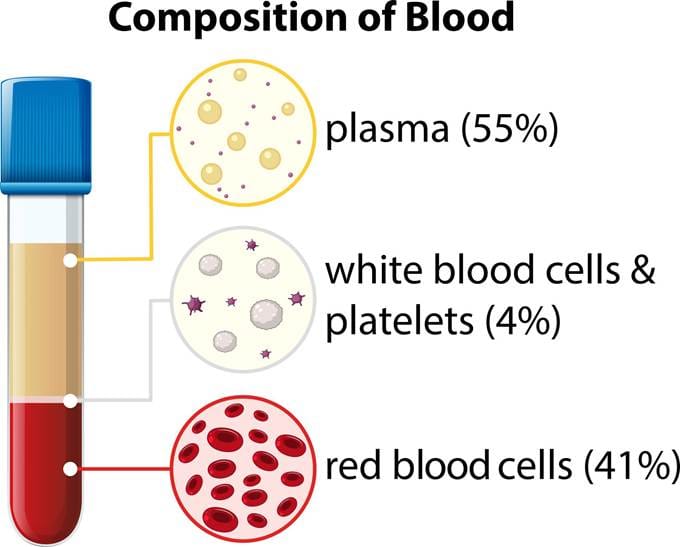
Blood consists of approximately:
- Plasma: about 55% of blood volume
- Formed elements: about 45% of blood volume
The percentage of blood volume occupied by red blood cells is called the hematocrit or packed cell volume (PCV).
A simplified representation is:
Blood = Plasma + Formed Elements
Plasma contains:
- Water
- Plasma proteins
- Electrolytes
- Nutrients
- Hormones
- Dissolved gases
- Enzymes
- Vitamins
- Waste products
Formed elements include:
- Red blood cells
- White blood cells
- Platelets
2. Plasma
Plasma is the pale-yellow liquid portion of blood in which the formed elements are suspended. It accounts for approximately 55% of total blood volume.
Plasma is composed mainly of water, with dissolved proteins, electrolytes, nutrients, gases, hormones, enzymes, and waste products.
Approximately 90–92% of plasma is water, while the remaining portion consists primarily of proteins and other dissolved substances.
Plasma performs several important functions. It acts as a transport medium, carries nutrients and hormones, maintains blood volume, contributes to osmotic pressure and acid–base balance, and provides proteins involved in immunity and blood coagulation.
3. Components of Plasma
A. Water
Water is the major component of plasma. It provides the liquid medium in which various substances can dissolve and circulate throughout the body.
Water allows the transportation of:
- Glucose
- Amino acids
- Electrolytes
- Hormones
- Metabolic waste products
- Proteins
- Water-soluble vitamins
Because plasma contains a large amount of water, it also contributes significantly to maintaining blood volume and body-fluid balance.
4. Plasma Proteins
Plasma proteins are among the most important components of plasma. The major plasma proteins are:
- Albumin
- Globulins
- Fibrinogen
Other plasma proteins are also present in smaller quantities.
A. Albumin
Albumin is the most abundant plasma protein and is synthesized primarily by the liver.
Its major functions include:
- Maintaining plasma colloid osmotic pressure
- Helping maintain blood volume
- Transporting various substances
- Binding certain drugs
- Transporting fatty acids
- Transporting bilirubin
- Transporting some hormones
- Contributing to buffering of blood pH
Albumin is particularly important for preventing excessive movement of water from the blood vessels into the tissues.
A significant reduction in plasma albumin can decrease plasma oncotic pressure and promote fluid movement into the interstitial space, potentially resulting in edema.
Albumin is also important in pharmacology because many drugs bind to plasma proteins, especially albumin. Only the unbound fraction of a drug is generally available to diffuse into tissues and exert pharmacological effects.
B. Globulins
Globulins are a heterogeneous group of plasma proteins.
They can broadly be divided into:
- Alpha globulins
- Beta globulins
- Gamma globulins
Some globulins function as transport proteins, while others participate in immune defense.
Gamma globulins include many immunoglobulins or antibodies, which are produced by plasma cells and participate in immune responses.
Globulins therefore have important roles in:
- Immunity
- Transport
- Inflammation
- Complement-related functions
- Defense against infectious organisms
C. Fibrinogen
Fibrinogen is a soluble plasma protein synthesized by the liver and plays an essential role in blood coagulation.
During coagulation, fibrinogen is converted into fibrin by the action of thrombin. Fibrin forms a network of insoluble fibers that helps trap blood cells and produces a stable blood clot.
Therefore, fibrinogen is essential for preventing excessive blood loss following vascular injury.
5. Electrolytes in Plasma
Plasma contains several electrolytes that are essential for normal physiological functions.
Important plasma electrolytes include:
- Sodium (Na⁺)
- Potassium (K⁺)
- Calcium (Ca²⁺)
- Magnesium (Mg²⁺)
- Chloride (Cl⁻)
- Bicarbonate (HCO₃⁻)
- Phosphate
- Sulfate
Sodium
Sodium is the major extracellular cation. It is important for:
- Maintenance of extracellular fluid volume
- Osmotic balance
- Nerve conduction
- Muscle function
- Regulation of water distribution
Potassium
Potassium is essential for:
- Resting membrane potential
- Nerve conduction
- Muscle contraction
- Normal cardiac electrical activity
Calcium
Calcium is important for:
- Bone metabolism
- Muscle contraction
- Blood coagulation
- Neurotransmitter release
- Intracellular signaling
Chloride
Chloride contributes to:
- Osmotic balance
- Electrical neutrality
- Acid–base balance
Bicarbonate
Bicarbonate is one of the most important components of the body’s extracellular buffer system and plays a major role in maintaining blood pH.
6. Hormones in Plasma
Hormones released by endocrine glands are transported through blood to their target tissues.
Examples include:
- Insulin
- Glucagon
- Thyroid hormones
- Cortisol
- Adrenaline
- Growth hormone
- Sex hormones
Blood therefore serves as an important communication pathway between endocrine organs and distant target tissues.
7. Dissolved Gases
Blood contains dissolved gases, primarily:
- Oxygen
- Carbon dioxide
- Nitrogen
Most oxygen is transported by hemoglobin within red blood cells, while most carbon dioxide is transported in the blood in the form of bicarbonate, with additional amounts carried as carbamino compounds or dissolved directly in plasma.
Gas transport is essential for cellular respiration and maintenance of acid–base balance.
8. Metabolic Waste Products
Blood collects metabolic waste products from tissues and transports them to organs responsible for their elimination or processing.
Important waste products include:
- Carbon dioxide
- Urea
- Uric acid
- Creatinine
- Bilirubin
- Other metabolic products
For example, carbon dioxide produced by cellular metabolism is transported to the lungs and exhaled. Urea and other nitrogenous waste products are transported to the kidneys and eliminated through urine.
9. Formed Elements of Blood
The cellular portion of blood is collectively known as the formed elements.
They include:
1. Red blood cells: Also called erythrocytes.
2. White blood cells: Also called leukocytes.
3. Platelets: Also called thrombocytes.
These components have distinct structures and functions.
10. Red Blood Cells
Red blood cells (RBCs), or erythrocytes, are the most abundant formed elements of blood.
Their primary function is the transportation of oxygen from the lungs to tissues and the transportation of carbon dioxide from tissues toward the lungs.
Mature human RBCs are biconcave, flexible, and lack a nucleus. Their shape provides a large surface area for gas exchange and allows them to pass through narrow capillaries.
The cytoplasm of RBCs contains a high concentration of hemoglobin, an iron-containing protein responsible for the red color of blood.
11. Hemoglobin
Hemoglobin is the major protein inside red blood cells and is responsible for oxygen transport.
Hemoglobin consists of globin protein chains associated with heme groups, each containing iron.
Oxygen binds reversibly to the iron-containing heme groups. In the lungs, hemoglobin binds oxygen, while in tissues it releases oxygen according to local physiological conditions.
Hemoglobin also contributes to carbon dioxide transport and buffering of hydrogen ions.
12. Functions of Red Blood Cells
The major functions of RBCs include:
Oxygen transport: RBCs transport oxygen from the lungs to tissues.
Carbon dioxide transport: RBCs participate in the transport of carbon dioxide from tissues toward the lungs.
Acid–base regulation: Hemoglobin acts as an important intracellular buffer and contributes to maintaining blood pH.
Blood viscosity: The number and properties of RBCs influence blood viscosity and therefore affect blood flow.
13. White Blood Cells
White blood cells (WBCs), or leukocytes, are cells involved primarily in immune defense and protection against disease.
Unlike mature RBCs, WBCs contain nuclei and possess various specialized cellular structures.
The major types of WBCs are:
- Neutrophils
- Lymphocytes
- Monocytes
- Eosinophils
- Basophils
They can broadly be divided into:
Granulocytes
- Neutrophils
- Eosinophils
- Basophils
Agranulocytes
- Lymphocytes
- Monocytes
14. Neutrophils
Neutrophils are generally the most abundant type of circulating white blood cell.
They are important components of the body’s innate immune system.
Their major functions include:
- Phagocytosis of microorganisms
- Destruction of bacteria
- Removal of damaged tissue
- Participation in acute inflammation
Neutrophils can migrate from blood into tissues in response to chemical signals released during infection or tissue injury.
15. Lymphocytes
Lymphocytes are central to adaptive immunity.
The major types include:
- B lymphocytes
- T lymphocytes
- Natural killer cells
B lymphocytes: B cells can differentiate into plasma cells that produce antibodies.
T lymphocytes: T cells participate in cellular immune responses and include several functional subtypes.
Natural killer cells: Natural killer cells contribute to defense against infected and abnormal cells.
Lymphocytes are therefore essential for specific immune recognition and immunological memory.
16. Monocytes
Monocytes are relatively large white blood cells that circulate in the blood and can migrate into tissues.
After entering tissues, they can differentiate into cells such as macrophages and participate in:
- Phagocytosis
- Antigen presentation
- Removal of cellular debris
- Regulation of inflammation
Monocytes and macrophages are important components of the body’s defense and tissue-cleaning systems.
17. Eosinophils
Eosinophils are particularly important in:
- Defense against certain parasites
- Allergic reactions
- Regulation of inflammatory responses
They contain cytoplasmic granules containing various biologically active substances.
Increased eosinophil counts may occur in certain parasitic infections and allergic or inflammatory conditions.
18. Basophils
Basophils are relatively rare circulating leukocytes.
They contain granules containing biologically active substances, including histamine and other mediators.
Basophils participate in:
- Allergic reactions
- Inflammatory responses
- Certain hypersensitivity reactions
They are functionally related to tissue mast cells but are distinct cell populations.
19. Platelets
Platelets, or thrombocytes, are small, membrane-bound cellular fragments derived from large bone-marrow cells called megakaryocytes.
Platelets are essential for hemostasis, the process by which bleeding is stopped following blood-vessel injury.
When a blood vessel is damaged, platelets adhere to the injured area, become activated, release signaling substances, and aggregate with other platelets.
This contributes to formation of the platelet plug.
Platelets also provide a surface that supports several reactions of the coagulation system, ultimately helping produce a stable fibrin clot.
Conclusion
Blood is a highly specialized connective tissue that performs numerous essential functions throughout the human body. Its composition is carefully organized into plasma and formed elements, with each component contributing to the maintenance of normal physiological function. Plasma provides the fluid medium for transportation and contains water, proteins, electrolytes, nutrients, hormones, gases, and waste products. Albumin maintains oncotic pressure, globulins contribute to immunity and transport, and fibrinogen participates in blood coagulation.
The formed elements consist of red blood cells, white blood cells, and platelets. Red blood cells and hemoglobin are primarily responsible for oxygen transport and contribute to carbon dioxide transport and acid–base regulation. White blood cells protect the body against infectious organisms and participate in immune and inflammatory responses. Platelets are essential for hemostasis and help prevent excessive blood loss following vascular injury.
Editorial Note
This article has been carefully researched and written by Deepak Rajput with a focus on accuracy, clarity, and evidence-based healthcare information. Pharmaacademias.com