
Mohr’s Method: Mohr’s method is a precipitation titration method (argentometric titration) used mainly for the quantitative determination of chloride (Cl⁻) and bromide (Br⁻) ions in a solution. It uses silver nitrate (AgNO₃) as the standard titrant and potassium chromate (K₂CrO₄) as the indicator.
The method is based on the formation of a sparingly soluble silver chloride precipitate, followed by the formation of brick-red silver chromate at the endpoint.

Principle of Mohr’s Method
In Mohr’s method, the chloride-containing solution is titrated with standard silver nitrate solution using potassium chromate as an indicator.
Initially, silver ions react preferentially with chloride ions to form white silver chloride precipitate:
Ag+ + Cl− → AgCl↓
As long as chloride ions are present, the added Ag⁺ is consumed in forming AgCl.
After almost all chloride ions have been precipitated, a slight excess of Ag⁺ reacts with chromate ions from the indicator to form brick-red silver chromate (Ag₂CrO₄):
2Ag+ + CrO42− → Ag2CrO4↓
The first permanent appearance of the brick-red colour indicates the endpoint.
In simple terms:
Chloride + AgNO₃ → White AgCl precipitate
↓
Chloride completely precipitated
↓
Excess AgNO₃ + K₂CrO₄ → Brick-red Ag₂CrO₄
↓
Endpoint
Reagents Required
1. Standard Silver Nitrate Solution (AgNO₃): Silver nitrate is used as the titrating agent.It provides Ag⁺ ions, which precipitate chloride ions as AgCl.
2. Potassium Chromate Indicator (K₂CrO₄): Potassium chromate acts as the indicator.It reacts with a slight excess of Ag⁺ at the endpoint to produce brick-red Ag₂CrO₄.
3. Sample Solution: The sample containing chloride ions is dissolved in water and suitably prepared for titration.
Procedure of Mohr’s Method
Step 1: Preparation of the Sample: Take a measured volume of the sample solution containing chloride ions in a clean conical flask.If necessary, dilute the sample appropriately with distilled water.
Step 2: Addition of Indicator: Add a small, known amount of potassium chromate indicator to the sample solution.The solution generally appears yellow because of chromate ions.
Step 3: Titration with Silver Nitrate: Fill a burette with standardized AgNO₃ solution.
Add AgNO₃ slowly to the sample while continuously swirling the flask.
A white precipitate of silver chloride is formed:
Ag+ + Cl− → AgCl↓
Step 4: Continue the Titration: Continue adding AgNO₃ until nearly all chloride ions have reacted.At this stage, almost all Ag⁺ ions are being consumed in the formation of AgCl.
Step 5: Detection of Endpoint: Near the endpoint, add AgNO₃ dropwise while continuously mixing.
Once chloride ions have been essentially completely precipitated, a slight excess of Ag⁺ reacts with chromate:
2Ag+ + CrO42− → Ag2CrO4↓
A permanent brick-red or reddish-brown colour/precipitate appears.
This is taken as the endpoint.
Why Does Silver Chromate Form at the Endpoint?
This is an important concept in Mohr’s method.
Silver chloride and silver chromate have different solubility products.
For AgCl:
Ksp(AgCl) = [Ag+][Cl−]
For Ag₂CrO₄:
Ksp(Ag2CrO4) = [Ag+]2[CrO42−]
During most of the titration, the concentration of Ag⁺ is too low to produce a visible amount of silver chromate.
However, after nearly all chloride ions have been removed as AgCl, the concentration of Ag⁺ begins to increase.
The Ag⁺ then reacts with chromate ions and produces visible Ag₂CrO₄.
Therefore, the appearance of the brick-red precipitate signals that the chloride precipitation is essentially complete.
pH Requirement
Mohr’s method should generally be performed in a near-neutral to mildly alkaline medium, approximately pH 6.5–10.
Why is pH important?
If the solution is too acidic, chromate ions can be converted into other chromium species, reducing the concentration of chromate available for endpoint detection.
If the solution is too alkaline, silver ions may react with hydroxide or carbonate ions and produce unwanted precipitates.
Therefore, proper pH control is essential for obtaining an accurate endpoint.
Titration Reaction
The main reaction is:
gNO3 + NaCl → AgCl↓ + NaNO3
Ionic equation:
Ag+ + Cl− → AgCl↓
Endpoint reaction:
2Ag+ + CrO42− → Ag2CrO4↓
AgCl: White precipitate
Ag₂CrO₄: Brick-red precipitate
Calculation
For a 1:1 reaction between AgNO₃ and chloride:
Ag+ + Cl− → AgCl
Therefore:
Moles of AgNO3 = Moles of Cl−
Using normality:
N1V1 = N2V2
Where:
- N1 = Normality of AgNO₃
- V1 = Volume of AgNO₃ used
- N2 = Normality of chloride-containing solution
- V2 = Volume of sample solution
The amount of chloride can then be calculated from the volume and concentration of AgNO₃ consumed.
Example
Suppose:
- Volume of sample = 25 mL
- AgNO₃ used = 20 mL
- AgNO₃ concentration = 0.1 N
Using:
N1V1 = N2V2
0.1 × 20 = N2 × 25
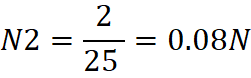
Thus, the chloride-containing solution has an equivalent concentration of 0.08 N with respect to chloride.
Applications of Mohr’s Method
Mohr’s method is mainly used for the determination of:
- Chloride ions
- Bromide ions
- Chloride in pharmaceutical substances
- Chloride in water samples
- Chloride in food and chemical samples
- Chloride in various laboratory preparations
It is particularly useful when a relatively simple and direct precipitation titration is required.
Advantages of Mohr’s Method
- It is simple and rapid.
- It does not require expensive instrumentation.
- The endpoint is relatively easy to observe.
- It provides reasonably accurate results when conditions are properly controlled.
- It is suitable for routine determination of chloride.
- Silver nitrate can be standardized and used for quantitative analysis.
Limitations of Mohr’s Method
- The solution must be maintained within a suitable pH range.
- Coloured samples may make the endpoint difficult to observe.
- Other ions that react with Ag⁺ can interfere with the analysis.
- Carbonate and other anions capable of forming silver precipitates can cause errors.
- The method is not suitable when the endpoint colour cannot be observed clearly.
- Excessive amounts of chromate indicator can affect the endpoint and should therefore be controlled.
Precautions
- Use a standardized AgNO₃ solution.
- Use a suitable amount of potassium chromate indicator.
- Maintain the solution at an appropriate pH.
- Add AgNO₃ slowly near the endpoint.
- Continuously swirl the solution during titration.
- Do not mistake a temporary colour change for the endpoint.
- The endpoint should be the first permanent brick-red colour.
- Protect silver nitrate solution from strong light because it is photosensitive.
- Use clean glassware to avoid contamination.
Difference Between the Precipitate and Endpoint
| Stage | Reaction | Observation |
| During titration | Ag++Cl−→AgClAg^+ + Cl^- rightarrow AgCl | White AgCl precipitate |
| Near endpoint | Most Cl⁻ has been precipitated | White precipitate remains |
| Endpoint | 2Ag++CrO42−→Ag2CrO42Ag^+ + CrO_4^{2-} rightarrow Ag_2CrO_4 | Permanent brick-red colour |
| After endpoint | Excess AgNO₃ present | Increasing Ag₂CrO₄ formation |
Conclusion
Mohr’s method is an argentometric precipitation titration in which chloride ions are determined using standard silver nitrate solution and potassium chromate as an indicator. Chloride is first precipitated quantitatively as white AgCl. After the chloride has been essentially precipitated, a slight excess of Ag⁺ reacts with chromate ions to form brick-red Ag₂CrO₄, marking the endpoint. Proper control of pH, indicator concentration, reagent addition and endpoint observation is essential for accurate results.
Editorial Note
This article has been carefully researched and written by Deepak Rajput with a focus on accuracy, clarity, and evidence-based healthcare information. Pharmaacademias.com