Carbohydrates as Plant Metabolites: Plants produce a large number of chemical substances through various metabolic processes. These substances are broadly classified into primary metabolites and secondary metabolites.
Carbohydrates are considered one of the most important primary metabolites of plants. They are directly involved in essential physiological processes such as energy production, energy storage, growth, development, transport of nutrients, and formation of plant tissues.
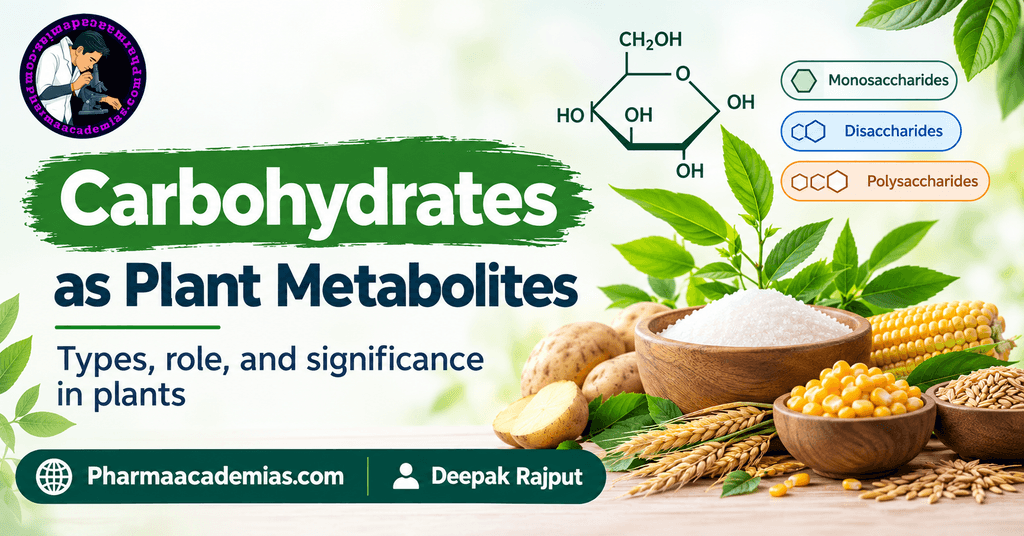
Carbohydrates are mainly synthesized by green plants through photosynthesis. The carbohydrates formed during photosynthesis are further converted into different forms according to the requirements of the plant.
For example, glucose may be used immediately for energy, converted into sucrose for transport, or converted into starch for storage.
2. Definition
Carbohydrates are organic compounds that are polyhydroxy aldehydes or ketones, or substances which produce polyhydroxy aldehydes or ketones on hydrolysis.
They are mainly composed of carbon, hydrogen, and oxygen.
The simplest general representation is: Cₙ(H₂O)ₙ
However, this formula does not apply to all carbohydrates.
Examples
- Glucose – C₆H₁₂O₆
- Fructose – C₆H₁₂O₆
- Sucrose – C₁₂H₂₂O₁₁
- Starch – (C₆H₁₀O₅)ₙ
3. Why are Carbohydrates Called Primary Plant Metabolites?
Carbohydrates are called primary metabolites because they are directly involved in the fundamental metabolic activities required for the survival, growth, and development of plants.
They perform several essential functions:
Energy production: Glucose is broken down during respiration to release energy in the form of ATP.
Energy storage: Excess glucose is converted into starch, which is stored in seeds, roots, tubers, and other plant parts.
Structural function: Carbohydrates such as cellulose and hemicellulose form important components of plant cell walls.
Transport: Sucrose is the major sugar transported through the phloem in many plants.
Biosynthetic role: Carbohydrate intermediates provide carbon skeletons for the formation of other important molecules such as amino acids, lipids, nucleotides, and secondary metabolites.
Thus, carbohydrates are closely associated with the basic metabolism of plants, which is the main reason for their classification as primary metabolites.
4. Formation of Carbohydrates in Plants
The major source of carbohydrates in plants is photosynthesis. Green plants contain chlorophyll, which captures light energy. This energy is used to convert carbon dioxide and water into carbohydrates.
Overall reaction
6CO₂ + 6H₂O → C₆H₁₂O₆ + 6O₂
Carbon dioxide + Water → Glucose + Oxygen
The glucose produced can then undergo several metabolic transformations.
5. Classification of Plant Carbohydrates
According to the number of sugar units, carbohydrates are mainly classified into:
A. Monosaccharides
B. Oligosaccharides
C. Polysaccharides
A. Monosaccharides: Monosaccharides are the simplest carbohydrates and cannot be hydrolysed into smaller carbohydrate molecules.
Important examples include:
- Glucose
- Fructose
- Galactose
- Ribose
- Xylose
Glucose: Glucose is one of the most important primary metabolites in plants. It is produced during photosynthesis and is used as an important source of energy and carbon.
Fructose: Fructose is commonly found in fruits, honey, and plant juices. It is an important source of energy.
Ribose: Ribose is a five-carbon sugar that forms part of RNA and several biologically important molecules.
B. Oligosaccharides: Oligosaccharides contain a small number of monosaccharide units linked through glycosidic bonds.
The most important example is sucrose.
Sucrose
Sucrose is formed from:
Glucose + Fructose → Sucrose
It is widely distributed in plants and is especially abundant in:
- Sugar cane
- Sugar beet
- Fruits
- Plant juices
Sucrose is particularly important because it acts as a major transport form of carbohydrate in plants.
C. Polysaccharides: Polysaccharides are complex carbohydrates consisting of a large number of monosaccharide units.
Important plant polysaccharides include:
- Starch
- Cellulose
- Hemicellulose
- Inulin
- Pectin
1. Starch: Starch is the principal storage carbohydrate of plants.
It is mainly composed of:
- Amylose
- Amylopectin
Starch is commonly stored in:
- Seeds
- Cereals
- Tubers
- Roots
- Rhizomes
Examples include potato, rice, wheat, and maize.
When energy is required, stored starch can be broken down into simpler sugars.
2. Cellulose: Cellulose is the major structural carbohydrate of plants. It is an important component of the plant cell wall and provides mechanical strength and rigidity to plant tissues. Cellulose consists of long chains of glucose units linked mainly through β-(1→4) glycosidic bonds. Humans cannot digest cellulose because they lack the enzyme cellulase required to break these bonds.
3. Hemicellulose: Hemicellulose is a group of complex polysaccharides present in plant cell walls.It works together with cellulose and other components to provide strength and structural support to plant tissues.
4. Inulin: Inulin is a fructose-containing storage polysaccharide found in the underground parts of several plants.It is considered a storage carbohydrate and is particularly associated with certain roots and rhizomes.
5. Pectin: Pectin is a complex carbohydrate found mainly in the cell walls and middle lamella of plants.It is particularly abundant in fruits.Pectin has the ability to form gels, making it useful both biologically and pharmaceutically.
6. Major Functions of Carbohydrates in Plants
Carbohydrates perform several important functions.
1. Source of energy: Glucose is metabolized through processes such as glycolysis and cellular respiration to produce ATP.
2. Storage of energy: Plants store excess carbohydrates mainly in the form of starch.
3. Structural role: Cellulose, hemicellulose, and pectin contribute to the structure and integrity of plant cell walls.
4. Transport: Sucrose is transported from source tissues, such as mature leaves, to sink tissues, such as roots, fruits, seeds, and growing tissues.
5. Growth and development: Carbohydrate metabolism provides energy and building materials required for the formation of new plant tissues.
6. Precursors for other metabolites
Carbohydrate intermediates are used for the synthesis of:
- Amino acids
- Fatty acids
- Nucleotides
- Organic acids
- Secondary metabolites
7. Carbohydrates and Plant Metabolism
Carbohydrates participate in several important metabolic pathways.
Glycolysis: In glycolysis, glucose is converted into pyruvate, with the production of energy.
Glucose → Pyruvate → Energy
Citric Acid Cycle: Products derived from carbohydrate metabolism enter the TCA cycle, contributing to energy production and biosynthesis.
Pentose Phosphate Pathway: This pathway produces pentose sugars and NADPH, which are important for biosynthetic reactions and nucleotide formation.
Therefore, carbohydrates are not simply food reserves; they are central molecules in plant metabolism.
8. Distribution of Carbohydrates in Plants
Different carbohydrates are found in different plant parts.
| Plant part | Common carbohydrates |
| Leaves | Glucose, fructose, sucrose |
| Fruits | Glucose, fructose, sucrose |
| Seeds | Starch |
| Tubers | Starch |
| Roots | Starch, inulin and other carbohydrates |
| Cell wall | Cellulose, hemicellulose, pectin |
| Plant exudates | Gums and mucilages |
The amount of carbohydrate present can vary according to plant species, age, season, environmental conditions, and plant part.
9. Pharmaceutical Importance
Carbohydrates are important not only physiologically but also in pharmacy and pharmacognosy.
Glucose: Used as an energy and nutritional agent.
Sucrose
Used as:
- Sweetening agent
- Syrup base
- Pharmaceutical excipient
Starch
Used as:
- Diluent
- Binder
- Disintegrant
- Thickening agent
Cellulose and cellulose derivatives
Used as:
- Tablet binders
- Film-forming agents
- Suspending agents
- Thickening agents
- Controlled-release excipients
Pectin
Used as:
- Gelling agent
- Thickening agent
- Stabilizing agent
Gums and mucilages
Examples include Acacia and Tragacanth. They are used as:
- Suspending agents
- Emulsifying agents
- Binding agents
- Thickening agents
10. Primary vs Secondary Metabolites
| Primary Metabolites | Secondary Metabolites |
| Directly involved in basic plant metabolism | Mainly involved in specialized functions |
| Essential for growth and development | Important in defence, adaptation and ecological interactions |
| Generally widely distributed | Often restricted to particular plants or tissues |
| Examples: carbohydrates, proteins, lipids, amino acids | Examples: alkaloids, flavonoids, tannins, terpenoids |
| Act as energy sources, structural materials, etc. | Often possess specific biological/pharmacological activities |
Editorial Note
This article has been carefully researched and written by Deepak Rajput with a focus on accuracy, clarity, and evidence-based healthcare information. Pharmaacademias.com