Proteins as Primary Plant Metabolites: Proteins are important primary metabolites of plants and are essential for the growth, development, reproduction, and normal functioning of plant cells. They are complex organic compounds made up of amino acids joined together by peptide bonds.
Plants synthesize proteins from amino acids using the genetic information present in their cells. Protein metabolism is closely associated with other primary metabolic processes, particularly the metabolism of carbohydrates and nitrogen compounds.
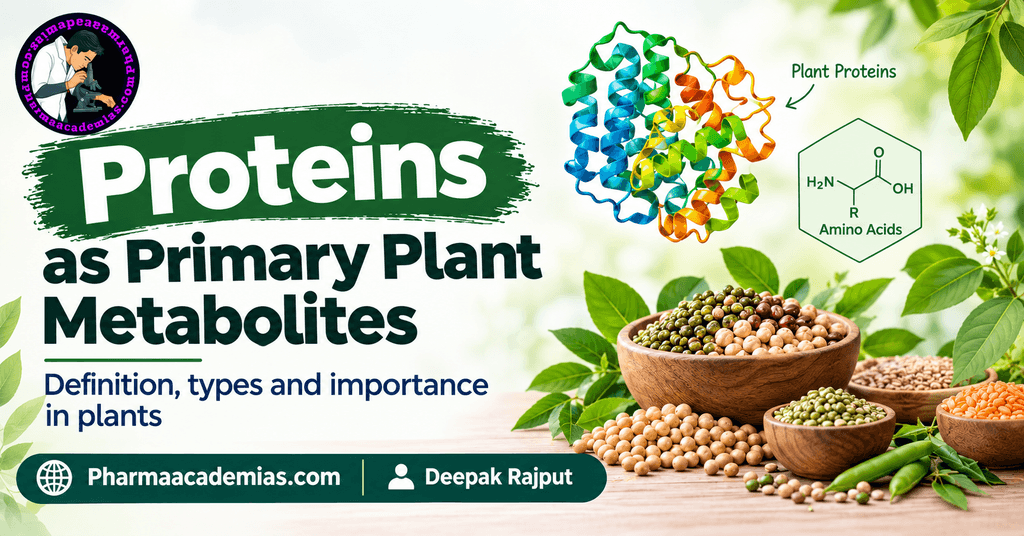
From a pharmaceutical and pharmacognostical point of view, proteins are important because they serve as structural materials, enzymes, storage substances, transport molecules, and biologically active compounds.
2. Definition of Proteins
Proteins are high-molecular-weight organic compounds composed of one or more chains of amino acids linked together by peptide bonds.
They mainly contain:
- Carbon (C)
- Hydrogen (H)
- Oxygen (O)
- Nitrogen (N)
Some proteins may also contain:
- Sulphur (S)
- Phosphorus (P)
- Other elements
The basic unit of a protein is an amino acid.
General structure of an amino acid
An amino acid generally contains:
NH₂ – CH(R) – COOH
where R represents the variable side chain.
Different amino acids have different R groups, which determine their individual properties.
3. Why Proteins are Primary Metabolites?
Proteins are classified as primary metabolites because they are directly involved in essential biological processes necessary for the growth, development, metabolism, and survival of plants.
Proteins perform many essential functions:
- Formation of plant tissues
- Catalysis of biochemical reactions
- Transport of substances
- Storage of nutrients
- Regulation of metabolism
- Defence against pathogens
- Cell signalling
- Growth and development
Therefore, proteins are fundamental components of the normal metabolism of plants.
4. Formation of Proteins in Plants
Plants obtain nitrogen mainly from the soil, usually in the form of nitrate and ammonium ions. Nitrogen is incorporated into amino acids, which are then used for protein synthesis.
The simplified sequence is:
Nitrogen sources → Amino acids → Peptides → Proteins
Protein synthesis takes place mainly on ribosomes.
The genetic information present in DNA is transcribed into RNA, and the RNA provides the instructions for assembling amino acids in the correct sequence.
5. Amino Acids – Building Blocks of Proteins
Proteins are made up of amino acids. Plants can synthesize many amino acids through their metabolic pathways. Some amino acids are also important intermediates in the synthesis of other plant constituents.
Examples of amino acids include:
- Glycine
- Alanine
- Valine
- Leucine
- Isoleucine
- Serine
- Threonine
- Aspartic acid
- Glutamic acid
- Lysine
- Methionine
- Phenylalanine
- Tyrosine
- Tryptophan
The specific sequence and number of amino acids determine the structure and function of a protein.
6. Structure of Proteins
Protein structure can be described at four levels.
A. Primary Structure: The primary structure is the specific sequence of amino acids in a protein chain.
Example:
Amino acid 1 → Amino acid 2 → Amino acid 3 → Amino acid 4
The amino acids are joined by peptide bonds.
B. Secondary Structure
The polypeptide chain folds into regular structures such as:
- α-helix
- β-pleated sheet
These structures are stabilized mainly by hydrogen bonds.
C. Tertiary Structure:
The tertiary structure is the three-dimensional folding of a single polypeptide chain.Various interactions between amino acid side chains help maintain this structure.
D. Quaternary Structure:
Some proteins consist of two or more polypeptide chains. The arrangement of these individual chains is called the quaternary structure.
7. Classification of Plant Proteins
Plant proteins can be classified in different ways. Based on their composition and solubility, some important groups are:
1. Albumins: Albumins are generally water-soluble proteins.They are commonly found in seeds and other plant tissues.
2. Globulins: Globulins are generally soluble in dilute salt solutions.They are important storage proteins in many seeds.
3. Prolamins: Prolamins are generally soluble in dilute alcohol.
Examples include:
- Zein – maize
- Gliadin – wheat
4. Glutelins: Glutelins are generally soluble in dilute acids or alkalis.They are important storage proteins in cereal grains.
8. Major Functions of Proteins in Plants
8.1 Structural Function: Proteins contribute to the structure of cells and tissues.
They are involved in the formation and maintenance of:
- Cell structures
- Cell membranes
- Cytoskeleton
- Various cellular components
8.2 Enzymatic Function: Many enzymes are proteins. Enzymes act as biological catalysts and increase the rate of biochemical reactions without being consumed in the reaction.
Examples of plant enzymes include:
- Amylase
- Protease
- Lipase
- Peroxidase
- Catalase
These enzymes participate in processes such as carbohydrate, protein, and lipid metabolism.
8.3 Storage Function: Some proteins act as storage proteins, particularly in seeds.They provide nitrogen and amino acids to the developing plant embryo during germination.
Examples:
- Zein – maize
- Gliadin – wheat
- Glutenin – wheat
- Legumin – legumes
8.4 Transport Function: Certain proteins help transport substances across plant cells and membranes.
Transport proteins are involved in the movement of:
- Ions
- Sugars
- Amino acids
- Water
- Other molecules
8.5 Regulatory Function: Some proteins regulate important physiological processes.
They may participate in:
- Cell growth
- Cell division
- Development
- Metabolic regulation
- Signal transmission
8.6 Defence Function
Plants produce certain proteins that help protect them against:
- Insects
- Fungi
- Bacteria
- Viruses
- Other pathogens
Examples include pathogenesis-related proteins and proteinase inhibitors.
Thus, proteins are important components of the plant’s natural defence system.
9. Proteins and Enzymes
One of the most important roles of proteins in plants is their function as enzymes. Enzymes control almost every major biochemical reaction occurring inside plant cells.
For example:
Starch → Glucose
This conversion involves enzymes such as amylases.
Similarly, proteins and enzymes participate in:
- Photosynthesis
- Respiration
- Glycolysis
- Protein synthesis
- Lipid metabolism
- Secondary metabolite formation
Therefore, proteins are directly connected with almost every aspect of plant metabolism.
10. Distribution of Proteins in Plants
Proteins are found throughout the plant.
They are particularly abundant in:
- Seeds
- Fruits
- Leaves
- Roots
- Embryos
- Storage tissues
Seeds
Seeds are particularly rich in storage proteins because these proteins provide nutrients to the developing embryo during germination.
11. Pharmaceutical Importance of Plant Proteins
Plant proteins are important in pharmaceutical sciences for several reasons.
1. Nutritional importance: Plant proteins provide essential amino acids and are important sources of nutrition.
Examples include proteins from:
- Soybean
- Pea
- Pulses
- Cereals
2. Enzymes: Several plant-derived enzymes have pharmaceutical and industrial applications.
Examples include:
- Papain
- Bromelain
Papain: Papain is a proteolytic enzyme obtained from papaya latex.It has applications in pharmaceutical and biotechnology-related processes.
Bromelain: Bromelain is a group of proteolytic enzymes obtained mainly from pineapple.It has been investigated and used in various pharmaceutical and therapeutic applications.
3. Vaccine and biotechnology research: Plant systems can be used for the production of certain recombinant proteins and biologically active molecules.
4. Pharmaceutical excipients and formulations: Some plant-derived proteins and protein-containing materials can have applications in pharmaceutical formulations and biotechnology.
12. Factors Affecting Protein Content in Plants
The amount and composition of proteins in plants can be influenced by several factors.
Genetic factors: Different plant species and varieties have different protein compositions.
Soil nitrogen: Availability of nitrogen strongly influences protein synthesis.
Plant age: Protein content may change during different stages of plant growth.
Environmental conditions
Factors such as:
- Temperature
- Water availability
- Light
- Soil conditions
can influence protein production.
Plant part: Seeds, leaves, roots, and other tissues may contain different amounts and types of proteins.
13. Important Examples of Plant Proteins
| Protein | Plant source | Importance |
| Zein | Maize | Storage protein |
| Gliadin | Wheat | Storage protein |
| Glutenin | Wheat | Storage protein |
| Legumin | Legumes | Storage protein |
| Albumins | Various seeds | Storage/nutritional role |
| Papain | Papaya | Proteolytic enzyme |
| Bromelain | Pineapple | Proteolytic enzyme |
14. Proteins as Primary Metabolites – Key Points
- Proteins are important primary metabolites of plants.
- They are made up of amino acids linked by peptide bonds.
- They mainly contain C, H, O, and N, and may also contain sulphur and other elements.
- Plants synthesize proteins using amino acids and genetic information.
- Many proteins function as enzymes.
- They are involved in growth, development, metabolism, transport, storage, regulation, and defence.
- Storage proteins are particularly abundant in seeds.
- Plant proteins are also important sources of nutritional and pharmaceutical substances.
- Important plant-derived proteins and enzymes include papain, bromelain, zein, gliadin, and legumin.
Conclusion
Proteins are essential primary plant metabolites because they are directly involved in almost every fundamental biological process of plants. They serve as structural components, enzymes, storage materials, transport molecules, regulatory molecules, and defence substances. Their synthesis depends largely on the availability of amino acids and nitrogen, while their structure determines their specific biological function.
From a pharmaceutical perspective, plant proteins are important as nutritional substances, enzymes, therapeutic research materials, and sources of biologically active compounds. Thus, proteins form an essential part of the primary metabolism of plants and play a central role in maintaining their normal growth and physiological functions.
Editorial Note
This article has been carefully researched and written by Deepak Rajput with a focus on accuracy, clarity, and evidence-based healthcare information. Pharmaacademias.com