Preparation and Standardization of Titrants: In volumetric analysis, the accuracy of titration depends mainly on the titrant used. A titrant is a solution of accurately known concentration that is added from a burette to react with another solution (analyte). Since many laboratory chemicals are not pure enough to prepare an exact concentration directly, they must be prepared approximately and then standardized against a primary standard substance. Pharmaacademias.com
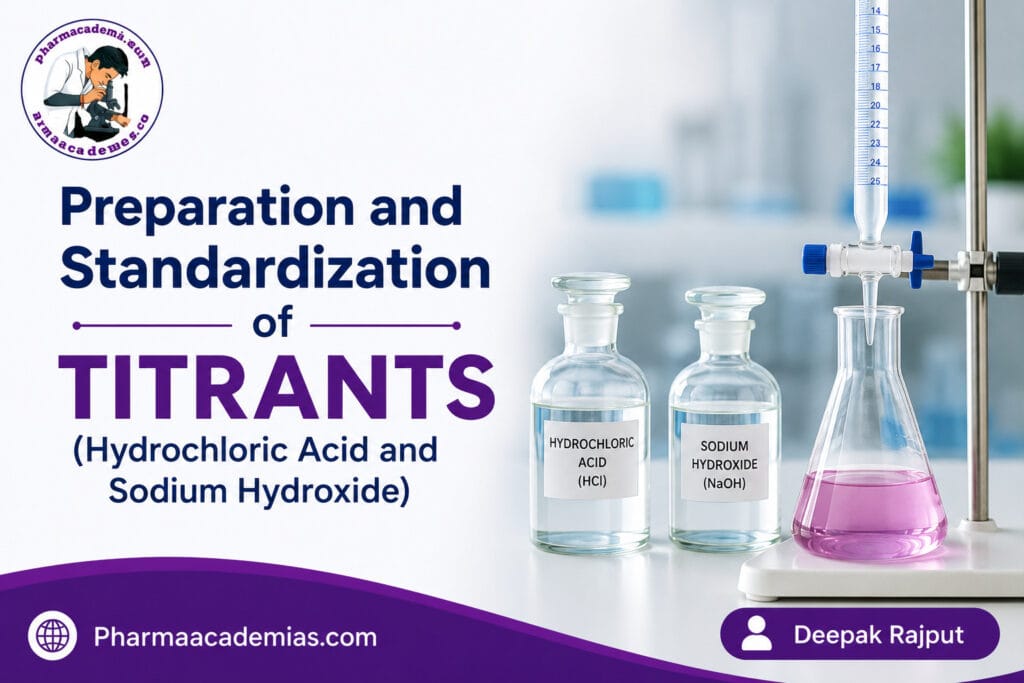
Among the most commonly used titrants in acid-base titrations are Hydrochloric Acid (HCl) and Sodium Hydroxide (NaOH). These solutions are known as secondary standard solutions because their exact concentration cannot be obtained simply by weighing and dissolving the reagent. Instead, they are standardized using highly pure and stable primary standards.
Standardization is essential because it ensures accurate analytical results, minimizes experimental errors, and provides reliable concentration values for use in pharmaceutical analysis, quality control, and research laboratories.
What is a Titrant?
A titrant is a standard solution of known concentration that is added slowly from a burette during a titration until the reaction with the analyte is complete.
Examples include:
- Hydrochloric acid (HCl)
- Sodium hydroxide (NaOH)
- Sulfuric acid (H₂SO₄)
- Potassium permanganate (KMnO₄)
What is Standardization?
Standardization is the process of determining the exact concentration (normality or molarity) of a prepared solution by titrating it against a primary standard.
A primary standard is a highly pure, stable, non-hygroscopic compound with a known composition that can be weighed accurately.
Difference Between Preparation and Standardization
| Preparation | Standardization |
| Making the solution of approximate concentration. | Determining the exact concentration of the prepared solution. |
| Done by dilution or dissolving chemicals. | Done by titration against a primary standard. |
| Approximate strength is obtained. | Exact strength is obtained. |
Preparation and Standardization of Hydrochloric Acid (HCl)
Hydrochloric acid is one of the most commonly used acid titrants in pharmaceutical analysis. Since concentrated hydrochloric acid is volatile and its concentration may vary over time, it cannot be used as a primary standard. Therefore, it is prepared approximately and then standardized.
Preparation of 0.1 N Hydrochloric Acid
Principle: Commercial concentrated hydrochloric acid contains about 35–37% HCl with a specific gravity of approximately 1.18. A calculated volume is diluted with distilled water to prepare an approximately 0.1 N solution.
Materials Required
- Concentrated Hydrochloric Acid
- Distilled Water
- Measuring Cylinder
- Volumetric Flask (1000 mL)
- Funnel
- Glass Rod
Procedure
- Take about 8.5 mL of concentrated hydrochloric acid.
- Add the acid slowly to about 500 mL of distilled water (never add water to acid).
- Mix carefully and allow the solution to cool if it becomes warm.
- Transfer the solution to a 1000 mL volumetric flask.
- Make up the volume to 1000 mL with distilled water.
- Mix thoroughly.
- Label the bottle as Approximately 0.1 N Hydrochloric Acid.
Standardization of Hydrochloric Acid
Primary Standard Used: Anhydrous Sodium Carbonate (Na₂CO₃)
Why Sodium Carbonate?
Sodium carbonate is used because it is:
- Highly pure
- Stable
- Non-hygroscopic
- Easily dried
- High molecular weight
- Reacts completely with HCl
Reaction
Na₂CO₃ + 2HCl → 2NaCl + CO₂ + H₂O
Indicator: Methyl Orange
Colour Change
- Yellow → Orange/Red
Procedure
- Dry sodium carbonate at 250°C and cool in a desiccator.
- Accurately weigh about 0.25 g sodium carbonate.
- Dissolve in distilled water.
- Transfer to a conical flask.
- Add 2–3 drops of methyl orange indicator.
- Fill the burette with prepared HCl.
- Titrate until the colour changes from yellow to orange-red.
- Repeat until concordant readings are obtained.
Calculation
Using the normality equation:
N₁V₁ = N₂V₂
Where:
- N₁ = Normality of HCl
- V₁ = Volume of HCl used
- N₂ = Normality of Sodium Carbonate
- V₂ = Volume of Sodium Carbonate solution
The calculated value gives the exact normality of hydrochloric acid.
Storage of Hydrochloric Acid
- Store in tightly closed glass bottles.
- Keep away from sunlight.
- Avoid contamination.
- Label with concentration and preparation date.
Preparation and Standardization of Sodium Hydroxide (NaOH)
Sodium hydroxide is the most commonly used alkaline titrant in pharmaceutical analysis. Pure sodium hydroxide cannot be weighed accurately because it absorbs moisture and carbon dioxide from the atmosphere. Therefore, it is always considered a secondary standard solution and must be standardized before use.
Preparation of 0.1 N Sodium Hydroxide
Principle: Approximately 4 g of sodium hydroxide pellets are dissolved in recently boiled and cooled distilled water and diluted to 1000 mL.
Freshly boiled water is used because it contains very little dissolved carbon dioxide.
Materials Required
- Sodium Hydroxide Pellets
- Distilled Water
- Volumetric Flask
- Funnel
- Glass Rod
Procedure
- Weigh about 4 g sodium hydroxide pellets quickly.
- Dissolve in about 500 mL freshly boiled and cooled distilled water.
- Transfer to a 1000 mL volumetric flask.
- Make up to volume with distilled water.
- Mix thoroughly.
- Store in a tightly closed polyethylene bottle.
- Label as Approximately 0.1 N Sodium Hydroxide.
Standardization of Sodium Hydroxide
Primary Standard Used: Potassium Hydrogen Phthalate (KHP)
Chemical Formula: KHC₈H₄O₄
Why KHP is Used?
KHP is:
- Highly pure
- Stable
- Non-hygroscopic
- High molecular weight
- Easy to dry
- Reacts completely with NaOH
Reaction
KHC₈H₄O₄ + NaOH → KNaC₈H₄O₄ + H₂O
Indicator: Phenolphthalein
Colour Change
- Colourless → Permanent Pale Pink
Procedure
- Dry KHP if required.
- Accurately weigh about 0.4–0.5 g KHP.
- Dissolve in distilled water.
- Add 2–3 drops of phenolphthalein indicator.
- Fill the burette with prepared NaOH.
- Titrate until a permanent pale pink colour appears and persists for about 30 seconds.
- Repeat until concordant readings are obtained.
Calculation
Use the equation:
N₁V₁ = N₂V₂
Where:
- N₁ = Normality of NaOH
- V₁ = Volume of NaOH
- N₂ = Normality of KHP
- V₂ = Volume of KHP solution
The result gives the exact normality of sodium hydroxide.
Storage of Sodium Hydroxide
- Store in airtight polyethylene bottles.
- Protect from carbon dioxide and moisture.
- Avoid prolonged exposure to air.
- Standardize periodically because the concentration may change over time.
Comparison Between HCl and NaOH Standardization
| Parameter | Hydrochloric Acid | Sodium Hydroxide |
| Type | Acid | Base |
| Nature | Secondary Standard | Secondary Standard |
| Primary Standard | Sodium Carbonate | Potassium Hydrogen Phthalate (KHP) |
| Indicator | Methyl Orange | Phenolphthalein |
| Colour Change | Yellow → Orange/Red | Colourless → Pale Pink |
| Reaction Type | Acid with Carbonate | Base with Weak Acid Salt |
| Storage | Glass Bottle | Polyethylene Bottle |
Precautions
- Always use clean glassware.
- Use freshly prepared indicators.
- Read the burette at eye level to avoid parallax error.
- Remove air bubbles from the burette tip before titration.
- Add the titrant slowly near the end point.
- Wash the walls of the conical flask with distilled water during titration.
- Perform at least three concordant titrations and calculate the average titre value.
- Always add acid to water, never water to concentrated acid.
- Store sodium hydroxide in airtight containers to prevent absorption of moisture and carbon dioxide.
Applications
The preparation and standardization of hydrochloric acid and sodium hydroxide are essential in:
- Pharmaceutical quality control laboratories.
- Assay of pharmaceutical substances according to pharmacopoeial methods.
- Preparation of standard solutions for acid–base titrations.
- Food and beverage analysis.
- Water quality testing.
- Chemical manufacturing.
- Research and academic laboratories.
- Clinical and environmental analytical laboratories.
Conclusion
Hydrochloric acid and sodium hydroxide are among the most widely used titrants in analytical chemistry and pharmaceutical analysis. Because neither reagent qualifies as a primary standard, each must first be prepared to an approximate concentration and then standardized against a suitable primary standard. Hydrochloric acid is commonly standardized using anhydrous sodium carbonate with methyl orange as the indicator, while sodium hydroxide is standardized using potassium hydrogen phthalate (KHP) with phenolphthalein as the indicator. Proper preparation, careful standardization, correct storage, and adherence to good laboratory practices ensure accurate, precise, and reproducible titration results, making these solutions indispensable in routine pharmaceutical analysis and quality control.
Editorial Note
This article has been carefully researched and written by Deepak Rajput with a focus on accuracy, clarity, and evidence-based healthcare information.