
Theories of acid base indicators: Acid–base titration is one of the most common and important methods used in volumetric analysis. It is an analytical technique used to determine the unknown concentration or strength of an acid or a base by reacting it with another solution of known concentration (called the standard solution). Pharmaacademias.com

The principle of acid–base titration is based on the neutralization reaction, in which an acid reacts with a base to form salt and water. The reaction continues until the acid and base have reacted completely. This point is called the equivalence point. To know when the reaction is complete, an acid–base indicator is used, which changes its color near the end of the titration.
Acid–base titrations are widely used in pharmaceutical industries, hospitals, food industries, chemical laboratories, water quality testing, environmental monitoring, and research laboratories to determine the purity and concentration of acidic and basic substances.
Principle of Acid–Base Titration
The principle of acid–base titration is based on the neutralization reaction.
When an acid reacts with a base, hydrogen ions (H⁺) from the acid combine with hydroxide ions (OH⁻) from the base to form water.
General Reaction:
Acid + Base → Salt + Water
Example: HCl + NaOH → NaCl + H₂O
At the equivalence point:
- Number of H⁺ ions = Number of OH⁻ ions
- Neutralization is complete.
- The amount of acid equals the amount of base according to the balanced chemical equation.
Important Terms
1. Titrant
The solution of known concentration that is added from the burette.
Example:
- 0.1 N Sodium hydroxide (NaOH)
- 0.1 N Hydrochloric acid (HCl)
2. Analyte
The solution of unknown concentration placed in the conical flask.
3. Indicator
A chemical substance that changes color near the end point of the titration.
Examples:
- Phenolphthalein
- Methyl Orange
- Methyl Red
- Bromothymol Blue
4. End Point
The point at which the indicator changes color.
It indicates that the titration is complete.
5. Equivalence Point
The theoretical point where the exact amount of acid has reacted completely with the base.
Ideally,
End Point ≈ Equivalence Point
Acid–Base Indicators
Acid–base indicators are weak organic acids or weak organic bases that show different colors in acidic and alkaline solutions.
They help us identify the completion of the titration by changing color within a certain pH range.
Theories of Acid–Base Indicators
There are two main theories explaining the working of acid–base indicators.
1. Ostwald’s Theory (Ionization Theory of Indicators)
Ostwald proposed that acid–base indicators are weak acids or weak bases.
The unionized form and the ionized form of the indicator have different colors.
For Acidic Indicators
The indicator exists as:
HIn ⇌ H⁺ + In⁻
Where,
- HIn = Unionized indicator (one color)
- In⁻ = Ionized indicator (another color)
In acidic solution:
- High concentration of H⁺ ions suppresses ionization.
- Indicator remains mainly as HIn.
- One color is observed.
In alkaline solution:
- OH⁻ ions remove H⁺ ions.
- Ionization increases.
- More In⁻ is formed.
- Another color appears.
Example: Phenolphthalein
HIn (Colorless) ⇌ H⁺ + In⁻ (Pink)
- In acidic medium → Colorless
- In alkaline medium → Pink
Example: Methyl Orange
HIn (Red) ⇌ H⁺ + In⁻ (Yellow)
- Acidic solution → Red
- Alkaline solution → Yellow
Advantages of Ostwald Theory
- Simple explanation.
- Explains color change based on ionization.
- Applicable to most common indicators.
Limitations
- Cannot explain indicators that change color due to structural changes.
- Does not explain behavior in non-aqueous solvents.
- Cannot explain all organic indicators.
2. Quinonoid Theory
The Quinonoid Theory explains color change based on the change in molecular structure.
According to this theory, indicators exist in two structural forms:
- Benzenoid Form
- Quinonoid Form
These two structures have different colors.
Depending on the pH of the solution, the indicator changes from one form to another.
Example: Phenolphthalein
In acidic solution:
- Exists in benzenoid form
- Colorless
In alkaline solution:
- Converts into quinonoid form
- Pink
Thus, the structural change causes the color change.
Advantages
- Explains structural changes.
- Better explanation for many indicators.
- Explains indicators not covered by Ostwald theory.
Limitations
- Cannot explain every indicator.
- Some indicators do not show clear benzenoid and quinonoid forms.
Comparison of Ostwald Theory and Quinonoid Theory
| Feature | Ostwald Theory | Quinonoid Theory |
| Based on | Ionization | Structural change |
| Indicator type | Weak acid/base | Organic compound |
| Color change due to | Ionized and unionized forms | Benzenoid and quinonoid forms |
| Mechanism | Ionization | Molecular rearrangement |
| Suitable for | Many indicators | Structural indicators |
Classification of Acid–Base Titrations
Acid–base titrations are classified according to the strength of the acid and the base involved.
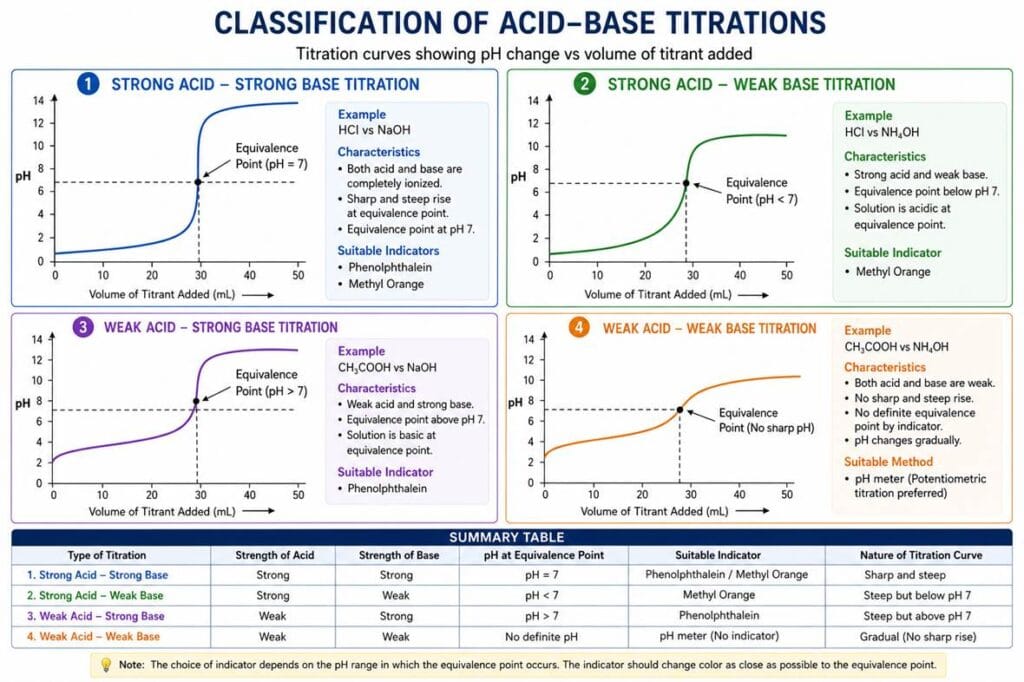
1. Strong Acid–Strong Base Titration
In this titration, both the acid and the base are completely ionized in water.
Examples:
- Hydrochloric acid (HCl)
- Sulfuric acid (H₂SO₄)
- Nitric acid (HNO₃)
Strong bases:
- Sodium hydroxide (NaOH)
- Potassium hydroxide (KOH)
Example Reaction
HCl + NaOH → NaCl + H₂O
Characteristics
- Very rapid reaction.
- Sharp end point.
- Equivalence point around pH 7.
- Many indicators can be used.
Suitable Indicators
- Phenolphthalein
- Methyl Orange
- Bromothymol Blue
2. Strong Acid–Weak Base Titration
A strong acid reacts with a weak base.
Examples
Strong acid:
- HCl
Weak base:
- Ammonium hydroxide (NH₄OH)
Reaction:
HCl + NH₄OH → NH₄Cl + H₂O
Characteristics
- Equivalence point is below pH 7.
- Solution becomes slightly acidic.
- Color change is less sharp than strong acid–strong base titration.
Suitable Indicator
Methyl Orange
Phenolphthalein is not suitable because the end point occurs in the acidic pH range.
3. Weak Acid–Strong Base Titration
A weak acid reacts with a strong base.
Examples
Weak acid:
- Acetic acid (CH₃COOH)
Strong base:
- Sodium hydroxide (NaOH)
Reaction:
CH₃COOH + NaOH → CH₃COONa + H₂O
Characteristics
- Equivalence point is above pH 7.
- Solution becomes slightly basic.
- Sharp end point.
Suitable Indicator: Phenolphthalein
Methyl Orange is not suitable because its color change occurs before the equivalence point.
4. Weak Acid–Weak Base Titration
Both acid and base are weak.
Example:
Acetic acid + Ammonium hydroxide
Reaction:
CH₃COOH + NH₄OH → CH₃COONH₄ + H₂O
Characteristics
- No sharp end point.
- Gradual pH change.
- Ordinary indicators are generally not reliable.
- Instrumental methods such as pH meter (potentiometric titration) are preferred.
Selection of Indicators
| Type of Titration | Suitable Indicator |
| Strong Acid – Strong Base | Phenolphthalein or Methyl Orange |
| Strong Acid – Weak Base | Methyl Orange |
| Weak Acid – Strong Base | Phenolphthalein |
| Weak Acid – Weak Base | pH meter (indicator generally not suitable) |
Applications of Acid–Base Titration
Acid–base titrations have many practical applications:
- Determination of the strength of acids and bases.
- Assay of pharmaceutical substances according to pharmacopoeial standards.
- Quality control of medicines.
- Analysis of antacids and other pharmaceutical formulations.
- Water quality testing, including acidity and alkalinity.
- Food industry analysis (e.g., acidity in beverages and dairy products).
- Environmental monitoring of water and soil samples.
- Chemical manufacturing and industrial process control.
- Educational laboratory experiments for teaching analytical chemistry.
Advantages
- Simple and easy to perform.
- Highly accurate when carried out correctly.
- Cost-effective.
- Rapid analysis.
- Requires only basic laboratory equipment.
- Suitable for routine quality control in pharmaceutical and chemical laboratories.
Limitations
- Requires a suitable indicator with an appropriate pH transition range.
- Weak acid–weak base titrations do not give a sharp end point with common indicators.
- Colored or turbid solutions can make end-point detection difficult.
- Results may be affected by improper standardization, contamination, or human error in observing the color change.
Conclusion
Acid–base titration is one of the most important analytical techniques used to determine the concentration and purity of acidic and basic substances. It works on the principle of neutralization, where acids react with bases to form salt and water. Acid–base indicators help identify the end point by changing color within a specific pH range. The behavior of these indicators is explained mainly by Ostwald’s Ionization Theory and the Quinonoid Theory. Depending on the strengths of the reacting acid and base, acid–base titrations are classified into strong acid–strong base, strong acid–weak base, weak acid–strong base, and weak acid–weak base titrations. Owing to their simplicity, accuracy, and wide range of applications, acid–base titrations remain indispensable in pharmaceutical analysis, quality control, research, environmental testing, and many industrial laboratories.
Editiorial note: This article has been carefully researched and written by Deepak Rajput with a focus on accuracy, clarity, and evidence-based healthcare information.