Glycosides as secondary plant metabolite: Glycosides are an important class of secondary metabolites of plant origin. They are widely distributed in medicinal plants and are particularly important in pharmacognosy because many glycosides possess significant therapeutic and pharmacological activities.
The name glycoside comes from the presence of a sugar part (glycone) attached to a non-sugar part (aglycone or genin).
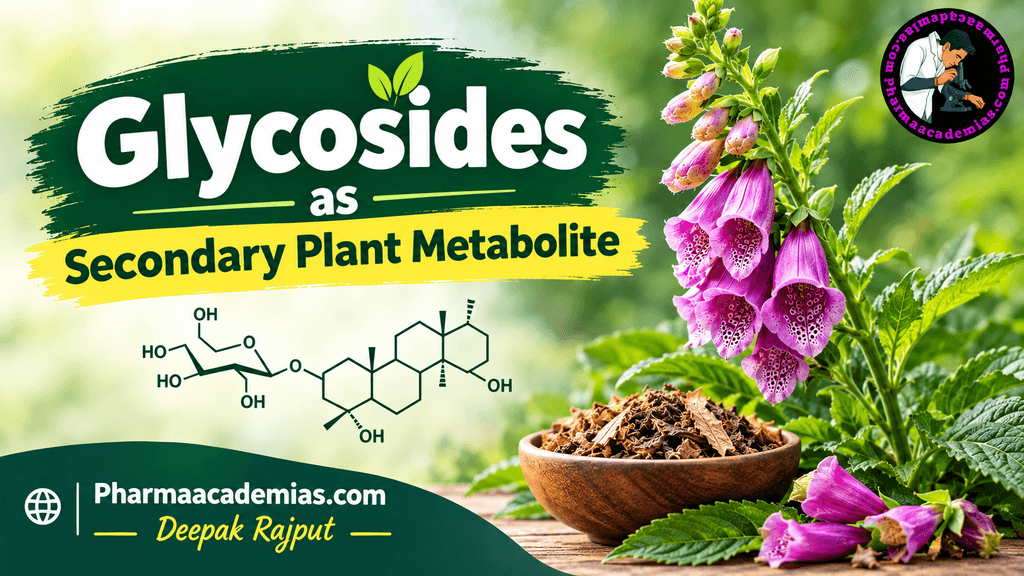
On hydrolysis, a glycoside generally gives:
Glycoside + Water → Sugar (Glycone) + Aglycone (Genin)
The sugar portion can influence the solubility, absorption, stability and transport of the compound, while the aglycone is often mainly responsible for the characteristic biological activity.
2. Definition of Glycosides
Glycosides are organic compounds in which a sugar moiety (glycone) is linked to a non-sugar moiety (aglycone or genin) through a glycosidic linkage.
Simple representation
Glycoside = Glycone + Aglycone
For example:
Digoxin → sugar part + steroidal aglycone
The sugar and aglycone are connected through a glycosidic bond.
3. Structure of a Glycoside
A typical glycoside consists of two major parts:
A. Glycone: The glycone is the sugar portion of the glycoside.
Common sugars include:
- Glucose
- Rhamnose
- Galactose
- Arabinose
- Xylose
The glycone can influence:
- Water solubility
- Transport within the plant
- Absorption
- Distribution
- Stability of the glycoside
B. Aglycone or Genin: The aglycone is the non-sugar portion.
It may belong to different chemical classes, such as:
- Steroids
- Anthraquinones
- Flavonoids
- Phenols
- Cyanogenic compounds
- Saponins
- Isothiocyanates
The aglycone generally determines the major pharmacological and chemical properties of the glycoside.
4. Glycosidic Linkage
The sugar and aglycone are joined through a glycosidic linkage.
Depending upon the atom through which the sugar is attached, glycosides may be classified as:
- O-glycosides
- C-glycosides
- N-glycosides
- S-glycosides
O-Glycosides: The sugar is attached through an oxygen atom. These are the most common type of glycosides found in medicinal plants.
C-Glycosides: The sugar is attached directly through a carbon-carbon bond.C-glycosides are generally more resistant to hydrolysis than O-glycosides.
S-Glycosides: The sugar is linked through sulfur.
Example: Sinigrin.
N-Glycosides: The sugar is linked through nitrogen.
5. Why Are Glycosides Considered Secondary Metabolites?
Glycosides are generally classified as secondary metabolites because they are not primarily responsible for basic processes such as:
- Photosynthesis
- Respiration
- Protein synthesis
- Basic cellular growth
Instead, they often participate in:
- Plant defense
- Protection from herbivores
- Interaction with microorganisms
- Storage or transport of bioactive compounds
- Ecological interactions
Many glycosides also have important medicinal properties and therefore are highly significant in pharmacognosy.
6. Classification of Glycosides
Glycosides can be classified according to the nature of the aglycone.
The major classes are:
- Anthraquinone glycosides
- Cardiac glycosides
- Saponin glycosides
- Cyanogenic glycosides
- Thioglycosides
- Flavonoid glycosides
- Phenolic glycosides
- Coumarin glycosides
7. Anthraquinone Glycosides
Anthraquinone glycosides contain an anthraquinone-type aglycone. They are particularly important because many have stimulant laxative activity.
Important examples
- Senna
- Aloe
- Cascara
8. Cardiac Glycosides
Cardiac glycosides contain a steroidal nucleus attached to a sugar portion and have an important action on the heart.
They are among the most pharmacologically important glycosides.
Examples
- Digoxin
- Digitoxin
- Ouabain
9. Saponin Glycosides
Saponins are glycosides containing a steroidal or triterpenoid aglycone. They are called saponins because their aqueous solutions can produce persistent foam, resembling soap.
Important properties
Saponins generally:
- Produce froth in water
- Are surface-active
- May cause hemolysis under appropriate conditions
- Have a bitter or acrid taste in many cases
Examples
- Diosgenin-containing steroidal saponins from Dioscorea
- Glycyrrhizin from liquorice
- Ginsenosides from Panax ginseng
Pharmaceutical importance
Saponins are used or investigated as:
- Expectorants
- Anti-inflammatory agents
- Surface-active agents
- Pharmaceutical intermediates
- Sources of steroidal sapogenins
10. Cyanogenic Glycosides
Cyanogenic glycosides are glycosides that can release hydrogen cyanide (HCN) when enzymatically hydrolyzed.
Important examples
- Amygdalin
- Linamarin
Important point
The plant stores the cyanogenic compound in a relatively inactive form. When plant tissue is damaged, enzymes can bring the components together and release hydrogen cyanide.
Significance
Hydrogen cyanide is highly toxic because it interferes with cellular respiration.
Therefore, cyanogenic plants can be toxic if improperly consumed.
11. Thioglycosides / Isothiocyanate Glycosides
These glycosides contain sulfur and are commonly associated with plants of the Brassicaceae family.
Example
Sinigrin
It occurs in plants such as black mustard.
On enzymatic hydrolysis, sinigrin can ultimately produce allyl isothiocyanate, which is responsible for the characteristic pungent smell and taste of mustard.
Importance
Isothiocyanates are responsible for:
- Pungency
- Irritant action
- Characteristic mustard odor
12. Flavonoid Glycosides
Flavonoid glycosides consist of a flavonoid aglycone attached to one or more sugar molecules.
Examples include glycosides of:
- Quercetin
- Rutin
- Hesperidin
Rutin
Rutin is a flavonoid glycoside found in several plants. It has been studied for its antioxidant and vascular-related properties.
13. Phenolic Glycosides
Phenolic glycosides contain a phenolic aglycone.
Example
Arbutin: Arbutin occurs in plants such as bearberry (Arctostaphylos uva-ursi). It has traditionally been associated with urinary tract preparations and hydrolyzes to release hydroquinone.
14. Coumarin Glycosides
These contain a coumarin nucleus attached to sugar.
Example
Aesculin: Aesculin is found in horse chestnut (Aesculus hippocastanum).
Coumarin glycosides are associated with various biological activities and are important constituents of several medicinal plants.
15. Important Glycosides and Their Sources
| Glycoside | Biological source | Major importance |
| Digoxin | Digitalis lanata | Cardiac glycoside |
| Digitoxin | Digitalis purpurea | Cardiac glycoside |
| Sennosides | Senna spp. | Stimulant laxative |
| Aloin | Aloe spp. | Anthraquinone-related laxative constituent |
| Glycyrrhizin | Glycyrrhiza glabra | Sweetening and medicinal applications |
| Amygdalin | Prunus species | Cyanogenic glycoside |
| Sinigrin | Brassica species | Pungent principle |
| Arbutin | Arctostaphylos uva-ursi | Urinary tract preparations |
| Rutin | Several plants | Flavonoid glycoside |
| Salicin | Salix species | Phenolic glycoside; analgesic-related historical importance |
| Ginsenosides | Panax ginseng | Saponin glycosides |
16. Hydrolysis of Glycosides
Hydrolysis is an important characteristic of many glycosides.
General reaction
Glycoside + H₂O → Glycone + Aglycone
Hydrolysis may occur by:
- Acids
- Enzymes
- Sometimes heat or other chemical conditions
Enzymatic hydrolysis
Plants often contain enzymes capable of hydrolyzing their own glycosides.
Examples include:
- β-glucosidase
- Myrosinase
This can be important in plant defense.
17. Enzymatic Hydrolysis and Plant Defense
This is an important concept.
In some plants, the glycoside and the enzyme responsible for its hydrolysis are stored in separate compartments.
18. Physical and Chemical Properties
1. Solubility: Many glycosides are more water-soluble than their corresponding aglycones because of the sugar portion.
2. Taste
Depending on the type, glycosides may be:
- Bitter
- Sweet
- Pungent
3. Hydrolysis: Many O-glycosides are susceptible to hydrolysis by acids or enzymes.
4. Crystalline nature: Many purified glycosides occur as crystalline substances.
5. Optical activity: Because sugar components are often optically active, many glycosides also show optical activity.
19. Biological Role of Glycosides in Plants
Glycosides perform several important functions in plants.
A. Plant defense: Some glycosides produce toxic or deterrent compounds when plant tissues are damaged.
B. Storage of active compounds: Glycosylation can convert a reactive aglycone into a more manageable storage form.
C. Transport: Sugar attachment can alter the polarity and movement of compounds within plant tissues.
D. Protection: Glycosylation can sometimes reduce the reactivity or toxicity of the aglycone and allow safer storage.
E. Ecological interactions: Glycosides can contribute to interactions between plants, insects, microorganisms and other organisms.
20. Pharmaceutical Importance of Glycosides
Glycosides are extremely important in pharmaceutical sciences.
1. Cardiac drugs: Digoxin and digitoxin are important cardiac glycosides.
2. Laxatives: Sennosides are widely recognized stimulant laxative constituents.Anthraquinone-related glycosides from plants such as senna have historically been important in treating constipation.
3. Expectorants: Some saponin-containing drugs have expectorant properties.
4. Anti-inflammatory and antioxidant applications
Several flavonoid glycosides have been studied for:
- Antioxidant activity
- Anti-inflammatory effects
- Vascular protective effects
5. Sweetening agents: Glycyrrhizin, obtained from liquorice, is intensely sweet and has pharmaceutical and food-related applications.
6. Drug discovery: Natural glycosides provide valuable chemical structures for developing new drugs and understanding plant-derived pharmacological activity.
21. Glycosides vs Alkaloids
| Feature | Glycosides | Alkaloids |
| Major structural feature | Sugar + aglycone | Nitrogen-containing structure |
| Nitrogen | Not necessarily present | Characteristic feature |
| General nature | Variable | Mostly basic |
| Taste | Variable | Usually bitter |
| Hydrolysis | Often gives sugar + aglycone | Not defined by sugar hydrolysis |
| Major examples | Digoxin, sennosides, glycyrrhizin | Morphine, quinine, atropine |
| Plant role | Defense, storage, transport, ecological functions | Mainly defense and ecological functions |
| Pharmaceutical activity | Cardiac, laxative, saponin, etc. | Analgesic, antimalarial, CNS, anticancer, etc. |
Conclusion
Glycosides are an important group of secondary plant metabolites composed of a sugar component (glycone) and a non-sugar component (aglycone/genin). They occur widely in medicinal plants and show diverse biological activities. Based on the aglycone, they include cardiac, anthraquinone, saponin, cyanogenic, thioglycoside, flavonoid, phenolic and coumarin glycosides.
Editorial Note
This article has been carefully researched and written by Deepak Rajput with a focus on accuracy, clarity, and evidence-based healthcare information. Pharmaacademias.com