Types of Communication in Healthcare: Communication in healthcare can be divided into different types depending on how many people are involved, how the information is shared, and the method used.
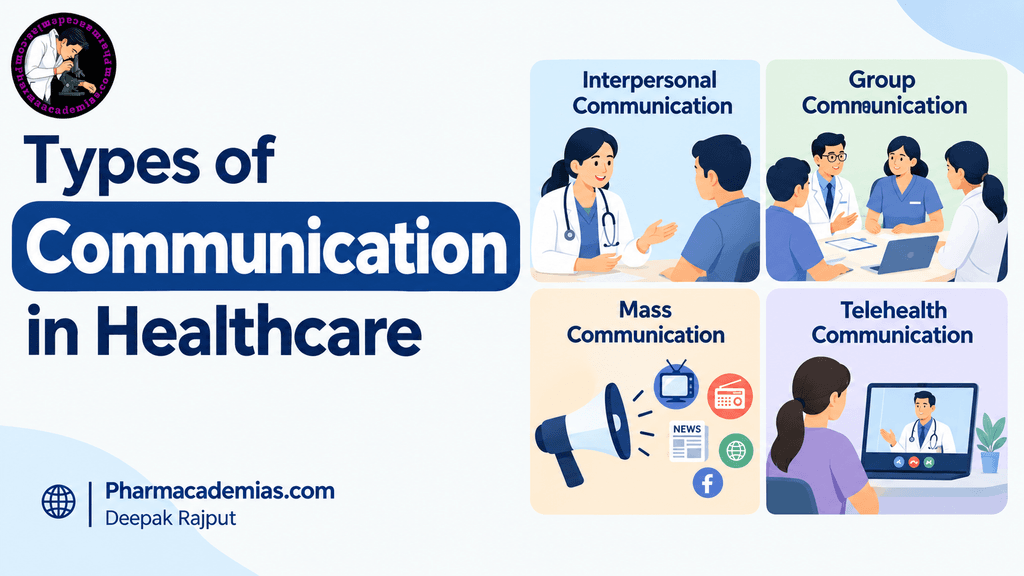
The four important types are:
- Interpersonal Communication
- Group Communication
- Mass Communication
- Telehealth Communication
Types of Communication in Healthcare
1. Interpersonal Communication
Interpersonal communication is the exchange of information between two or more individuals, usually involving direct interaction.
In healthcare, it commonly occurs between:
- Doctor and patient
- Pharmacist and patient
- Nurse and patient
- Doctor and pharmacist
- Healthcare professional and caregiver
Examples
- A pharmacist explains the dose and timing of a medicine to a patient.
- A doctor discusses the patient’s symptoms with them.
- A nurse explains a procedure to a patient.
Features
- Usually involves a small number of people.
- Allows immediate feedback.
- Can be verbal and non-verbal.
- Helps build trust and rapport.
- Allows questions and clarification.
- Can be personalized according to the patient’s needs.
Importance in Healthcare
Interpersonal communication is important for:
- Patient counselling
- Taking medical history
- Explaining treatment
- Understanding patient concerns
- Improving medication adherence
- Building patient confidence
Example
Pharmacist: “How are you taking this medicine?”
Patient: “I am taking it once daily.”
Pharmacist: “It should be taken twice daily.”
Here, the pharmacist can immediately correct the patient’s misunderstanding.
2. Group Communication
Group communication is communication that takes place among a group of people who interact with each other to share information, discuss problems, or achieve a common goal.
In healthcare, group communication may involve:
- Doctors
- Nurses
- Pharmacists
- Laboratory professionals
- Patients
- Students
- Healthcare teams
Examples
- A healthcare team discussing a patient’s treatment plan.
- A pharmacist conducting a health-awareness session for patients.
- A group of medical professionals discussing infection control.
- A classroom discussion among pharmacy students.
Features
- Involves more people than interpersonal communication.
- Members can exchange ideas and opinions.
- Feedback can come from several people.
- Requires good listening and coordination.
- Leadership may be required.
Importance in Healthcare
Group communication helps in:
- Teamwork
- Decision-making
- Case discussions
- Health education
- Problem-solving
- Sharing professional knowledge
- Coordinating patient care
Example
A doctor, pharmacist, nurse, and laboratory professional discuss a patient’s treatment and laboratory reports. Each professional provides relevant information.
3. Mass Communication
Mass communication is the process of communicating information to a large number of people, usually through mass media or digital platforms.
Common channels include:
- Television
- Radio
- Newspapers
- Websites
- Social media
- Posters
- Public announcements
- Online videos
Examples in Healthcare
- Government health campaign on vaccination.
- Television advertisement about oral hygiene.
- Newspaper article about disease prevention.
- Social media campaign about diabetes awareness.
- Website publishing information about medicines or health.
Features
- Reaches a large audience.
- Information is generally designed for the public.
- Usually less personalized.
- Can spread information quickly.
- Digital media can provide rapid feedback through comments, messages, etc.
Importance in Healthcare
Mass communication is useful for:
- Health education
- Disease awareness
- Public health campaigns
- Vaccination awareness
- Emergency health information
- Promoting healthy lifestyles
- Preventing the spread of misinformation
Example
During an infectious disease outbreak, health authorities use television, newspapers, websites, and social media to tell the public about symptoms, prevention, and when to seek medical help.
4. Telehealth Communication
Telehealth communication is the exchange of healthcare information using telecommunication and digital technologies when the healthcare professional and patient are not physically present at the same location.
It can include:
- Video consultation
- Telephone consultation
- Online messaging
- Remote monitoring
- Electronic communication
- Digital health platforms
Examples
- A doctor consults with a patient through a video call.
- A pharmacist provides medication counselling through a telephone call.
- A patient sends a medical report electronically to a healthcare professional.
- A healthcare professional monitors a patient’s health data remotely.
Features
- Uses digital or telecommunication technology.
- Healthcare professional and patient may be in different locations.
- Saves travel time.
- Can improve access to healthcare.
- Requires suitable technology and internet/telephone connectivity.
- Privacy and confidentiality must be maintained.
Importance in Healthcare
Telehealth communication helps to:
- Provide healthcare to people in remote areas.
- Reduce travel time.
- Provide follow-up consultations.
- Improve access to specialists.
- Support remote patient monitoring.
- Provide health counselling and education.
Limitations
- Poor internet connectivity
- Technical problems
- Difficulty in physical examination
- Privacy and confidentiality concerns
- Digital literacy problems
- Not suitable for every medical condition
Difference Between Types of Communication
| Type | Main Meaning | Example |
| Interpersonal | Communication between individuals | Pharmacist counselling a patient |
| Group | Communication among a group | Healthcare team discussing a patient |
| Mass | Communication with a large audience | TV health-awareness campaign |
| Telehealth | Healthcare communication using technology from a distance | Online doctor-patient consultation |
Easy Memory Trick
Remember:
I – G – M – T
I = Interpersonal → Individual interaction
G = Group → Group discussion
M = Mass → Massive audience
T = Telehealth → Technology + Healthcare
Exam Point
- Interpersonal: Best for personalized patient communication.
- Group: Best for teamwork and discussion.
- Mass: Best for public health education and awareness.
- Telehealth: Best for providing healthcare remotely using technology.
Editorial Note
This article has been carefully researched and written by Deepak Rajput with a focus on accuracy, clarity, and evidence-based healthcare information. Pharmaacademias.com