1. Definition of Suspension
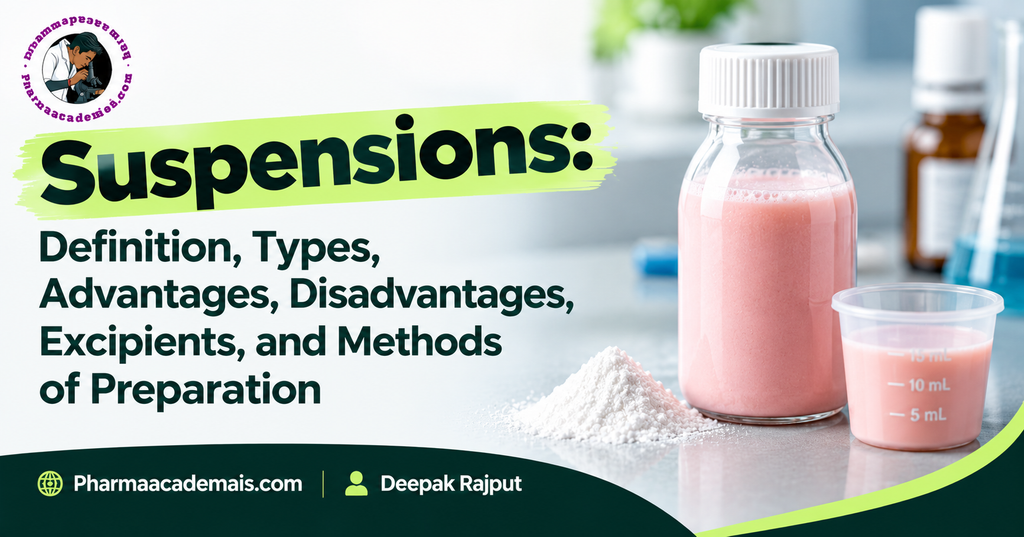
Suspensions: A suspension is a heterogeneous, biphasic liquid dosage form in which finely divided, insoluble solid particles are dispersed throughout a liquid medium called the dispersion medium or vehicle.
The solid particles constitute the dispersed phase, while the liquid constitutes the continuous phase.
Suspensions are used for oral, topical, ophthalmic, and certain other routes of administration, provided the formulation is specifically designed for that route.
Examples:
- Oral suspension: Amoxicillin suspension.
- Antacid suspension: Aluminium hydroxide and magnesium hydroxide suspension.
- Topical suspension: Calamine lotion.
- Ophthalmic suspension: Prednisolone acetate eye drops.
2. Types of Suspensions
Suspensions are classified according to the degree of aggregation of their particles into two main types:
- Flocculated suspensions
- Deflocculated suspensions
A. Flocculated Suspension
Definition: A flocculated suspension is a suspension in which solid particles form loose aggregates called flocs due to weak interparticle attraction.
Characteristics:
- Particles form loose clusters.
- Sedimentation occurs relatively rapidly.
- The sediment is loose and porous.
- The sediment is generally easy to redisperse.
- The supernatant liquid becomes clear relatively quickly.
B. Deflocculated Suspension
Definition: A deflocculated suspension is a suspension in which particles remain largely separate and do not form significant loose aggregates.
Characteristics:
- Particles remain individually dispersed.
- Sedimentation is generally slower.
- The supernatant may remain cloudy for longer.
- Sediment may become compact and form a hard cake.
- The sediment may be difficult to redisperse.
Difference Between Flocculated and Deflocculated Suspensions
| Feature | Flocculated suspension | Deflocculated suspension |
| Particle arrangement | Loose aggregates (flocs) | Mostly individual particles |
| Sedimentation rate | Relatively rapid | Relatively slow |
| Sediment volume | Usually larger | Usually smaller |
| Nature of sediment | Loose and porous | Compact and dense |
| Caking | Less likely | More likely |
| Redispersion | Usually easy | May be difficult |
| Supernatant | Clears relatively quickly | Remains cloudy longer |
| Physical stability | Easier redispersion, but rapid settling | Slower settling, but risk of hard caking |
Important point: A well-designed pharmaceutical suspension should remain sufficiently uniform during handling and should redisperse easily after settling. Controlled flocculation is often used to reduce the risk of irreversible caking.
3. Advantages of Suspensions
- Suitable for poorly water-soluble drugs: Drugs with low aqueous solubility can be formulated as suspensions.
- Improved palatability: Some unpleasant-tasting drugs may be more acceptable in suspended form than in solution.
- Flexible dosing: The dose can be adjusted by measuring different volumes, when permitted by the product instructions.
- Useful for children and elderly patients: Liquid preparations may be easier to swallow than tablets or capsules.
- Potential improvement in chemical stability: A drug that degrades rapidly in solution may be more stable when maintained in a suitable solid state.
- Different routes of administration: Suspensions can be designed for oral, topical, ophthalmic, and other appropriate routes.
- Possible prolonged action: Certain specially formulated injectable suspensions provide prolonged drug release.
4. Disadvantages of Suspensions
- Sedimentation: Solid particles may settle during storage.
- Risk of caking: Particles may form a hard sediment that is difficult to redisperse.
- Dose variation: Inadequate shaking can result in nonuniform dosing.
- Physical instability: Changes in particle size, aggregation, or sedimentation behaviour may occur.
- Bulkiness: Suspensions may require larger containers and more storage space than solid dosage forms.
- Manufacturing challenges: Particle size, viscosity, wetting, and sedimentation must be carefully controlled.
- Limited suitability for some routes: Special requirements apply to ophthalmic and injectable suspensions.
- Storage requirements: Some suspensions require specific storage conditions or reconstitution before use.
5. Formulation Excipients Used in Suspensions
Excipients are substances added to a formulation to improve its physical stability, palatability, manufacturability, and overall performance.
| Excipient category | Function | Examples |
| Vehicle | Provides the continuous liquid phase | Purified water, suitable oils |
| Wetting agents | Help the vehicle spread over solid particles | Polysorbates, glycerol |
| Suspending agents | Increase viscosity and slow particle settling | Sodium carboxymethylcellulose, xanthan gum |
| Flocculating agents | Promote controlled aggregation of particles | Suitable electrolytes, polymers, surfactants |
| Deflocculating agents | Help maintain particle separation | Suitable dispersants, depending on the formulation |
| Buffers | Maintain the required pH | Citrate or phosphate buffer systems |
| Preservatives | Control microbial growth where appropriate | Sodium benzoate, methylparaben |
| Sweetening agents | Improve taste | Sucrose, sorbitol |
| Flavouring agents | Improve palatability | Peppermint or fruit flavours |
| Colouring agents | Improve appearance or identification | Approved pharmaceutical colours |
| Antioxidants | Reduce oxidation of susceptible ingredients | Ascorbic acid, sodium metabisulfite |
| Density-adjusting agents | Help adjust the density of the vehicle when needed | Suitable soluble excipients |
The choice of excipients depends on the drug, route, pH, compatibility, and intended shelf life. Not every suspension requires every category listed above.
6. General Methods of Preparation of Suspensions
Two general approaches are commonly used: dispersion of insoluble particles and precipitation of the drug from a solution. In routine pharmaceutical compounding, the dispersion method is widely used.
Method 1: Dispersion Method
In this method, an insoluble solid drug is finely divided and dispersed in a suitable liquid vehicle.
Procedure:
- Weigh the ingredients: Accurately weigh the drug and required excipients.
- Reduce particle size: Triturate or mill the drug to achieve the required particle size.
- Wet the powder: Add a suitable wetting agent or a small quantity of vehicle to form a smooth paste.
- Prepare the vehicle: Dissolve or disperse the suspending agent and other soluble excipients in the vehicle.
- Incorporate the drug: Add the wetted drug gradually to the vehicle with continuous mixing.
- Mix thoroughly: Ensure uniform dispersion of the solid particles.
- Adjust the final volume: Add the remaining vehicle to obtain the required quantity.
- Homogenize if necessary: Use suitable equipment to improve uniformity and particle distribution.
- Package and label: Transfer to a suitable container and include instructions such as “Shake well before use” where appropriate.
Examples: Calamine lotion and many oral antacid suspensions.
Method 2: Precipitation Method
In this method, the drug is initially dissolved in a suitable solvent and then converted into fine solid particles by changing the solvent conditions or adding an appropriate precipitating agent.
Procedure:
- Dissolve the drug in a suitable solvent.
- Prepare the receiving vehicle containing the required excipients.
- Add the drug solution gradually to the receiving vehicle or introduce a suitable precipitating agent.
- Control mixing and other conditions to obtain particles of the desired size.
- Allow precipitation to occur under controlled conditions.
- Add suspending agents or other excipients as required.
- Adjust the final volume and mix thoroughly.
- Evaluate the particle size, uniformity, and physical stability.
Examples: Certain specially formulated suspensions prepared by controlled precipitation.
Method 3: Reconstitution Method
Some medicines are supplied as dry powders or granules because the drug is less stable in an aqueous vehicle during long-term storage.
Procedure:
- Supply the drug and excipients as a dry powder or granules.
- Before use, add the specified quantity of the recommended vehicle, usually water.
- Mix or shake according to the product instructions until uniformly dispersed.
- Allow any required standing time, then remix if instructed.
- Label with the storage conditions and period of use after reconstitution.
Example: Amoxicillin powder for oral suspension.
7. Evaluation of Suspensions
The following tests are used to assess suspension quality and stability.
1. Sedimentation Volume: Sedimentation volume indicates the volume occupied by the sediment compared with the original suspension volume.
F = Vu/Vo
Where:
- F = sedimentation volume
- Vu = final volume of sediment
- Vo = original total volume of suspension
Example:
If the original suspension volume is 100 mL and the sediment occupies 40 mL:
F = 40/100 = 0.4
Therefore, the sedimentation volume is 0.4, or 40%.
A larger sedimentation volume may indicate a more voluminous sediment, but it does not by itself prove overall stability or good redispersibility.
2. Degree of Flocculation: The degree of flocculation compares the sedimentation volume of a flocculated suspension with that of a corresponding deflocculated suspension.
Β = F/ F ∞
Where:
- β = degree of flocculation
- F = sedimentation volume of the flocculated suspension
- ∞ = sedimentation volume of the corresponding deflocculated suspension
A value greater than 1 indicates a larger sedimentation volume in the flocculated system under the comparison conditions.
3. Redispersibility: This test evaluates how easily the settled particles can be uniformly dispersed again by shaking or mixing.
4. Particle Size Analysis: Particle size is measured to ensure that the particles meet the required specifications and that excessive crystal growth or aggregation has not occurred.
5. Viscosity: Viscosity affects sedimentation, pouring, spreading, and ease of administration.
6. pH Measurement: The pH is checked to ensure drug stability, excipient compatibility, and suitability for the intended route.
7. Drug Content Uniformity: Samples are assessed to confirm that the drug is distributed uniformly throughout the preparation when properly mixed.
8. Microbial Quality: Microbial limits or sterility testing are applied as appropriate to the route and product requirements.
8. Important Precautions
- Use the appropriate particle size for the intended dosage form.
- Ensure proper wetting of hydrophobic powders.
- Select a suitable suspending agent and vehicle.
- Avoid excessive viscosity that makes pouring or administration difficult.
- Minimize the risk of irreversible caking.
- Ensure the preparation can be redispersed adequately.
- Use appropriate preservatives when needed.
- Label multidose suspensions with suitable shaking and storage instructions.
- For reconstituted medicines, follow the manufacturer’s specified vehicle, volume, storage conditions, and beyond-use period.
Conclusion
Suspensions are biphasic liquid dosage forms containing insoluble solid particles dispersed in a liquid vehicle. They are classified as flocculated or deflocculated according to the aggregation state of their particles. Their formulation commonly requires a vehicle, wetting agent, suspending agent, and other excipients selected according to the drug and route of administration.
The main aim of suspension formulation is to achieve acceptable physical stability, uniform dosing, ease of redispersion, and suitable patient acceptability.
References
- Aulton, M. E., and Taylor, K. M. G. Aulton’s Pharmaceutics: The Design and Manufacture of Medicines. Elsevier.
- Allen, L. V. Ansel’s Pharmaceutical Dosage Forms and Drug Delivery Systems. Wolters Kluwer.
- Remington: The Science and Practice of Pharmacy. Pharmaceutical Press.
- Indian Pharmacopoeia. Indian Pharmacopoeia Commission.
Editorial Note
This article has been carefully researched and written by Deepak Rajput with a focus on accuracy, clarity, and evidence-based healthcare information. Pharmaacademias.com