Pharmaceutical Liquid Dosage Forms for External Use: Liquid dosage forms are pharmaceutical preparations in which drugs are dissolved, suspended, or dispersed in a suitable liquid vehicle. They are used for application to the skin, mucous membranes, and body cavities, or for administration into specific body sites.
Liquid preparations for external use and body cavities include liniments, lotions, throat paints, applications, gargles, mouthwashes, enemas, eye drops, ear drops, nasal drops, and tinctures.
These preparations differ in their composition, method of administration, therapeutic purpose, and required quality standards.
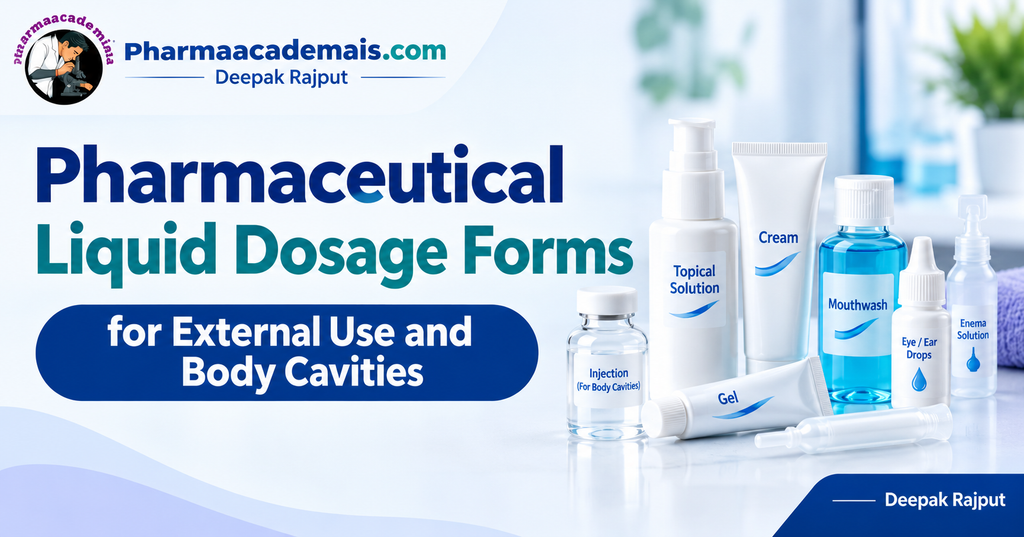
Pharmaceutical Liquid Dosage Forms for External Use
2. Liniments
Liniments are liquid or semiliquid pharmaceutical preparations intended for application to the skin with rubbing. They usually contain medicinal substances dissolved or dispersed in an alcoholic, oily, or emulsified vehicle.
Uses
- To relieve muscular pain and joint discomfort.
- To produce counterirritant or warming effects.
- To provide local analgesic or anti-inflammatory effects, depending on the ingredients.
- To improve the application of medicinal substances to the skin.
Method of preparation
- Weigh or measure all ingredients accurately.
- Dissolve alcohol-soluble ingredients in alcohol or another suitable solvent.
- Dissolve oil-soluble ingredients in the oil phase, when required.
- Combine the ingredients using the method appropriate to the formulation.
- For emulsified liniments, incorporate the oil and aqueous phases using a suitable emulsifying agent.
- Mix thoroughly to obtain a uniform preparation.
- Transfer into a suitable, well-closed container.
Examples
- Methyl salicylate liniment.
- Camphor liniment.
- Turpentine liniment.
Precaution: Liniments are intended for external application and must not be swallowed. They should not be applied to broken skin unless specifically indicated.
3. Lotions
Lotions are liquid preparations intended for external application to the skin without vigorous rubbing. They may be solutions, suspensions, or emulsions containing medicinal substances in a suitable vehicle.
Uses
- To soothe irritated skin.
- To relieve itching and inflammation.
- To protect the skin.
- To provide antiseptic, astringent, or soothing effects, depending on their composition.
Method of preparation
- Weigh the ingredients accurately.
- Dissolve water-soluble ingredients in purified water or another suitable vehicle.
- Dissolve other ingredients in an appropriate solvent if required.
- For suspensions, disperse insoluble particles uniformly using suitable wetting and suspending agents.
- For emulsions, combine the oil and aqueous phases using an appropriate emulsification method.
- Mix thoroughly and adjust to the final quantity.
- Package in a suitable container, with shaking instructions if necessary.
Examples
- Calamine lotion.
- Zinc oxide lotion.
- Benzyl benzoate lotion.
Precaution: Suspended lotions should be shaken before use when directed. Avoid contact with the eyes unless the product is specifically intended for ophthalmic use.
4. Throat Paints
Throat paints are viscous liquid preparations intended for application to the mucous membrane of the throat using a suitable applicator. They contain medicinal substances in a vehicle that helps the preparation remain in contact with the affected area.
Uses
- To provide local soothing effects.
- To deliver medicinal substances to the throat.
- To provide local antiseptic or other therapeutic effects when appropriate ingredients are included.
Method of preparation
- Accurately weigh the medicinal substances and excipients.
- Dissolve the soluble ingredients in a suitable vehicle, such as glycerol or a glycerol-based mixture.
- Incorporate other ingredients using a suitable solvent or dispersion method.
- Mix thoroughly until a uniform preparation is obtained.
- Adjust the final quantity and check the preparation for uniformity.
- Package in a suitable, well-closed container with an appropriate applicator.
Examples
- Compound glycerin-based throat paint formulations.
- Glycerol-based preparations containing locally acting medicinal ingredients.
Precaution: Only preparations specifically formulated for throat use should be applied to the throat. The ingredients and concentration must be suitable for the intended mucosal site.
5. Applications
Applications are liquid, semiliquid, or other topical pharmaceutical preparations applied directly to the skin or affected surface for a local therapeutic effect. The term describes the method of use rather than one specific pharmaceutical dosage form.
Uses
- To treat localized skin conditions.
- To provide antiseptic or soothing effects.
- To deliver topical medicinal agents.
- To protect or treat affected areas of the skin.
Method of preparation
The method depends on the formulation.
- Weigh the ingredients accurately.
- Dissolve soluble ingredients in a suitable vehicle.
- Disperse insoluble ingredients when required.
- Add any necessary stabilizers, preservatives, or other excipients.
- Mix until uniform.
- Transfer to an appropriate container and label for external use.
Examples
- Povidone-iodine topical solution.
- Hydrogen peroxide topical solution, where appropriate.
- Antiseptic topical preparations.
Precaution: Applications must be suitable for the intended site. A product intended for intact skin should not automatically be used on wounds, eyes, or mucous membranes.
6. Gargles
Gargles are aqueous solutions intended to be placed in the mouth and throat, where they are used to wash or treat the throat and are then expelled rather than swallowed.
Uses
- To cleanse the mouth and throat.
- To relieve throat irritation.
- To provide antiseptic or anti-inflammatory effects when appropriate ingredients are present.
- To help reduce unpleasant mouth odour in suitable formulations.
Method of preparation
- Weigh the ingredients accurately.
- Dissolve the soluble ingredients in purified water.
- Add flavouring agents, buffers, or other excipients if required.
- Mix thoroughly until a clear or appropriately uniform solution is obtained.
- Adjust to the required final volume.
- Package in a suitable container with directions for use and dilution, if necessary.
Examples
- Povidone-iodine gargle.
- Benzydamine gargle.
- Sodium chloride gargle.
Precaution: Gargles should generally be expelled after use unless the product instructions state otherwise. Follow the prescribed dilution and age-specific directions.
7. Mouthwashes
Mouthwashes are liquid preparations intended to rinse the oral cavity. They may contain antiseptic, deodorizing, astringent, or other ingredients to maintain oral hygiene or provide a specific therapeutic effect.
Uses
- To maintain oral hygiene.
- To reduce unpleasant breath.
- To help control oral microbial growth.
- To provide relief in certain oral conditions, depending on the active ingredients.
Method of preparation
- Weigh or measure the ingredients.
- Dissolve water-soluble ingredients in purified water.
- Dissolve poorly water-soluble ingredients using an appropriate solvent or solubilizing agent, if required.
- Add sweeteners, flavours, colours, and preservatives where appropriate.
- Mix thoroughly and adjust the final volume.
- Check the preparation for clarity, uniformity, and stability.
- Package in a suitable container with instructions for use.
Examples
- Chlorhexidine mouthwash.
- Cetylpyridinium chloride mouthwash.
- Sodium fluoride mouthwash.
Precaution: Mouthwashes should not be swallowed unless specifically formulated for ingestion. Some formulations require dilution before use.
8. Enemas
Enemas are liquid preparations introduced into the rectum through the anus for local or systemic effects, or to facilitate bowel evacuation.
Types
- Evacuant enemas: Used to promote bowel evacuation.
- Retention enemas: Retained in the rectum for a specified period to produce a local or systemic effect.
- Medicated enemas: Contain drugs for specific therapeutic purposes.
- Diagnostic enemas: Used in certain diagnostic procedures.
Uses
- To relieve constipation.
- To empty the bowel before selected medical procedures.
- To administer medicines rectally when indicated.
- To provide local treatment for certain rectal or colonic conditions.
Method of preparation
- Select the appropriate drug, vehicle, and concentration.
- Dissolve the soluble ingredients in a suitable vehicle or disperse them using an appropriate method.
- Adjust the pH, tonicity, and final volume as required by the formulation.
- Mix thoroughly to ensure uniformity.
- Verify the quality and compatibility of the ingredients.
- Fill into a suitable container or rectal delivery device.
- Apply the required microbial quality controls and packaging procedures.
Examples
- Sodium phosphate enema.
- Glycerin enema.
- Mesalazine retention enema.
Precautions: Enemas must be used according to the product instructions. Certain enemas, especially phosphate-containing products, can cause serious electrolyte disturbances in susceptible patients if used improperly.
9. Eye Drops
Eye drops are sterile liquid preparations intended for instillation into the conjunctival sac of the eye. They may be solutions, suspensions, or emulsions containing one or more active ingredients.
Uses
- To treat eye infections when an appropriate antimicrobial is prescribed.
- To reduce inflammation.
- To lower intraocular pressure in glaucoma.
- To lubricate the eye and relieve dryness.
Method of preparation
Ophthalmic preparations require specialized manufacturing controls.
- Select suitable ophthalmic-grade ingredients and a compatible vehicle.
- Dissolve the active ingredient or prepare a uniform dispersion.
- Adjust pH and tonicity as appropriate for the formulation.
- Use suitable filtration or sterilization procedures validated for the product.
- For suspensions, use an appropriate process that maintains particle quality and uniformity.
- Fill into suitable sterile containers under controlled conditions.
- Verify sterility, particulate quality, container integrity, and other applicable quality specifications.
Examples
- Timolol eye drops.
- Latanoprost eye drops.
- Artificial tears containing carboxymethylcellulose.
Precautions:
- Eye drops must be sterile.
- Avoid touching the dropper tip to the eye or other surfaces.
- Do not use a preparation beyond its specified period after opening.
- Never use a non-ophthalmic preparation in the eye.
10. Ear Drops
Ear drops are liquid pharmaceutical preparations intended for instillation into the external auditory canal. They may contain solutions or suspensions of medicinal substances in aqueous, oily, or other suitable vehicles.
Uses
- To soften impacted earwax.
- To treat selected external ear infections.
- To reduce pain or inflammation when suitable ingredients are included.
- To deliver medication locally into the external ear canal.
Method of preparation
- Select an appropriate vehicle based on the drug and intended use.
- Dissolve the active ingredients in the vehicle or disperse them uniformly.
- Add suitable stabilizers or other excipients if required.
- Mix thoroughly and adjust to the final quantity.
- Check the preparation for uniformity, stability, and applicable microbial quality requirements.
- Fill into a suitable dropper container.
- Label with the route of administration and relevant precautions.
Examples
- Carbamide peroxide ear drops.
- Ofloxacin ear drops.
- Acetic acid ear drops.
Precaution: Some ear preparations are unsuitable when the tympanic membrane is perforated or a ventilation tube is present. The product must be appropriate for the condition and the status of the eardrum.
11. Nasal Drops
Nasal drops are liquid preparations intended for instillation into the nasal cavity. They may be aqueous or oily solutions, suspensions, or other suitable liquid formulations.
Uses
- To relieve nasal congestion.
- To moisturize dry nasal passages.
- To treat allergic rhinitis.
- To deliver specific medicines locally into the nasal cavity.
Method of preparation
- Dissolve the active ingredient in a suitable vehicle or prepare a uniform dispersion.
- Adjust pH and tonicity when required.
- Add suitable buffers, stabilizers, or preservatives where appropriate.
- Mix thoroughly and adjust to the final volume.
- Verify clarity or uniformity, drug content, and applicable microbial quality requirements.
- Fill into a suitable dropper or dispensing container.
- Label with the dose, route, and storage instructions.
Examples
- Xylometazoline nasal drops.
- Saline nasal drops.
- Oxymetazoline nasal drops.
Precautions:
- Use the preparation only by the nasal route.
- Topical decongestants should generally be used for the recommended short duration because prolonged use can cause rebound congestion.
- Avoid sharing dispensing containers.
12. Tinctures
Tinctures are alcoholic or hydroalcoholic liquid preparations containing medicinal substances extracted from plant materials or, in some cases, prepared by dissolving chemical substances in a suitable alcoholic vehicle.
They may be intended for internal or external use, depending on the formulation.
Uses
- To extract and preserve suitable constituents from crude drugs.
- To provide concentrated liquid preparations of medicinal substances.
- To serve as ingredients in other pharmaceutical formulations.
- To provide local effects when formulated for external use.
Method of preparation
Tinctures may be prepared by maceration, percolation, or dissolution, depending on the starting material and pharmacopoeial formula.
1. Maceration method
- Reduce the crude drug to the specified particle size.
- Place it in a suitable closed vessel.
- Add the prescribed solvent or menstruum.
- Allow it to stand for the specified period, with occasional mixing.
- Separate the liquid extract by filtration or pressing.
- Clarify the liquid and adjust to the required volume or strength.
- Transfer into a suitable, well-closed container.
2. Percolation method
- Prepare and moisten the powdered crude drug with the specified solvent.
- Allow it to stand for the required time.
- Transfer the material into a suitable percolator.
- Pass the menstruum through the material at a controlled rate.
- Collect the percolate.
- Adjust the extract to the specified volume or strength.
- Clarify and package appropriately.
3. Dissolution method
- Accurately weigh the required chemical or medicinal substance.
- Dissolve it in the prescribed solvent.
- Add further solvent to make up the required volume.
- Mix thoroughly and filter if necessary.
- Package in a suitable container.
Examples
- Iodine tincture.
- Benzoin tincture.
- Calendula tincture.
Precaution: Tinctures may contain substantial amounts of alcohol. Their route of administration must be checked carefully, as external-use tinctures must not be swallowed.
13. Comparison Table
| Preparation | Intended site | Main purpose | Examples |
| Liniments | Skin | Pain relief and counterirritant effects | Methyl salicylate liniment |
| Lotions | Skin | Soothing and topical treatment | Calamine lotion |
| Throat paints | Throat mucosa | Local application and soothing | Glycerol-based throat paint |
| Applications | Skin or specified surface | Local therapeutic effect | Povidone-iodine topical solution |
| Gargles | Mouth and throat | Throat cleansing and treatment | Benzydamine gargle |
| Mouthwashes | Oral cavity | Oral hygiene | Chlorhexidine mouthwash |
| Enemas | Rectum | Bowel evacuation or drug delivery | Sodium phosphate enema |
| Eye drops | Eye | Ophthalmic treatment | Timolol eye drops |
| Ear drops | External ear canal | Earwax removal or local treatment | Carbamide peroxide drops |
| Nasal drops | Nasal cavity | Congestion relief or nasal treatment | Xylometazoline drops |
| Tinctures | Depends on formulation | Extraction or medicinal delivery | Iodine tincture |
14. Important General Precautions
- Use pharmaceutical-grade ingredients and suitable vehicles.
- Maintain the required concentration, pH, and physical stability.
- Follow appropriate microbial quality requirements for the intended route.
- Use sterile preparations for ophthalmic administration.
- Clearly label the intended route of administration.
- Use suitable packaging to protect the preparation from contamination, light, moisture, or evaporation.
- Provide appropriate storage, dosing, dilution, and expiry instructions.
- Do not assume that a preparation suitable for the skin is also suitable for the eyes, ears, nose, or other mucous membranes.
References
- Aulton, M. E., and Taylor, K. M. G. Aulton’s Pharmaceutics: The Design and Manufacture of Medicines. Elsevier.
- Allen, L. V. Ansel’s Pharmaceutical Dosage Forms and Drug Delivery Systems. Wolters Kluwer.
- Indian Pharmacopoeia. Indian Pharmacopoeia Commission.
- British Pharmacopoeia. British Pharmacopoeia Commission.
- Remington: The Science and Practice of Pharmacy. Pharmaceutical Press.
Editorial Note
This article has been carefully researched and written by Deepak Rajput with a focus on accuracy, clarity, and evidence-based healthcare information. Pharmaacademias.com