
Types of Bones: Bones are the hard, living organs that make up the skeletal system. They provide shape and support to the body, protect internal organs, store minerals such as calcium and phosphorus, and help in the production of blood cells inside the bone marrow. Although all bones perform similar basic functions, they differ in shape, size, and structure according to the role they perform in the body. Based on their shape, bones are classified into five main types: long bones, short bones, flat bones, irregular bones, and sesamoid bones. Pharmaacademias.com
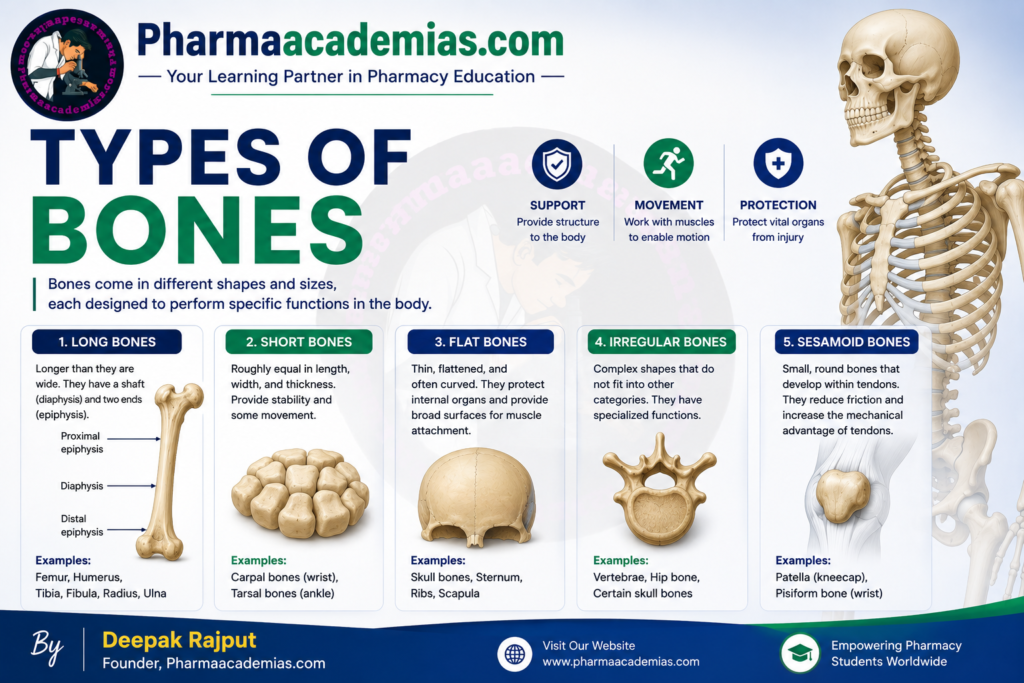
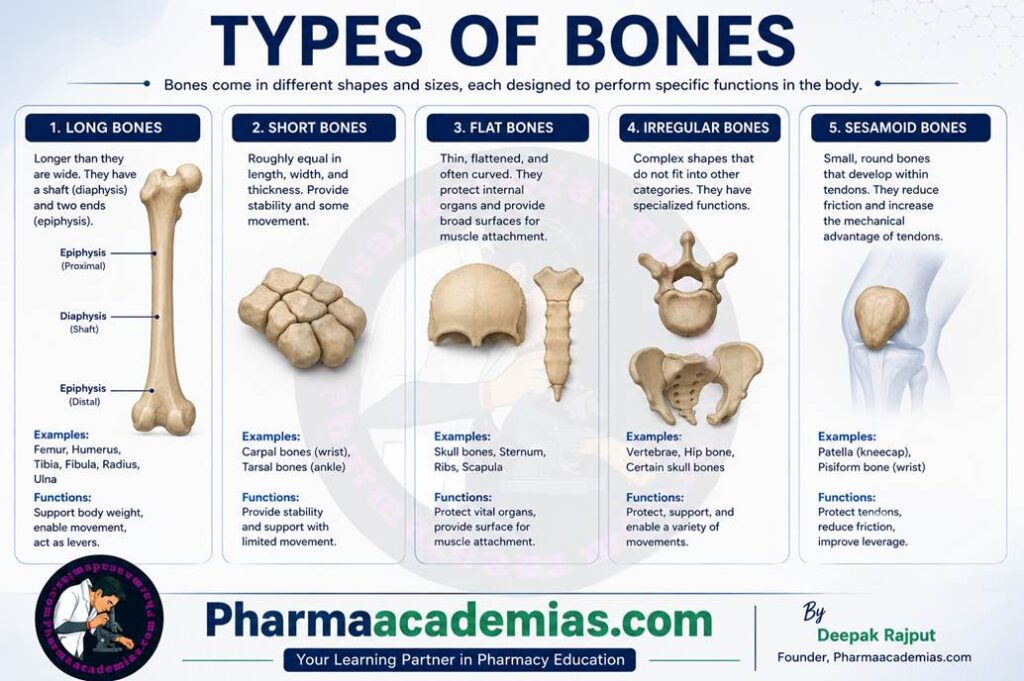
Types of Bones
1. Long Bones
Long bones are bones that are longer than they are wide. They have a cylindrical shaft called the diaphysis and enlarged ends known as the epiphyses. The shaft is mainly composed of compact bone, which provides strength, while the ends contain spongy bone that helps absorb stress during movement. The central cavity of the shaft, called the medullary cavity, contains bone marrow.
Long bones are primarily responsible for supporting body weight and facilitating movement. They act as levers when muscles contract, allowing activities such as walking, running, jumping, lifting, and throwing. These bones are among the strongest in the human body because they bear significant mechanical stress.
Common examples of long bones include the femur (thigh bone), tibia, fibula, humerus, radius, ulna, metacarpals, metatarsals, and phalanges (finger and toe bones). The femur is the longest and strongest bone in the human body.
2. Short Bones
Short bones are approximately equal in length, width, and thickness, giving them a cube-like shape. They are composed mainly of spongy bone surrounded by a thin layer of compact bone. This structure allows them to provide strength while maintaining flexibility.
The primary function of short bones is to provide stability and support with limited movement. They also help absorb shock during activities involving the hands and feet.
Examples of short bones include the carpal bones of the wrist and the tarsal bones of the ankle. These bones work together to distribute body weight evenly and allow controlled movements of the hands and feet.
3. Flat Bones
Flat bones are thin, flattened, and often slightly curved. They consist of two layers of compact bone with a layer of spongy bone sandwiched between them. This arrangement makes them both strong and lightweight.
The main function of flat bones is to protect delicate internal organs and provide broad surfaces for muscle attachment. Many important muscles involved in movement are attached to flat bones.
Examples of flat bones include the bones of the skull (cranial bones), sternum (breastbone), ribs, and scapula (shoulder blade). The skull protects the brain, while the ribs and sternum protect the heart and lungs.
4. Irregular Bones
Irregular bones have complex shapes that do not fit into the categories of long, short, or flat bones. Their unique structures are adapted to perform specialized functions in different parts of the body.
These bones provide support, protect nervous tissue, and offer numerous attachment points for muscles and ligaments. Because of their unusual shapes, irregular bones contribute to stability and flexibility in specific regions of the body.
Examples include the vertebrae of the spinal column, sacrum, coccyx, sphenoid bone, ethmoid bone, and many facial bones such as the mandible and maxilla.
5. Sesamoid Bones
Sesamoid bones are small, round bones that develop within tendons, especially where tendons pass over joints. Unlike other bones, they are embedded within connective tissue rather than directly connected to other bones.
Their primary function is to protect tendons from excessive wear and tear, reduce friction, and improve the mechanical efficiency of muscles by changing the angle at which tendons pull on bones.
The most well-known sesamoid bone is the patella (kneecap), which is also the largest sesamoid bone in the human body. Smaller sesamoid bones are also found in the hands and feet.
Additional Classification of Bones
Apart from classification based on shape, bones may also be grouped according to their internal structure.
Compact Bone
Compact bone, also called cortical bone, forms the hard outer layer of all bones. It is dense, strong, and capable of withstanding heavy loads. Compact bone provides structural support and protection while resisting bending and compression.
Spongy Bone
Spongy bone, also known as cancellous or trabecular bone, is found mainly at the ends of long bones and inside flat, short, and irregular bones. It has a porous, honeycomb-like structure that makes bones lighter while maintaining strength. The spaces within spongy bone contain red bone marrow, where blood cells are produced.
Importance of Different Types of Bones
Each type of bone is specially designed to perform a particular function. Long bones provide movement and support, short bones offer stability and absorb shock, flat bones protect vital organs and provide muscle attachment, irregular bones perform specialized structural functions, and sesamoid bones protect tendons and improve muscle efficiency. Together, these different types of bones enable the human skeleton to provide support, movement, protection, mineral storage, and blood cell production.
Summary Table
| Type of Bone | Shape | Main Function | Examples |
| Long Bones | Longer than wide | Support body weight and facilitate movement | Femur, Humerus, Tibia, Radius |
| Short Bones | Cube-shaped | Stability and shock absorption | Carpals, Tarsals |
| Flat Bones | Thin and flattened | Protection of organs and muscle attachment | Skull, Sternum, Ribs, Scapula |
| Irregular Bones | Complex shape | Support, protection, and specialized functions | Vertebrae, Sacrum, Mandible |
| Sesamoid Bones | Small and round | Protect tendons and improve muscle action | Patella, Small sesamoid bones of hands and feet |