
Leprosy, also known as Hansen’s disease, is a chronic infectious disease caused primarily by Mycobacterium leprae and, less commonly, by Mycobacterium lepromatosis. It mainly affects the skin, peripheral nerves, mucous membranes of the upper respiratory tract, and eyes. Unlike many bacterial infections, leprosy progresses very slowly, often taking 2 to 20 years or even longer before symptoms become apparent due to the organism’s exceptionally slow rate of multiplication.
Leprosy has been recognized for thousands of years and was historically associated with social stigma because of its visible skin lesions and deformities. However, modern medical research has shown that the disease is completely curable with multidrug therapy (MDT), and patients who begin appropriate treatment quickly become non-infectious. Early diagnosis and prompt treatment are essential because permanent nerve damage and disability occur mainly when diagnosis is delayed.
Although the global burden of leprosy has decreased significantly due to the widespread implementation of MDT by the World Health Organization (WHO), the disease remains a public health concern in several developing countries, including India, Brazil, and Indonesia. India continues to report the highest number of new leprosy cases each year, making awareness among healthcare professionals particularly important.
The hallmark features of leprosy include hypopigmented or reddish skin patches with loss of sensation, thickening of peripheral nerves, muscle weakness, and, in advanced cases, deformities of the hands, feet, and face. The disease develops because M. leprae has a unique affinity for Schwann cells, which form the myelin sheath around peripheral nerves, resulting in nerve inflammation and sensory loss.
Definition of Leprosy
Leprosy (Hansen’s disease) is defined as a chronic granulomatous infectious disease caused by Mycobacterium leprae, characterized by involvement of the skin, peripheral nerves, mucous membranes, and eyes, leading to sensory loss, skin lesions, nerve damage, and, if untreated, permanent disability and deformity.
Leprosy is a chronic communicable disease, but it is not highly contagious, as prolonged and close contact with an untreated patient is usually required for transmission.
Causative Organism
The disease is caused by:
- Mycobacterium leprae (most common)
- Mycobacterium lepromatosis (less common)
Characteristics of Mycobacterium leprae include:
- Acid-fast bacillus
- Rod-shaped bacterium
- Intracellular pathogen
- Cannot be cultured on artificial laboratory media
- Extremely slow multiplication (approximately one division every 12–14 days)
- Prefers cooler parts of the body, such as the skin, peripheral nerves, nose, ears, fingers, and toes
Mode of Transmission
Leprosy is transmitted mainly through:
- Prolonged close contact with untreated patients
- Respiratory droplets released during coughing or sneezing
- Nasal secretions
Transmission through casual contact, handshakes, sharing food, or touching patients is extremely uncommon.
Most individuals possess natural immunity against M. leprae, and only a small proportion of exposed persons develop the disease.
Types of Leprosy
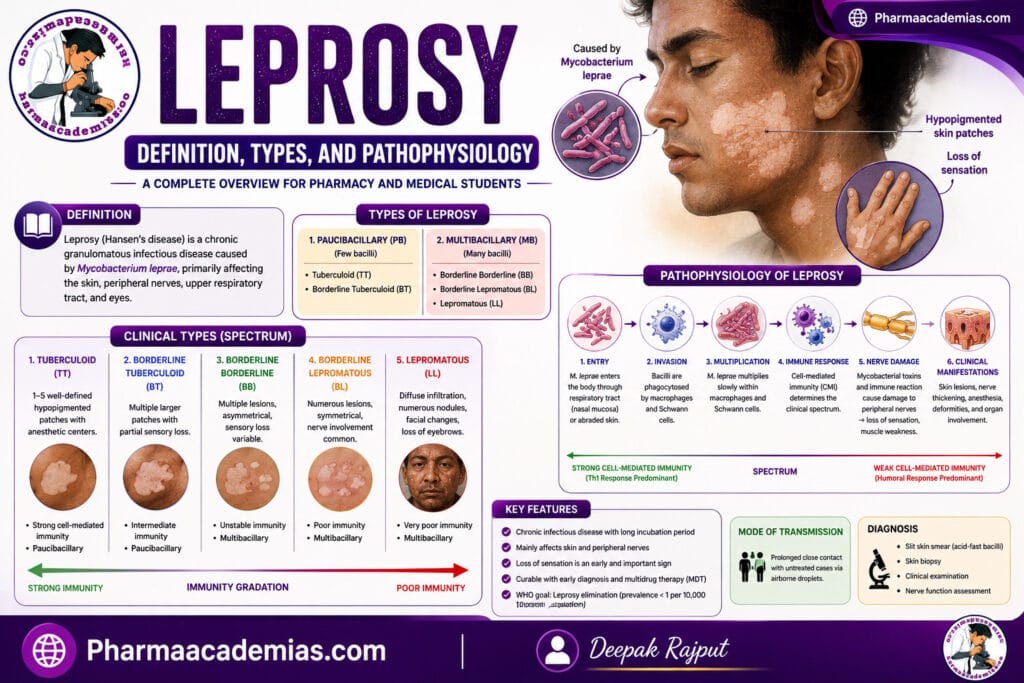
Leprosy is classified according to the patient’s immune response against Mycobacterium leprae. The Ridley–Jopling classification is widely used because it reflects the immunological and clinical spectrum of the disease.
1. Tuberculoid Leprosy (TT): Tuberculoid leprosy represents the mildest form of the disease and occurs in individuals with a strong cell-mediated immune response against M. leprae.
Patients typically present with one or a few well-defined hypopigmented or reddish skin patches that show complete loss of sensation. Peripheral nerves supplying these lesions become enlarged and damaged, leading to muscle weakness.
Only a very small number of bacteria are present in the lesions, making this form paucibacillary and minimally infectious.
2. Borderline Tuberculoid (BT): Borderline tuberculoid leprosy lies between tuberculoid and borderline forms.Patients have multiple asymmetrical lesions with partial sensory loss. The immune response remains relatively strong but is less effective than in pure tuberculoid disease.
3. Mid-Borderline (BB): This unstable intermediate form exhibits features of both tuberculoid and lepromatous leprosy.Numerous skin lesions of varying appearance occur, and the immune response is moderate. Patients may progress toward either tuberculoid or lepromatous disease depending on changes in immunity.
4. Borderline Lepromatous (BL): Borderline lepromatous leprosy develops when cell-mediated immunity becomes weaker.
Patients exhibit numerous symmetrical skin lesions, widespread nerve involvement, and increasing bacterial multiplication.
Without treatment, this form often progresses to lepromatous leprosy.
5. Lepromatous Leprosy (LL): Lepromatous leprosy represents the most severe form of the disease and occurs in patients with very poor cell-mediated immunity against M. leprae.
Numerous bacteria multiply throughout the body, producing:
- Diffuse skin infiltration
- Multiple nodules
- Thickened skin
- Symmetrical lesions
- Extensive peripheral nerve involvement
- Nasal congestion and destruction
- Eye involvement
- Facial deformities (“lion-like facies”)
Because bacterial numbers are extremely high, lepromatous leprosy is classified as multibacillary and is more infectious than other forms.
WHO Classification
For treatment purposes, the World Health Organization classifies leprosy into two categories.
Paucibacillary (PB) Leprosy
This form involves:
- One to five skin lesions
- Negative skin smear
- Low bacterial load
Patients receive 6 months of multidrug therapy (MDT).
Multibacillary (MB) Leprosy
This form includes:
- More than five skin lesions
- Positive skin smear
- High bacterial load
Patients receive 12 months or longer of multidrug therapy (MDT).
Pathophysiology of Leprosy
The pathophysiology of leprosy depends largely on the interaction between Mycobacterium leprae and the host’s immune response. Unlike many bacterial infections in which tissue damage results directly from bacterial toxins, most tissue injury in leprosy is caused by the body’s immune response and by the organism’s ability to invade peripheral nerves.
1. Entry of Mycobacterium leprae
The infection usually begins when M. leprae enters the body through the nasal mucosa after inhalation of respiratory droplets released by an untreated patient.
Less commonly, the organism may enter through damaged skin.
After entering the body, the bacteria spread slowly through the bloodstream and lymphatic system to cooler body tissues.
2. Preference for Cooler Body Parts
Unlike many pathogens, M. leprae grows best at temperatures slightly lower than core body temperature.
Therefore, it mainly infects:
- Skin
- Peripheral nerves
- Nose
- Ear lobes
- Fingers
- Toes
- Eyes
- Testes
This explains why internal organs are usually spared.
3. Infection of Macrophages and Schwann Cells
One of the most unique features of M. leprae is its ability to invade:
Macrophages: The bacteria survive and multiply within tissue macrophages by avoiding intracellular destruction.These infected macrophages become part of granulomatous lesions.
Schwann Cells: The organism has a strong affinity for Schwann cells, which produce the myelin sheath surrounding peripheral nerves.
After entering Schwann cells, M. leprae:
- Multiplies slowly
- Damages myelin
- Causes nerve inflammation
- Leads to progressive nerve degeneration
Schwann cell infection is the hallmark of leprosy.
4. Host Immune Response Determines Disease Type
The severity of leprosy depends almost entirely on the strength of the patient’s cell-mediated immunity (CMI).
Strong Cell-Mediated Immunity (Tuberculoid Leprosy)
In tuberculoid leprosy:
- Th1 lymphocytes become activated.
- Cytokines such as IFN-γ and IL-2 stimulate macrophages.
- Activated macrophages efficiently destroy M. leprae.
- Granulomas form around infected cells.
As a result:
- Very few bacteria survive.
- Disease remains localized.
- Skin lesions are few.
- Nerve damage is localized.
Weak Cell-Mediated Immunity (Lepromatous Leprosy)
In lepromatous leprosy:
- Th2 immune response predominates.
- IL-4, IL-5, and IL-10 suppress macrophage activity.
- Cell-mediated immunity becomes ineffective.
Consequently:
- Bacteria multiply freely.
- Numerous tissues become infected.
- Diffuse lesions develop.
- Widespread nerve damage occurs.
5. Granuloma Formation
Activated macrophages surround infected tissues and form granulomas.
Granulomas attempt to contain bacterial spread.
In tuberculoid leprosy, granulomas are well formed and effective.
In lepromatous leprosy, granulomas are poorly organized because immune responses are weak.
6. Peripheral Nerve Damage
Peripheral nerve involvement is the most important pathological event in leprosy.
The bacteria invade Schwann cells, producing:
- Demyelination
- Axonal degeneration
- Fibrosis
- Permanent nerve damage
Affected nerves become enlarged and tender.
Loss of nerve function produces:
- Loss of pain sensation
- Loss of temperature sensation
- Loss of touch sensation
- Muscle weakness
- Paralysis
Because patients cannot feel pain, repeated unnoticed injuries occur.
7. Development of Skin Lesions
Infected macrophages accumulate within the skin.
Inflammatory cells release cytokines that produce:
- Hypopigmented patches
- Red plaques
- Nodules
- Thickened skin
- Loss of sweating
- Hair loss over lesions
Loss of sensation within lesions results from destruction of cutaneous sensory nerves.
8. Secondary Injury and Deformities
The absence of pain sensation leads to repeated trauma.
Patients unknowingly experience:
- Burns
- Cuts
- Pressure injuries
- Repeated infections
Over time these injuries result in:
- Chronic ulcers
- Bone destruction
- Finger shortening
- Claw hand
- Foot drop
- Facial deformities
These deformities arise mainly from nerve damage, not from direct bacterial destruction.
9. Leprosy Reactions
Even during treatment, patients may develop acute inflammatory episodes known as leprosy reactions.
Type 1 Reaction (Reversal Reaction)
- Occurs mainly in borderline leprosy.
- Caused by sudden changes in cell-mediated immunity.
- Existing skin lesions become swollen and red.
- Acute nerve inflammation may cause rapid loss of nerve function.
Type 2 Reaction (Erythema Nodosum Leprosum – ENL)
Occurs mainly in lepromatous leprosy.
It results from immune complex deposition (Type III hypersensitivity).
Patients develop:
- Painful nodules
- Fever
- Joint pain
- Eye inflammation
- Generalized illness
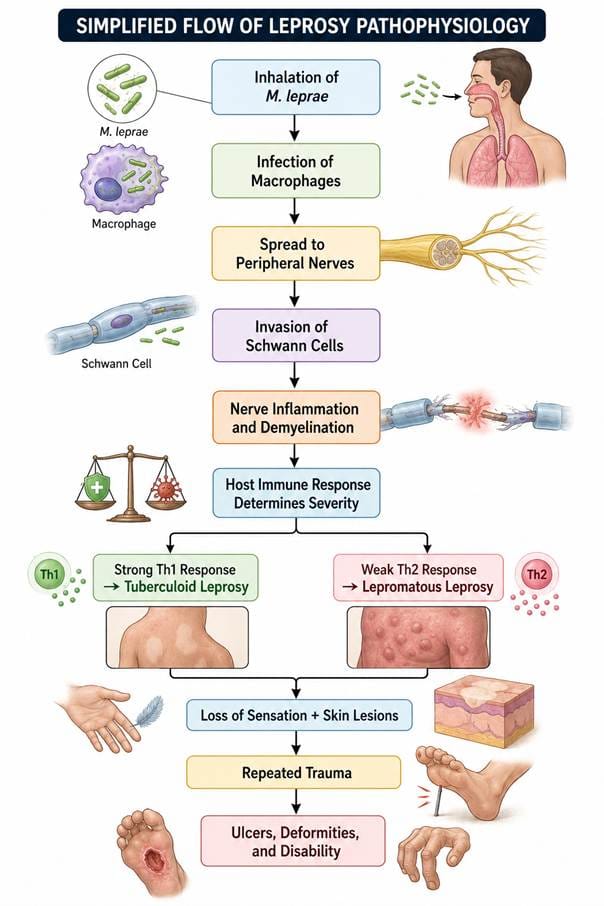
Simplified Flow of Leprosy Pathophysiology
Inhalation of M. leprae
↓
Infection of Macrophages
↓
Spread to Peripheral Nerves
↓
Invasion of Schwann Cells
↓
Nerve Inflammation and Demyelination
↓
Host Immune Response Determines Severity
↓
Strong Th1 Response → Tuberculoid Leprosy
Weak Th2 Response → Lepromatous Leprosy
↓
Loss of Sensation + Skin Lesions
↓
Repeated Trauma
↓
Ulcers, Deformities, and Disability
Clinical Features Resulting from the Pathophysiology
The pathological changes in the skin and peripheral nerves produce the characteristic clinical manifestations of leprosy, including:
- Hypopigmented or reddish skin patches with reduced sensation
- Thickened peripheral nerves
- Numbness of the hands and feet
- Muscle weakness and wasting
- Dry skin due to loss of sweat gland function
- Loss of eyebrows (madarosis), particularly in lepromatous leprosy
- Nasal congestion, epistaxis, and nasal deformity
- Eye involvement leading to dryness, keratitis, or blindness
- Chronic ulcers on pressure points
- Hand and foot deformities such as claw hand and foot drop
Complications of Leprosy
If untreated or diagnosed late, leprosy may lead to serious complications, including:
- Permanent peripheral neuropathy
- Muscle paralysis
- Claw hand deformity
- Foot drop
- Chronic plantar ulcers
- Blindness due to ocular involvement
- Secondary bacterial infections
- Bone resorption and shortening of fingers or toes
- Severe physical disability and social stigma
Conclusion
Leprosy (Hansen’s disease) is a chronic infectious disease caused by Mycobacterium leprae that primarily affects the skin and peripheral nerves. The disease is unique because its clinical presentation depends largely on the host’s cell-mediated immune response. Individuals with a strong Th1-mediated response develop localized tuberculoid leprosy, whereas those with a weak Th2-dominant response develop disseminated lepromatous leprosy with a high bacterial burden. The hallmark pathological event is the invasion of Schwann cells, leading to nerve damage, sensory loss, and disability. Early diagnosis and treatment with WHO-recommended multidrug therapy (MDT) can completely cure the infection, prevent transmission, and significantly reduce the risk of irreversible deformities and long-term complications.