Basic Principles of Wound Healing: Wound healing is a complex, highly coordinated biological process through which the body repairs damaged tissues and restores the integrity of the skin or other injured structures after trauma, surgery, burns, infections, or disease. The skin acts as the body’s primary protective barrier against physical injury, microorganisms, harmful chemicals, and excessive water loss. When this barrier is disrupted due to a wound, the body immediately initiates a series of cellular and molecular events designed to stop bleeding, prevent infection, remove damaged tissue, and regenerate or repair the injured area.
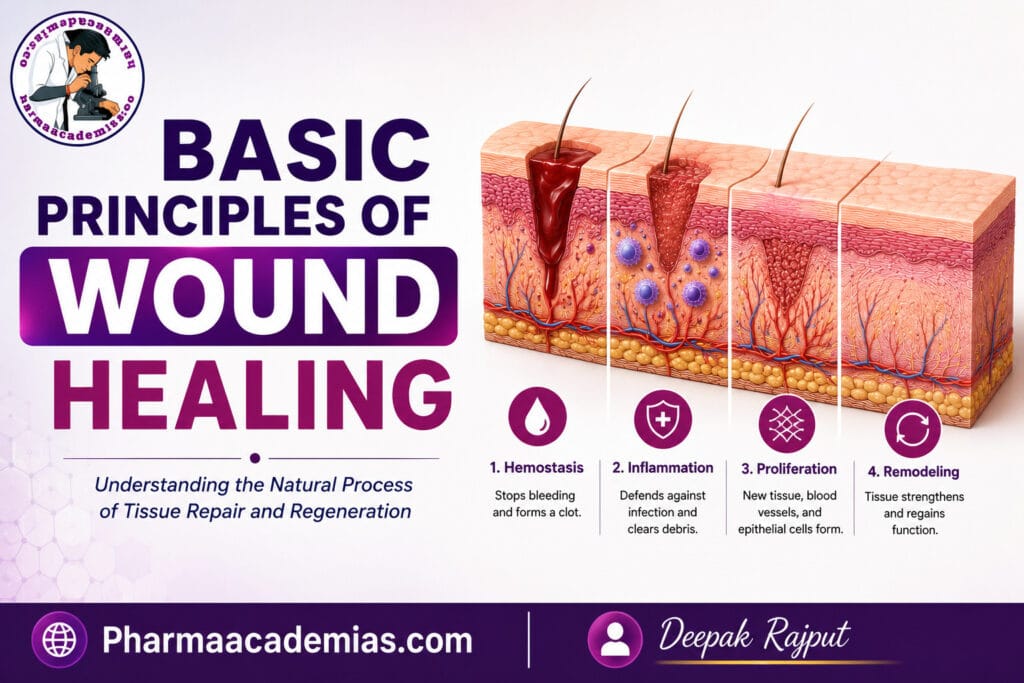
Wound healing is not a single event but a continuous process involving numerous cell types, growth factors, cytokines, extracellular matrix proteins, and blood vessels. These components work together in a carefully regulated sequence to restore tissue structure and function. Under normal conditions, wound healing occurs in an orderly manner through overlapping phases that include hemostasis, inflammation, proliferation, and remodeling. Each phase is essential, and disruption of any stage can delay healing or result in chronic wounds.
The speed and quality of wound healing depend on several factors, including the patient’s age, nutritional status, blood supply, presence of infection, underlying diseases such as diabetes mellitus, medications, and the severity of tissue damage. While minor wounds may heal within a few days, deep or extensive injuries can require several weeks or months to heal completely.
Understanding the basic principles of wound healing is important for healthcare professionals because effective wound management helps prevent infection, reduces complications, minimizes scarring, and improves patient recovery.
Definition of Wound Healing
Wound healing is defined as the natural physiological process by which the body repairs damaged tissues through a sequence of overlapping cellular, biochemical, and molecular events that restore the structural and functional integrity of the injured tissue.
The ultimate goal of wound healing is to:
- Restore the protective barrier of the skin.
- Prevent microbial invasion.
- Replace damaged tissue.
- Recover normal tissue function as much as possible.
Classification of Wounds
Before understanding the healing process, it is useful to know the different types of wounds.
Based on Duration
Acute Wounds: Acute wounds heal within the expected period through the normal stages of wound healing. Examples include surgical incisions, cuts, abrasions, and minor burns.
Chronic Wounds: Chronic wounds fail to heal within the normal time frame, usually due to persistent inflammation, infection, poor blood supply, or underlying diseases such as diabetes. Examples include diabetic foot ulcers, pressure ulcers, and venous leg ulcers.
Based on the Method of Healing
Primary Intention
Healing by primary intention occurs when wound edges are clean, closely approximated, and sutured together.
Examples include surgical incisions.
Characteristics include:
- Minimal tissue loss
- Rapid healing
- Small scar formation
- Low risk of infection
Secondary Intention
Healing by secondary intention occurs when wound edges cannot be approximated because of extensive tissue loss.
Examples include burns, traumatic wounds, and infected ulcers.
Characteristics include:
- Large amount of granulation tissue
- Greater wound contraction
- Longer healing time
- More noticeable scar
Tertiary Intention (Delayed Primary Closure)
In tertiary intention, the wound is initially left open because of contamination or infection and closed surgically after the wound becomes clean.
This method reduces the risk of infection while allowing eventual surgical closure.
Basic Principles of Wound Healing
Successful wound healing depends on several fundamental biological principles.
1. Hemostasis (Control of Bleeding)
The first principle of wound healing is the immediate control of bleeding.
As soon as tissue injury occurs, damaged blood vessels constrict to reduce blood loss. Platelets rapidly adhere to exposed collagen fibers within the injured vessel wall, forming a temporary platelet plug.
Activated platelets release numerous chemical mediators such as:
- Platelet-derived growth factor (PDGF)
- Transforming growth factor-beta (TGF-β)
- Serotonin
- Thromboxane A₂
These substances initiate blood clot formation and recruit inflammatory cells to the wound.
Simultaneously, the coagulation cascade produces fibrin, which stabilizes the platelet plug and forms a blood clot.
The clot serves several important functions:
- Stops bleeding.
- Prevents microbial entry.
- Provides a temporary matrix for migrating cells.
- Stores growth factors required for tissue repair.
Hemostasis usually occurs within minutes after injury.
2. Inflammatory Phase
Once bleeding has stopped, the inflammatory phase begins.
This stage generally lasts 1–4 days, although it may continue longer in infected wounds.
Inflammation is an essential protective response that removes bacteria, dead tissue, and foreign material from the wound.
Initially, damaged cells release inflammatory mediators such as:
- Histamine
- Prostaglandins
- Bradykinin
- Cytokines
- Chemokines
These mediators produce:
- Vasodilation
- Increased vascular permeability
- Redness
- Heat
- Swelling
- Pain
The first immune cells to arrive are neutrophils, which phagocytose bacteria and cellular debris.
Within 48–72 hours, macrophages become the dominant inflammatory cells.
Macrophages play a central role in wound healing because they:
- Remove dead tissue.
- Destroy microorganisms.
- Release growth factors.
- Stimulate fibroblast activity.
- Promote angiogenesis.
- Initiate tissue regeneration.
Without macrophages, normal wound healing cannot proceed efficiently.
3. Proliferative Phase
The proliferative phase usually begins around the third day after injury and continues for approximately 2–3 weeks, depending on wound size.
Its primary objective is to replace damaged tissue with new healthy tissue.
Several important events occur simultaneously.
Granulation Tissue Formation
Fibroblasts migrate into the wound under the influence of growth factors.
These cells synthesize:
- Collagen (mainly Type III collagen)
- Fibronectin
- Proteoglycans
- Extracellular matrix proteins
The newly formed connective tissue, known as granulation tissue, appears pink because it contains numerous newly formed blood vessels.
Granulation tissue fills the wound and provides structural support for healing.
Angiogenesis
Angiogenesis refers to the formation of new blood vessels from existing capillaries.
Growth factors such as vascular endothelial growth factor (VEGF) stimulate endothelial cells to proliferate and migrate into the wound.
These new capillaries supply:
- Oxygen
- Nutrients
- Growth factors
- Immune cells
Adequate blood supply is essential for successful wound healing.
Epithelialization
Keratinocytes from the wound edges begin migrating across the wound surface.
These cells proliferate rapidly until the entire wound surface becomes covered by new epithelium.
Small superficial wounds may become completely epithelialized within several days.
Wound Contraction
Specialized fibroblasts known as myofibroblasts contract the wound by pulling its edges toward the center.
This process significantly reduces wound size and shortens healing time.
Wound contraction is especially important during healing by secondary intention.
4. Remodeling (Maturation) Phase
The remodeling phase is the final stage of wound healing.
It begins approximately three weeks after injury and may continue for several months or even one year.
During this phase, the newly formed tissue becomes stronger and more organized.
Several changes occur:
- Type III collagen is gradually replaced by stronger Type I collagen.
- Collagen fibers become thicker.
- Fibers are rearranged along lines of mechanical stress.
- Excess blood vessels disappear.
- Cellular activity decreases.
- Scar tissue matures.
Although tensile strength increases continuously during remodeling, healed skin usually regains only 70–80% of its original strength.
Therefore, scar tissue never becomes completely identical to normal skin.
Role of Growth Factors in Wound Healing
Growth factors are signaling proteins that regulate nearly every stage of wound healing.
Some of the most important growth factors include:
Platelet-Derived Growth Factor (PDGF): PDGF stimulates the migration and proliferation of fibroblasts, smooth muscle cells, and inflammatory cells. It also promotes collagen synthesis and granulation tissue formation.
Transforming Growth Factor-beta (TGF-β): TGF-β promotes fibroblast proliferation, collagen production, extracellular matrix deposition, and scar formation. It is one of the most important regulators of tissue repair.
Vascular Endothelial Growth Factor (VEGF): VEGF stimulates angiogenesis by promoting the growth of new capillaries, thereby improving oxygen and nutrient delivery to the healing tissue.
Epidermal Growth Factor (EGF): EGF stimulates keratinocyte migration and proliferation, accelerating epithelialization of the wound surface.
Fibroblast Growth Factor (FGF): FGF promotes fibroblast activity, collagen synthesis, angiogenesis, and overall tissue regeneration.
Factors Affecting Wound Healing
Several local and systemic factors influence the rate and quality of wound healing.
Local Factors
These include:
- Infection
- Poor blood supply
- Foreign bodies
- Excessive wound movement
- Tissue necrosis
- Radiation exposure
- Repeated trauma
These factors interfere directly with the healing process and may prolong inflammation or prevent proper tissue repair.
Systemic Factors: Several conditions affecting the entire body also influence wound healing.
Age: Healing becomes slower with increasing age because of reduced collagen synthesis, decreased cellular activity, and impaired immune function.
Nutrition: Adequate nutrition is essential for wound repair.
Important nutrients include:
- Protein
- Vitamin C
- Vitamin A
- Zinc
- Iron
Protein deficiency significantly delays collagen synthesis and tissue regeneration.
Diabetes Mellitus: Diabetes impairs wound healing through poor circulation, neuropathy, reduced immune function, and increased susceptibility to infection.
Oxygen Supply: Oxygen is required for collagen synthesis, angiogenesis, bacterial killing, and cellular metabolism.
Poor oxygenation delays every stage of wound healing.
Medications: Certain drugs impair wound healing, including:
- Corticosteroids
- Immunosuppressants
- Chemotherapeutic agents
These medications reduce inflammation and cellular proliferation.
Smoking: Smoking causes vasoconstriction and reduces oxygen delivery to tissues.Nicotine and carbon monoxide significantly delay wound healing.
Complications of Impaired Wound Healing
When wound healing is disrupted, several complications may occur.
These include:
- Chronic non-healing wounds
- Wound infection
- Dehiscence (reopening of the wound)
- Excessive scar formation
- Hypertrophic scars
- Keloids
- Contractures
- Chronic ulcers
Proper wound care and early intervention help prevent these complications.
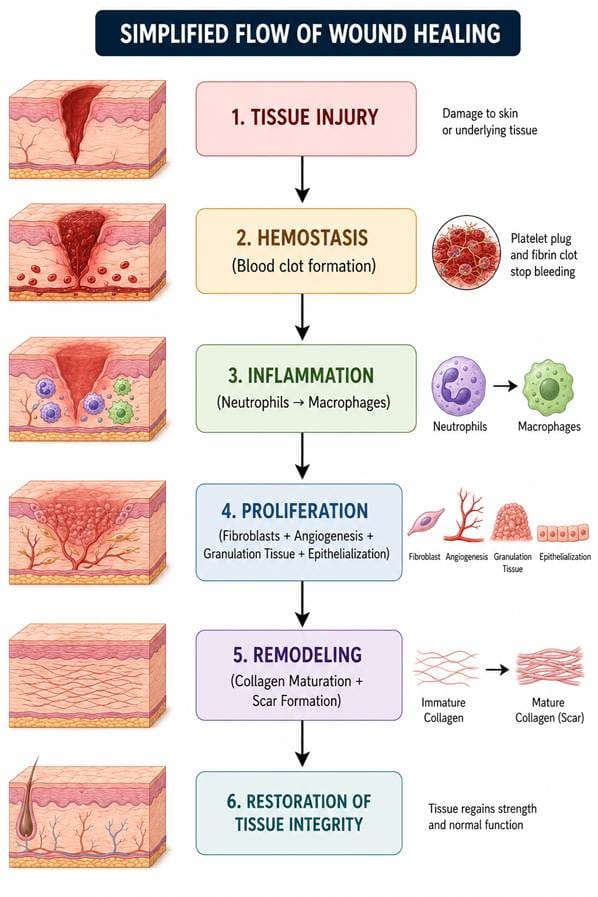
Simplified Flow of Wound Healing
Tissue Injury
↓
Hemostasis
(Blood clot formation)
↓
Inflammation
(Neutrophils → Macrophages)
↓
Proliferation
(Fibroblasts + Angiogenesis + Granulation Tissue + Epithelialization)
↓
Remodeling
(Collagen Maturation + Scar Formation)
↓
Restoration of Tissue Integrity
Clinical Importance of Wound Healing
Understanding wound healing is essential in medicine, surgery, nursing, pharmacy, and allied health sciences. Proper knowledge of the healing process helps healthcare professionals choose appropriate dressings, prevent infections, optimize nutritional support, and identify factors that may delay recovery. It also forms the scientific basis for advanced wound care techniques, including skin grafting, tissue engineering, growth factor therapy, negative-pressure wound therapy, and regenerative medicine.
Conclusion
Wound healing is a dynamic and highly organized physiological process that restores the integrity of damaged tissues following injury. It proceeds through four overlapping phases: hemostasis, inflammation, proliferation, and remodeling, each regulated by numerous cells, cytokines, growth factors, and extracellular matrix proteins. Successful healing depends on effective control of bleeding, removal of damaged tissue and microorganisms, formation of granulation tissue, angiogenesis, epithelialization, collagen deposition, and scar maturation. Numerous local and systemic factors, including infection, nutrition, diabetes, blood supply, and age, influence the speed and quality of healing. A thorough understanding of the basic principles of wound healing is essential for preventing complications, promoting tissue repair, and improving patient outcomes in clinical practice.