Alkaloids as Secondary plant metabolites: Alkaloids are an important group of nitrogen-containing secondary metabolites of plant origin. They are widely distributed in medicinal plants and are especially important in pharmacognosy because many alkaloids possess strong pharmacological activities.
Unlike primary metabolites such as carbohydrates, proteins and lipids, alkaloids are not generally required directly for basic growth and development. They are mainly associated with plant defense, protection from herbivores and microorganisms, and ecological interactions.
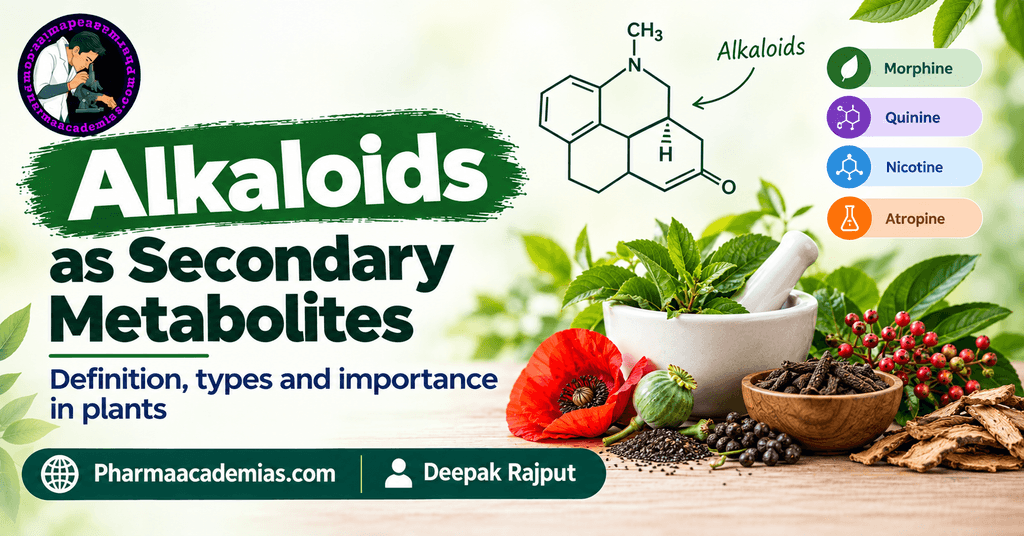
Many well-known medicinal compounds are alkaloids, for example:
- Morphine – analgesic
- Quinine – antimalarial
- Atropine – anticholinergic
- Caffeine – CNS stimulant
- Nicotine – stimulant and toxic alkaloid
- Reserpine – antihypertensive
- Vincristine and Vinblastine – anticancer agents
2. Definition of Alkaloids
Alkaloids are naturally occurring, basic, nitrogen-containing organic compounds, mainly produced by plants, which generally possess marked physiological or pharmacological activity.
The word alkaloid means “alkali-like”, because many alkaloids show basic properties due to the presence of nitrogen.
Simple definition
Alkaloids are nitrogen-containing basic secondary metabolites of plants that usually have pronounced physiological and pharmacological effects.
However, not every alkaloid is strongly basic, and some naturally occurring nitrogen-containing compounds may be classified as alkaloids despite having weak or unusual basic properties.
3. General Characteristics of Alkaloids
Alkaloids show several common characteristics:
1. Presence of nitrogen: Nitrogen is the most important characteristic feature of alkaloids.
The nitrogen may occur:
- inside a heterocyclic ring, or
- in a side chain.
Examples:
- Atropine – contains nitrogen in a tropane ring system.
- Morphine – contains a nitrogen-containing ring.
- Ephedrine – nitrogen is present in a side chain.
2. Mostly basic in nature: Most alkaloids are basic compounds because the nitrogen atom can accept a proton.
Therefore, they can form salts with acids.
For example:
Alkaloid base + HCl → Alkaloid hydrochloride
These salts are often more water-soluble than the free alkaloid.
3. Usually bitter in taste: Many alkaloids have a characteristically bitter taste.
Examples:
- Quinine – intensely bitter
- Caffeine – bitter
- Strychnine – extremely bitter
Important: Taste should not be used alone to identify an alkaloid.
4. Physiologically active: Alkaloids generally produce significant effects on humans and animals.
Examples:
| Alkaloid | Major action |
| Morphine | Analgesic |
| Atropine | Anticholinergic |
| Quinine | Antimalarial |
| Caffeine | CNS stimulant |
| Reserpine | Antihypertensive |
| Vincristine | Anticancer |
5. Mostly crystalline solids
Many alkaloids occur as:
- crystalline solids
- amorphous solids
However, some alkaloids are liquids.
Example: Nicotine is a volatile liquid alkaloid.
6. Solubility: The solubility of alkaloids depends upon whether they are present as free bases or salts.
Generally:
Free alkaloid bases → more soluble in organic solvents
Alkaloid salts → more soluble in water
This property is very important in the extraction and purification of alkaloids.
4. Occurrence of Alkaloids in Plants
Alkaloids are widely distributed throughout the plant kingdom.
They may occur in different plant parts such as:
- Roots
- Rhizomes
- Stems
- Bark
- Leaves
- Flowers
- Fruits
- Seeds
- Latex
However, the alkaloid concentration can vary considerably between different plant parts.
Examples
| Plant | Plant part | Important alkaloid |
| Papaver somniferum | Latex | Morphine, codeine |
| Cinchona spp. | Bark | Quinine, quinidine |
| Atropa belladonna | Leaves/roots | Atropine, hyoscyamine |
| Datura spp. | Leaves/seeds | Atropine, scopolamine |
| Strychnos nux-vomica | Seeds | Strychnine, brucine |
| Rauwolfia serpentina | Roots | Reserpine |
| Catharanthus roseus | Leaves | Vincristine, vinblastine |
| Coffea spp. | Seeds | Caffeine |
| Nicotiana tabacum | Leaves | Nicotine |
| Ephedra spp. | Stems | Ephedrine |
5. Biosynthesis of Alkaloids
Alkaloids are secondary metabolites, but they are generally synthesized from primary metabolic precursors, particularly amino acids.
Important precursor amino acids include:
- Ornithine
- Lysine
- Phenylalanine
- Tyrosine
- Tryptophan
- Histidine
- Aspartic acid
These amino acids undergo various biochemical reactions such as:
- Decarboxylation
- Methylation
- Oxidation
- Reduction
- Condensation
- Cyclization
These reactions ultimately produce different alkaloid structures.
Important relationship
Primary metabolites → amino acids → alkaloid biosynthesis → secondary metabolites
This is an important concept for examinations.
6. Classification of Alkaloids
Alkaloids can be classified in several ways. The most useful classification is based on the chemical structure and origin of nitrogen.
A. True Alkaloids
True alkaloids:
- are derived from amino acids,
- contain nitrogen within a heterocyclic ring, and
- generally possess strong physiological activity.
Examples
- Morphine
- Atropine
- Quinine
- Nicotine
- Strychnine
Example
Morphine contains nitrogen as a part of its ring system.
7. Protoalkaloids
Protoalkaloids are nitrogen-containing compounds that are derived from amino acids, but the nitrogen is not present within a heterocyclic ring.
Examples
- Ephedrine
- Mescaline
Important point
Protoalkaloids are amino-acid-derived alkaloids with nitrogen outside the heterocyclic ring.
8. Pseudoalkaloids
Pseudoalkaloids are alkaloid-like compounds in which the nitrogen is not derived directly from an amino acid.
They may arise from other metabolic pathways.
Examples
- Caffeine
- Theobromine
- Aconitine
- Steroidal alkaloids
Important example
Caffeine is generally considered a pseudoalkaloid because its nitrogen-containing purine skeleton is associated with purine metabolism rather than direct incorporation of an amino acid nitrogen in the classical alkaloid biosynthetic sense.
9. Classification According to Chemical Ring
Alkaloids can also be classified according to the heterocyclic ring present.
| Type | Ring system | Example |
| Pyridine alkaloids | Pyridine | Nicotine |
| Tropane alkaloids | Tropane | Atropine, cocaine |
| Quinoline alkaloids | Quinoline | Quinine |
| Isoquinoline alkaloids | Isoquinoline | Morphine, papaverine |
| Indole alkaloids | Indole | Reserpine, strychnine, vincristine |
| Imidazole alkaloids | Imidazole | Pilocarpine |
| Purine alkaloids | Purine | Caffeine |
| Piperidine alkaloids | Piperidine | Piperine |
| Steroidal alkaloids | Steroidal nucleus | Solasodine |
10. Important Alkaloids and Their Sources
This is an important section for Pharmacognosy
| Alkaloid | Biological source | Major use/action |
| Morphine | Papaver somniferum | Analgesic |
| Codeine | Papaver somniferum | Antitussive, analgesic |
| Quinine | Cinchona spp. | Antimalarial |
| Quinidine | Cinchona spp. | Antiarrhythmic |
| Atropine | Atropa, Datura | Anticholinergic |
| Scopolamine | Datura, Hyoscyamus | Anticholinergic, motion sickness |
| Reserpine | Rauwolfia serpentina | Antihypertensive |
| Strychnine | Strychnos nux-vomica | Highly toxic; CNS stimulant historically |
| Caffeine | Coffea, Camellia sinensis | CNS stimulant |
| Nicotine | Nicotiana tabacum | CNS stimulant; toxic |
| Ephedrine | Ephedra spp. | Sympathomimetic |
| Cocaine | Erythroxylum coca | Local anesthetic; controlled drug |
| Vincristine | Catharanthus roseus | Anticancer |
| Vinblastine | Catharanthus roseus | Anticancer |
| Pilocarpine | Pilocarpus spp. | Miotic, glaucoma therapy |
| Piperine | Piper nigrum | Pungent principle |
11. Pharmacological Importance of Alkaloids
Alkaloids are extremely important in pharmaceutical sciences because many possess powerful biological activities.
1. Analgesic activity: Morphine is one of the most important naturally occurring opioid analgesics.It is used for the management of severe pain.Codeine also possesses analgesic activity and has been used as an antitussive.
2. Antimalarial activity: Quinine, obtained from Cinchona bark, has historically been an important antimalarial drug.
3. Anticholinergic activity: Atropine and scopolamine block muscarinic acetylcholine receptors.
They have applications in:
- ophthalmology
- pre-anesthetic medication
- treatment of certain bradycardias
- motion sickness in the case of scopolamine
4. Anticancer activity
Two very important alkaloids obtained from Catharanthus roseus are:
- Vincristine
- Vinblastine
They are important anticancer agents.
5. CNS stimulant activity
Examples include:
- Caffeine
- Nicotine
Caffeine stimulates the central nervous system and reduces fatigue and drowsiness.
6. Antihypertensive activity: Reserpine, obtained from Rauwolfia serpentina, has historically been used as an antihypertensive drug.
7. Local anesthetic activity: Cocaine possesses local anesthetic properties and historically played an important role in the development of local anesthesia.
12. Role of Alkaloids in Plants
Although alkaloids are not usually considered essential for basic plant growth like carbohydrates and proteins, they may provide important ecological advantages.
Major roles include:
1. Defense against herbivores: Many alkaloids are bitter or toxic and discourage animals and insects from feeding on plants.
2. Protection against microorganisms: Some alkaloids may contribute to resistance against pathogens.
3. Protection from insects: Certain alkaloids have insecticidal or insect-deterring effects.
4. Storage and transport of nitrogen: Some alkaloids may serve as temporary forms in which nitrogen is stored or redistributed within the plant.
5. Ecological interactions: Alkaloids can influence interactions between plants, insects, microorganisms and other organisms.
13. Extraction of Alkaloids
The basic principle of alkaloid extraction depends upon their acid-base properties.
14. Identification Tests for Alkaloids
Several general reagents are used for the detection of alkaloids.
1. Dragendorff’s reagent: Produces an orange or reddish-orange precipitate with many alkaloids.
Important for exam:
Dragendorff’s test → orange/reddish-orange precipitate
2. Mayer’s reagent: Produces a cream or white precipitate with many alkaloids.
Remember:
Mayer → Cream precipitate
3. Wagner’s reagent: Produces a reddish-brown precipitate.
Remember:
Wagner → Reddish-brown
4. Hager’s reagent: Hager’s reagent is a solution of picric acid and generally produces a yellow precipitate with alkaloids.
15. General Properties of Alkaloids
| Property | General observation |
| Nature | Mostly basic |
| Nitrogen | Present |
| Taste | Usually bitter |
| Physical state | Mostly crystalline solids |
| Solubility | Free bases often soluble in organic solvents |
| Salt form | Usually more water-soluble |
| Molecular structure | Often complex |
| Pharmacological activity | Usually pronounced |
| Distribution | Various plant parts |
| Toxicity | Some are highly toxic |
16. Alkaloids vs Primary Metabolites
It is important not to confuse alkaloids with primary metabolites.
| Primary metabolites | Alkaloids |
| Essential for basic growth and development | Mainly involved in ecological/defensive functions |
| Includes carbohydrates, proteins, lipids | Secondary metabolites |
| Usually widely distributed | Distribution may be restricted to particular plants |
| Generally less potent pharmacologically | Often highly pharmacologically active |
| Directly involved in central metabolism | Often produced from primary metabolic precursors |
17. Pharmaceutical Importance of Alkaloids
Alkaloids are among the most important natural products in pharmaceutical science.
They are used as:
- Analgesics
- Antimalarials
- Anticancer agents
- Anticholinergics
- CNS stimulants
- Antihypertensive agents
- Local anesthetics
- Antitussives
- Miotics
- Sympathomimetic agents
They also serve as important lead compounds for drug discovery and medicinal chemistry.
Conclusion
Alkaloids are a major class of nitrogen-containing secondary plant metabolites with diverse chemical structures and powerful biological activities. They are commonly produced from amino-acid-derived metabolic pathways and are found in different parts of medicinal plants. Their importance in pharmacy is enormous because compounds such as morphine, quinine, atropine, reserpine, caffeine, ephedrine, vincristine and vinblastine have important therapeutic applications.
Editorial Note
This article has been carefully researched and written by Deepak Rajput with a focus on accuracy, clarity, and evidence-based healthcare information. Pharmaacademias.com