Types of Redox Titrations: Redox titrations, also known as oxidation-reduction titrations, find extensive use in chemistry as a versatile class of analytical techniques. They involve the transfer of electrons between reactants and are essential for determining the concentration of various substances. This detailed note explores redox titrations’ principles, types, and applications.
Types of Redox Titrations
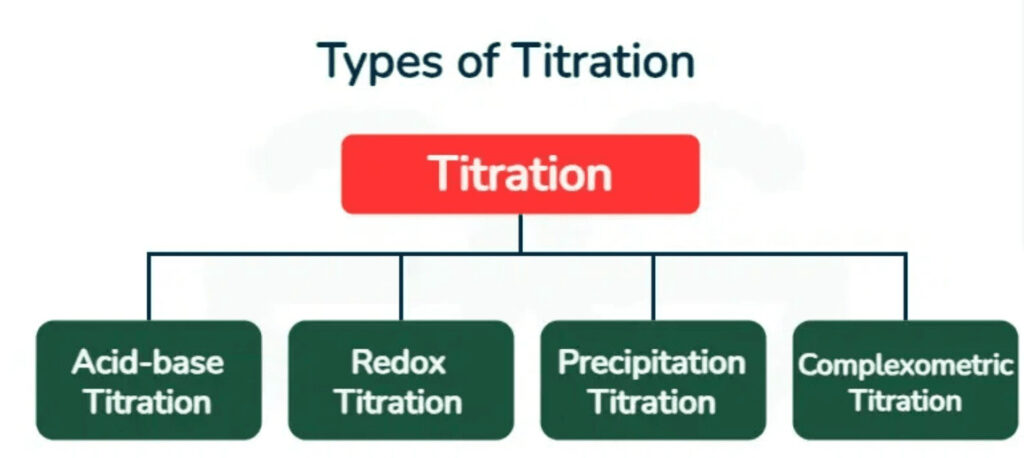
1. Direct Redox Titrations
Chemists widely employ direct redox titrations as a fundamental analytical technique in chemistry to determine the concentration of a reducing agent (analyte).This detailed note delves into the principles and applications of direct redox titrations, shedding light on their significance in various analytical contexts.
Principles of Direct Redox Titrations
Reaction Mechanism: In direct redox titrations, an oxidizing titrant directly titrates the reducing agent, which is the analyte. The reaction typically involves the transfer of electrons from the reducing agent to the oxidizing agent.
Endpoint Detection: The titration reaches its endpoint when it oxidizes all the reducing agent, often signaled by a noticeable change in the color of an indicator or a shift in an instrumental parameter, such as electrode potential in potentiometric titrations.
Applications of Direct Redox Titrations
Quantification of Reducing Agents: Chemists widely use direct redox titrations to determine the concentration of reducing agents in various samples. Common examples include the analysis of vitamin C (ascorbic acid) in fruit juices and the quantification of iron in iron ores.
Quality Control: The pharmaceutical industry employs direct redox titrations to assess the potency of certain drugs or the concentration of active ingredients.
Environmental Analysis: Reducing agents like sulfur dioxide in environmental samples can be quantified using direct redox titrations.
Educational Laboratories: Direct redox titrations are used as teaching tools in chemistry laboratories to illustrate fundamental titration principles.
2. Indirect Redox Titrations (Back Titrations)
Principle: Chemists use indirect redox titrations, often referred to as back titrations, as a powerful analytical technique in chemistry to determine the concentration of analytes that do not readily undergo direct redox reactions. This detailed note explores the principles, procedures, and applications of indirect redox titrations.
Principles of Indirect Redox Titrations
Reaction Mechanism: In indirect redox titrations, the analyte does not directly react with the titrant. Instead, the analyte is first treated with an excess of a known reagent that reacts with it to form a new substance.
Back Titration: After the formation of the new substance, chemists titrate the excess reagent with a titrant of known concentration. The change in concentration of the titrant is proportional to the amount of the analyte.
Applications
Insoluble Analytes: Indirect redox titrations are particularly useful when the analyte is sparingly soluble in the titration medium or when the reaction with the analyte is too slow to reach an endpoint in a reasonable time.
Interfering Substances: When interfering substances are present, back titrations can effectively separate the analyte from these substances, ensuring accurate results.
Complex Matrices: In complex sample matrices, such as environmental samples or biological fluids, back titrations can simplify the determination of specific analytes.
3. Potentiometric Redox Titrations
Potentiometric redox titrations are a specialized form of analytical chemistry that use electrode potential measurements to determine the endpoint of redox reactions. This note explores potentiometric redox titrations’ principles, procedures, and applications.
Principles of Potentiometric Redox Titrations
Measurement of Electrode Potential: In potentiometric redox titrations, an electrode, often a platinum electrode, immerses in the titration solution. The titration continuously measures the potential difference (voltage) between the electrode and a reference electrode as it proceeds.
Change in Electrode Potential: During the titration, the electrode potential changes as the redox reaction progresses. The endpoint is determined by monitoring this change in electrode potential.
Principle: In potentiometric redox titrations, an electrode (often a platinum electrode) measures the potential difference as the titration progresses. The endpoint is determined by monitoring changes in electrode potential.
Applications of Potentiometric Redox Titrations
Analyzing Substances without Visible Endpoints: Chemists use potentiometric titrations when the redox reaction does not produce a noticeable color change, as is the case with many redox indicators. Examples include the determination of hydrogen peroxide in disinfectants.
High Precision Analysis: Potentiometric titrations offer high precision and are often used when accuracy and repeatability are essential.
Selective Analysis: In cases where interfering substances are present, potentiometric titrations can selectively determine the target analyte, reducing the impact of interferences.
4. Complexometric Redox Titrations
Complexometric redox titrations represent a specialized analytical technique that combines aspects of complexometric and redox titrations. In this note, we will explore the principles, procedures, and applications of complexometric redox titrations.
Principles of Complexometric Redox Titrations
Chelating Agents: Complexometric redox titrations involve chelating agents, also known as complexing agents. These agents form stable complexes with metal ions in the sample. Common chelating agents include ethylenediaminetetraacetic acid (EDTA).
Redox Indicator: A redox indicator is added to the titration mixture. This indicator undergoes a redox reaction with the metal ion-EDTA complex, resulting in a change in the indicator’s color or potential. The endpoint of the titration is determined by detecting this change.
Applications: Common applications include the analysis of metal ions, such as the determination of copper in brass alloys.
Applications of Redox Titrations
Determination of Chemical Oxygen Demand (COD): Redox titrations measure the oxygen required to oxidize organic and inorganic compounds in water samples.
Quantifying Analytes in Various Industries: Redox titrations play a crucial role in pharmaceutical, environmental, food, and industrial chemistry for quality control, research, and regulatory compliance.
Quantifying Reducing and Non-Reducing Sugars: In the food industry, redox titrations are used to analyze sugar content.
Analysis of Oxidizable Substances: Redox titrations are applied to determine the concentration of vitamins C (ascorbic acid) and sulfur dioxide.
Environmental Analysis: Redox titrations measure pollutants, such as chlorine in water.
Visit to: Pharmacareerinsider.com and Pharmaacademias.com