Skip to content
Pharmaacademias
  • Home
  • CoursesExpand
    • B.Pharm Old Syllabus Notes (Archive)Expand
      • SEM-I oldExpand
        • Human Anatomy and Physiology-IExpand
          • Unit 1
          • Unit 2
          • Unit 3
          • Unit 4
          • Unit 5
        • Pharmaceutical AnalysisExpand
          • Unit 1
          • Unit 2
          • Unit 3
          • Unit 4
          • Unit 5
        • Pharmaceutics – 1Expand
          • Unit 1
          • Unit 2
          • Unit 3
          • Unit 4
          • Unit 5
        • Pharmaceutical Inorganic ChemistryExpand
          • Unit 1
          • Unit 2
          • Unit 3
          • Unit 4
          • Unit 5
        • Remedial BiologyExpand
          • Unit 1
          • rb Unit 2
      • SEM-IIExpand
        • Human Anatomy and Physiology – IIExpand
          • Unit 1
          • Unit 2
          • Unit 3
          • Unit 4
          • Unit 5
        • BiochemistryExpand
          • Unit 1
          • Unit 2
          • Unit 3
          • Unit 4
          • Unit 5
        • PathophysiologyExpand
          • Unit 1
          • Unit 2
          • Unit 3
          • Unit 4
          • Unit 5
        • Pharmaceutical Organic Chemistry IExpand
          • poc1 Unit 1
      • SEM-IIIExpand
        • Pharmaceutical Organic Chemistr IIExpand
          • Unit 1
          • Unit 2
          • Unit 3
          • Unit 4
          • Unit 5
        • Physical Pharmaceutics IExpand
          • Unit 1
          • Unit 2
          • Unit 3
          • Unit 4
          • Unit 5
        • Pharmaceutical MicrobiologyExpand
          • Unit 1
          • Unit 2
          • Unit 3
          • Unit 4
          • Unit 5
        • Pharmaceutical EngineeringExpand
          • Unit 1
          • Unit 2
          • Unit 3
          • Unit 4
          • Unit 5
        • Universal human values and professional ethicsExpand
          • value Unit 1
      • SEM-IVExpand
        • Pharmaceutical Organic Chemistry IIIExpand
          • POC 3 Unit 1
          • POC 3 Unit 2
        • Medicinal Chemistry – IExpand
          • Unit 1
        • Physical Pharmaceutics – IIExpand
          • Unit 1
          • pp2 Unit 2
        • Pharmacology-1Expand
          • Unit 1
          • Unit 2
          • Unit 3
          • Unit 4
          • Unit 5
        • Pharmacognosy and Phytochemistry – IExpand
          • Unit 1
          • Unit 2
          • Unit 3
          • Unit 4
          • Unit 5
      • SEM-VExpand
        • Medicinal Chemistry IIExpand
          • mc2 Unit 1
        • Industrial Pharmacy IExpand
          • Unit 1
          • Unit 2
          • BIP Unit 3
          • BIP Unit 4
        • Pharmacology-IIExpand
          • Unit 1
          • Unit 2
          • colo2 Unit 3
        • Pharmacognosy & Phytochemistry IIExpand
          • Unit 1
          • Unit 2
          • cog Unit 3
        • Pharmaceutical JurisprudenceExpand
          • Unit 1
          • Unit 2
          • Unit 3
          • juris Unit 4
      • SEM-VIExpand
        • Medicinal Chemistry IIIExpand
          • MC III Unit 1
        • Herbal Drug TechnologyExpand
          • Unit 1
          • HDT Unit 2
        • Biopharmaceutics & PharmacokineticsExpand
          • kinet Unit 1
          • Kinet Unit 2
        • Pharmaceutical BiotechnologyExpand
          • Unit 1
          • Unit 2
          • biotech Unit 3
        • Pharmaceutical Quality AssuranceExpand
          • Unit 1
      • SEM- VIIExpand
        • Instrumental Method of AnalysisExpand
          • lysis Unit 1
          • Unit 3
          • Unit 4
          • Unit 5
        • Industrial Pharmacy-IIExpand
          • IP 2 Unit 1
        • Pharmacy PracticeExpand
          • Unit 1
          • pp Unit 2
        • Novel Drug Delivery SystemExpand
          • Unit 1
          • ndds Unit 2
      • SEM-VIIIExpand
        • Biostatistics and Research MethodologyExpand
          • Unit 1
        • PharmacovigilanceExpand
          • Unit-1
          • Unit 2
          • Unit 3
          • vigi Unit 4
        • Social and Preventive PharmacyExpand
          • Social Unit 1
    • B.Pharm New PCI Syllabus 2026Expand
      • SEM-1 newExpand
        • Basics of Python Programming for Pharmaceutical SciencesExpand
          • Unit 1
          • Python Unit 2
        • General PharmacyExpand
          • Unit 1
          • Unit 2
          • Unit 3
        • Healthcare Psychology and Communication SkillsExpand
          • Unit 1
          • Unit 2
          • Unit 3
        • Human Anatomy, Physiology and Pathophysiology IExpand
          • Unit 1
          • Unit 2
          • Unit 3
          • Unit 4
          • new HAP Unit 5
        • Introduction to PharmacognosyExpand
          • Unit 1
          • Unit 2
          • Unit 3
          • ITP Unit 4
        • Pharmaceutical Inorganic and Analytical ChemistryExpand
          • Unit 1
          • Unit 2
          • new ana Unit 3
    • D.PharmaExpand
      • PharmaceuticsExpand
        • Chapter 1
        • Chapter 2
        • Chpater 3
        • Chpater 4
        • dceu Chapter 5
      • Pharmaceutical ChemistryExpand
        • Chapter 1
        • Chapter 2
        • Chapter 3
        • Chapter 4
        • Chapter 5
        • dchem Chapter 6
      • PharmacognosyExpand
        • Chapter 3
        • Chapter 1
        • Chapter 2
        • Chapter 4
        • cogno Chapter 5
      • Human Anatomy and PhysiologyExpand
        • Chapter 1
        • Chapter 2
        • Chapter 3
        • Chapter 4
        • Chapter 5
        • Chapter 6
        • Chapter 7
        • Chapter 8
        • Chapter 9
        • Chapter 10
        • Chapter 11
        • Chapter 12
        • Chapter 13
        • Chapter 14
        • Chapter 15
      • Social PharmacyExpand
        • Chapter 1
        • Chapter 2
        • Chapter 3
        • sp Chapter 4
      • PharmacologyExpand
        • Chapter 1
        • Chapter 2
        • Chapter 3
        • Chapter 4
        • Chapter 5
        • Chapter 6
        • Chapter 7
        • Chapter 8
        • Chapter 9
        • Chapter 10
        • Chapter 11
        • Chapter 12
        • Chapter 13
      • Community pharmacy and managementExpand
        • Chapter 1
        • Chapter 2
        • Chapter 3
        • Chapter 5
        • Chapter 6
        • Chapter 7
        • cpm Chapter 8
      • Biochemistry & Clinical PathologyExpand
        • Chapter 1
        • Chapter 2
        • Chapter 3
        • Chapter 4
        • Chapter 5
        • Chapter 6
        • Chapter 7
      • PharmacotherapeuticsExpand
        • Chapter 1
        • the Chapter 2
      • Hospital and Clinical PharmacyExpand
        • Chapter 1
        • Chapter 2
        • hcp Chapter 3
      • Pharmacy law and EthicsExpand
        • Chapter 1
        • Chapter 2
    • M.PharmExpand
      • Pharmacology Branch
    • Pharm DExpand
      • Human Anatomy & Physiology (D)Expand
        • Unit 1
        • Unit 2
        • Unit 3
        • hap Unit 4 (D)
        • Unit 5
        • Unit 6
        • Unit 7
        • Unit 8
        • Unit 9
        • Unit 10
        • Unit 11
        • Unit 12
        • hap Unit 13
    • DMLTExpand
      • dmlt 1 yearExpand
        • Anatomy and Physiology
  • Study MaterialExpand
    • Practicals
    • Notes pdf
    • Previous year papers
    • Books
  • Blog
  • Jobs
  • Syllabus
Pharmaacademias
  • Sources and Types of Impurities
    Unit 1 | Home

    Sources and Types of Impurities in Pharmaceuticals

    ByDeepak Rajput May 25, 2026May 25, 2026

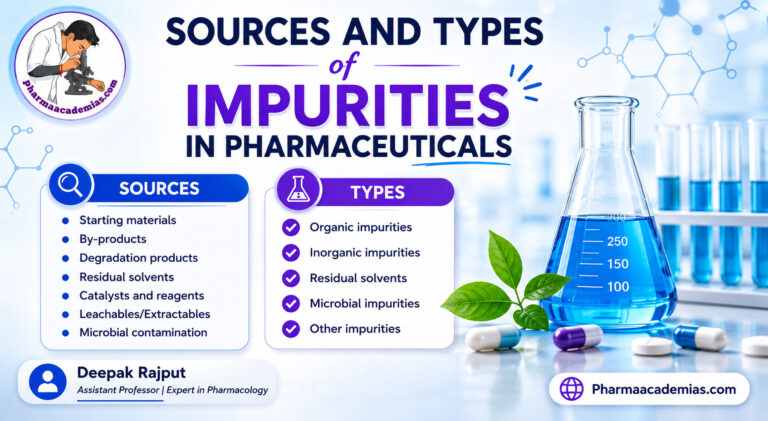
    Sources and Types of Impurities: In pharmaceutical sciences, the purity of drug substances and pharmaceutical formulations is one of the most important parameters for ensuring safety, efficacy, and quality. Pharmaceutical products are expected to meet strict standards because even very small amounts of unwanted substances may influence therapeutic activity or produce harmful effects. However, complete…
    Read More Sources and Types of Impurities in PharmaceuticalsContinue

  • Impurities in pharmaceutical analysis
    Unit 1 | Home

    Impurities in pharmaceutical analysis: Definition, types etc

    ByDeepak Rajput May 25, 2026May 25, 2026

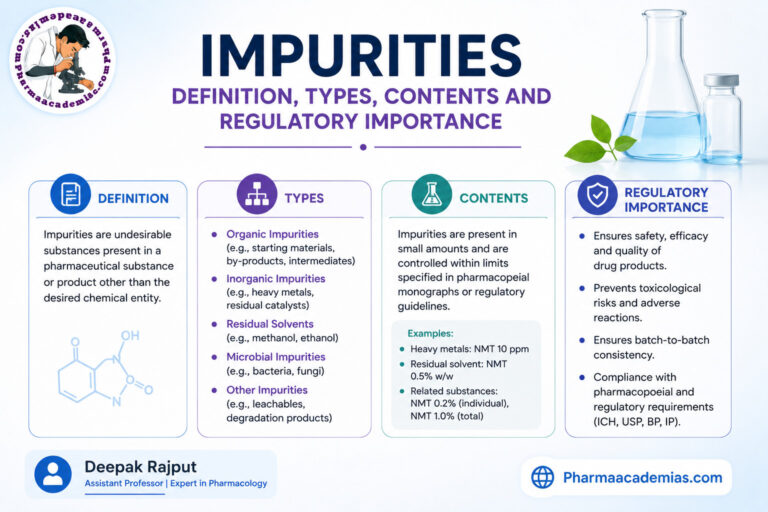
    Impurities in pharmaceutical analysis: In pharmaceutical sciences, medicinal chemistry, pharmaceutical analysis, and drug manufacturing, the purity of a drug substance or pharmaceutical product is one of the most critical determinants of its quality, safety, and therapeutic efficacy. No pharmaceutical substance can be considered absolutely pure because unwanted chemicals or foreign materials may remain associated with…

    Read More Impurities in pharmaceutical analysis: Definition, types etcContinue

  • Accuracy Precision and Significant Figures
    Unit 1 | Home

    Accuracy Precision and Significant Figures

    ByDeepak Rajput May 25, 2026May 25, 2026

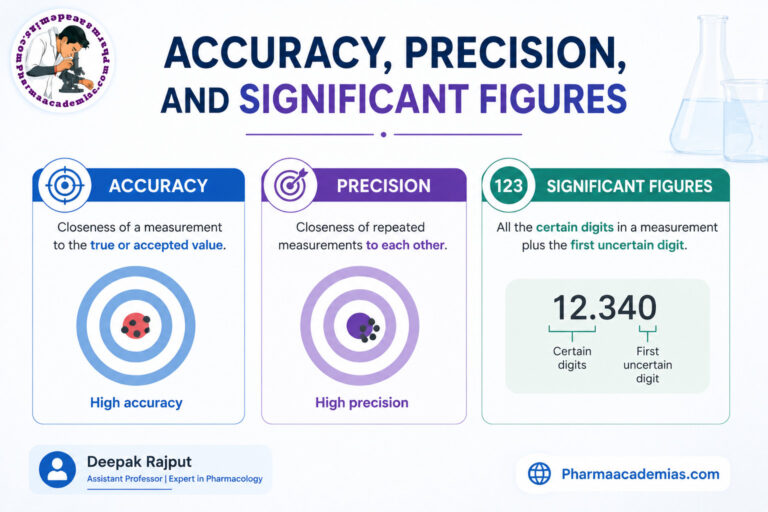
    Accuracy Precision and Significant Figures: In scientific research, pharmaceutical analysis, chemistry, pharmacology, and laboratory experimentation, the reliability of observations and measurements plays a fundamental role in determining the validity of experimental results. Every scientific conclusion depends heavily on how accurately and precisely data are collected and interpreted. Even the most advanced analytical techniques become meaningless…

    Read More Accuracy Precision and Significant FiguresContinue

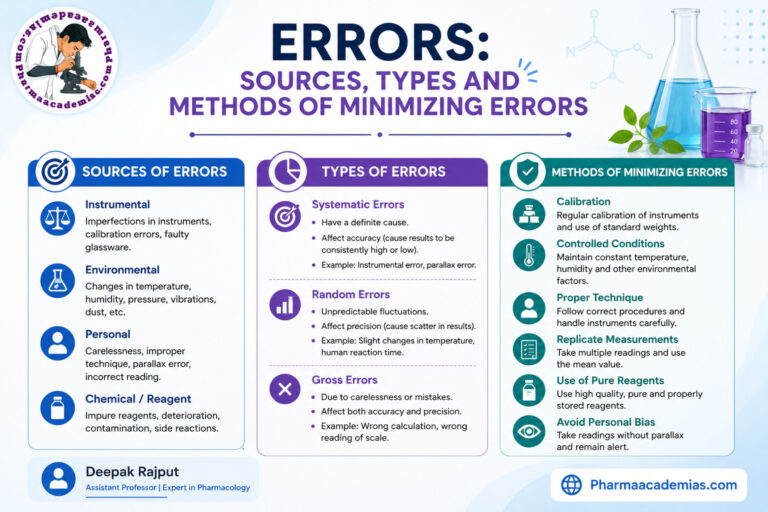
  • Errors in Pharmaceutical Analysis
    Unit 1

    Errors in Pharmaceutical Analysis: Errors Sources , types

    ByDeepak Rajput May 25, 2026May 25, 2026

    Errors in Pharmaceutical Analysis: In every field of science, medicine, pharmacy, engineering, and analytical experimentation, the term error occupies a central position because no experiment, observation, or measurement can ever be perfectly exact. Whenever a scientist performs an experiment, records data, weighs a chemical, measures a volume, or observes a biological response, there is always…

    Read More Errors in Pharmaceutical Analysis: Errors Sources , typesContinue

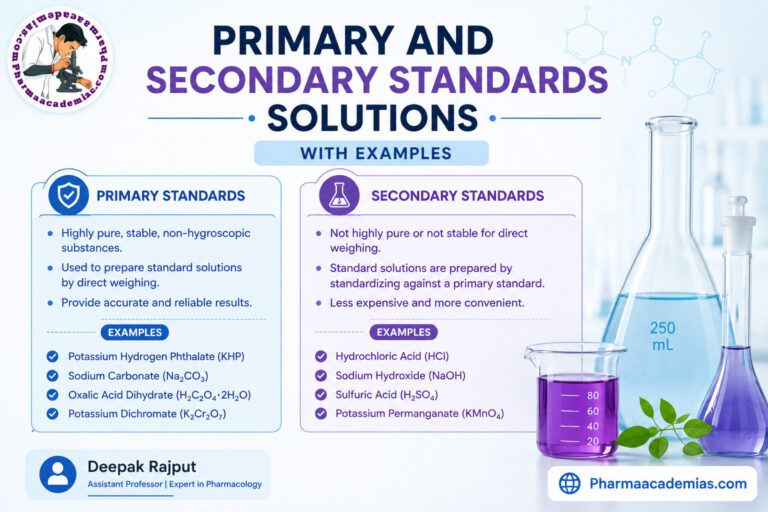
  • Primary and Secondary Standards Solutions
    Unit 1 | Home

    Primary and Secondary Standards Solutions with Examples

    ByDeepak Rajput May 25, 2026May 25, 2026

    Primary and Secondary Standards Solutions: Quantitative chemical analysis is one of the most important aspects of pharmaceutical analysis and analytical chemistry. In volumetric analysis or titration methods, accurate determination of concentration is essential for obtaining reliable analytical results. To achieve this accuracy, solutions of known concentration called standard solutions are used. Standard solutions are solutions…

    Read More Primary and Secondary Standards Solutions with ExamplesContinue

  • Methods of Expressing Strength of Solutions
    Unit 1 | Home

    Methods of Expressing Strength of Solutions

    ByDeepak Rajput May 25, 2026May 25, 2026

    Methods of Expressing Strength of Solutions: Solutions are homogeneous mixtures in which one or more substances, known as solutes, are dissolved in another substance called the solvent. In pharmaceutical sciences, chemistry, pharmacology, and clinical practice, solutions are extensively used for preparing medicines, reagents, injections, syrups, ophthalmic preparations, and laboratory formulations. The therapeutic efficacy and safety…

    Read More Methods of Expressing Strength of SolutionsContinue

  • Pharmaceutical Analysis
    Unit 1 | Home

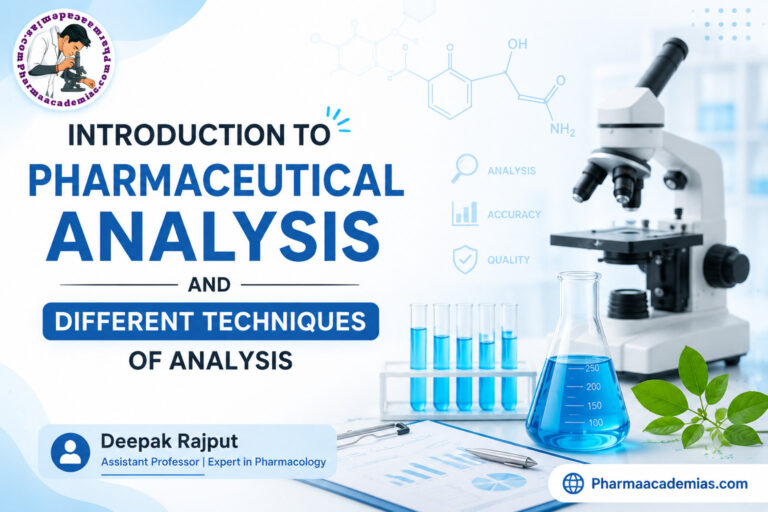
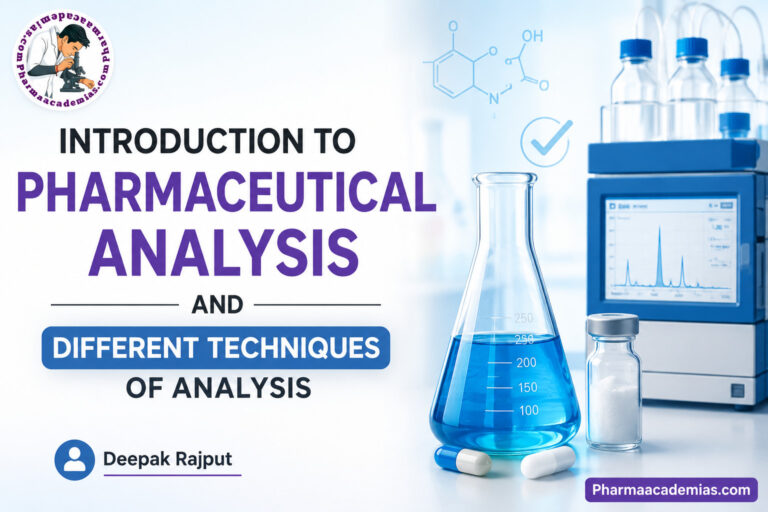
    Pharmaceutical Analysis & Different Techniques of analysis

    ByDeepak Rajput May 25, 2026May 25, 2026

    Pharmaceutical Analysis: Pharmaceutical analysis is one of the most important branches of pharmaceutical sciences. It deals with the identification, determination, separation, purification, and quantification of chemical substances used in the preparation of medicines and pharmaceutical products. The quality, purity, safety, and efficacy of pharmaceutical products depend greatly upon accurate analytical evaluation. Therefore, pharmaceutical analysis plays…

    Read More Pharmaceutical Analysis & Different Techniques of analysisContinue

  • Official and Non-Official Drugs
    Unit 1 | Home

    Official and Non-Official Drugs, Codified and Non-Codified Drugs

    ByDeepak Rajput May 23, 2026May 23, 2026

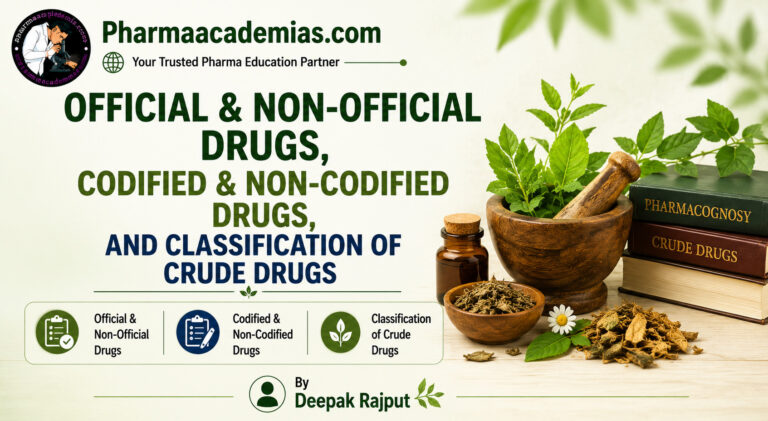
    Official and Non-Official Drugs: Pharmacognosy is the branch of pharmaceutical science that deals with crude drugs obtained from natural sources such as plants, animals, minerals, and microorganisms. Crude drugs have been used since ancient times for the treatment and prevention of diseases. As pharmaceutical science developed, it became necessary to organize, standardize, and classify these…

    Read More Official and Non-Official Drugs, Codified and Non-Codified DrugsContinue

  • American Herbal Pharmacopoeia
    Unit 1 | Home

    American Herbal Pharmacopoeia: Definition, History, Future

    ByDeepak Rajput May 23, 2026May 23, 2026

    American Herbal Pharmacopoeia; The use of herbal medicines has increased enormously throughout the world during the last few decades. People are increasingly turning toward natural therapies for maintaining health, preventing diseases, and managing chronic disorders. This growing popularity of herbal medicine created a strong need for proper scientific evaluation, quality control, authentication, and standardization of…

    Read More American Herbal Pharmacopoeia: Definition, History, FutureContinue

  • Unani Pharmacopoeia of India
    Unit 1 | Home

    Unani Pharmacopoeia of India: Definition, History, etc

    ByDeepak Rajput May 23, 2026May 23, 2026

    Unani Pharmacopoeia of India: India has a rich heritage of traditional systems of medicine, among which the Unani system occupies an important position. Unani medicine is one of the oldest healing systems in the world and is based on the principles of ancient Greek medicine. The system was later developed and enriched by Arab and…

    Read More Unani Pharmacopoeia of India: Definition, History, etcContinue

Page navigation

Previous PagePrevious 1 … 12 13 14 15 16 … 218 Next PageNext
  • About Pharmaacademias
  • Contact Us
  • Disclaimer
  • Privacy Policy
  • Terms and Conditions

© 2026 Pharmaacademias - WordPress Theme by Kadence WP

  • Home
  • Courses
    • B.Pharm Old Syllabus Notes (Archive)
      • SEM-I old
        • Human Anatomy and Physiology-I
          • Unit 1
          • Unit 2
          • Unit 3
          • Unit 4
          • Unit 5
        • Pharmaceutical Analysis
          • Unit 1
          • Unit 2
          • Unit 3
          • Unit 4
          • Unit 5
        • Pharmaceutics – 1
          • Unit 1
          • Unit 2
          • Unit 3
          • Unit 4
          • Unit 5
        • Pharmaceutical Inorganic Chemistry
          • Unit 1
          • Unit 2
          • Unit 3
          • Unit 4
          • Unit 5
        • Remedial Biology
          • Unit 1
          • rb Unit 2
      • SEM-II
        • Human Anatomy and Physiology – II
          • Unit 1
          • Unit 2
          • Unit 3
          • Unit 4
          • Unit 5
        • Biochemistry
          • Unit 1
          • Unit 2
          • Unit 3
          • Unit 4
          • Unit 5
        • Pathophysiology
          • Unit 1
          • Unit 2
          • Unit 3
          • Unit 4
          • Unit 5
        • Pharmaceutical Organic Chemistry I
          • poc1 Unit 1
      • SEM-III
        • Pharmaceutical Organic Chemistr II
          • Unit 1
          • Unit 2
          • Unit 3
          • Unit 4
          • Unit 5
        • Physical Pharmaceutics I
          • Unit 1
          • Unit 2
          • Unit 3
          • Unit 4
          • Unit 5
        • Pharmaceutical Microbiology
          • Unit 1
          • Unit 2
          • Unit 3
          • Unit 4
          • Unit 5
        • Pharmaceutical Engineering
          • Unit 1
          • Unit 2
          • Unit 3
          • Unit 4
          • Unit 5
        • Universal human values and professional ethics
          • value Unit 1
      • SEM-IV
        • Pharmaceutical Organic Chemistry III
          • POC 3 Unit 1
          • POC 3 Unit 2
        • Medicinal Chemistry – I
          • Unit 1
        • Physical Pharmaceutics – II
          • Unit 1
          • pp2 Unit 2
        • Pharmacology-1
          • Unit 1
          • Unit 2
          • Unit 3
          • Unit 4
          • Unit 5
        • Pharmacognosy and Phytochemistry – I
          • Unit 1
          • Unit 2
          • Unit 3
          • Unit 4
          • Unit 5
      • SEM-V
        • Medicinal Chemistry II
          • mc2 Unit 1
        • Industrial Pharmacy I
          • Unit 1
          • Unit 2
          • BIP Unit 3
          • BIP Unit 4
        • Pharmacology-II
          • Unit 1
          • Unit 2
          • colo2 Unit 3
        • Pharmacognosy & Phytochemistry II
          • Unit 1
          • Unit 2
          • cog Unit 3
        • Pharmaceutical Jurisprudence
          • Unit 1
          • Unit 2
          • Unit 3
          • juris Unit 4
      • SEM-VI
        • Medicinal Chemistry III
          • MC III Unit 1
        • Herbal Drug Technology
          • Unit 1
          • HDT Unit 2
        • Biopharmaceutics & Pharmacokinetics
          • kinet Unit 1
          • Kinet Unit 2
        • Pharmaceutical Biotechnology
          • Unit 1
          • Unit 2
          • biotech Unit 3
        • Pharmaceutical Quality Assurance
          • Unit 1
      • SEM- VII
        • Instrumental Method of Analysis
          • lysis Unit 1
          • Unit 3
          • Unit 4
          • Unit 5
        • Industrial Pharmacy-II
          • IP 2 Unit 1
        • Pharmacy Practice
          • Unit 1
          • pp Unit 2
        • Novel Drug Delivery System
          • Unit 1
          • ndds Unit 2
      • SEM-VIII
        • Biostatistics and Research Methodology
          • Unit 1
        • Pharmacovigilance
          • Unit-1
          • Unit 2
          • Unit 3
          • vigi Unit 4
        • Social and Preventive Pharmacy
          • Social Unit 1
    • B.Pharm New PCI Syllabus 2026
      • SEM-1 new
        • Basics of Python Programming for Pharmaceutical Sciences
          • Unit 1
          • Python Unit 2
        • General Pharmacy
          • Unit 1
          • Unit 2
          • Unit 3
        • Healthcare Psychology and Communication Skills
          • Unit 1
          • Unit 2
          • Unit 3
        • Human Anatomy, Physiology and Pathophysiology I
          • Unit 1
          • Unit 2
          • Unit 3
          • Unit 4
          • new HAP Unit 5
        • Introduction to Pharmacognosy
          • Unit 1
          • Unit 2
          • Unit 3
          • ITP Unit 4
        • Pharmaceutical Inorganic and Analytical Chemistry
          • Unit 1
          • Unit 2
          • new ana Unit 3
    • D.Pharma
      • Pharmaceutics
        • Chapter 1
        • Chapter 2
        • Chpater 3
        • Chpater 4
        • dceu Chapter 5
      • Pharmaceutical Chemistry
        • Chapter 1
        • Chapter 2
        • Chapter 3
        • Chapter 4
        • Chapter 5
        • dchem Chapter 6
      • Pharmacognosy
        • Chapter 3
        • Chapter 1
        • Chapter 2
        • Chapter 4
        • cogno Chapter 5
      • Human Anatomy and Physiology
        • Chapter 1
        • Chapter 2
        • Chapter 3
        • Chapter 4
        • Chapter 5
        • Chapter 6
        • Chapter 7
        • Chapter 8
        • Chapter 9
        • Chapter 10
        • Chapter 11
        • Chapter 12
        • Chapter 13
        • Chapter 14
        • Chapter 15
      • Social Pharmacy
        • Chapter 1
        • Chapter 2
        • Chapter 3
        • sp Chapter 4
      • Pharmacology
        • Chapter 1
        • Chapter 2
        • Chapter 3
        • Chapter 4
        • Chapter 5
        • Chapter 6
        • Chapter 7
        • Chapter 8
        • Chapter 9
        • Chapter 10
        • Chapter 11
        • Chapter 12
        • Chapter 13
      • Community pharmacy and management
        • Chapter 1
        • Chapter 2
        • Chapter 3
        • Chapter 5
        • Chapter 6
        • Chapter 7
        • cpm Chapter 8
      • Biochemistry & Clinical Pathology
        • Chapter 1
        • Chapter 2
        • Chapter 3
        • Chapter 4
        • Chapter 5
        • Chapter 6
        • Chapter 7
      • Pharmacotherapeutics
        • Chapter 1
        • the Chapter 2
      • Hospital and Clinical Pharmacy
        • Chapter 1
        • Chapter 2
        • hcp Chapter 3
      • Pharmacy law and Ethics
        • Chapter 1
        • Chapter 2
    • M.Pharm
      • Pharmacology Branch
    • Pharm D
      • Human Anatomy & Physiology (D)
        • Unit 1
        • Unit 2
        • Unit 3
        • hap Unit 4 (D)
        • Unit 5
        • Unit 6
        • Unit 7
        • Unit 8
        • Unit 9
        • Unit 10
        • Unit 11
        • Unit 12
        • hap Unit 13
    • DMLT
      • dmlt 1 year
        • Anatomy and Physiology
  • Study Material
    • Practicals
    • Notes pdf
    • Previous year papers
    • Books
  • Blog
  • Jobs
  • Syllabus
Search