
Impurities in pharmaceutical analysis: In pharmaceutical sciences, medicinal chemistry, pharmaceutical analysis, and drug manufacturing, the purity of a drug substance or pharmaceutical product is one of the most critical determinants of its quality, safety, and therapeutic efficacy. No pharmaceutical substance can be considered absolutely pure because unwanted chemicals or foreign materials may remain associated with the drug during various stages of synthesis, formulation, storage, packaging, or transportation. These unwanted substances are known as impurities.
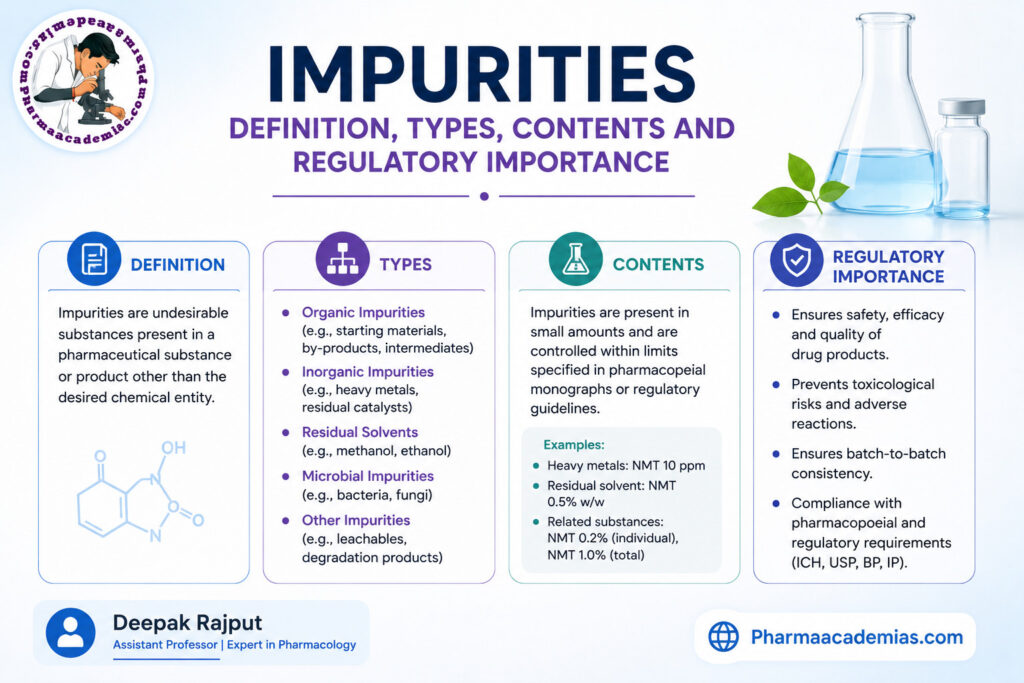
The study of impurities occupies a central position in pharmaceutical quality control because impurities can influence the safety, stability, effectiveness, and shelf life of pharmaceutical products. Even trace quantities of certain impurities may produce toxic effects, allergic reactions, carcinogenicity, organ damage, or therapeutic failure. Therefore, pharmaceutical industries and regulatory authorities place strict emphasis on the identification, control, and monitoring of impurities in drug substances and finished pharmaceutical products.
The increasing complexity of modern drug synthesis, biotechnology-derived products, and highly potent pharmaceutical compounds has further highlighted the importance of impurity profiling and regulatory monitoring. Today, impurity analysis is regarded as an essential component of drug development, manufacturing, quality assurance, and regulatory approval.
Impurities in pharmaceutical analysis
Impurities may be defined as unwanted chemicals, foreign substances, or contaminants that remain associated with pharmaceutical substances during manufacturing, storage, or degradation.
According to pharmaceutical terminology, an impurity is any component present in a drug substance or finished pharmaceutical product other than the intended active pharmaceutical ingredient (API) or formulation excipients.
Impurities may originate from raw materials, intermediates, reagents, catalysts, solvents, degradation processes, microbial contamination, packaging interactions, or environmental exposure.
The presence of impurities does not necessarily indicate poor manufacturing practice because complete elimination of all impurities is practically impossible. However, impurities must remain within acceptable limits established by pharmacopoeias and regulatory agencies.
Importance of Studying Impurities
The study of impurities is essential because impurities can significantly affect the quality, efficacy, and safety of pharmaceutical products. Certain impurities may be pharmacologically inactive, while others may possess toxicological or biological activity.
Some impurities can reduce drug potency by interfering with the therapeutic action of the active ingredient. Others may alter drug stability, resulting in discoloration, precipitation, degradation, or reduced shelf life.
Toxic impurities are particularly dangerous because even small quantities may cause severe adverse effects. Certain impurities may produce mutagenic, teratogenic, carcinogenic, hepatotoxic, or nephrotoxic effects. Historical pharmaceutical disasters have demonstrated the severe consequences of inadequate impurity control.
Impurity profiling is therefore necessary for:
- Ensuring drug safety
- Maintaining therapeutic efficacy
- Establishing product stability
- Meeting regulatory standards
- Preventing toxic effects
- Improving manufacturing quality
- Supporting regulatory approval
In pharmaceutical industries, impurity analysis forms an integral part of quality control and quality assurance programs.
Types of Impurities in pharmaceutical analysis
Impurities are classified in several ways depending on their origin, chemical nature, or method of formation. The major types of impurities include organic impurities, inorganic impurities, residual solvents, degradation products, microbial impurities, and toxic impurities.
Organic Impurities
Organic impurities are among the most commonly encountered impurities in pharmaceutical substances. These impurities arise mainly during the synthesis, purification, or storage of drug substances.
Organic impurities may include:
- Starting materials
- Reaction intermediates
- By-products
- Degradation products
- Unreacted reagents
- Synthetic side products
During chemical synthesis, several side reactions may occur simultaneously along with the desired reaction. These side reactions often produce unwanted organic compounds that remain associated with the final product.
For example, incomplete chemical reactions may leave traces of starting materials in the final drug substance. Similarly, oxidation, hydrolysis, photolysis, or thermal decomposition during storage may produce degradation products.
Organic impurities are particularly important because many possess biological activity and may influence therapeutic response or toxicity.
Inorganic Impurities
Inorganic impurities arise mainly from manufacturing processes and handling procedures. These impurities generally originate from reagents, catalysts, filter aids, heavy metals, salts, or equipment used during drug synthesis.
Examples include:
- Heavy metals
- Residual catalysts
- Sulfates
- Chlorides
- Iron particles
- Ash residues
- Filter materials
Heavy metal contamination is especially important because metals such as lead, mercury, arsenic, cadmium, and chromium may produce severe toxic effects even at very low concentrations.
Inorganic impurities may also enter pharmaceutical products through water used during manufacturing, corrosion of equipment, or environmental contamination.
Pharmacopoeias therefore prescribe strict limits for inorganic impurities in pharmaceutical preparations.
Residual Solvents
Residual solvents are volatile organic chemicals used during manufacturing or purification processes that remain in the final pharmaceutical product.
These solvents are widely used in:
- Drug synthesis
- Extraction
- Purification
- Crystallization
- Chromatographic separation
Although solvents facilitate manufacturing processes, their residues may pose health hazards if present beyond permissible limits.
Examples of residual solvents include:
- Methanol
- Ethanol
- Acetone
- Benzene
- Chloroform
- Toluene
- Hexane
Certain residual solvents are highly toxic, carcinogenic, or neurotoxic. For instance, benzene is a known carcinogen and must be strictly controlled.
Residual solvents are classified according to their toxicity risk by the International Council for Harmonisation of Technical Requirements for Pharmaceuticals for Human Use.
Classification of Residual Solvents
Class 1 Solvents
These solvents should be avoided because they possess significant toxic or carcinogenic potential.
Examples:
- Benzene
- Carbon tetrachloride
Class 2 Solvents
These solvents should be limited because of their inherent toxicity.
Examples:
- Methanol
- Acetonitrile
- Toluene
Class 3 Solvents
These solvents possess relatively low toxic potential.
Examples:
- Ethanol
- Acetone
- Acetic acid
Degradation Products
Degradation products are impurities formed when pharmaceutical substances undergo chemical decomposition during storage or handling.
Drug degradation may occur due to:
- Heat
- Light
- Moisture
- Oxygen
- pH changes
- Microbial action
Common degradation reactions include:
- Hydrolysis
- Oxidation
- Reduction
- Racemization
- Photolysis
For example, aspirin undergoes hydrolysis to form salicylic acid and acetic acid. Similarly, epinephrine may oxidize upon exposure to air and light.
Degradation products are important because they may reduce therapeutic efficacy or produce toxic effects.
Stability testing is therefore performed to identify degradation pathways and establish proper storage conditions.
Microbial Impurities
Microbial impurities arise due to contamination by microorganisms such as bacteria, fungi, yeasts, or viruses.
These impurities are especially important in:
- Injectable preparations
- Ophthalmic products
- Biological products
- Herbal medicines
- Sterile formulations
Microbial contamination may occur from:
- Raw materials
- Water
- Air
- Personnel
- Manufacturing equipment
- Packaging systems
Microbial growth may produce toxins, alter drug composition, reduce stability, and endanger patient safety.
Sterility testing and microbial limit testing are therefore essential components of pharmaceutical quality control.
Toxic Impurities
Certain impurities possess significant toxicological properties and may produce harmful physiological effects even at trace concentrations.
These impurities may include:
- Heavy metals
- Genotoxic compounds
- Carcinogens
- Residual pesticides
- Nitrosamines
The discovery of nitrosamine contamination in several pharmaceutical products highlighted the global importance of impurity monitoring.
Toxic impurities require extremely strict regulatory control because long-term exposure may result in cancer, organ damage, genetic mutations, or reproductive toxicity.
Contents of Impurities in Pharmaceutical Substances
The term “contents of impurities” refers to the quantity or concentration of impurities present in pharmaceutical substances or formulations. Regulatory authorities establish permissible impurity limits based on toxicological evaluation, daily drug exposure, route of administration, and duration of therapy.
Impurity content is generally expressed as:
- Percentage (%)
- Parts per million (ppm)
- Micrograms per gram
- Milligrams per dose
Pharmacopoeias and regulatory guidelines specify acceptable limits for various impurities.
For example:
- Heavy metals may be permitted only in trace quantities.
- Residual solvents must remain below specified ppm limits.
- Degradation products must remain within stability specifications.
Analytical techniques such as chromatography, spectroscopy, electrophoresis, and mass spectrometry are used to determine impurity levels accurately.
Impurity Profiling
Impurity profiling refers to the identification, characterization, quantification, and qualification of impurities present in pharmaceutical substances.
It involves:
- Detection of impurities
- Structural characterization
- Determination of impurity source
- Toxicological assessment
- Quantification within permissible limits
Impurity profiling is an essential part of modern pharmaceutical development because regulatory approval depends heavily on detailed impurity data.
Advanced analytical techniques used for impurity profiling include:
- High Performance Liquid Chromatography (HPLC)
- Gas Chromatography (GC)
- Mass Spectrometry (MS)
- Nuclear Magnetic Resonance (NMR)
- Infrared Spectroscopy (IR)
- Capillary Electrophoresis
Regulatory Importance of Impurities
The regulatory importance of impurities has increased tremendously with the advancement of pharmaceutical sciences and global harmonization standards. Regulatory authorities require detailed impurity profiles to ensure drug safety, efficacy, and quality before granting marketing approval.
Organizations such as:
- World Health Organization
- United States Food and Drug Administration
- European Medicines Agency
- International Council for Harmonisation of Technical Requirements for Pharmaceuticals for Human Use
have established strict guidelines for impurity control and reporting.
ICH Guidelines for Impurities
The International Council for Harmonisation of Technical Requirements for Pharmaceuticals for Human Use has developed internationally accepted guidelines for impurity evaluation.
Major impurity-related guidelines include:
- ICH Q3A: Impurities in new drug substances
- ICH Q3B: Impurities in new drug products
- ICH Q3C: Residual solvents
- ICH Q3D: Elemental impurities
- ICH M7: Assessment of mutagenic impurities
These guidelines specify:
- Reporting thresholds
- Identification thresholds
- Qualification thresholds
- Permissible daily exposure limits
Pharmaceutical companies must comply with these requirements to obtain regulatory approval.
Regulatory Thresholds
Regulatory agencies establish threshold levels above which impurities must be reported, identified, and toxicologically qualified.
These thresholds depend on:
- Daily dose
- Duration of therapy
- Toxicological profile
- Route of administration
If impurity levels exceed regulatory limits, additional toxicological studies may be required.
Role of Pharmacopoeias
Pharmacopoeias such as:
- Indian Pharmacopoeia Commission
- United States Pharmacopeial Convention
- British Pharmacopoeia Commission
provide official standards and impurity limits for pharmaceutical substances.
These standards help ensure consistency, quality, and patient safety worldwide.
Methods for Control of Impurities
Impurity control involves careful monitoring throughout the manufacturing and storage process.
Important methods include:
- Selection of high-purity raw materials
- Proper manufacturing practices
- Validation of analytical methods
- Controlled storage conditions
- Stability testing
- Routine quality control testing
- Environmental monitoring
- Equipment maintenance
Implementation of World Health Organization Good Manufacturing Practices (GMP) further helps minimize contamination and impurity formation.
Consequences of Uncontrolled Impurities
Failure to control impurities may result in:
- Toxicity
- Drug recalls
- Product instability
- Therapeutic failure
- Regulatory rejection
- Loss of public confidence
- Legal consequences
- Financial losses for manufacturers
Several global drug recalls have occurred due to contamination with carcinogenic impurities such as nitrosamines.
Therefore, impurity monitoring is considered one of the most critical aspects of pharmaceutical quality assurance.
Conclusion
Impurities are unwanted substances present in pharmaceutical products that may arise during synthesis, formulation, storage, or degradation. Although complete elimination of impurities is practically impossible, their presence must remain within scientifically and legally acceptable limits to ensure drug safety and therapeutic effectiveness.
Impurities may be organic, inorganic, residual solvents, degradation products, microbial contaminants, or toxic substances. Their identification, characterization, quantification, and control are essential components of pharmaceutical analysis and quality assurance.
Modern pharmaceutical regulations place strong emphasis on impurity profiling because impurities can significantly influence drug stability, efficacy, and patient safety. International guidelines established by organizations such as the International Council for Harmonisation of Technical Requirements for Pharmaceuticals for Human Use, World Health Organization, and United States Food and Drug Administration ensure global harmonization of impurity standards.
Thus, the study of impurities is indispensable in pharmaceutical sciences and plays a vital role in the development of safe, effective, stable, and high-quality medicines for public health.