
Accuracy Precision and Significant Figures: In scientific research, pharmaceutical analysis, chemistry, pharmacology, and laboratory experimentation, the reliability of observations and measurements plays a fundamental role in determining the validity of experimental results. Every scientific conclusion depends heavily on how accurately and precisely data are collected and interpreted. Even the most advanced analytical techniques become meaningless if measurements are unreliable or improperly expressed. Therefore, the concepts of accuracy, precision, and significant figures form the foundation of scientific measurement and analytical science.
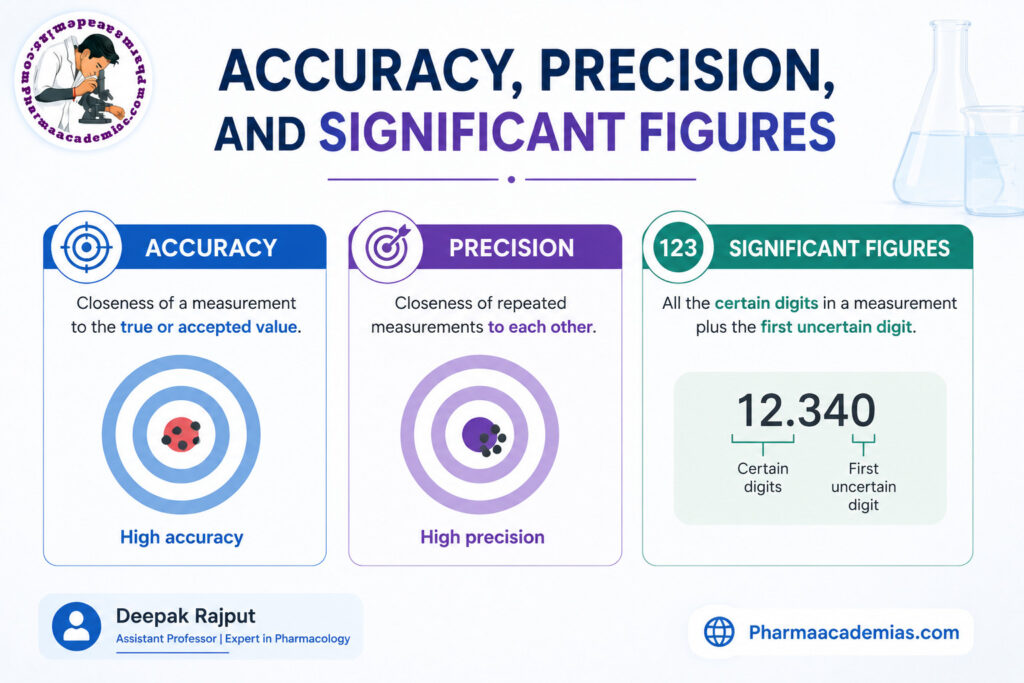
These concepts are especially important in pharmaceutical sciences because even a minor deviation in drug concentration, dose calculation, or analytical measurement may lead to therapeutic failure, toxicity, or incorrect research findings. Hence, understanding the principles of accuracy, precision, and significant figures is essential for obtaining dependable and reproducible results.
Accuracy Precision and Significant Figures
Accuracy
Accuracy refers to the closeness of a measured value to the true, accepted, or actual value. It indicates how correct or valid an experimental measurement is. A measurement is considered accurate when it closely agrees with the standard or true value.
In analytical chemistry and pharmaceutical analysis, accuracy reflects the ability of a method or instrument to produce results that are free from significant systematic error. Accurate measurements provide confidence that the obtained result genuinely represents the actual quantity being measured.
For example, suppose the true weight of a chemical sample is 100 mg. If an analytical balance gives readings such as 99.9 mg, 100.1 mg, or 100.0 mg, the measurements are considered highly accurate because they are very close to the true value.
Accuracy is therefore associated primarily with correctness.
Importance of Accuracy
Accuracy is extremely important in scientific and pharmaceutical work because incorrect measurements may produce false interpretations and unsafe outcomes. In pharmaceutical industries, accurate weighing of active pharmaceutical ingredients ensures proper dosage formulation and therapeutic effectiveness. In clinical laboratories, accurate diagnostic results are necessary for proper treatment decisions.
In research studies, accurate data strengthen the reliability and credibility of scientific conclusions. Regulatory authorities such as the World Health Organization and United States Food and Drug Administration emphasize accuracy as an essential parameter in analytical method validation and quality control.
Factors Affecting Accuracy
Several factors can influence the accuracy of measurements. Instrumental defects, improper calibration, environmental conditions, human errors, contaminated samples, and poor methodology may all reduce accuracy.
For instance, a balance that is not calibrated properly may consistently give readings higher than the actual value. Similarly, using impure reagents in analytical experiments may alter the observed results and reduce measurement accuracy.
Environmental conditions such as temperature, humidity, and vibration may also affect sensitive analytical instruments.
Determination of Accuracy
Accuracy is often determined by comparing experimental results with a known standard or reference value. It may be expressed in terms of absolute error, relative error, or percentage error.
The percentage error can be calculated using the formula:

A smaller percentage error indicates greater accuracy.
Precision
Precision refers to the closeness of repeated measurements to one another under identical experimental conditions. It indicates the reproducibility or consistency of measurements.
A set of measurements may be highly precise even if they are not accurate. Precision focuses on the degree of agreement among repeated observations rather than closeness to the true value.
For example, if the true value of a sample is 100 mg and repeated measurements give values such as 95.1 mg, 95.2 mg, and 95.1 mg, the measurements are very close to one another and therefore highly precise, although they are not accurate because they deviate from the true value.
Precision is therefore associated mainly with consistency and reproducibility.
Importance of Precision
Precision is essential because reproducible measurements indicate reliability and stability of analytical procedures. In pharmaceutical manufacturing, precise formulation processes ensure uniform drug content in tablets, capsules, and injections.
In research experiments, precision helps scientists determine whether observed variations are due to experimental error or actual biological or chemical differences. Highly precise methods produce dependable and repeatable results.
Precision is also critical in pharmacological assays, spectroscopic analysis, chromatography, and quality control testing.
Types of Precision
Precision may be classified into different categories depending on the experimental conditions.
Repeatability: Repeatability refers to precision under the same operating conditions over a short interval of time. It involves the same analyst, same equipment, same laboratory, and same procedure.
Intermediate Precision: Intermediate precision evaluates reproducibility within the same laboratory but under varying conditions such as different days, analysts, or instruments.
Reproducibility: Reproducibility refers to precision obtained between different laboratories using the same method and sample.
Factors Affecting Precision
Precision may be affected by random errors arising from fluctuations in temperature, electrical noise, vibration, observer variability, or inconsistent experimental conditions.
Poor instrument sensitivity, unstable reagents, and inadequate procedural control may also reduce precision.
Unlike systematic errors, random errors mainly influence precision rather than accuracy.
Statistical Expression of Precision
Precision is commonly evaluated statistically using standard deviation, variance, and coefficient of variation.
Lower standard deviation indicates greater precision because the measurements are closely grouped around the mean.
The coefficient of variation is calculated as:

Smaller CV values represent higher precision.
Difference Between Accuracy and Precision
Accuracy and precision are closely related but fundamentally different concepts. Accuracy refers to correctness, whereas precision refers to consistency.
An experiment may be:
- Accurate but not precise
- Precise but not accurate
- Both accurate and precise
- Neither accurate nor precise
For example, if repeated measurements are scattered around the true value, the experiment may be accurate on average but not precise. Conversely, if measurements are closely grouped but far from the true value, the experiment is precise but inaccurate.
The ideal analytical method should possess both high accuracy and high precision.
Significant Figures
Significant figures are the meaningful digits in a number that convey the precision of a measurement. They include all certain digits plus the first uncertain digit.
In scientific measurements, no instrument can provide perfectly exact values. Therefore, significant figures are used to indicate the degree of certainty associated with a measured quantity.
For example, if a balance measures a sample as 5.62 g, the digits 5 and 6 are certain, while 2 is the estimated uncertain digit. Thus, the measurement contains three significant figures.
Significant figures prevent overestimation of measurement accuracy and ensure proper scientific reporting.
Importance of Significant Figures
Significant figures are extremely important in laboratory calculations because they reflect the reliability and precision of experimental measurements.
Reporting excessive digits may imply false precision, while reporting too few digits may result in loss of important information.
For example, writing the result of a measurement as 25.678945 g when the balance can only measure up to 0.01 g is scientifically incorrect because the extra digits are meaningless.
Significant figures help maintain consistency and honesty in scientific communication.
Rules for Determining Significant Figures
Several rules are used to identify significant figures in numerical values.
Non-Zero Digits
All non-zero digits are always significant.
Examples:
- 456 contains 3 significant figures
- 98.76 contains 4 significant figures
Zeros Between Non-Zero Digits
Zeros located between non-zero digits are significant.
Examples:
- 1002 contains 4 significant figures
- 50.07 contains 4 significant figures
Leading Zeros
Zeros placed before non-zero digits are not significant because they only indicate the position of the decimal point.
Examples:
- 0.0056 contains 2 significant figures
- 0.00081 contains 2 significant figures
Trailing Zeros in Decimal Numbers
Zeros appearing after a decimal point are significant.
Examples:
- 5.600 contains 4 significant figures
- 0.0200 contains 3 significant figures
Trailing Zeros in Whole Numbers
Trailing zeros in whole numbers without decimal points may or may not be significant depending on notation.
For example:
- 1500 may contain 2, 3, or 4 significant figures
- 1500 clearly indicates 4 significant figures
Scientific notation is often used to avoid ambiguity.
Scientific Notation and Significant Figures
Scientific notation expresses numbers in the form:
N × 10n
where (N) is a number between 1 and 10, and (n) is an integer.
For example:
- 0.00045 = 4.5 ×10⁻⁴
- 56000 = 5.6 × 10⁴
Scientific notation clearly indicates the number of significant figures and simplifies calculations involving very large or very small numbers.
Rounding Off Significant Figures
When calculations produce more digits than justified, the result should be rounded according to standard rules.
If the digit to be dropped is less than 5, the preceding digit remains unchanged.
Example:
- 5.432 rounded to 3 significant figures becomes 5.43
If the digit to be dropped is greater than or equal to 5, the preceding digit increases by one.
Example:
- 7.896 rounded to 3 significant figures becomes 7.90
Significant Figures in Calculations
The number of significant figures in calculated results depends on the mathematical operation performed.
Addition and Subtraction
In addition and subtraction, the result should contain the same number of decimal places as the measurement with the fewest decimal places.
Example:
12.45 + 3.2 = 15.65
The correct answer should be:
15.7
Multiplication and Division
In multiplication and division, the result should contain the same number of significant figures as the measurement with the fewest significant figures.
Example:
4.56 × 1.2 = 5.472
The correct answer becomes:
5.5
because 1.2 contains only two significant figures.
Relationship Between Accuracy, Precision, and Significant Figures
Accuracy, precision, and significant figures are closely interconnected concepts in scientific analysis.
Accuracy reflects how close measurements are to the true value. Precision reflects the consistency of repeated measurements. Significant figures indicate the certainty and reliability of recorded data.
A highly accurate and precise instrument usually allows reporting of measurements with greater significant figures. Conversely, poor accuracy or precision limits the meaningful digits that can be reported.
Thus, proper use of significant figures ensures that reported results honestly represent the true capability of the measurement system.
Applications in Pharmaceutical and Analytical Sciences
These concepts are widely applied in pharmaceutical industries, quality control laboratories, clinical research, analytical chemistry, pharmacology, and biotechnology.
During tablet manufacturing, accurate and precise weighing of ingredients ensures dose uniformity. In spectrophotometric analysis, precise absorbance readings improve concentration determination. In pharmacological studies, accurate dose administration ensures valid biological responses.
Significant figures are important in reporting assay results, dissolution studies, calibration data, and statistical analysis.
Regulatory guidelines for analytical method validation require demonstration of both accuracy and precision to ensure reliability of pharmaceutical products.
Conclusion
Accuracy, precision, and significant figures are essential principles of scientific measurement and analytical experimentation. Accuracy refers to the closeness of a measured value to the true value, while precision describes the reproducibility and consistency of repeated measurements. Significant figures represent the meaningful digits that communicate the certainty of a measurement.
Together, these concepts ensure reliability, credibility, and scientific validity of experimental data. In pharmaceutical sciences and laboratory practice, proper understanding and application of these principles are crucial for maintaining product quality, patient safety, and research integrity.
Therefore, mastery of accuracy, precision, and significant figures is fundamental for every scientist, pharmacist, researcher, and laboratory professional engaged in scientific investigation and analytical work.