Errors in Pharmaceutical Analysis: In every field of science, medicine, pharmacy, engineering, and analytical experimentation, the term error occupies a central position because no experiment, observation, or measurement can ever be perfectly exact. Whenever a scientist performs an experiment, records data, weighs a chemical, measures a volume, or observes a biological response, there is always some degree of deviation between the observed value and the true or accepted value. This deviation is known as an error. Errors are unavoidable components of scientific work, and understanding them is essential for obtaining reliable, reproducible, and meaningful results.
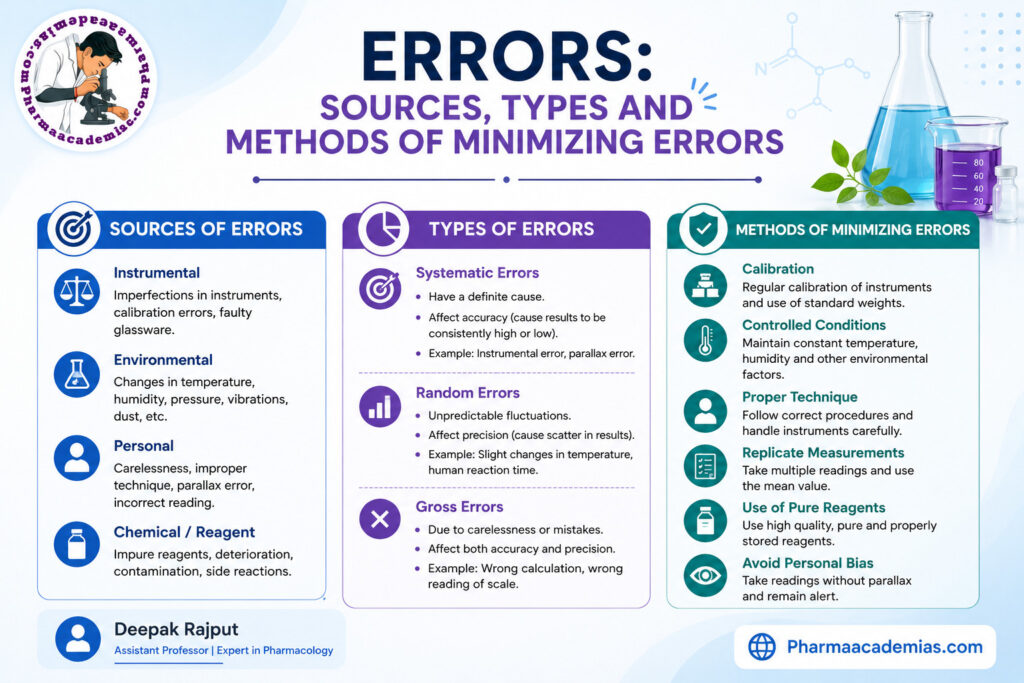
In pharmaceutical sciences and laboratory investigations, the importance of errors becomes even greater because incorrect observations may lead to wrong conclusions, inaccurate formulations, improper diagnosis, therapeutic failure, or unsafe products. Therefore, the study of errors, their sources, their classification, and methods for minimizing them forms the foundation of experimental accuracy and quality assurance.
An error does not necessarily mean a mistake caused by negligence or incompetence. In scientific terminology, an error simply refers to the difference between the measured value and the actual or true value. Even highly skilled scientists working with sophisticated instruments encounter errors because every measuring system has limitations. Thus, errors are natural phenomena associated with experimental processes.
Mathematically, error may be expressed as:
Error = Measured Value − True Value
The magnitude and direction of this difference determine the reliability and precision of the experiment. If the deviation is very small, the measurement is considered accurate. If the deviation is large, the reliability of the experiment decreases.
Errors in Pharmaceutical Analysis
Sources of Errors
Errors may arise from numerous sources during experimentation or measurement. These sources may be related to instruments, environmental conditions, human limitations, methodological problems, or sample characteristics. Understanding the origin of errors helps researchers identify weak points in the experimental process and improve the quality of results.
Instrumental Sources of Errors
One of the most common sources of error is the measuring instrument itself. Every instrument possesses certain limitations due to imperfect design, wear and tear, manufacturing defects, or calibration problems. Even highly advanced analytical devices such as spectrophotometers, chromatographs, pH meters, balances, and microscopes may produce inaccurate readings if they are not properly maintained or calibrated.
For example, an analytical balance that is improperly calibrated may consistently show a higher or lower weight than the actual mass. Similarly, a thermometer with a defective mercury column may give inaccurate temperature readings. Electrical fluctuations in instruments may also affect measurements and introduce deviations.
Instruments may additionally develop mechanical friction, zero errors, sensitivity loss, or drift over time. These problems can gradually reduce measurement accuracy and lead to systematic deviations in experimental observations.
Personal or Human Sources of Errors
Human limitations are another major source of errors in laboratory work. These errors arise because the observer may incorrectly read, record, calculate, or interpret data. Such errors are often influenced by fatigue, carelessness, lack of concentration, insufficient training, poor eyesight, or misunderstanding of procedures.
For instance, while measuring liquid volume using a burette or pipette, an observer may incorrectly read the meniscus level due to parallax error. Similarly, during titration experiments, subjective judgment regarding the endpoint color change may vary from person to person.
Calculation mistakes during data analysis also contribute significantly to errors. In pharmaceutical calculations, a small mathematical error may lead to major inaccuracies in drug dosage or concentration. Human errors may additionally occur during sample labeling, reagent preparation, dilution procedures, or timing of experimental steps.
Environmental Sources of Errors
Environmental conditions strongly influence the accuracy of scientific measurements. Variations in temperature, humidity, pressure, vibration, dust, electromagnetic interference, and air currents may alter instrument performance or sample characteristics.
For example, analytical balances are highly sensitive to air movement and vibration. Similarly, temperature changes may affect the volume of liquids, reaction rates, and electrical resistance in instruments. Hygroscopic substances may absorb moisture from the atmosphere, causing changes in weight and composition.
In microbiological or pharmacological studies, contamination from the environment may significantly alter experimental results. Exposure to light may degrade photosensitive drugs or chemicals, thereby introducing additional errors.
Thus, maintaining controlled environmental conditions is essential for reducing experimental inaccuracies.
Methodological Sources of Errors
Errors may also arise from defects in experimental design or methodology. If the procedure itself is inappropriate, incomplete, or poorly standardized, the results obtained may not represent the true outcome.
For example, using an unsuitable analytical method for a particular drug may result in inaccurate estimation of its concentration. Improper sampling techniques may produce samples that are not representative of the whole population. Inadequate reaction time, incorrect reagent concentration, or incomplete extraction procedures may further contribute to methodological errors.
Lack of standardization between laboratories may additionally produce variation in results. Therefore, validated and standardized procedures are extremely important in scientific experimentation.
Sample-Related Sources of Errors
The nature and quality of the sample itself can also introduce errors. Biological samples such as blood, urine, plasma, or tissue may undergo degradation during storage or transportation. Similarly, pharmaceutical products may deteriorate due to improper handling, heat, moisture, or microbial contamination.
Non-homogeneous samples are another common problem. If the sample composition varies throughout the material, the measured portion may not accurately represent the entire sample. Improper mixing or incomplete dissolution can therefore lead to inaccurate results.
Types of Errors
Errors are classified into several categories depending on their origin, nature, and behavior. The major types of errors include systematic errors, random errors, and gross errors.
Systematic Errors
Systematic errors are reproducible and consistent deviations that occur in the same direction each time a measurement is performed. These errors either increase or decrease the measured value continuously and predictably. Since they follow a definite pattern, systematic errors are often easier to identify and correct compared to random errors.
Systematic errors affect the accuracy of measurements. They cause the measured values to differ consistently from the true value.
Systematic errors may arise due to faulty instruments, improper calibration, flawed experimental methods, or personal bias of the observer.
For example, if a balance always measures 5 mg higher than the actual weight, every measurement will contain the same positive deviation. Similarly, if a thermometer consistently reads 2°C lower than the actual temperature, all temperature readings will be affected systematically.
Systematic errors are further divided into several categories.
Instrumental Errors
These errors occur due to defects or improper calibration of measuring instruments. Mechanical wear, electrical instability, zero shift, and manufacturing imperfections may all contribute to instrumental errors.
For instance, a pH meter with an uncalibrated electrode may continuously provide incorrect pH values. Instrumental errors can usually be minimized through regular calibration, maintenance, and quality control procedures.
Personal Errors
Personal errors arise from consistent mistakes made by the observer. These may include incorrect reading habits, reaction time delays, subjective judgments, or observational bias.
For example, one observer may consistently record titration endpoints earlier than another observer. Similarly, parallax error caused by viewing a scale from the wrong angle is considered a personal systematic error.
Method Errors
Method errors result from shortcomings in the experimental procedure or analytical technique. These errors occur when the selected method cannot accurately measure the desired parameter.
For example, interference from other chemicals during spectrophotometric analysis may cause consistently higher absorbance values. Similarly, incomplete chemical reactions may lead to lower product yield measurements.
Random Errors
Random errors are unpredictable variations that occur due to uncontrollable fluctuations in experimental conditions. Unlike systematic errors, random errors do not occur in a fixed direction. They may increase or decrease measurements irregularly.
These errors arise from small uncontrollable changes in temperature, electrical noise, vibration, observer reaction time, or biological variability. Random errors affect the precision of measurements rather than accuracy.
For example, repeated measurements of the same sample may show slight differences even under identical conditions. A balance may fluctuate by a few milligrams due to air currents or vibration. Human reaction time during stopwatch measurements may also vary slightly.
Random errors cannot be completely eliminated, but they can be reduced statistically by taking multiple measurements and calculating the average value.
The presence of random errors causes scatter in experimental data. Greater scatter indicates lower precision, whereas closely grouped values indicate higher precision.
Gross Errors
Gross errors are serious mistakes caused mainly by human negligence, carelessness, or procedural failure. These errors are usually large and abnormal compared to other experimental deviations.
Examples include incorrect calculation, misplacement of decimal points, using wrong reagents, recording data improperly, contamination of samples, or reading the wrong scale.
Gross errors may severely distort experimental results and often render the data invalid. Unlike random or systematic errors, gross errors are generally avoidable through proper attention, training, and verification procedures.
Because gross errors are irregular and obvious, they are often identified during data review or statistical analysis. Suspicious values are commonly referred to as outliers.
Absolute Error
Absolute error refers to the numerical difference between the observed value and the true value, irrespective of sign.
Mathematically:
Absolute Error = Measured Value − True Value
Absolute error provides an indication of the magnitude of deviation in a measurement.
Relative Error
Relative error expresses the absolute error in relation to the true value and is usually represented as a fraction or percentage.

Relative error helps compare the accuracy of measurements of different magnitudes.
Percentage Error
Percentage error is obtained by multiplying relative error by 100.

This form is widely used in laboratory calculations because it expresses deviation in percentage terms, making interpretation easier.
Methods of Minimizing Errors
Although errors cannot be completely eliminated, they can be minimized significantly through careful planning, proper technique, and quality control measures. Reduction of errors improves both the accuracy and precision of experimental results.
Proper Calibration of Instruments
Regular calibration of instruments is one of the most effective methods for minimizing errors. Calibration ensures that the instrument readings correspond accurately to standard reference values.
Analytical balances, pH meters, spectrophotometers, thermometers, chromatographic systems, and other laboratory equipment should be calibrated periodically using certified standards. Calibration helps detect instrumental drift, zero errors, and sensitivity changes before they affect measurements.
Preventive maintenance and servicing further improve instrument reliability and performance.
Standardization of Procedures
Following standardized operating procedures is essential for reducing methodological variability. Standardized methods ensure uniformity in sample preparation, reagent concentration, analytical conditions, and measurement techniques.
In pharmaceutical industries and research laboratories, standard operating procedures (SOPs) are prepared to ensure consistency and reproducibility. Validation of analytical methods also helps confirm accuracy, specificity, precision, and robustness.
Proper Training of Personnel
Well-trained laboratory personnel are less likely to commit personal or gross errors. Training improves technical skills, observational accuracy, data recording practices, and understanding of experimental protocols.
Researchers should be educated regarding correct instrument handling, calibration procedures, safety practices, and data interpretation techniques. Continuous professional development further enhances laboratory competence.
Repetition of Measurements
Repeating experiments multiple times helps reduce the effect of random errors. When several measurements are obtained, the average value generally approaches the true value more closely than a single observation.
Statistical analysis of repeated measurements also helps identify abnormal readings and assess precision. Replication is therefore a fundamental principle of scientific experimentation.
Use of High-Quality Reagents and Samples
Pure chemicals, standardized reagents, and properly preserved samples reduce contamination and analytical variability. Expired or impure reagents may produce unwanted side reactions and inaccurate results.
Biological samples should be stored under appropriate conditions to prevent degradation. Homogenization of samples ensures representative analysis.
Environmental Control
Maintaining suitable laboratory conditions minimizes environmental interference. Temperature, humidity, light exposure, dust, and vibration should be carefully controlled.
Sensitive analytical instruments are often placed in air-conditioned rooms with vibration isolation systems. Protection from electromagnetic interference and proper ventilation also improve experimental accuracy.
Careful Observation and Recording
Careful attention during observation and recording is essential for minimizing human errors. Data should be recorded immediately and accurately to avoid memory-based mistakes.
Double-checking calculations, verifying labels, and reviewing observations help prevent gross errors. Electronic data recording systems may further reduce transcription mistakes.
Use of Statistical Methods
Statistical tools are widely used to evaluate and minimize errors in experimental work. Statistical analysis helps determine mean, standard deviation, variance, confidence limits, and significance levels.
Outlier detection methods help identify abnormal data points caused by gross errors. Statistical quality control techniques are extensively used in pharmaceutical manufacturing and analytical laboratories.
Validation and Quality Assurance
Validation confirms that an analytical method consistently produces reliable and accurate results. Parameters such as accuracy, precision, specificity, linearity, robustness, and sensitivity are evaluated during validation.
Quality assurance programs monitor every stage of laboratory operation to ensure compliance with standards and regulatory requirements. Good Laboratory Practices (GLP) and Good Manufacturing Practices (GMP) are essential systems for minimizing errors in pharmaceutical industries.
Conclusion
Errors are inseparable components of scientific measurement and experimentation. They represent the difference between observed values and true values and arise from numerous sources including instruments, environment, methodology, samples, and human limitations. Errors may be systematic, random, or gross in nature, each affecting experimental reliability in different ways.
A clear understanding of errors is essential in pharmacy, medicine, analytical chemistry, and scientific research because experimental accuracy directly influences the validity of conclusions and the safety of pharmaceutical products. Although complete elimination of errors is impossible, careful calibration, standardization, replication, environmental control, personnel training, and statistical analysis can greatly minimize their impact.
Thus, the study of errors not only improves experimental precision and accuracy but also strengthens the credibility, reproducibility, and scientific integrity of research findings.