
Buffer Equation or Henderson Hasselbalch Equation: Buffer solutions play a crucial role in pharmaceutical sciences because many drugs are stable and effective only within a specific pH range. A buffer is a solution that resists changes in pH when small amounts of acid or base are added. To understand and calculate the pH of buffer solutions, the Henderson–Hasselbalch equation, commonly known as the buffer equation, is used.
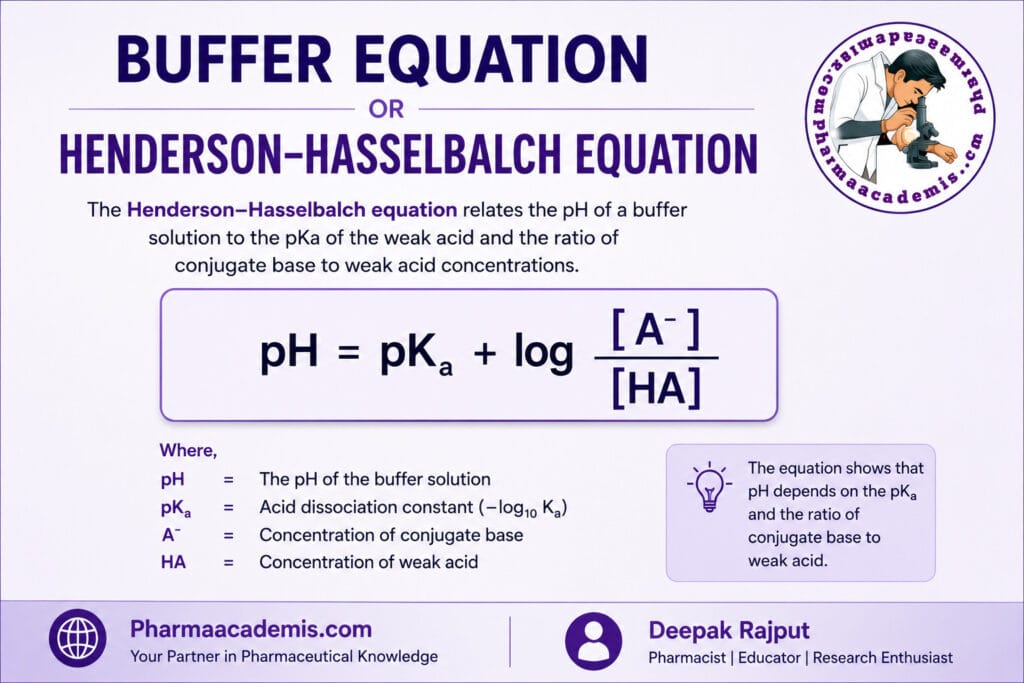
The Henderson–Hasselbalch equation is one of the most important equations in pharmaceutical chemistry, biochemistry, pharmacology, and formulation science. It provides a mathematical relationship between the pH of a solution, the dissociation constant of a weak acid or weak base, and the concentration ratio of the buffer components.
This equation is extensively used in the formulation of injections, ophthalmic preparations, oral liquids, biological products, and controlled drug delivery systems. It also helps in predicting drug ionization, absorption, distribution, and excretion.
Historical Background of Buffer Equation or Henderson Hasselbalch Equation
The Henderson–Hasselbalch equation was developed from the work of the American physiologist Lawrence Joseph Henderson and later modified by the Danish physician and chemist Karl Albert Hasselbalch.
Henderson first derived an equation describing the relationship between carbonic acid and bicarbonate ions in blood. Hasselbalch later expressed the equation in logarithmic form, making it easier to use for calculating pH.
Today, the Henderson–Hasselbalch equation is considered the foundation of buffer calculations in chemistry and pharmacy.
What is a Buffer?
A buffer is a solution that maintains a relatively constant pH even when small amounts of acid or alkali are added.
Buffers are generally composed of:
Acidic Buffer
A weak acid and its salt with a strong base.
Examples:
- Acetic acid + Sodium acetate
- Citric acid + Sodium citrate
- Carbonic acid + Sodium bicarbonate
Basic Buffer
A weak base and its salt with a strong acid.
Examples:
- Ammonium hydroxide + Ammonium chloride
- Pyridine + Pyridinium chloride
The ability of these systems to resist pH changes is explained quantitatively by the Henderson–Hasselbalch equation.
Buffer Equation or Henderson Hasselbalch Equation for Acidic Buffers
Consider a weak acid HA:
HA ⇌ H++A−
The acid dissociation constant is:
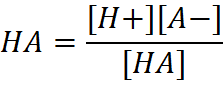
Rearranging:
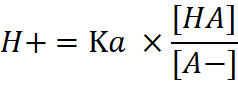
Taking negative logarithms on both sides:

Since:
pH = −log[H+]
and
pKa = −logKa
the equation becomes:
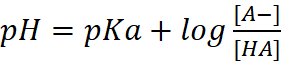
or
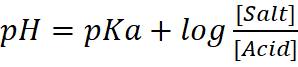
This is the Henderson–Hasselbalch equation for acidic buffers.
Meaning of Each Term
pH: The pH indicates the acidity or alkalinity of the solution.
pKa: The pKa represents the strength of the weak acid.
- Lower pKa = stronger acid
- Higher pKa = weaker acid
The pKa is the pH at which the acid is 50% ionized.
Salt Concentration: The salt provides the conjugate base (A⁻).
Examples:
- Sodium acetate in acetate buffer
- Sodium citrate in citrate buffer
Acid Concentration: The weak acid remains largely unionized and acts as the proton donor.
Examples:
- Acetic acid
- Citric acid
- Carbonic acid
Example 1: Acetate Buffer
A buffer contains:
- 0.2 M sodium acetate
- 0.1 M acetic acid
The pKa of acetic acid is 4.76.
Using the Henderson–Hasselbalch equation:
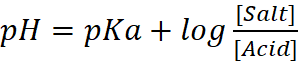
Substituting values:
pH=4.76+log2
pH = 4.76 + 0.301
pH = 5.06
Therefore, the pH of the buffer solution is 5.06.
Example 2: Equal Concentration of Acid and Salt
Suppose:
- Acetic acid = 0.1 M
- Sodium acetate = 0.1 M
Then:
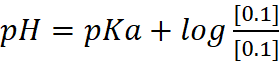
pH = pKa + log1
Since:
log1 = 0
Therefore:
pH = pKa
Thus:
pH = 4.76
This demonstrates an important principle:
When the concentration of acid equals the concentration of salt, the pH of the buffer is equal to the pKa of the acid.
Henderson–Hasselbalch Equation for Basic Buffers
For a weak base:
BOH ⇌ B+ + OH−
The base dissociation constant is:

Taking logarithms:

Since:
pH + pOH = 14
Therefore:
pH = 14 – pOH
This equation is used for basic buffer systems such as ammonium hydroxide–ammonium chloride buffers.
Buffer Capacity and the Henderson–Hasselbalch Equation
Buffer capacity refers to the ability of a buffer to resist pH changes.
The Henderson–Hasselbalch equation shows that buffering is most effective when:
pH = pKa
At this point:
[Salt] = [Acid]
and the buffer can neutralize both added acids and bases effectively.
The useful buffering range is generally:
pKa ± 1
For example:
If pKa = 4.76,
the effective buffering range is:
3.76 to 5.76
Outside this range, buffering action decreases significantly.
Pharmaceutical Importance of the Buffer Equation
The Henderson–Hasselbalch equation has numerous applications in pharmacy.
1. Buffer Preparation: The equation helps formulate buffers with a desired pH.
For example, if a pharmacist wants to prepare an acetate buffer of pH 5.0, the equation can be used to determine the required ratio of acetic acid and sodium acetate.
2. Drug Stability: Many drugs degrade rapidly at unsuitable pH values.
Examples:
- Penicillins undergo acid hydrolysis.
- Certain vitamins degrade under alkaline conditions.
- Protein drugs may denature outside specific pH ranges.
Buffer equations help determine and maintain the optimum pH for maximum drug stability.
3. Drug Solubility: The solubility of weak electrolytes depends on pH.
For example:
- Aspirin becomes more soluble in alkaline media.
- Weak bases become more soluble in acidic media.
Formulators use the Henderson–Hasselbalch equation to predict and control drug solubility.
4. Drug Absorption: Most drugs cross biological membranes in their unionized form.
The Henderson–Hasselbalch equation helps estimate the ratio of ionized and unionized drug molecules at a given pH.
Example: Aspirin (Weak Acid)
pKa = 3.5
In the stomach (pH 1–2):
- Mostly unionized
- Better absorption
In the intestine (pH 6–8):
- Mostly ionized
- Reduced membrane penetration
Example: Morphine (Weak Base)
In acidic environments:
- Highly ionized
- Poor absorption
In alkaline environments:
- More unionized
- Better absorption
5. Design of Ophthalmic Preparations: Eye drops should have a pH close to tears (approximately 7.4).
The Henderson–Hasselbalch equation helps formulators select appropriate buffer systems to maintain ocular comfort and drug stability.
6. Parenteral Formulations: Injectable products require careful pH control because:
- Extreme pH causes pain.
- Drug precipitation may occur.
- Tissue irritation can result.
Buffer calculations ensure appropriate formulation pH.
7. Physiological Acid–Base Balance: The Henderson–Hasselbalch equation is also used to understand blood pH regulation.
For the bicarbonate buffer system:
H2CO3 ⇌ H+ + HCO3−
The blood pH can be expressed as:
This equation is widely used in clinical medicine to evaluate acid–base disorders such as acidosis and alkalosis.
Limitations of the Henderson–Hasselbalch Equation
Although highly useful, the equation has certain limitations.
- It is most accurate for dilute solutions.
- It assumes ideal behavior of ions.
- It becomes less accurate at very high ionic strengths.
- It is applicable mainly to weak acids and weak bases.
- It does not accurately describe strongly acidic or strongly alkaline solutions.
Despite these limitations, it remains one of the most widely used equations in pharmaceutical and biological sciences.
Conclusion
The Henderson–Hasselbalch equation is the fundamental mathematical expression used to describe buffer systems. It relates pH to the pKa of a weak acid and the ratio of salt to acid concentrations. The equation provides valuable information about buffer preparation, drug stability, solubility, ionization, absorption, and physiological acid–base balance. In pharmaceutical sciences, it serves as an essential tool for formulation development, quality control, and understanding the behavior of drugs in biological systems. Because of its broad applicability and practical significance, the Henderson–Hasselbalch equation remains one of the most important equations studied in pharmaceutical chemistry and pharmaceutics.