
Calculation of pH for Buffer Solutions: The calculation of pH for buffer solutions is an important aspect of pharmaceutical chemistry and pharmaceutics because many drugs and pharmaceutical preparations must be maintained within a specific pH range to ensure their stability, solubility, safety, and therapeutic effectiveness. Buffer solutions are widely used in pharmaceutical formulations such as injections, eye drops, oral liquids, biological products, and analytical procedures. The pH of a buffer solution can be accurately calculated using the Henderson–Hasselbalch equation, which relates the pH of the solution to the dissociation constant of the weak acid or weak base and the ratio of the concentrations of the buffer components.
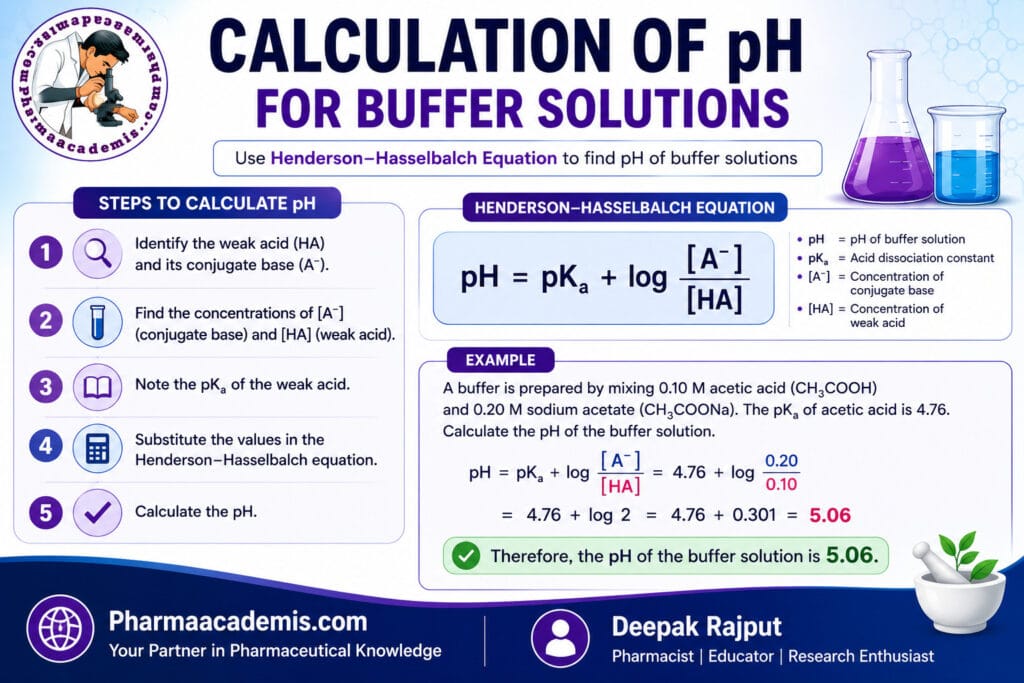
The calculation of buffer pH helps pharmaceutical scientists design formulations with the desired acidity or alkalinity and predict how a drug will behave in different physiological environments.
Basic Principles of Calculation of pH for Buffer Solutions
A buffer solution contains either:
- A weak acid and its salt with a strong base (Acidic Buffer), or
- A weak base and its salt with a strong acid (Basic Buffer).
Examples of acidic buffers include acetic acid–sodium acetate and citric acid–sodium citrate systems. Examples of basic buffers include ammonium hydroxide–ammonium chloride systems.
The pH of these systems depends on the ratio of the concentrations of the buffer components rather than their absolute concentrations.
Henderson–Hasselbalch Equation for Acidic Buffers
Consider a weak acid (HA) that dissociates as:
HA ⇌ H+ + A−
According to the law of mass action:
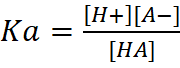
Rearranging:
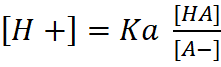
Taking the negative logarithm of both sides:

Substituting:
pH = −log[H+]
and
pKa = − logKa
we obtain:
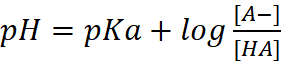
or
This is the Henderson–Hasselbalch equation for acidic buffers.
Meaning of the Terms in the Equation
pH: Represents the acidity or alkalinity of the buffer solution.
pKa: Represents the strength of the weak acid.A lower pKa indicates a stronger acid, whereas a higher pKa indicates a weaker acid.
[Salt]
Represents the concentration of the conjugate base.
Example:
- Sodium acetate in an acetate buffer.
- Sodium citrate in a citrate buffer.
[Acid]
Represents the concentration of the weak acid.
Example:
- Acetic acid.
- Citric acid.
The ratio of salt to acid determines the final pH of the buffer.
Example 1: Acetate Buffer
Problem
Calculate the pH of a buffer containing:
- Acetic acid = 0.1 M
- Sodium acetate = 0.2 M
- pKa of acetic acid = 4.76
Solution
Using Henderson–Hasselbalch equation:
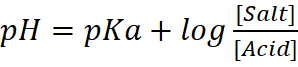
Substituting values:
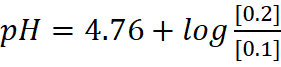
pH=4.76+log2
pH=4.76+0.301
pH=5.06
Result
The pH of the buffer solution is:
[5.06]
Example 2: Buffer with Equal Acid and Salt Concentration
Problem
Calculate the pH of a buffer containing:
- Acetic acid = 0.1 M
- Sodium acetate = 0.1 M
- pKa = 4.76
Solution
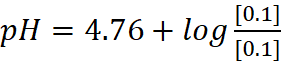
pH=4.76+log1
Since:
log1=0
Therefore:
pH=4.76
Result
[pH=pKa]
This example demonstrates an important principle:
When the concentration of acid equals the concentration of salt, the pH of the buffer equals the pKa of the acid.
Example 3: Citrate Buffer
Problem
A buffer contains:
- Citric acid = 0.05 M
- Sodium citrate = 0.20 M
- pKa = 3.13
Solution
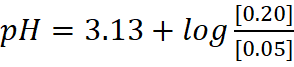
pH = 3.13 + log4
pH = 3.13 + 0.602
pH = 3.73
Result
[pH=3.73]
Calculation of pH for Basic Buffers
Basic buffers contain a weak base and its salt.
Examples include:
- Ammonium hydroxide + Ammonium chloride
- Pyridine + Pyridinium chloride
The equation used is:
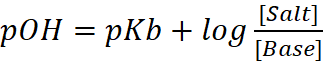
After calculating pOH:
pH = 14 – pOH
Example 4: Ammonium Hydroxide Buffer
Problem
Calculate the pH of a buffer containing:
- NH₄OH = 0.1 M
- NH₄Cl = 0.2 M
- pKb = 4.75
Solution
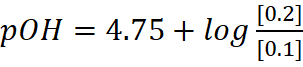
pOH=4.75+log2
pOH=4.75+0.301
pOH=5.05
Now:
pH=14−5.05
pH=8.95
Result
[pH = 8.95]
Effect of Salt-to-Acid Ratio on pH
The Henderson–Hasselbalch equation clearly shows that the pH depends on the ratio of salt to acid.
Case 1: Salt = Acid
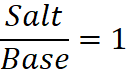
pH = pKa
Case 2: Salt > Acid
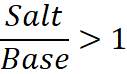
pH becomes greater than pKa.
The buffer becomes less acidic.
Case 3: Salt < Acid
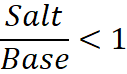
pH becomes lower than pKa.
The buffer becomes more acidic.
Quick Calculations Using Logarithms
Common logarithmic values used in buffer calculations:
| Ratio | Log Value |
| 1 | 0 |
| 2 | 0.301 |
| 3 | 0.477 |
| 4 | 0.602 |
| 5 | 0.699 |
| 10 | 1 |
| 0.5 | -0.301 |
| 0.1 | -1 |
Example
If:
pKa=4.76
and
Then:
pH = 4.76 + 1
pH=5.76
Similarly, if:
Then
pH = 4.76 – 1
pH = 3.76
Buffer pH and Buffer Capacity
Buffer capacity refers to the ability of a buffer to resist changes in pH when acids or bases are added.
The Henderson–Hasselbalch equation shows that maximum buffer capacity occurs when:
pH = pKa
At this point:
Salt = Acid
and the buffer can neutralize both added acids and bases most effectively.
The effective buffering range is:
pKa ± 1
For example:
If pKa = 4.76
Then the effective buffering range is:
3.76 to 5.76
Within this range, the buffer can effectively resist pH changes.
Pharmaceutical Applications of Buffer pH Calculations
The calculation of buffer pH is extremely important in pharmaceutical sciences.
Ophthalmic Preparations: Eye drops are formulated close to the pH of tears (approximately 7.4) to minimize irritation and discomfort.
Injectable Formulations: Parenteral preparations require controlled pH to prevent pain, tissue damage, and precipitation of drugs.
Oral Solutions and Syrups: Buffers maintain the desired taste, stability, and preservative effectiveness.
Drug Stability: Many drugs degrade outside specific pH ranges. Buffer calculations help maintain optimal pH and extend shelf life.
Drug Absorption: The pH of body fluids influences drug ionization. Buffer calculations help predict the proportion of ionized and unionized drug forms and their absorption through biological membranes.
Analytical Chemistry
Buffer solutions are used in:
- Dissolution studies
- Stability testing
- Chromatography
- Quality control analysis
Accurate pH calculations ensure reproducible and reliable analytical results.
Important Points for Examination
- Henderson–Hasselbalch equation for acidic buffers:
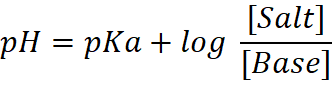
- Henderson–Hasselbalch equation for basic buffers:
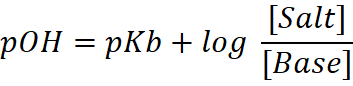
- Relationship between pH and pOH:
pH + pOH = 14
- When salt concentration equals acid concentration
pH = pK_a
- Maximum buffering action occurs when:
pH = pKa
- Effective buffer range:
pKa ± 1
Conclusion
The calculation of pH for buffer solutions is based on the Henderson–Hasselbalch equation, which relates the pH of a solution to the pKa of a weak acid (or pKb of a weak base) and the ratio of the concentrations of the buffer components. This equation provides a simple and practical method for designing and evaluating buffer systems used in pharmaceutical formulations. Accurate buffer pH calculations are essential for ensuring drug stability, improving solubility, controlling drug absorption, maintaining physiological compatibility, and producing high-quality pharmaceutical products. Consequently, mastery of buffer pH calculations is a fundamental requirement for pharmacists, pharmaceutical scientists, and researchers involved in drug development and formulation science.