Isotonicity is an important concept in pharmaceutical sciences, particularly in the formulation of parenteral and ophthalmic preparations. The term isotonicity refers to the ability of a solution to exert the same osmotic pressure as body fluids such as blood plasma, tears, and intracellular fluids. Maintaining isotonicity is essential because differences in osmotic pressure between a pharmaceutical preparation and body fluids can cause movement of water across biological membranes, leading to cellular damage, irritation, pain, or tissue injury.
In pharmacy, isotonicity is especially important for intravenous (IV) fluids, injections, eye drops, contact lens solutions, and other sterile preparations that come into direct contact with sensitive tissues. Proper adjustment of isotonicity ensures patient comfort, safety, and therapeutic effectiveness.
Definition of Isotonicity
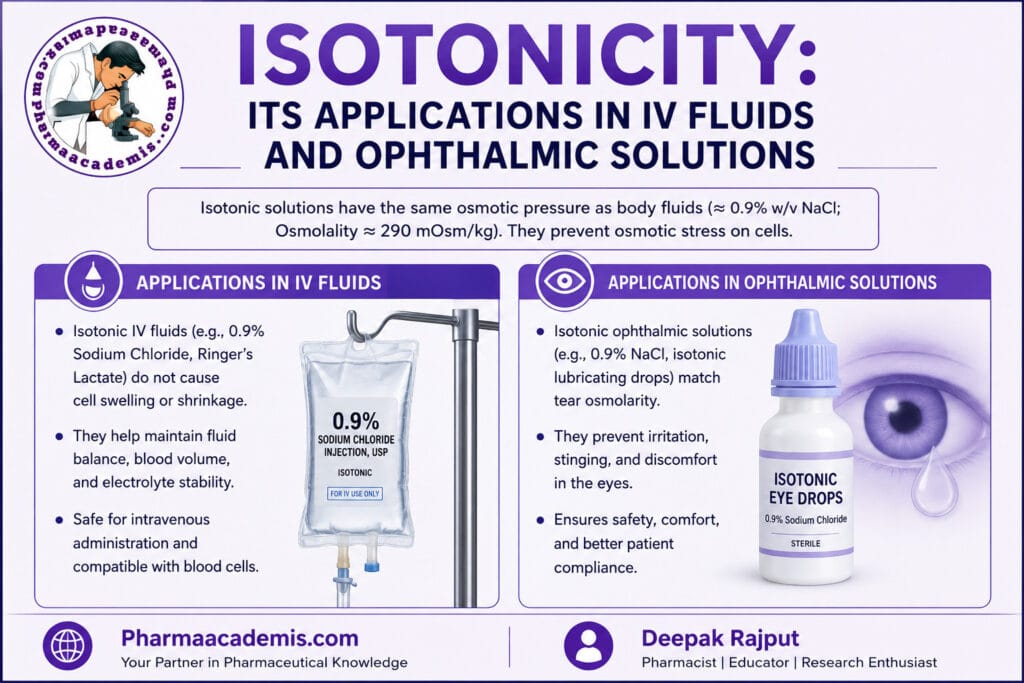
Isotonicity is defined as the condition in which two solutions separated by a semipermeable membrane have the same osmotic pressure, resulting in no net movement of water across the membrane.
A solution is said to be isotonic when its osmotic pressure is equal to that of body fluids such as blood plasma or lacrimal fluid (tears).
Human blood plasma and tears are approximately isotonic with a 0.9% sodium chloride solution, commonly known as normal saline.
Thus, a solution that produces the same osmotic effect as 0.9% sodium chloride solution is considered isotonic.
Understanding Osmosis and Osmotic Pressure
To understand isotonicity, it is necessary to understand osmosis.
Osmosis is the movement of water molecules through a semipermeable membrane from a region of lower solute concentration to a region of higher solute concentration until equilibrium is established.
Osmotic pressure is the pressure required to prevent the movement of water through the membrane.
In biological systems, cell membranes act as semipermeable membranes. Therefore, if a pharmaceutical solution has a different osmotic pressure from body fluids, water movement occurs, causing cells to swell or shrink.
Types of Solutions Based on Tonicity
Solutions can be classified into three categories:
Isotonic Solutions
An isotonic solution possesses the same osmotic pressure as body fluids.
There is no net movement of water across cell membranes.
Cells maintain their normal shape and function.
Examples
- 0.9% Sodium chloride solution (Normal saline)
- 5% Dextrose solution
- Balanced electrolyte solutions
When red blood cells are placed in an isotonic solution, they retain their normal shape.
Hypotonic Solutions
A hypotonic solution has a lower osmotic pressure than body fluids.
Water enters the cells due to osmosis.
As a result, cells swell and may eventually rupture.
This process is called hemolysis in red blood cells.
Example
- 0.45% Sodium chloride solution
When red blood cells are placed in a hypotonic solution, they absorb water, swell, and may burst.
Hypertonic Solutions
A hypertonic solution has a higher osmotic pressure than body fluids.
Water moves out of cells into the surrounding solution.
Cells shrink and become dehydrated.
This process is known as crenation in red blood cells.
Examples
- 3% Sodium chloride solution
- Concentrated glucose solutions
When red blood cells are exposed to hypertonic solutions, they lose water and shrink.
Significance of Isotonicity in Pharmacy
Isotonicity is important because many pharmaceutical preparations come into direct contact with blood, tissues, or mucous membranes.
If these preparations are not isotonic:
- Pain and irritation may occur.
- Cellular damage may result.
- Drug absorption may be altered.
- Tissue injury may develop.
- Therapeutic efficacy may decrease.
Therefore, pharmaceutical scientists carefully adjust formulations to achieve isotonicity whenever necessary.
Isotonicity in Intravenous (IV) Fluids
Importance of IV Fluids
Intravenous fluids are administered directly into the bloodstream. Since blood plasma has a specific osmotic pressure, IV solutions should ideally be isotonic with blood.
An isotonic IV solution prevents damage to red blood cells and maintains normal physiological function.
Normal Saline (0.9% Sodium Chloride)
Normal saline is the most common isotonic IV fluid.
Composition:
- Sodium chloride: 0.9 g per 100 mL
- Water for injection: q.s.
It possesses approximately the same osmotic pressure as blood plasma.
Clinical Uses
- Fluid replacement
- Electrolyte replenishment
- Drug dilution
- Treatment of dehydration
- Maintenance of blood volume
Because it is isotonic, normal saline does not cause hemolysis or crenation of red blood cells.
5% Dextrose Injection
A 5% dextrose solution is approximately isotonic with blood plasma when administered.
Uses
- Caloric supplementation
- Fluid replacement
- Treatment of dehydration
- Vehicle for injectable drugs
After administration, glucose is metabolized, leaving free water available for cellular functions.
Ringer’s Lactate Solution
Ringer’s lactate is a balanced isotonic electrolyte solution containing:
- Sodium chloride
- Potassium chloride
- Calcium chloride
- Sodium lactate
Uses
- Trauma management
- Surgical patients
- Burn treatment
- Fluid resuscitation
Its electrolyte composition closely resembles extracellular fluid.
Effects of Non-Isotonic IV Fluids
Hypotonic IV Solutions
If a hypotonic solution is administered excessively:
- Water enters red blood cells.
- Cells swell.
- Hemolysis may occur.
- Cerebral edema may develop.
Hypertonic IV Solutions
If a hypertonic solution is administered:
- Water leaves cells.
- Cellular dehydration occurs.
- Tissue damage may result.
- Vein irritation may increase.
Thus, isotonicity is essential for safe intravenous therapy.
Isotonicity in Ophthalmic Solutions
Importance of Ophthalmic Preparations
The eye is highly sensitive to changes in osmotic pressure.
Tears possess an osmotic pressure approximately equivalent to that of 0.9% sodium chloride solution.
Therefore, ophthalmic preparations should ideally be isotonic with lacrimal fluid.
Normal Osmotic Pressure of Tears
Tear fluid is isotonic with approximately:
- 0.9% Sodium chloride solution
This corresponds to a freezing-point depression of approximately:
0.52∘C
Solutions producing the same freezing-point depression are generally considered isotonic with tears.
Advantages of Isotonic Ophthalmic Solutions
When eye drops are isotonic:
- Patient comfort is improved.
- Reflex tearing is minimized.
- Drug retention time increases.
- Therapeutic efficacy improves.
- Ocular irritation is reduced.
Examples of Isotonic Ophthalmic Solutions
Artificial Tears: Used to lubricate dry eyes and maintain ocular comfort.
Antibiotic Eye Drops
Examples:
- Chloramphenicol eye drops
- Ciprofloxacin eye drops
These are usually adjusted to isotonicity to avoid irritation.
Antiglaucoma Eye Drops
Examples:
- Timolol eye drops
- Latanoprost eye drops
Proper isotonicity improves patient compliance.
Effects of Non-Isotonic Eye Drops
Hypotonic Eye Drops
May cause:
- Corneal swelling
- Ocular discomfort
- Excess tearing
Hypertonic Eye Drops
May cause:
- Burning sensation
- Eye irritation
- Cellular dehydration
However, some hypertonic ophthalmic solutions are intentionally used therapeutically.
Example:
5% Sodium chloride ophthalmic solution is used to reduce corneal edema by drawing excess water from corneal tissues.
Methods for Adjusting Isotonicity
Pharmaceutical formulations can be adjusted to isotonicity using several methods.
Sodium Chloride Equivalent Method (E-Value Method)
This method uses the sodium chloride equivalent value (E-value) of a drug to calculate the amount of sodium chloride required to make the solution isotonic.
It is one of the most commonly used methods in pharmacy.
Cryoscopic Method
This method is based on freezing-point depression.
Body fluids have a freezing-point depression of approximately:
0.52∘C
A solution that produces the same freezing-point depression is considered isotonic.
White–Vincent Method
This method calculates the volume of isotonic solution that can be prepared from a given quantity of drug.
It is widely used in compounding ophthalmic preparations.
Sprowls Method
A modification of the White–Vincent method that uses tabulated values to simplify calculations.
Pharmaceutical Applications of Isotonicity
Isotonicity is important in various pharmaceutical preparations.
Intravenous Fluids
- Normal saline
- Dextrose injection
- Ringer’s lactate
Ophthalmic Preparations
- Eye drops
- Artificial tears
- Contact lens solutions
Nasal Preparations
Isotonic nasal sprays reduce irritation and improve patient comfort.
Irrigation Solutions
Used during surgical procedures and wound cleansing.
Injectable Preparations
Many injections are formulated to be isotonic to reduce pain and tissue damage.
Importance in Patient Safety
Maintaining isotonicity helps:
- Prevent hemolysis
- Prevent crenation
- Reduce pain and irritation
- Improve patient compliance
- Protect sensitive tissues
- Ensure optimal therapeutic response
Consequently, isotonicity is one of the most important quality parameters evaluated during pharmaceutical formulation development.
Conclusion
Isotonicity refers to the condition in which a pharmaceutical solution possesses the same osmotic pressure as body fluids such as blood plasma and tears. Isotonic solutions prevent abnormal movement of water across biological membranes and maintain normal cell structure and function. In intravenous fluids, isotonicity is essential to prevent hemolysis, crenation, and disturbances in fluid balance. In ophthalmic solutions, isotonicity minimizes irritation, improves patient comfort, and enhances therapeutic effectiveness. Pharmaceutical scientists use methods such as the sodium chloride equivalent method, cryoscopic method, White–Vincent method, and Sprowls method to adjust isotonicity. Therefore, understanding isotonicity is fundamental for the development of safe, effective, and patient-friendly pharmaceutical formulations.