Skip to content

  • Home
  • CoursesExpand
    • B.Pharm Old Syllabus Notes (Archive)Expand
      • SEM-I oldExpand
        • Human Anatomy and Physiology-IExpand
          • Unit 1
          • Unit 2
          • Unit 3
          • Unit 4
          • Unit 5
        • Pharmaceutical AnalysisExpand
          • Unit 1
          • Unit 2
          • Unit 3
          • Unit 4
          • Unit 5
        • Pharmaceutics – 1Expand
          • Unit 1
          • Unit 2
          • Unit 3
          • Unit 4
          • Unit 5
        • Pharmaceutical Inorganic ChemistryExpand
          • Unit 1
          • Unit 2
          • Unit 3
          • Unit 4
          • Unit 5
        • Remedial BiologyExpand
          • Unit 1
          • rb Unit 2
      • SEM-IIExpand
        • Human Anatomy and Physiology – IIExpand
          • Unit 1
          • Unit 2
          • Unit 3
          • Unit 4
          • Unit 5
        • BiochemistryExpand
          • Unit 1
          • Unit 2
          • Unit 3
          • Unit 4
          • Unit 5
        • PathophysiologyExpand
          • Unit 1
          • Unit 2
          • Unit 3
          • Unit 4
          • Unit 5
        • Pharmaceutical Organic Chemistry IExpand
          • poc1 Unit 1
      • SEM-IIIExpand
        • Pharmaceutical Organic Chemistr IIExpand
          • Unit 1
          • Unit 2
          • Unit 3
          • Unit 4
          • Unit 5
        • Physical Pharmaceutics IExpand
          • Unit 1
          • Unit 2
          • Unit 3
          • Unit 4
          • Unit 5
        • Pharmaceutical MicrobiologyExpand
          • Unit 1
          • Unit 2
          • Unit 3
          • Unit 4
          • Unit 5
        • Pharmaceutical EngineeringExpand
          • Unit 1
          • Unit 2
          • Unit 3
          • Unit 4
          • Unit 5
        • Universal human values and professional ethicsExpand
          • value Unit 1
      • SEM-IVExpand
        • Pharmaceutical Organic Chemistry IIIExpand
          • POC 3 Unit 1
          • POC 3 Unit 2
        • Medicinal Chemistry – IExpand
          • Unit 1
        • Physical Pharmaceutics – IIExpand
          • Unit 1
          • pp2 Unit 2
        • Pharmacology-1Expand
          • Unit 1
          • Unit 2
          • Unit 3
          • Unit 4
          • Unit 5
        • Pharmacognosy and Phytochemistry – IExpand
          • Unit 1
          • Unit 2
          • Unit 3
          • Unit 4
          • Unit 5
      • SEM-VExpand
        • Medicinal Chemistry IIExpand
          • mc2 Unit 1
        • Industrial Pharmacy IExpand
          • Unit 1
          • Unit 2
          • BIP Unit 3
          • BIP Unit 4
        • Pharmacology-IIExpand
          • Unit 1
          • Unit 2
          • colo2 Unit 3
        • Pharmacognosy & Phytochemistry IIExpand
          • Unit 1
          • Unit 2
          • cog Unit 3
        • Pharmaceutical JurisprudenceExpand
          • Unit 1
          • Unit 2
          • Unit 3
          • juris Unit 4
      • SEM-VIExpand
        • Medicinal Chemistry IIIExpand
          • MC III Unit 1
        • Herbal Drug TechnologyExpand
          • Unit 1
          • HDT Unit 2
        • Biopharmaceutics & PharmacokineticsExpand
          • kinet Unit 1
          • Kinet Unit 2
        • Pharmaceutical BiotechnologyExpand
          • Unit 1
          • Unit 2
          • biotech Unit 3
        • Pharmaceutical Quality AssuranceExpand
          • Unit 1
      • SEM- VIIExpand
        • Instrumental Method of AnalysisExpand
          • lysis Unit 1
          • Unit 3
          • Unit 4
          • Unit 5
        • Industrial Pharmacy-IIExpand
          • IP 2 Unit 1
        • Pharmacy PracticeExpand
          • Unit 1
          • pp Unit 2
        • Novel Drug Delivery SystemExpand
          • Unit 1
          • ndds Unit 2
      • SEM-VIIIExpand
        • Biostatistics and Research MethodologyExpand
          • Unit 1
        • PharmacovigilanceExpand
          • Unit-1
          • Unit 2
          • Unit 3
          • vigi Unit 4
        • Social and Preventive PharmacyExpand
          • Social Unit 1
    • B.Pharm New PCI Syllabus 2026Expand
      • SEM-1 newExpand
        • Basics of Python Programming for Pharmaceutical SciencesExpand
          • Unit 1
        • General PharmacyExpand
          • Unit 1
          • Unit 2
          • Unit 3
        • Healthcare Psychology and Communication SkillsExpand
          • Unit 1
        • Human Anatomy, Physiology and Pathophysiology IExpand
          • Unit 1
          • New HAP Unit 2
        • Introduction to PharmacognosyExpand
          • Unit 1
        • Pharmaceutical Inorganic and Analytical ChemistryExpand
          • Unit 1
          • Unit 2
          • new ana Unit 3
    • D.PharmaExpand
      • PharmaceuticsExpand
        • Chapter 1
        • Chapter 2
        • Chpater 3
        • Chpater 4
        • dceu Chapter 5
      • Pharmaceutical ChemistryExpand
        • Chapter 1
        • Chapter 2
        • Chapter 3
        • Chapter 4
        • Chapter 5
        • dchem Chapter 6
      • PharmacognosyExpand
        • Chapter 3
        • Chapter 1
        • Chapter 2
        • Chapter 4
        • cogno Chapter 5
      • Human Anatomy and PhysiologyExpand
        • Chapter 1
        • Chapter 2
        • Chapter 3
        • Chapter 4
        • Chapter 5
        • Chapter 6
        • Chapter 7
        • Chapter 8
        • Chapter 9
        • Chapter 10
        • Chapter 11
        • Chapter 12
        • Chapter 13
        • Chapter 14
        • Chapter 15
      • Social PharmacyExpand
        • Chapter 1
        • Chapter 2
        • Chapter 3
        • sp Chapter 4
      • PharmacologyExpand
        • Chapter 1
        • Chapter 2
        • Chapter 3
        • Chapter 4
        • Chapter 5
        • Chapter 6
        • Chapter 7
        • Chapter 8
        • Chapter 9
        • Chapter 10
        • Chapter 11
        • Chapter 12
        • Chapter 13
      • Community pharmacy and managementExpand
        • Chapter 1
        • Chapter 2
        • Chapter 3
        • Chapter 5
        • Chapter 6
        • Chapter 7
        • cpm Chapter 8
      • Biochemistry & Clinical PathologyExpand
        • Chapter 1
        • Chapter 2
        • Chapter 3
        • Chapter 4
        • Chapter 5
        • Chapter 6
        • Chapter 7
      • PharmacotherapeuticsExpand
        • Chapter 1
        • the Chapter 2
      • Hospital and Clinical PharmacyExpand
        • Chapter 1
        • Chapter 2
        • hcp Chapter 3
      • Pharmacy law and EthicsExpand
        • Chapter 1
        • Chapter 2
    • M.PharmExpand
      • Pharmacology Branch
    • Pharm DExpand
      • Human Anatomy & Physiology (D)Expand
        • Unit 1
        • Unit 2
        • Unit 3
        • hap Unit 4 (D)
        • Unit 5
        • Unit 6
        • Unit 7
        • Unit 8
        • Unit 9
        • Unit 10
        • Unit 11
        • Unit 12
        • hap Unit 13
    • DMLTExpand
      • dmlt 1 yearExpand
        • Anatomy and Physiology
  • Study MaterialExpand
    • Practicals
    • Notes pdf
    • Previous year papers
    • Books
  • Blog
  • Jobs
  • Syllabus
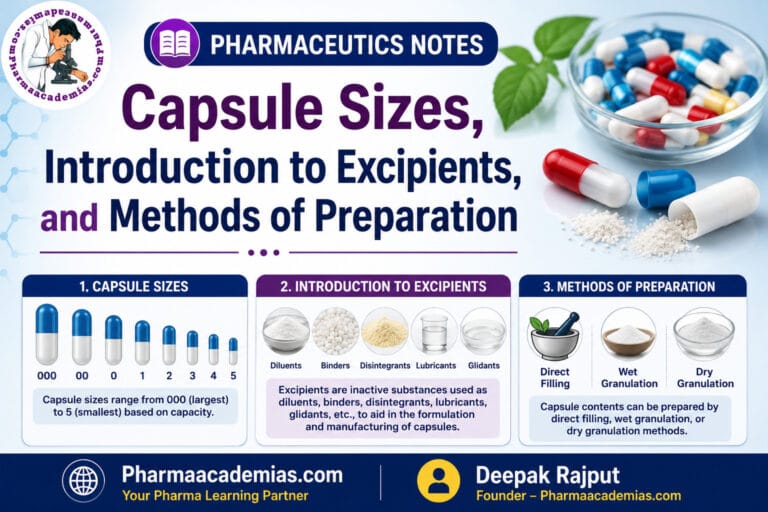
  • Excipients
    Unit 3

    What are Excipients: Definition and Methods of Preparation

    ByDeepak Rajput May 7, 2026May 7, 2026

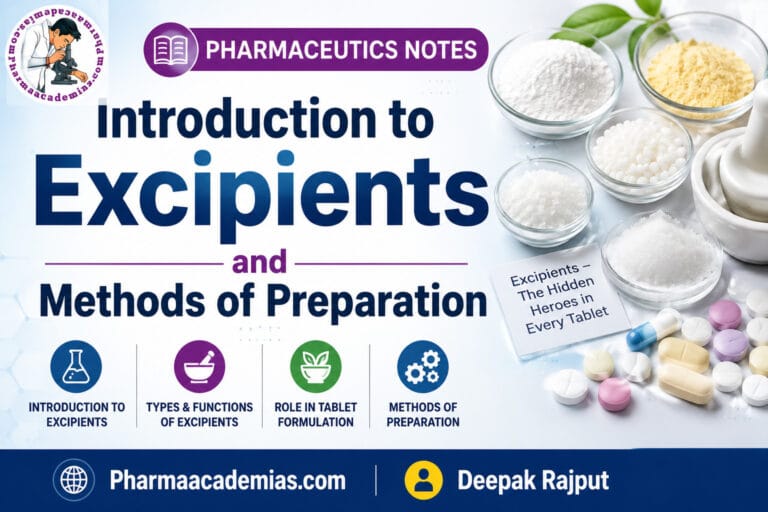
    Excipients are pharmacologically inactive substances that are formulated along with the active pharmaceutical ingredient (API) in a dosage form. Although excipients do not produce therapeutic effects directly, they play a vital role in the formulation, manufacturing, stability, appearance, bioavailability, and patient acceptability of pharmaceutical products. In modern pharmaceutics, excipients are considered essential components of drug…

    Read More What are Excipients: Definition and Methods of PreparationContinue

  • Eutectic Mixtures
    Unit 3

    Eutectic Mixtures: Classification, Advantage, & Disadvantage

    ByDeepak Rajput May 7, 2026May 7, 2026

    A eutectic mixtures is a combination of two or more solid substances that, when mixed together in a particular proportion, liquefy or melt at a temperature lower than the melting point of either individual component. In pharmaceutical compounding, eutectic formation is an important phenomenon because it may affect the stability, appearance, and handling properties of…

    Read More Eutectic Mixtures: Classification, Advantage, & DisadvantageContinue

  • Hygroscopic Powders
    Home | Unit 3

    Hygroscopic Powders: Classification, Advantage, & Disadvantage

    ByDeepak Rajput May 7, 2026May 7, 2026

    Hygroscopic powders are pharmaceutical substances that have the ability to absorb moisture from the atmosphere when exposed to air. This property is known as hygroscopicity. In pharmaceutics, hygroscopic substances are very important because their moisture-absorbing nature can significantly affect the stability, flow properties, appearance, handling, and therapeutic effectiveness of powder formulations. Many pharmaceutical drugs and…

    Read More Hygroscopic Powders: Classification, Advantage, & DisadvantageContinue

  • Efflorescent powders
    Home | Unit 3

    Efflorescent powders: Classification, Advantage, & Disadvantage

    ByDeepak Rajput May 7, 2026May 7, 2026

    Efflorescent powders are pharmaceutical powders that contain substances capable of losing water of crystallization when exposed to air or dry environmental conditions. This phenomenon is known as efflorescence. In pharmaceutical science, efflorescence is an important consideration during the preparation, storage, and dispensing of powders because the release of water can affect the stability, appearance, flow…

    Read More Efflorescent powders: Classification, Advantage, & DisadvantageContinue

  • Effervescent Powders
    Home | Unit 3

    Effervescent Powders: Classification, Advantage, & Disadvantage

    ByDeepak Rajput May 7, 2026May 7, 2026

    Effervescent powders are pharmaceutical preparations that contain a mixture of acids and carbonates or bicarbonates which react rapidly in the presence of water to release carbon dioxide gas. This liberation of carbon dioxide produces effervescence, resulting in a sparkling solution that improves the palatability and administration of medications. Effervescent powders are widely used for oral…

    Read More Effervescent Powders: Classification, Advantage, & DisadvantageContinue

  • Dusting Powders
    Unit 3

    Dusting Powders: Classification, Advantages, and Disadvantages

    ByDeepak Rajput May 7, 2026May 7, 2026

    Dusting powders are finely divided medicinal or non-medicinal powders intended for external application to the skin. They are one of the most commonly used topical pharmaceutical preparations and are designed to protect the skin, reduce friction, absorb moisture, and deliver therapeutic agents locally. Dusting powders are widely used in dermatology, wound care, cosmetic preparations, and…

    Read More Dusting Powders: Classification, Advantages, and DisadvantagesContinue

  • Powders
    Unit 3

    Powders: Classification, Advantages, and Disadvantages

    ByDeepak Rajput May 7, 2026May 7, 2026

    Powders play a significant role in pharmaceutical formulation because they can be administered directly, filled into capsules, compressed into tablets, or reconstituted into liquids before use. Due to their versatility, powders are used in hospitals, community pharmacies, and industrial pharmaceutical manufacturing. They are especially useful when rapid drug action is required, as finely divided particles…

    Read More Powders: Classification, Advantages, and DisadvantagesContinue

  • Pharmacy Degree to Job
    Blog

    Pharmacy Degree to Job: Build a Job-Ready Profile in 2026

    ByDeepak Rajput May 6, 2026May 6, 2026

    Pharmacy Degree to Job: In today’s highly competitive pharmaceutical industry, earning a pharmacy degree is no longer enough to secure a job. Every year, thousands of students graduate with strong academic backgrounds, yet many struggle to get shortlisted for interviews or land their first role. The problem is not a lack of knowledge. Most pharmacy…

    Read More Pharmacy Degree to Job: Build a Job-Ready Profile in 2026Continue

  • Active Pharmaceutical Ingredients
    Home | Unit 2

    Introduction to Active Pharmaceutical Ingredients and Excipients

    ByDeepak Rajput April 30, 2026April 30, 2026

    Active Pharmaceutical Ingredients: A pharmaceutical product is not just a drug—it is a carefully engineered system designed to deliver a therapeutic effect safely and effectively. Every dosage form, whether a tablet, capsule, injection, or cream, is composed of two fundamental components: This distinction is central to pharmaceutics because the success of a drug therapy depends…

    Read More Introduction to Active Pharmaceutical Ingredients and ExcipientsContinue

  • What are Dosage Forms
    Home | Unit 2

    What are Dosage Forms: Routes of Administration & Classification

    ByDeepak Rajput April 30, 2026April 30, 2026

    What are Dosage Form: In pharmaceutical sciences, drugs are rarely administered in their pure chemical form. Instead, they are formulated into dosage forms, which are designed to ensure safe, effective, and convenient delivery of the drug to the body. The concept of dosage forms is central to pharmaceutics because it directly influences drug stability, bioavailability,…

    Read More What are Dosage Forms: Routes of Administration & ClassificationContinue

Page navigation

Previous PagePrevious 1 … 9 10 11 12 13 … 212 Next PageNext
  • About Pharmaacademias
  • Contact Us
  • Disclaimer
  • Privacy Policy
  • Terms and Conditions

© 2026 - WordPress Theme by Kadence WP

×

🎓 Pharmacy Students & Aspirants

Notes aur Pharmacy Jobs ki notification pane ke liye Telegram group join karein!

Join Now
  • Home
  • Courses
    • B.Pharm Old Syllabus Notes (Archive)
      • SEM-I old
        • Human Anatomy and Physiology-I
          • Unit 1
          • Unit 2
          • Unit 3
          • Unit 4
          • Unit 5
        • Pharmaceutical Analysis
          • Unit 1
          • Unit 2
          • Unit 3
          • Unit 4
          • Unit 5
        • Pharmaceutics – 1
          • Unit 1
          • Unit 2
          • Unit 3
          • Unit 4
          • Unit 5
        • Pharmaceutical Inorganic Chemistry
          • Unit 1
          • Unit 2
          • Unit 3
          • Unit 4
          • Unit 5
        • Remedial Biology
          • Unit 1
          • rb Unit 2
      • SEM-II
        • Human Anatomy and Physiology – II
          • Unit 1
          • Unit 2
          • Unit 3
          • Unit 4
          • Unit 5
        • Biochemistry
          • Unit 1
          • Unit 2
          • Unit 3
          • Unit 4
          • Unit 5
        • Pathophysiology
          • Unit 1
          • Unit 2
          • Unit 3
          • Unit 4
          • Unit 5
        • Pharmaceutical Organic Chemistry I
          • poc1 Unit 1
      • SEM-III
        • Pharmaceutical Organic Chemistr II
          • Unit 1
          • Unit 2
          • Unit 3
          • Unit 4
          • Unit 5
        • Physical Pharmaceutics I
          • Unit 1
          • Unit 2
          • Unit 3
          • Unit 4
          • Unit 5
        • Pharmaceutical Microbiology
          • Unit 1
          • Unit 2
          • Unit 3
          • Unit 4
          • Unit 5
        • Pharmaceutical Engineering
          • Unit 1
          • Unit 2
          • Unit 3
          • Unit 4
          • Unit 5
        • Universal human values and professional ethics
          • value Unit 1
      • SEM-IV
        • Pharmaceutical Organic Chemistry III
          • POC 3 Unit 1
          • POC 3 Unit 2
        • Medicinal Chemistry – I
          • Unit 1
        • Physical Pharmaceutics – II
          • Unit 1
          • pp2 Unit 2
        • Pharmacology-1
          • Unit 1
          • Unit 2
          • Unit 3
          • Unit 4
          • Unit 5
        • Pharmacognosy and Phytochemistry – I
          • Unit 1
          • Unit 2
          • Unit 3
          • Unit 4
          • Unit 5
      • SEM-V
        • Medicinal Chemistry II
          • mc2 Unit 1
        • Industrial Pharmacy I
          • Unit 1
          • Unit 2
          • BIP Unit 3
          • BIP Unit 4
        • Pharmacology-II
          • Unit 1
          • Unit 2
          • colo2 Unit 3
        • Pharmacognosy & Phytochemistry II
          • Unit 1
          • Unit 2
          • cog Unit 3
        • Pharmaceutical Jurisprudence
          • Unit 1
          • Unit 2
          • Unit 3
          • juris Unit 4
      • SEM-VI
        • Medicinal Chemistry III
          • MC III Unit 1
        • Herbal Drug Technology
          • Unit 1
          • HDT Unit 2
        • Biopharmaceutics & Pharmacokinetics
          • kinet Unit 1
          • Kinet Unit 2
        • Pharmaceutical Biotechnology
          • Unit 1
          • Unit 2
          • biotech Unit 3
        • Pharmaceutical Quality Assurance
          • Unit 1
      • SEM- VII
        • Instrumental Method of Analysis
          • lysis Unit 1
          • Unit 3
          • Unit 4
          • Unit 5
        • Industrial Pharmacy-II
          • IP 2 Unit 1
        • Pharmacy Practice
          • Unit 1
          • pp Unit 2
        • Novel Drug Delivery System
          • Unit 1
          • ndds Unit 2
      • SEM-VIII
        • Biostatistics and Research Methodology
          • Unit 1
        • Pharmacovigilance
          • Unit-1
          • Unit 2
          • Unit 3
          • vigi Unit 4
        • Social and Preventive Pharmacy
          • Social Unit 1
    • B.Pharm New PCI Syllabus 2026
      • SEM-1 new
        • Basics of Python Programming for Pharmaceutical Sciences
          • Unit 1
        • General Pharmacy
          • Unit 1
          • Unit 2
          • Unit 3
        • Healthcare Psychology and Communication Skills
          • Unit 1
        • Human Anatomy, Physiology and Pathophysiology I
          • Unit 1
          • New HAP Unit 2
        • Introduction to Pharmacognosy
          • Unit 1
        • Pharmaceutical Inorganic and Analytical Chemistry
          • Unit 1
          • Unit 2
          • new ana Unit 3
    • D.Pharma
      • Pharmaceutics
        • Chapter 1
        • Chapter 2
        • Chpater 3
        • Chpater 4
        • dceu Chapter 5
      • Pharmaceutical Chemistry
        • Chapter 1
        • Chapter 2
        • Chapter 3
        • Chapter 4
        • Chapter 5
        • dchem Chapter 6
      • Pharmacognosy
        • Chapter 3
        • Chapter 1
        • Chapter 2
        • Chapter 4
        • cogno Chapter 5
      • Human Anatomy and Physiology
        • Chapter 1
        • Chapter 2
        • Chapter 3
        • Chapter 4
        • Chapter 5
        • Chapter 6
        • Chapter 7
        • Chapter 8
        • Chapter 9
        • Chapter 10
        • Chapter 11
        • Chapter 12
        • Chapter 13
        • Chapter 14
        • Chapter 15
      • Social Pharmacy
        • Chapter 1
        • Chapter 2
        • Chapter 3
        • sp Chapter 4
      • Pharmacology
        • Chapter 1
        • Chapter 2
        • Chapter 3
        • Chapter 4
        • Chapter 5
        • Chapter 6
        • Chapter 7
        • Chapter 8
        • Chapter 9
        • Chapter 10
        • Chapter 11
        • Chapter 12
        • Chapter 13
      • Community pharmacy and management
        • Chapter 1
        • Chapter 2
        • Chapter 3
        • Chapter 5
        • Chapter 6
        • Chapter 7
        • cpm Chapter 8
      • Biochemistry & Clinical Pathology
        • Chapter 1
        • Chapter 2
        • Chapter 3
        • Chapter 4
        • Chapter 5
        • Chapter 6
        • Chapter 7
      • Pharmacotherapeutics
        • Chapter 1
        • the Chapter 2
      • Hospital and Clinical Pharmacy
        • Chapter 1
        • Chapter 2
        • hcp Chapter 3
      • Pharmacy law and Ethics
        • Chapter 1
        • Chapter 2
    • M.Pharm
      • Pharmacology Branch
    • Pharm D
      • Human Anatomy & Physiology (D)
        • Unit 1
        • Unit 2
        • Unit 3
        • hap Unit 4 (D)
        • Unit 5
        • Unit 6
        • Unit 7
        • Unit 8
        • Unit 9
        • Unit 10
        • Unit 11
        • Unit 12
        • hap Unit 13
    • DMLT
      • dmlt 1 year
        • Anatomy and Physiology
  • Study Material
    • Practicals
    • Notes pdf
    • Previous year papers
    • Books
  • Blog
  • Jobs
  • Syllabus
Search