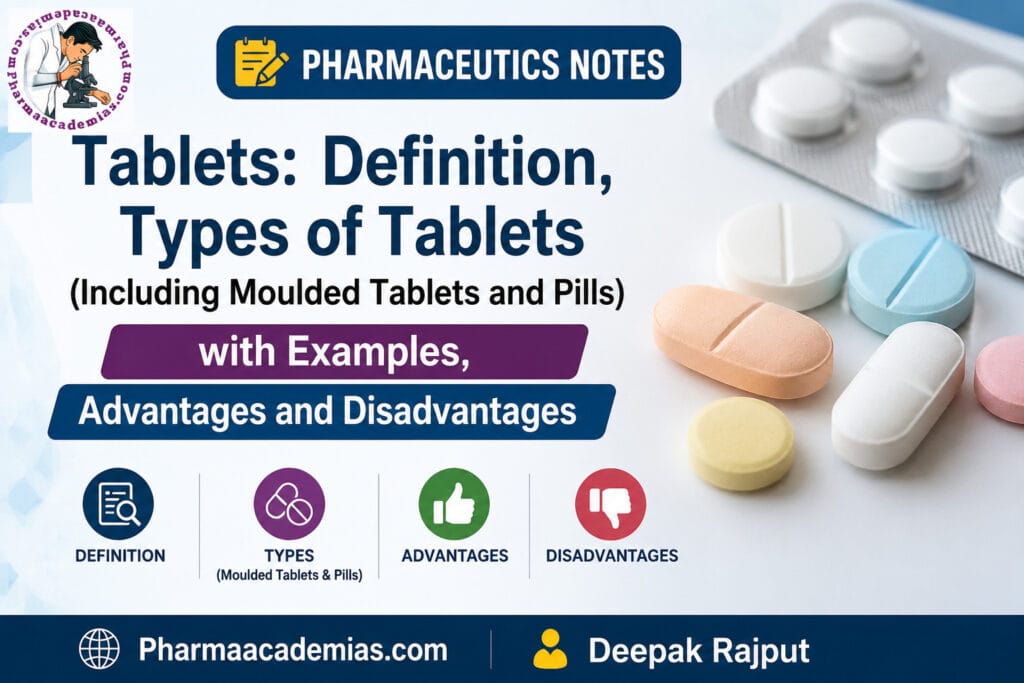
What are Tablets: Tablets are the most widely used and preferred solid dosage forms in the pharmaceutical industry. They are convenient to manufacture, transport, store, and administer, making them the first choice for both healthcare professionals and patients. Tablets account for a major share of all pharmaceutical products because they provide accurate dosing, better stability, ease of administration, and cost-effective large-scale production. Pharmaacademias.com
Modern tablets are designed not only to deliver drugs orally but also through various routes such as buccal, sublingual, vaginal, and implantation. Depending on the therapeutic requirement, tablets can be manufactured in different shapes, sizes, hardness, and release characteristics.
Definition of Tablets What are Tablets
A tablet is a solid unit dosage form containing one or more active pharmaceutical ingredients (APIs) along with suitable pharmaceutical excipients. Tablets are usually prepared by compression or moulding and are intended for oral administration or administration through other routes such as sublingual, buccal, vaginal, or implantation.
According to pharmacopeial standards, tablets should possess:
- Uniform weight
- Uniform drug content
- Adequate mechanical strength
- Acceptable appearance
- Appropriate disintegration and dissolution characteristics
- Chemical, physical, and microbiological stability
Characteristics of an Ideal Tablet
An ideal tablet should possess the following characteristics:
- It should contain the accurate amount of drug.
- It should be chemically and physically stable throughout its shelf life.
- It should have sufficient mechanical strength to withstand handling, packaging, and transportation.
- It should disintegrate and dissolve at the desired rate after administration.
- It should be easy to swallow.
- It should have an elegant appearance.
- It should be free from contamination.
- It should provide maximum therapeutic effect with minimum side effects.
Types of Tablets
Tablets are classified according to their method of manufacture, route of administration, coating, and drug release characteristics.
1. Compressed Tablets
Compressed tablets are the most commonly used type of tablet and are prepared by applying high pressure to powders or granules using a tablet compression machine. During compression, the particles undergo rearrangement, deformation, and bonding to form a compact solid dosage form with adequate mechanical strength. These tablets are intended to be swallowed whole with water.
Examples
- Paracetamol Tablet
- Metformin Tablet
- Ibuprofen Tablet
- Aspirin Tablet
Characteristics
- Simple formulation
- Economical manufacturing
- Suitable for immediate drug release
2. Multiple Compressed Tablets
These tablets contain more than one compressed layer or core.
They are manufactured when:
- Incompatible drugs need separation.
- Controlled drug release is required.
- Combination therapy is desired.
Types
- Bilayer tablets
- Multilayer tablets
- Compression-coated tablets
Examples
- Bilayer Metformin Tablets
- Bilayer Anti-hypertensive Tablets
3. Coated Tablets
Coated tablets possess one or more layers of coating material over the tablet core.
The coating improves:
- Taste
- Appearance
- Stability
- Protection from moisture and light
- Ease of swallowing
Types
Sugar-coated Tablets
These tablets are coated with sugar syrup.
Examples
- Multivitamin tablets
- Iron tablets
Film-coated Tablets
These tablets are coated with a thin polymer film.
Examples
- Ciprofloxacin Tablets
- Diclofenac Tablets
Enteric-coated Tablets
The coating prevents drug release in the stomach and allows release in the intestine.
Used for:
- Acid-sensitive drugs
- Drugs causing gastric irritation
Examples
- Aspirin EC Tablets
- Omeprazole Tablets
- Pantoprazole Tablets
4. Chewable Tablets
Chewable tablets are specially formulated tablets that are intended to be chewed completely before swallowing rather than swallowed whole. These tablets are designed for patients who have difficulty swallowing conventional tablets, such as children, elderly individuals, and patients with dysphagia. They usually contain sweetening agents, flavouring agents, and pleasant-tasting excipients to improve palatability and patient acceptance. Since the drug is released after chewing, these tablets generally provide faster disintegration and dissolution than conventional compressed tablets.
They are especially suitable for:
- Children
- Elderly patients
- Patients with swallowing difficulties
Examples
- Calcium Tablets
- Antacid Tablets
- Vitamin C Tablets
5. Effervescent Tablets
Effervescent tablets are specially formulated tablets that contain a combination of organic acids, such as citric acid or tartaric acid, and sodium bicarbonate. When these tablets are dissolved in water before administration, an acid-base reaction occurs, producing carbon dioxide gas. The release of carbon dioxide facilitates rapid dissolution of the tablet and results in a pleasant-tasting solution. The drug is taken after complete dissolution.
Examples
- Vitamin C Effervescent Tablets
- Electrolyte Tablets
- Paracetamol Effervescent Tablets
6. Dispersible Tablets
Dispersible tablets are tablets that are designed to disperse rapidly in a small quantity of water before administration, forming a uniform suspension. They are particularly useful for pediatric and geriatric patients who have difficulty swallowing conventional tablets. Because the tablet disperses quickly, accurate dosing can be achieved even in patients unable to swallow solid dosage forms. They provide faster drug absorption and are useful for pediatric patients.
Examples
- Dispersible Amoxicillin Tablets
- Zinc Dispersible Tablets
7. Orally Disintegrating Tablets (ODTs)
Orally disintegrating tablets, also known as mouth-dissolving tablets, are formulated to disintegrate rapidly in the mouth without the need for water. These tablets generally disintegrate within a few seconds after being placed on the tongue, allowing the drug to be swallowed with saliva or, in some cases, absorbed through the oral mucosa. They improve patient compliance, especially among pediatric, geriatric, and psychiatric patients.
Examples
- Ondansetron ODT
- Olanzapine ODT
- Rizatriptan ODT
8. Buccal Tablets
Buccal tablets are intended to be placed between the cheek and the gum, where they slowly dissolve and release the drug for absorption through the buccal mucosa. Unlike sublingual tablets, buccal tablets are designed to remain in place for an extended period, providing sustained drug absorption and prolonged therapeutic action. Advantages include avoidance of first-pass metabolism and rapid onset of action.
Examples
- Prochlorperazine Buccal Tablets
- Fentanyl buccal tablets
9. Sublingual Tablets
Sublingual tablets are designed to be placed beneath the tongue, where they dissolve rapidly and release the drug for absorption through the highly vascular sublingual mucosa. This route allows the drug to enter the systemic circulation directly without passing through the gastrointestinal tract or undergoing first-pass metabolism in the liver. As a result, sublingual tablets provide a rapid onset of therapeutic action and are particularly useful in emergency situations.
The drug enters systemic circulation directly through the sublingual mucosa.
Examples
- Nitroglycerin Tablets
- Isosorbide Dinitrate Tablets
10. Vaginal Tablets
Vaginal tablets are solid dosage forms specially designed to be inserted into the vagina, where they dissolve or disintegrate in the presence of vaginal secretions to release the active pharmaceutical ingredient. They are intended primarily for local treatment of infections and other gynecological conditions, although certain vaginal tablets are also used for systemic drug delivery. These tablets are generally oval, bullet-shaped, or capsule-shaped to facilitate easy insertion and improve patient comfort. Unlike oral tablets, vaginal tablets are formulated to remain in the vaginal cavity long enough to provide effective drug release and therapeutic action.
Examples
- Clotrimazole Vaginal Tablets
- Misoprostol Vaginal Tablets
Moulded Tablets
Moulded tablets, also known as tablet triturates, are prepared by moulding rather than compression. In this manufacturing technique, the active drug is blended with water-soluble excipients such as lactose, sucrose, or mannitol. A hydroalcoholic solution is then added to produce a moist plastic mass, which is filled into specially designed moulds. After removal from the moulds, the tablets are dried carefully to produce the finished product. Tablet triturates have historically been used in pharmacy for dispensing potent drugs in very small doses because they provide excellent content uniformity. They are also widely employed in homeopathic medicine, where rapid dissolution is considered desirable. Modern pharmaceutical manufacturing uses moulded tablets less frequently because compressed tablets provide superior mechanical strength and greater production efficiency.
They are generally soft, porous, and dissolve rapidly in water or saliva.
Method of Preparation
The drug is mixed with suitable excipients such as lactose and a moistening agent (e.g., hydroalcoholic solution). The moist mass is pressed into moulds, removed carefully, and dried under controlled conditions.
Unlike compressed tablets, moulded tablets do not require high compression forces.
Characteristics
- Soft and porous structure
- Rapid dissolution
- Low mechanical strength
- Pleasant mouthfeel
- Easy to prepare in small quantities
Uses
Moulded tablets are commonly used for:
- Potent drugs requiring accurate dosing
- Homeopathic preparations
- Sublingual administration
- Rapidly dissolving formulations
Examples
- Nitroglycerin Moulded Tablets
- Homeopathic Tablet Triturates
Advantages of Moulded Tablets
Moulded tablets dissolve much faster than compressed tablets because of their porous structure. They are particularly useful when rapid drug action is desired, such as in sublingual administration. Since they are prepared without high compression pressure, they are suitable for drugs that are sensitive to compression. Their smooth texture and pleasant mouthfeel also improve patient acceptability.
Disadvantages of Moulded Tablets
The major limitation of moulded tablets is their low mechanical strength, making them fragile and prone to breakage during handling and transportation. They are more sensitive to moisture and generally have lower stability than compressed tablets. In addition, their manufacturing process is slower and less suitable for large-scale industrial production.
What are Pills
Pills are one of the oldest pharmaceutical dosage forms and were widely used before the development of compressed tablets. A pill is a small spherical solid dosage form prepared by mixing the drug with suitable excipients to form a plastic mass. This mass is rolled into cylindrical rods, divided into equal portions, and shaped into spherical units before drying. In some cases, pills are coated with sugar or other materials to improve appearance and mask unpleasant taste.
Traditional pharmaceutical examples include Aloes Pills, Ferric Pills, Blue Pills (Mercury Pills), and Compound Rhubarb Pills. Although these preparations played an important role in the history of pharmacy, they have now been almost completely replaced by tablets and capsules because of advances in pharmaceutical technology.
Method of Preparation
The drug is mixed with excipients to form a cohesive plastic mass. This mass is rolled into long cylindrical rods and then cut into equal-sized pieces. Each piece is rolled into a spherical shape and dried. Sometimes pills are coated with sugar or gelatin to improve appearance, stability, and palatability.
Characteristics
- Spherical shape
- Uniform size
- Hand-prepared in traditional pharmacy
- Slow disintegration compared with moulded tablets
- Rarely manufactured today
Uses
Historically, pills were widely used for oral drug administration. Today, they are occasionally used in traditional medicine and certain herbal formulations but have been almost entirely replaced by modern tablets and capsules.
Examples
- Traditional Iron Pills
- Herbal Ayurvedic Pills
- Homeopathic Pills (Sugar Globules)
Advantages of Pills
Pills are relatively simple to prepare on a small scale and can contain drugs with unpleasant taste because the spherical form may be coated. They are easy to swallow and were once widely used for individualized compounding in pharmacies.
Disadvantages of Pills
Pills show poor dose uniformity compared with modern compressed tablets. Their preparation is labor-intensive and unsuitable for mass production. They generally disintegrate more slowly, leading to slower drug release, and their spherical shape makes large-scale automated manufacturing difficult. For these reasons, pills have been largely replaced by tablets and capsules in modern pharmaceutical practice.
Advantages of Tablets
Tablets offer numerous advantages that make them the most commonly used pharmaceutical dosage form. They provide accurate dosing, ensuring that each tablet contains a precise amount of the active ingredient. Tablets are highly stable because their low moisture content reduces the risk of microbial growth and chemical degradation, resulting in a longer shelf life.
From a manufacturing perspective, tablets are economical to produce on a large scale through automated processes, making them cost-effective for both manufacturers and patients. They are also compact, lightweight, and easy to package, transport, and store. Many patients prefer tablets because they are convenient to carry and administer.
Tablets can be modified in various ways to meet therapeutic needs. They may be coated to improve appearance or mask unpleasant taste, formulated as sustained-release or controlled-release products to reduce dosing frequency, or designed as chewable, dispersible, or orally disintegrating tablets for special patient populations. Additionally, tablets generally provide better dose uniformity than many other dosage forms and are less prone to contamination during handling.
Disadvantages of Tablets
Despite their many benefits, tablets also have certain limitations. Some patients, particularly children, elderly individuals, and those with swallowing disorders, may experience difficulty swallowing conventional tablets. Drugs that are poorly compressible or unstable under compression may not be suitable for tablet formulation.
Certain medications can irritate the stomach lining, making tablet administration less desirable unless enteric coating is used. Drugs with poor water solubility may exhibit slow dissolution, resulting in delayed or incomplete absorption. In addition, tablets usually have a slower onset of action than liquid formulations because they must first disintegrate and dissolve before the drug can be absorbed.
Moisture-sensitive tablets require specialized packaging to maintain stability. Once manufactured, the dose of a tablet cannot easily be adjusted without splitting, which may not always provide accurate dosing. Finally, the manufacturing process often involves sophisticated equipment and stringent quality control measures, increasing production complexity.
Comparison of Compressed Tablets, Moulded Tablets, and Pills
| Characteristic | Compressed Tablets | Moulded Tablets | Pills |
| Method of preparation | Prepared by compression | Prepared by moulding | Prepared by rolling a plastic mass into spherical units |
| Mechanical strength | High | Low | Moderate |
| Disintegration | Moderate | Very rapid | Slow to moderate |
| Porosity | Low | High | Moderate |
| Stability | Excellent | Moderate | Moderate |
| Manufacturing scale | Large-scale industrial production | Small-scale production | Traditional small-scale preparation |
| Modern pharmaceutical use | Very common | Limited | Rare and largely obsolete |
| Examples | Paracetamol, Ibuprofen, Metformin | Nitroglycerin triturates, Homeopathic tablets | Aloes Pill, Ferric Pill |
Conclusion
Tablets remain the most important and widely used pharmaceutical dosage form because they combine accurate dosing, stability, convenience, and cost-effective manufacturing. They are available in numerous forms—including compressed, coated, chewable, dispersible, effervescent, sublingual, buccal, and orally disintegrating tablets—to meet diverse therapeutic requirements.
Moulded tablets are prepared by moulding rather than compression and are valued for their rapid dissolution, although they have lower mechanical strength. Pills, in contrast, are traditional spherical dosage forms prepared by rolling a plastic mass. While historically significant, pills have been largely replaced by modern tablets and capsules due to advances in pharmaceutical technology. Understanding the characteristics, advantages, and limitations of these dosage forms is essential for the proper selection, formulation, and therapeutic use of medicines.