
Optogenetics: How Light Can Control Neurons, Brain Activity and Cellular Functions
Imagine a technology in which scientists can use light to control specific cells and neurons inside a living organism. This may sound like something from science fiction, but modern neuroscience has developed a technique that makes this possible.
Optogenetics is a powerful biological technique that combines genetic engineering and light to control the activity of selected cells. In neuroscience, it is mainly used to activate or inhibit specific populations of neurons and to understand how particular neural circuits influence behaviour, learning, memory, movement and other functions.
The basic idea is relatively simple: scientists introduce genes that produce light-sensitive proteins, commonly known as opsins, into selected cells. When these cells are exposed to a particular wavelength of light, the light-sensitive proteins change their activity and produce a biological response.
In simple words:
Optogenetics = Genetic targeting + Light-sensitive proteins + Controlled light
Because of its ability to provide both cellular specificity and extremely precise timing, optogenetics has become an important research tool for studying the nervous system and many complex biological processes.
What Is Optogenetics?
The term optogenetics combines two important concepts: “opto”, referring to light, and “genetics”, referring to the use or modification of genetic information. Together, these concepts describe a technique in which genetically modified cells can be controlled or studied using light.
In optogenetics, scientists introduce specific genes into selected cells. These genes provide instructions for producing light-sensitive proteins called opsins. Once the opsins are produced by the target cells, exposure to a particular wavelength of light can change the activity of those cells.
In neuroscience, this approach is particularly useful because researchers can target a specific population of neurons and then control their activity with light. Depending on the type of opsin used, light stimulation can either increase neuronal activity or decrease neuronal activity.
1. Genetic Component
Genes encoding light-sensitive proteins are introduced into selected cells.
2. Light-Sensitive Protein
The target cells produce opsins that can respond to specific wavelengths of light.
3. Light Stimulation
Controlled light is delivered to the cells to produce the desired biological response.
The Basic Principle
Specific cell → Opsin gene introduced → Opsin expressed → Light applied → Cellular response
This ability to connect a particular cell population with a controlled light stimulus is what makes optogenetics especially valuable for investigating the relationship between neuronal activity, neural circuits and behaviour.
Why Was Optogenetics Needed?
The brain contains billions of neurons that communicate with each other through highly organized and complex networks. To understand how the brain produces a particular behaviour, scientists need to know not only which brain region is involved, but also which specific cells and neural pathways are responsible.
Before the development of optogenetics, researchers already had several methods for manipulating neuronal activity. However, many of these techniques had important limitations when scientists wanted to control a very specific population of neurons.
Limitations of Traditional Approaches
Electrical Stimulation
Electrical stimulation can activate neurons very rapidly, but it may also stimulate nearby neurons or neuronal processes. This can make it difficult to determine exactly which cells produced the observed effect.
Pharmacological Methods
Drugs can modify neuronal activity by interacting with receptors, enzymes or other molecular targets. However, drugs may affect many cells and their effects can last much longer than the experimental period.
Need for Greater Precision
Researchers needed a technique that could control selected cells with greater cellular specificity and with very precise timing.
What Problem Does Optogenetics Solve?
Optogenetics combines genetic targeting with optical stimulation. This allows researchers to select a particular population of cells genetically and then use light to control their activity.
For example, instead of electrically stimulating an entire area of the brain, scientists can genetically target a particular type of neuron and then activate or inhibit those neurons using an appropriate light stimulus.
Why Is This Important?
Imagine that a researcher observes a mouse showing a particular behaviour after stimulation of a brain region. The next question is: which neurons actually caused that behaviour?
Optogenetics provides a way to investigate this question by allowing researchers to manipulate specific neuronal populations and observe the resulting physiological or behavioural changes.
The central idea behind optogenetics is:
Target specific cells → Control them with light → Observe the biological effect
How Does Optogenetics Work?
The basic principle of optogenetics involves introducing a gene for a light-sensitive protein into selected cells and then using controlled light to change the activity of those cells. In neuroscience, this allows researchers to activate or inhibit specific populations of neurons with high temporal precision.
A typical optogenetic experiment can be understood as a series of steps, starting with the selection of target cells and ending with the observation of a physiological or behavioural response.
Selection of Target Cells
The first step is to identify the particular population of cells that researchers want to study or control. In neuroscience, the target may be a specific type of neuron located in a particular brain region.
For example, researchers may want to investigate dopaminergic neurons, cortical neurons, hippocampal neurons or specific types of interneurons. The objective is to introduce the optogenetic system primarily into the cells of interest.
Introduction of the Opsin Gene
Once the target cells have been identified, scientists introduce a gene that encodes a light-sensitive protein called an opsin.
Different genetic strategies can be used to achieve this. Viral vectors are commonly used as delivery vehicles, while specific promoters or genetic systems can help restrict expression to particular cell populations.
One important approach is the Cre-loxP system, which can help researchers achieve cell-type-specific expression of an optogenetic protein.
Expression of the Light-Sensitive Protein
After the genetic material reaches the target cells, the cells use the introduced genetic instructions to produce the selected opsin.
Depending on the particular optogenetic protein, the opsin may be located in the cell membrane or function through an intracellular signaling pathway. Once the protein is present, the cell becomes responsive to the appropriate wavelength of light.
Delivery of Light
The next step is to deliver light to the cells expressing the opsin. Researchers can use different optical systems depending on the experimental design and the location of the target cells.
Common light-delivery approaches include optical fibers, LEDs and laser-based systems. For deeper regions of the brain, an optical fiber can be positioned so that light reaches the desired area.
The wavelength and intensity of light are selected according to the properties of the particular opsin being used.
Light Changes Cellular Activity
When the appropriate wavelength of light reaches the opsin, the protein undergoes a light-dependent change. Depending on the type of opsin, this can alter the movement of ions across the cell membrane or influence intracellular signaling.
For neuronal optogenetics, these changes can alter the membrane potential of the neuron and therefore influence whether the neuron becomes more or less likely to generate an action potential.
Activation of Neurons
Some opsins allow positively charged ions to enter the neuron when activated by light. This can cause depolarization and increase the likelihood of neuronal firing.
Light → Opsin activation → Ion movement → Depolarization → Increased neuronal activity
Inhibition of Neurons
Other light-sensitive proteins can reduce neuronal activity by changing ion movement or membrane potential in an inhibitory direction.
Light → Opsin activation → Inhibitory effect → Reduced neuronal activity
Optogenetics in One Simple Sequence
Target cells → Introduce opsin gene → Opsin expression → Deliver specific light → Opsin responds → Cellular activity changes → Biological/behavioural response
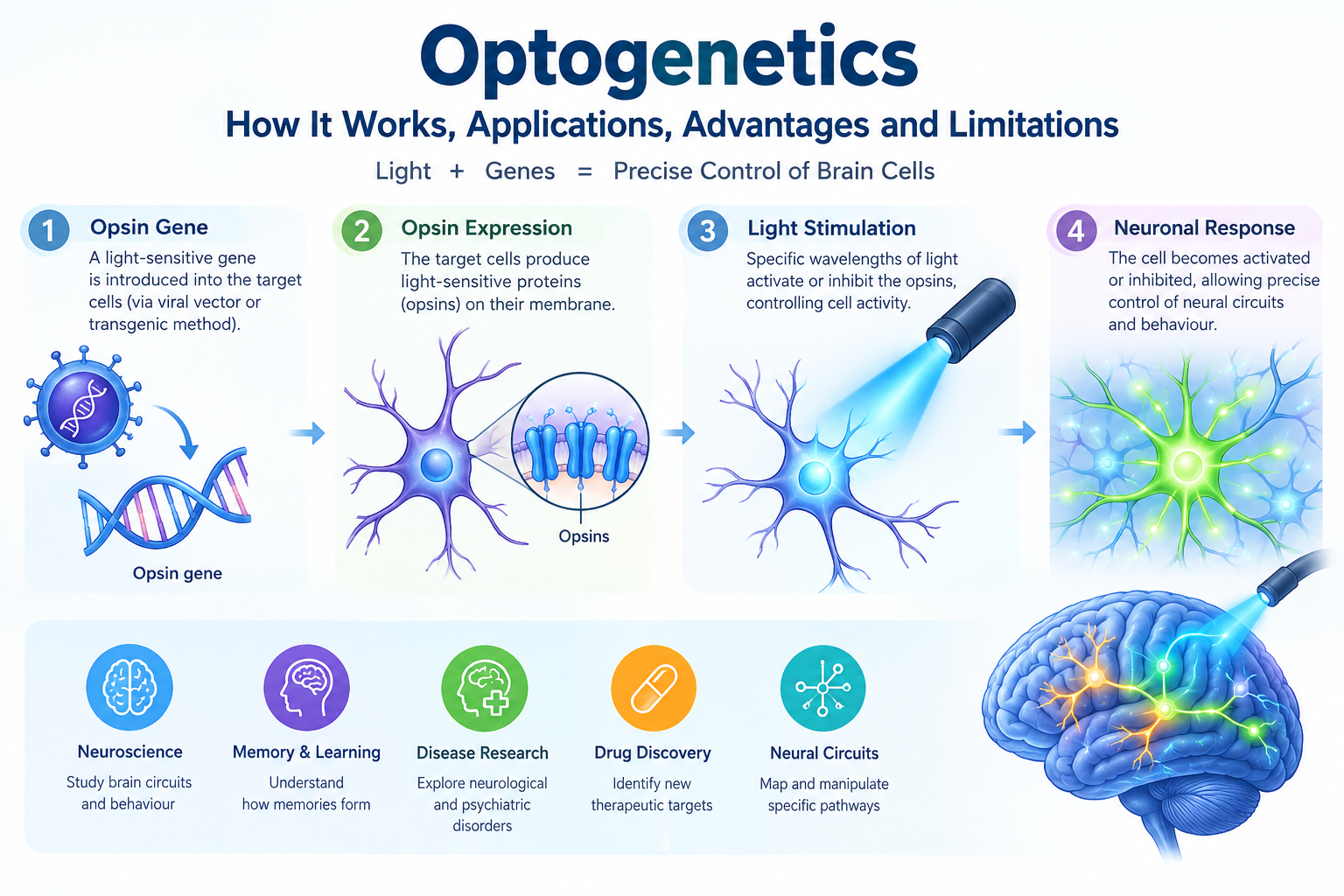
How Optogenetics Works
An interactive simplified view of how a genetically targeted neuron can be controlled using light.
How Is Light Delivered in Optogenetics?
Once the selected cells express a light-sensitive opsin, researchers need to deliver light to those cells. This is one of the most important parts of an optogenetic experiment because the light must reach the correct location with appropriate timing and intensity.
Optogenetics does not simply mean “shining light on the brain”. Researchers use specially designed light-delivery systems to deliver controlled light to the region or cells containing the light-sensitive opsin.
LED Light Sources
LEDs can be used to generate light of an appropriate wavelength. They are useful when researchers need controlled optical stimulation.
Optical Fibers
Very thin optical fibers can be positioned close to the target tissue. They allow light to be delivered into specific regions that may not be directly accessible from outside.
Target Brain Region
The light is directed toward the region containing the genetically targeted opsin-expressing cells so that only the intended cells are strongly affected.
The main goal of optogenetics is to achieve high spatial and temporal control. Researchers therefore carefully control factors such as the location of stimulation, the wavelength of light, the duration of stimulation and the timing of light pulses.This allows researchers to study how specific cells or neural circuits contribute to particular physiological or behavioural responses.
Genetic Targeting: How Are Specific Cells Selected?
One of the most powerful features of optogenetics is that researchers can target particular cells or neuronal populations rather than activating all nearby cells.
The light itself does not decide which cells should respond. Instead, researchers first make selected cells express a light-sensitive protein called an opsin. Only cells containing the appropriate opsin are designed to respond strongly to the corresponding light stimulus.
Opsin Gene
The genetic information required to produce a light-sensitive opsin is introduced into the cells that researchers want to study.
Viral Vectors
In many experimental systems, specially engineered viral vectors, such as adeno-associated virus (AAV) vectors, can be used as gene-delivery tools to introduce the opsin gene into target cells.
Cell-Type Specific Targeting
Genetic strategies can be designed so that opsin expression occurs preferentially in particular cell types or neuronal populations. This increases the specificity of the experiment.
Opsin Expression
After the genetic material is expressed, the target cells produce the light-sensitive opsin protein in their cell membrane.
Suppose researchers want to study a particular group of neurons in the brain. Instead of stimulating the entire brain region, they can use a genetic strategy to make the selected neurons express an appropriate opsin.Later, when light is delivered to that region, the opsin-expressing neurons can respond to the light while nearby cells without the opsin are much less directly affected.
Genetic targeting is a major reason why optogenetics can provide high cellular specificity. However, the exact targeting strategy, viral vector, promoter, opsin and delivery method depend on the experimental system and the cells being studied.
Major Types of Opsins
Opsins are light-sensitive proteins that allow researchers to control cellular activity using light. Different opsins can produce different effects, including activation or inhibition of neuronal activity.
Excitatory opsins can produce a change in membrane potential that makes a neuron more likely to generate an action potential.
A well-known example is Channelrhodopsin-2 (ChR2), a light-gated cation channel. When activated by appropriate light, it allows cations to pass through the membrane and can depolarize the neuron.
Inhibitory opsins are used to reduce the probability of neuronal activation. They can alter membrane potential in a direction that makes action-potential generation less likely.
Examples include halorhodopsin (NpHR), Arch and some inhibitory anion-conducting channelrhodopsins such as GtACR2.
| Opsin | General Type | Light Response | Effect on Neuron | Typical Purpose |
|---|---|---|---|---|
| Channelrhodopsin-2 (ChR2) | Cation channel | Light opens the channel | Depolarization / activation | Studying neuronal activation |
| Halorhodopsin (NpHR) | Light-driven ion pump | Light drives chloride transport | Inhibition | Reducing neuronal activity |
| Archaerhodopsin (Arch) | Proton pump | Light-driven proton transport | Hyperpolarization / inhibition | Silencing neuronal activity |
| GtACR2 | Anion-conducting channelrhodopsin | Light opens the anion channel | Usually inhibitory | Rapid optical inhibition |
The exact effect of an opsin depends on its molecular properties, ion gradients, membrane potential, cell type and experimental conditions. Therefore, it is better to understand opsins by their specific mechanism rather than simply labeling every opsin as “on” or “off”.
Basic Concept
Temporal Precision: Controlling Cells with Precise Timing
One of the major advantages of optogenetics is its ability to control cellular activity with very precise timing. Researchers can deliver short pulses of light and observe how cells respond to those changes.
Temporal precision means that researchers can control when a particular group of cells is stimulated or inhibited. Light can be turned on and off rapidly, allowing experimental manipulation on very short timescales.
Precise Timing
Light stimulation can be delivered at carefully controlled time points, allowing researchers to investigate the relationship between cellular activity and behaviour.
Rapid Light Pulses
Instead of continuously stimulating a cell, researchers can use short light pulses with controlled duration and frequency.
On–Off Control
The light source can be controlled experimentally so that stimulation can be started, stopped or repeated according to the experimental design.
Why is this useful?
- Helps study the timing of neuronal activity.
- Allows researchers to test whether a specific circuit is involved in a behaviour.
- Can separate immediate cellular effects from longer-term effects.
- Provides controlled stimulation rather than continuous uncontrolled activation.
Compared with Pharmacological Methods
- Drugs often require time for administration, distribution and receptor interaction.
- Their effects may persist even after administration has stopped.
- Optical stimulation can be switched on and off rapidly during an experiment.
- This makes optogenetics particularly useful for studying fast biological processes.
Temporal precision does not mean that every optogenetic experiment produces an instantaneous or identical response. The actual response depends on the opsin, cell type, light intensity, stimulation pattern, membrane properties and experimental conditions.
Spatial Precision: Targeting Specific Cells and Regions
Another major strength of optogenetics is spatial precision. Researchers can design experiments in which light-sensitive proteins are expressed in selected cells or cell populations and then deliver light to a defined anatomical region.
Spatial precision refers to the ability to control where cellular activity is manipulated. Instead of affecting an entire organ or a large population of cells, researchers can focus their experiment on a particular cell type, neural population or anatomical region.
Specific Cell Types
Genetic targeting strategies can be used to make opsins preferentially expressed in particular types of cells or neurons.
Specific Brain Regions
Light can be delivered to a defined region so that the experiment focuses on the neural circuit or tissue of interest.
Specific Neural Circuits
Researchers can investigate how selected groups of connected neurons contribute to physiological functions or behaviour.
Region
Spatial + Genetic Specificity
Optogenetics becomes especially powerful when genetic targeting and localized light delivery are combined. The genetic component determines which cells contain the opsin, while the optical component determines where and when stimulation is delivered.
Why This Matters
This approach allows researchers to investigate the contribution of specific cells and circuits without relying only on broad stimulation of surrounding tissue.
Example in Neuroscience
A researcher may want to determine whether a particular neuronal population contributes to fear, reward, movement or memory. Targeted opsin expression combined with localized optical stimulation can help test such circuit-level questions.
Not Completely Unlimited
Spatial precision is high but not perfect. Factors such as gene-delivery specificity, opsin expression, light scattering and the physical properties of the tissue can influence the actual area affected.
Optogenetics combines genetic specificity with optical control. In simple terms, the genetic approach helps decide which cells can respond, while the optical system helps control where and when the stimulation occurs.
Optogenetics in Neuroscience
Optogenetics has become an important research technique in neuroscience because it allows scientists to investigate how specific neurons and neural circuits contribute to brain function and behaviour.
The brain contains many different populations of neurons that communicate with each other through complex neural circuits. Optogenetics allows researchers to manipulate selected populations of these cells and then observe the resulting changes in neural activity, physiology or behaviour.
Studying Neural Circuits
Researchers can investigate how different groups of neurons communicate with one another and how particular circuits contribute to specific brain functions.
- Identify important neuronal populations.
- Activate selected neurons.
- Inhibit selected neurons.
- Observe the resulting physiological or behavioural response.
Fear and Emotional Behaviour
Optogenetic experiments have been used to investigate neural circuits associated with fear, anxiety and other emotional behaviours.
By controlling selected neuronal populations, researchers can test whether particular circuits contribute to the formation or expression of specific behavioural responses.
Memory and Learning
Optogenetics can be used to investigate how specific neuronal populations participate in learning and memory processes.
Researchers can manipulate neural activity during particular phases of an experiment and examine whether this changes memory-related behaviour.
Reward and Motivation
Neural circuits involved in reward, motivation and reinforcement can also be studied using optical manipulation.
This is particularly useful for understanding how specific pathways contribute to motivated behaviour and reward-related responses.
Movement and Motor Control
Optogenetics has helped researchers investigate neuronal circuits involved in movement and motor behaviour.
By activating or inhibiting selected neurons, researchers can study how particular neural pathways contribute to movement.
Neurological and Psychiatric Research
Optogenetics provides a research tool for investigating mechanisms underlying neurological and psychiatric disorders.
It can help identify abnormal circuit activity and potential cellular targets for future therapeutic research.
Optogenetic experiments can provide strong evidence about the role of specific neural populations, but behavioural outcomes are complex and depend on the circuit, cell type, stimulation pattern and experimental conditions. Therefore, optogenetics is primarily a powerful research tool for understanding biological mechanisms rather than a simple method for controlling behaviour.
Optogenetics in Memory and Learning
Memory is not stored in one single location in the brain. It involves complex patterns of activity across groups of neurons and neural circuits. Optogenetics has provided researchers with a powerful way to investigate these cellular and circuit mechanisms.
During learning, particular groups of neurons may become active and undergo changes that are associated with formation and later expression of a memory. Optogenetics can be used experimentally to manipulate selected neuronal populations and investigate their contribution to memory-related behaviour.
Learning
Learning involves changes in the nervous system that allow an organism to acquire or modify information, skills or behavioural responses. Optogenetic tools can help researchers identify which neuronal circuits participate in these processes.
Memory Formation
When an experience occurs, particular neuronal populations may become active. Researchers can study whether these cells and their connections are important for storing or expressing information associated with that experience.
Memory Recall
Researchers can investigate what happens when previously involved neuronal populations are activated again. Such experiments can help examine the relationship between neuronal activity and retrieval of stored information.
Neural Ensembles
A memory-related experience may involve coordinated activity across a population or ensemble of neurons rather than a single neuron. Optogenetics can help researchers manipulate these populations experimentally.
Simple Example
Imagine an experimental animal experiencing a particular environment during a learning task. A group of neurons becomes active during that experience.
Researchers can use genetic and optical techniques to identify or manipulate neurons associated with that experience. Later, controlled activation of the relevant neuronal population can be used to study whether its activity is associated with memory-related behavioural responses.
Such experiments help scientists investigate whether particular neural ensembles are involved in memory storage and retrieval.
Why Optogenetics Is Useful
- Precise control over selected neuronal populations.
- Rapid manipulation of neural activity.
- Ability to test activation as well as inhibition.
- Useful for studying specific phases of learning and memory.
What Can Researchers Learn?
- Which neurons participate in a memory-related process.
- Which circuits are important for memory expression.
- How neuronal activity relates to behaviour.
- How different brain regions interact during memory-related tasks.
A memory is not simply equivalent to one neuron or one isolated group of cells. Memory involves distributed neural circuits and complex cellular and synaptic changes. Optogenetics is a research tool that allows scientists to test the causal contribution of selected neuronal populations within these larger networks.
Optogenetics in Neurological Disease Research
Many neurological and psychiatric disorders involve abnormal activity within specific neurons or neural circuits. Optogenetics allows researchers to investigate these circuits with high experimental precision and can therefore be valuable in disease research.
Most applications discussed in this section are experimental research applications. Optogenetics is primarily a laboratory research technology and should not be confused with an established routine treatment for these diseases.
Parkinson’s Disease Research
Parkinson’s disease involves dysfunction within neural circuits that are important for movement. Optogenetic techniques can help researchers study how specific neuronal pathways contribute to abnormal motor function.
- Study motor-control circuits.
- Investigate specific neuronal pathways.
- Examine how circuit activity changes movement.
- Explore potential mechanisms for future therapies.
Epilepsy Research
Epileptic seizures involve abnormal and excessive neuronal activity. Optogenetics can be used experimentally to investigate how particular neuronal populations contribute to seizure initiation or propagation.
- Study abnormal circuit activity.
- Identify potentially important neuronal populations.
- Investigate mechanisms of seizure propagation.
- Explore experimental circuit-control strategies.
Addiction Research
Addiction involves complex changes in reward, motivation and reinforcement circuits. Optogenetics allows researchers to manipulate selected neuronal pathways and investigate their contribution to drug-related behaviours.
- Study reward pathways.
- Investigate reinforcement mechanisms.
- Examine neuronal responses associated with drug exposure.
Anxiety and Psychiatric Research
Neural circuits involved in stress, fear, anxiety and emotional processing can be investigated using optogenetic approaches.
This can help researchers understand how specific neuronal populations contribute to complex emotional behaviours.
Neurodegenerative Disease Research
Optogenetics can also be used as a research tool to investigate specific neuronal populations affected by neurodegenerative processes.
By manipulating defined circuits, researchers can examine relationships between neuronal activity, circuit dysfunction and behaviour.
Understanding Disease Mechanisms
One of the major benefits is that researchers can move beyond simply observing abnormal brain activity and experimentally test whether specific neuronal populations contribute to a disease-related phenotype.
Why It Is Valuable
It allows researchers to test causal relationships between neuronal activity and disease-related behaviours or physiological changes.
Drug Discovery Relevance
Understanding disease-associated circuits may help identify biological pathways and targets that can later be investigated using conventional pharmacological approaches.
Future Potential
Optogenetics may contribute to the development of new experimental approaches for circuit-based therapies, although significant technical and clinical challenges remain.
Optogenetics vs Pharmacology vs Electrical Stimulation
Optogenetics is one of several methods used to manipulate or study cellular and neural activity. Pharmacological methods and electrical stimulation are also widely used, but each approach has different strengths and limitations.
Pharmacology mainly uses chemical agents to influence biological targets. Electrical stimulation uses electrical current to influence excitable tissue. Optogenetics uses light-sensitive proteins and light to control selected cells experimentally.
| Feature | Optogenetics | Pharmacology | Electrical Stimulation |
|---|---|---|---|
| Basic Method | Light is used to activate or inhibit cells expressing specific opsins. | Drugs or other chemical agents interact with molecular targets. | Electrical current is applied to excitable tissue. |
| Targeting | Can achieve high cellular specificity when combined with appropriate genetic targeting. | Depends on drug distribution, molecular target and receptor/enzyme expression. | Current can affect multiple excitable cells near the stimulation site. |
| Timing | Light can be delivered in precisely controlled patterns and pulses. | Drug effects may develop and persist according to absorption, distribution, metabolism and elimination. | Electrical pulses can be delivered rapidly. |
| Cell-Type Specificity | Can be very high when genetic targeting is sufficiently specific. | Usually depends on where the drug reaches and which molecular targets it affects. | Often lower because nearby electrically excitable cells may also respond. |
| Reversibility | Optical stimulation can generally be stopped rapidly, although the biological response may not always stop immediately. | Duration depends on the drug and its pharmacokinetic properties. | Stimulation can be stopped rapidly, but biological effects may vary. |
| Main Advantage | Combines genetic targeting with precise optical control. | Useful for studying molecular pathways and drug-target interactions. | Direct and rapid stimulation of excitable tissue. |
Pharmacology
Pharmacological approaches are extremely important for understanding drug action, receptors, enzymes, signaling pathways and therapeutic effects.
- Uses chemical compounds.
- Useful for receptor and pathway studies.
- Highly relevant to drug discovery.
- Effects depend on pharmacokinetics and pharmacodynamics.
Electrical Stimulation
Electrical stimulation can rapidly influence electrically excitable cells, but stimulation may not always distinguish individual cell types within the affected region.
- Rapid stimulation.
- Useful in neuroscience research.
- Can influence nearby excitable cells.
- Does not require opsin expression.
Optogenetics
Optogenetics combines genetic engineering with optical stimulation, allowing researchers to investigate selected cells and neural circuits with high experimental precision.
- Uses light-sensitive opsins.
- Can target selected cell populations.
- Provides precise temporal control.
- Useful for causal circuit studies.
Drug
Current
Opsin + Light
These methods are not necessarily competitors. In modern biomedical research, pharmacology, electrical stimulation, optogenetics and other experimental approaches can complement one another. The best method depends on the biological question being investigated.
Editorial Note
This article has been carefully researched and written by Deepak Rajput with a focus on accuracy, clarity, and evidence-based healthcare information. Pharmaacademias.com