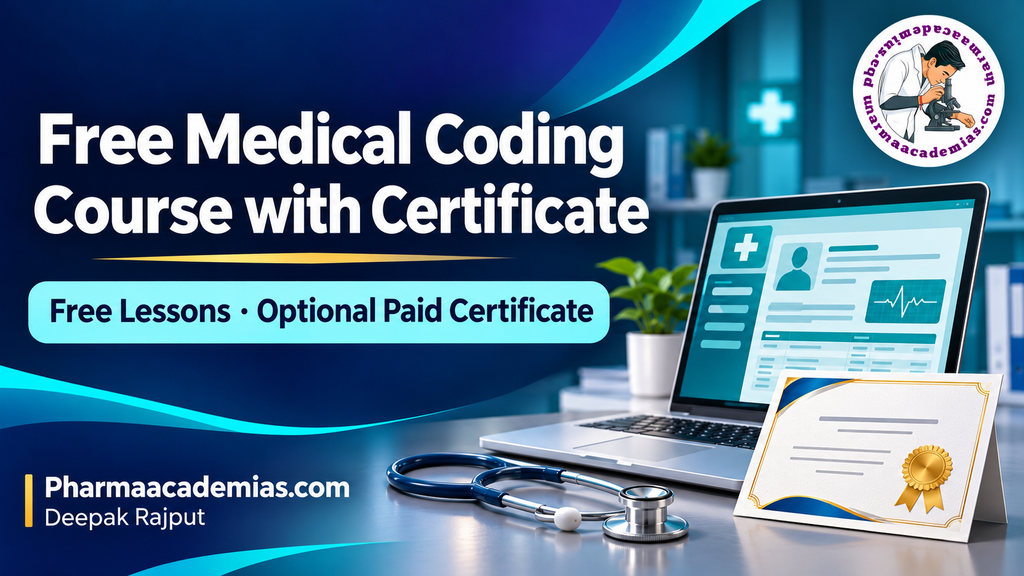
Free Medical Coding Course with Certificate
Free Medical Coding Course with Certificate: If you are a pharmacy student or a recent graduate exploring healthcare careers, Great Learning Academy’s Medical Coding (CPC) Foundations course is a free way to learn the basics. This beginner-level, self-paced online course takes approximately 3 hours and 45 minutes.
A medical coder reviews clinical documentation and assigns standard codes to the diagnoses, procedures, and services recorded during a patient visit. For example, if a physician documents type 2 diabetes and records a procedure performed during the same visit, a coder uses the documented details to look up and verify the applicable diagnosis and procedure codes.
The course introduces ICD-10-CM for diagnoses, CPT for procedures and services, and HCPCS Level II for items and services such as medical supplies and equipment. It also explains how coding fits into medical billing and how modifiers add information about a service.
Medical Coding Course at a Glance
- Course name
- Medical Coding (CPC) Foundations
- Provider
- Great Learning Academy
- Learning time
- 3 hours and 45 minutes
- Difficulty level
- Beginner
- Format
- Online and self-paced
- Course fee
- Free enrollment and lessons
- Completion certificate
- Optional and available for a fee
- Core topics
- ICD-10-CM, CPT, and HCPCS Level II
- Who it’s for
- Students, freshers, and healthcare career beginners
What Will You Learn in the Medical Coding Course?
Great Learning Academy’s Medical Coding (CPC) Foundations course introduces the coding systems used in U.S. healthcare. You’ll learn how medical coders work with patient records, choose codes for diagnoses and services, and follow coding rules before those codes are used in an insurance claim.
Medical Coding, Billing, and the Revenue Cycle
Learn how a documented patient visit becomes a coded record. Medical coders assign codes based on the provider’s documentation. The billing team uses those codes to prepare claims, submit them to insurers, and follow up on payments or denials.
Medical Terminology and Anatomy
Review common medical terms and body systems that appear in patient records. For pharmacy students, this is where your anatomy and pathophysiology knowledge comes in. Recognizing the condition, affected body part, or documented details about a procedure helps you understand what to look up.
ICD-10-CM for Diagnosis Coding
ICD-10-CM is used to code documented diagnoses and other reasons for a patient encounter. The course introduces a two-step lookup. Start with the diagnosis in the Alphabetic Index, then confirm the code and read any applicable instructions in the Tabular List. The instructions help you check whether the code fits the documentation.
CPT Codes and Modifiers
CPT codes describe many procedures and services performed by healthcare professionals. The course introduces how to locate a procedure code and use modifiers when appropriate. A modifier adds context about how or under what circumstances a service was provided.
HCPCS Level II and Patient Encounter Coding
HCPCS Level II covers items and services such as wheelchairs, certain medical supplies, and ambulance transport. The course also walks through a complete patient encounter so you can see how diagnosis, procedure, and supply codes may be used together for the same visit.
Coding Compliance, Ethics, and the CPC Exam
Learn about common compliance issues such as upcoding, which can occur when a code reflects a higher service level than the documentation supports. The course also introduces patient information privacy and explains the structure of AAPC’s Certified Professional Coder (CPC) exam.
Who Should Take This Free Medical Coding Course?
Great Learning Academy’s Medical Coding (CPC) Foundations course is designed for beginners with no prior medical coding experience. It suits students and graduates who want to explore how patient records are reviewed and coded before committing to a longer training program.
B.Pharm and M.Pharm Students
Subjects such as anatomy, physiology, pharmacology, and pathophysiology help you understand the medical terms in a patient record. The course introduces the next step in medical coding. You learn to identify what the provider documented and use that information to look up the applicable code.
Pharm.D Students and Graduates
If you have reviewed patient case histories during your training, you may already be familiar with diagnoses, procedures, and treatment notes. This course shows how a medical coder reads those details and checks which ones support code selection.
Nursing, Allied Health, and Life Science Students
Your understanding of body systems and clinical terminology can help you follow the course examples. Pay particular attention to how small details, such as the side of the body documented in a case, can affect which diagnosis code is appropriate.
Freshers Exploring Medical Coding or Billing
If you are comparing entry-level healthcare roles, the course helps you understand where medical coding fits into revenue cycle management (RCM). You can see whether reviewing records, checking code instructions, and working carefully with details are tasks you enjoy.
How to Practise Medical Coding After the Course
Start with a short fictional outpatient case. A case with one documented diagnosis and one procedure gives you enough detail to practise the basic workflow.
- Read the case and highlight the relevant details. Identify the diagnosis the provider documented and the service that was performed. Note any details that could affect coding.
- Look up the diagnosis in ICD-10-CM. Find the main term in the Alphabetic Index, then confirm the code description and any applicable instructions in the Tabular List.
- Look up the procedure in a CPT reference. Compare the code description with the documented service. Check whether the practice case includes enough detail to support your selection.
- Write a one-line reason for each code. Use the case wording to explain your choice, then compare your reasoning with the answer explanation if one is provided.
Is the Great Learning Medical Coding Certificate Free?
Enrollment and course lessons are free. Great Learning Academy offers an optional completion certificate after you successfully finish the Medical Coding (CPC) Foundations course and pay a separate, non-refundable certificate fee. Check the amount shown on the platform before paying.
Great Learning Academy Completion Certificate
This certificate records that you completed Great Learning Academy’s beginner-level course. It documents introductory training in ICD-10-CM diagnosis coding, CPT procedure coding, HCPCS Level II, and coding compliance. You can list it under Courses and Training on your résumé if you obtain the certificate.
AAPC Certified Professional Coder (CPC) Credential
The CPC credential is a professional certification from AAPC. Earning it requires passing AAPC’s CPC exam. Great Learning’s foundation course introduces the exam structure and the code sets you’ll encounter, so you can use it to decide what to study next.
How to Add the Course Certificate to Your Résumé
If you obtain the completion certificate, use the course title and issuing organization. Add your actual completion month and year. You can also include a short line about the topics you studied.
Medical Coding (CPC) Foundations
Great Learning Academy · [Month Year]
Topics covered: ICD-10-CM, CPT, HCPCS Level II, and coding compliance.
Frequently Asked Questions About the Course
Can beginners take this course without coding experience?
Yes. Great Learning Academy’s Medical Coding (CPC) Foundations course is designed for beginners. It starts with medical coding and billing basics before introducing ICD-10-CM, CPT, and HCPCS Level II.
Do I need to know Python or any programming language?
No. In this course, coding means assigning standard codes to documented diagnoses, procedures, and services. The exercises focus on reading medical documentation and looking up codes in the relevant code sets.
How long does the course take to complete?
Great Learning Academy lists approximately 3 hours and 45 minutes of learning content. The course is self-paced, so you can pause to take notes or set aside extra time to practise code lookup.
Can I study the lessons without buying the certificate?
Yes. Enrollment and access to the lessons are free. If you want the optional Great Learning Academy completion certificate, successfully finish the course and pay the separate, non-refundable certificate fee.
Does this course earn me the AAPC CPC credential?
Great Learning Academy offers its own course completion certificate. To earn AAPC’s Certified Professional Coder (CPC) credential, you must meet AAPC’s requirements and pass its separate CPC exam.
How to Enroll in the Free Medical Coding Course
- Open the official course page. Use the button below to visit Great Learning Academy’s Medical Coding (CPC) Foundations course page.
- Sign up or log in. Use your email to create an account, or sign in if you already have one.
- Complete the lessons at your own pace. Start with the coding and billing basics, then work through the code sets and patient encounter examples.
- Request your certificate if you want one. After successfully completing the course, review the fee shown by Great Learning and follow the platform’s payment instructions to obtain your completion certificate.
Start Learning Medical Coding
Learn the basics of diagnosis and procedure coding at your own pace. The lessons are free, and a completion certificate is available for a separate fee.
Start Free Medical Coding CourseEditorial Note
This article has been carefully researched and written by Deepak Rajput with a focus on accuracy, clarity, and evidence-based healthcare information. Pharmaacademias.com