
Estimation of Barium Sulphate by Gravimetry: Barium sulphate (BaSO₄) can be quantitatively estimated by gravimetric analysis. The method is based on the precipitation of sulphate ions as highly insoluble barium sulphate by adding a soluble barium salt, usually barium chloride (BaCl₂).
The precipitate is separated by filtration, washed to remove soluble impurities, dried or ignited to constant weight, and accurately weighed. From the mass of BaSO₄ obtained, the amount of sulphate or the original substance can be calculated.
Principle
The estimation is based on the following precipitation reaction:
Ba2+ + SO42− → BaSO4↓
When a solution containing sulphate ions is treated with a suitable soluble barium salt, white, highly insoluble barium sulphate is formed.
The precipitate is:
- Allowed to digest,
- Filtered,
- Washed,
- Dried/ignited,
- Cooled in a desiccator,
- Weighed to constant weight.
Since the composition of BaSO₄ is definite and known, the amount of sulphate present can be calculated from the mass of BaSO₄.
Important reaction
Na2SO4 + BaCl2 → BaSO4↓ + 2NaCl
The ionic equation is:
SO42− + Ba2+ →BaSO4↓
Requirements
Apparatus
- Analytical balance
- Beaker
- Glass rod
- Measuring cylinder/pipette
- Watch glass
- Filter funnel
- Ashless filter paper
- Crucible
- Desiccator
- Bunsen burner or muffle furnace
- Hot plate or water bath
Reagents
- Sample containing sulphate
- Barium chloride solution (BaCl₂)
- Dilute hydrochloric acid (HCl)
- Distilled water
- Suitable washing liquid
Procedure
1. Preparation of Sample Solution
Accurately weigh the required quantity of the sample and dissolve it in distilled water. Transfer the solution into a suitable beaker. If the sample does not dissolve completely in water, an appropriate solvent or treatment may be used according to the nature of the sample.
2. Acidification of the Solution
Add a small amount of dilute hydrochloric acid (HCl) to the sample solution. Acidification helps prevent the formation of unwanted precipitates such as carbonates and improves the purity of the BaSO₄ precipitate. The solution is generally heated to an appropriate temperature before precipitation.
3. Addition of Barium Chloride
Add hot barium chloride solution slowly to the hot, acidified sample solution with continuous stirring.
The sulphate ions react with barium ions to form barium sulphate:
Ba2+ + SO42− → BaSO4↓
A white precipitate of BaSO₄ is formed.
Barium chloride should generally be added slowly and in slight excess to ensure complete precipitation.
4. Digestion of the Precipitate
After complete addition of BaCl₂, the mixture is heated and allowed to stand for some time. This process is known as digestion or aging. Digestion allows the small particles of BaSO₄ to grow into larger crystals.
Advantages of digestion
- Produces larger particles
- Improves filterability
- Reduces adsorption of impurities
- Improves purity of the precipitate
- Helps reduce loss through the filter
This is particularly important because BaSO₄ can otherwise form a very fine precipitate.
5. Testing for Complete Precipitation
Complete precipitation should be confirmed before filtration. A few drops of BaCl₂ solution can be added to the clear supernatant liquid. If no additional white precipitate forms, precipitation is considered complete. If further precipitate forms, more BaCl₂ should be added and the mixture allowed to digest again.
6. Filtration
The BaSO₄ precipitate is separated from the mother liquor by filtration. An ashless filter paper is commonly used when the precipitate will subsequently be ignited. Care must be taken during transfer so that no precipitate remains stuck to the beaker or is lost during filtration.
7. Washing
The precipitate is washed several times with a suitable washing liquid.
Washing removes soluble impurities such as:
- Excess BaCl₂
- Chloride ions
- Other soluble salts
- Mother liquor
The washing should be thorough but not excessive.
8. Drying and Ignition
After washing, the filter paper containing the BaSO₄ precipitate is transferred carefully to a previously weighed crucible. The precipitate is first dried.
The filter paper is then carefully charred and finally ignited at an appropriate temperature.
The purpose of ignition is to:
- Remove moisture
- Remove the filter paper
- Obtain a stable weighing form
- Produce constant mass
BaSO₄ is relatively thermally stable, making it suitable for gravimetric estimation.
9. Cooling in a Desiccator
After ignition, the crucible is allowed to cool in a desiccator. The desiccator prevents the dried precipitate from absorbing atmospheric moisture or becoming contaminated by dust.
10. Weighing
The crucible containing BaSO₄ is accurately weighed.
The mass of BaSO₄ is calculated as:
Mass of BaSO4 = Mass of crucible + BaSO4 − Mass of empty crucible
11. Heating to Constant Weight
The crucible is reheated, cooled in a desiccator and weighed again. This process is repeated until two successive weights are essentially constant.
Therefore:
Ignite → Cool → Weigh → Reignite → Cool → Reweigh
until constant weight is obtained.
Calculation
The molecular mass of barium sulphate is approximately:
BaSO4 = 137.33 + 32.06 + (4×16.00)
= 233.39 g/mol
The molecular mass of sulphate ion is:
SO42− = 32.06 + (4×16.00)
= 96.06 g/mol
Therefore, the gravimetric factor for sulphate from BaSO₄ is:
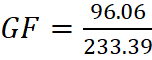
GF≈0.4116
Thus:
Mass of SO42− = Mass of BaSO4 × 0.4116
Example Calculation
Suppose 0.250 g of BaSO₄ is obtained after ignition.
Then:
Mass of sulfate = 0.250 × 0.4116
= 0.1029 g
Therefore, the sample contains approximately:
0.103 g of SO42−
Estimation of Barium Ion as BaSO₄
The same gravimetric principle can be used to estimate barium ions.
If the sample contains Ba²⁺, sulphate ions can be added to precipitate barium as BaSO₄:
Ba2+ + SO42− → BaSO4↓
Since one mole of Ba²⁺ produces one mole of BaSO₄:

Mass of Ba = Mass of BaSO4 × 0.5884
Thus, the mass of barium can be calculated directly from the mass of BaSO₄ obtained.
Why BaSO₄ is Suitable for Gravimetric Estimation
Barium sulphate is particularly suitable because:
- It is very sparingly soluble in water.
- It has a definite chemical composition.
- It is relatively stable during drying and ignition.
- It can be obtained in a form suitable for filtration.
- Its high molecular mass gives a reasonably favorable gravimetric factor.
- The precipitation reaction is simple and well defined.
Factors Affecting the Precipitation
1. Temperature: Precipitation is generally carried out using a hot solution because heating can improve crystal growth and filtration characteristics.
2. Rate of Addition of BaCl₂: BaCl₂ should be added slowly with continuous stirring.Rapid addition may produce very fine particles and increase the possibility of impurity contamination.
3. Concentration: Very concentrated solutions may produce excessively fine precipitates. Suitable dilution favors the formation of better crystals.
4. Acidity: A suitable acidic medium helps minimize interference from other anions, particularly carbonate.
However, excessive acidity should be avoided because it can affect sulphate speciation and precipitation conditions.
5. Digestion: Proper digestion produces larger and purer BaSO₄ particles.
Sources of Error
1. Incomplete precipitation: If some sulphate remains in solution, the mass of BaSO₄ will be lower than expected.
2. Loss during filtration: Fine BaSO₄ particles may pass through the filter or may be lost during transfer.
3. Coprecipitation: Other substances may be incorporated into or adsorbed by the BaSO₄ precipitate.
4. Inadequate washing: Remaining soluble impurities increase the final mass and produce a positive error.
5. Excessive washing: Excessive washing can potentially cause mechanical losses.
6. Incomplete ignition: Residual moisture or organic matter can increase the measured mass.
7. Contamination: Dust or impurities entering the crucible can increase the measured weight.
8. Incorrect weighing: Failure to cool the crucible properly before weighing may result in inaccurate measurements.
Precautions
- Use accurately weighed sample.
- Use a properly standardized or accurately prepared BaCl₂ solution where required.
- Maintain suitable acidity.
- Add BaCl₂ slowly with continuous stirring.
- Use a slight excess of BaCl₂ to ensure complete precipitation.
- Allow sufficient time for digestion.
- Test the supernatant liquid for complete precipitation.
- Wash the precipitate thoroughly.
- Use ashless filter paper when ignition is required.
- Avoid loss of precipitate during transfer and filtration.
- Ignite carefully to remove the filter paper completely.
- Cool the crucible in a desiccator before weighing.
- Continue heating, cooling and weighing until constant weight is obtained.
Editorial Note
This article has been carefully researched and written by Deepak Rajput with a focus on accuracy, clarity, and evidence-based healthcare information. Pharmaacademias.com