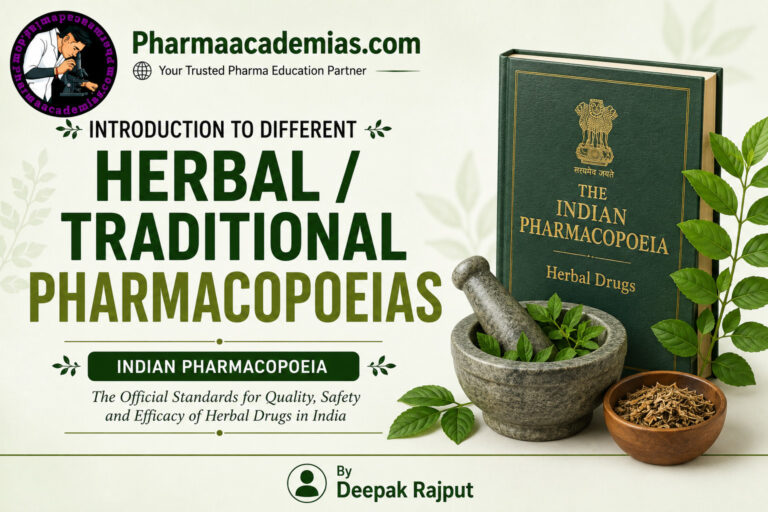
Ayurvedic Pharmacopoeia of India: India possesses one of the oldest and richest traditional systems of medicine in the world. Among these traditional systems, Ayurveda is regarded as the most ancient and scientifically developed healthcare system. Ayurveda has been practiced in India for thousands of years and continues to play a significant role in healthcare and disease management.
The word “Ayurveda” is derived from two Sanskrit words: “Ayur” meaning life and “Veda” meaning knowledge or science. Therefore, Ayurveda literally means the “Science of Life.” This system emphasizes the maintenance of health, prevention of diseases, and treatment through natural substances, dietary regulation, and lifestyle modifications.
Ayurvedic medicines are mainly prepared from medicinal plants, minerals, metals, and animal products. Since natural drugs can vary in quality, purity, strength, and therapeutic efficacy, standardization of Ayurvedic medicines became essential. To ensure uniform standards and quality control of Ayurvedic drugs and formulations, the Government of India developed the Ayurvedic Pharmacopoeia of India (API).
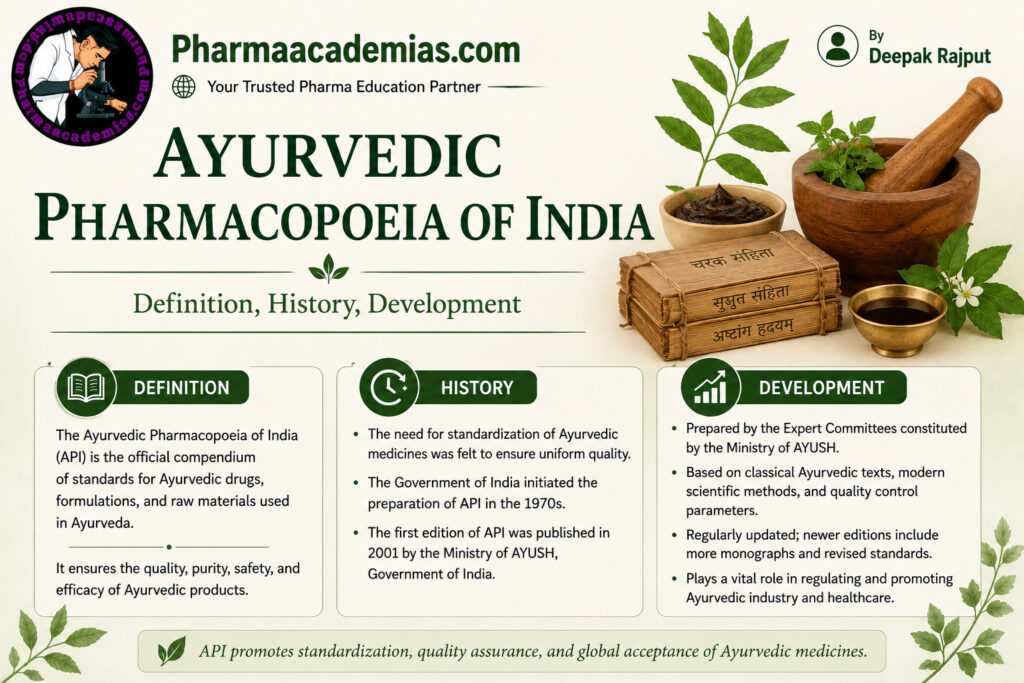
The Ayurvedic Pharmacopoeia of India is an official compendium that provides standards for Ayurvedic drugs and formulations. It contains scientifically validated monographs that help ensure the identity, purity, quality, and strength of Ayurvedic medicines used in healthcare.
The API serves as an authoritative reference for manufacturers, pharmacists, researchers, regulatory authorities, students, and practitioners involved in Ayurveda and pharmacognosy.
Definition of Ayurvedic Pharmacopoeia of India
The Ayurvedic Pharmacopoeia of India may be defined as:
“An official publication containing standards, specifications, and monographs for single and compound Ayurvedic drugs used in the Ayurvedic system of medicine.”
It provides detailed scientific information necessary for the authentication, identification, standardization, and quality control of Ayurvedic medicinal substances.
Historical Background of Ayurveda
Ayurveda originated in India more than 5000 years ago and is considered one of the oldest healthcare systems known to humanity. Ancient Ayurvedic knowledge was documented in classical texts such as:
These texts describe numerous medicinal plants, formulations, surgical procedures, disease classifications, and therapeutic approaches.
Ayurvedic medicines were traditionally prepared according to formulations mentioned in classical texts. However, variations in raw materials, processing methods, and quality led to inconsistencies in therapeutic outcomes.
With the growth of Ayurvedic pharmaceutical industries and increasing global use of herbal medicines, the need for standardized official references became essential. This led to the development of the Ayurvedic Pharmacopoeia of India.
Development of Ayurvedic Pharmacopoeia of India
The Government of India recognized the importance of standardization of Ayurvedic medicines and established committees for preparing pharmacopoeial standards.
In 1962, the Government of India constituted the Ayurvedic Pharmacopoeia Committee under the Ministry of Health and Family Welfare. The committee was responsible for developing standards for Ayurvedic drugs.
The first volume of the Ayurvedic Pharmacopoeia of India was published in 1986.
The API has been published in multiple volumes covering:
- Single herbal drugs
- Mineral drugs
- Compound formulations
The pharmacopoeia is continuously revised and expanded to include additional medicinal substances and updated scientific methods.
Objectives of Ayurvedic Pharmacopoeia of India
The Ayurvedic Pharmacopoeia of India was developed with several important objectives.
Standardization of Ayurvedic Drugs: One of the primary objectives of API is to establish official quality standards for Ayurvedic drugs and formulations.
Natural drugs may vary due to environmental, geographical, and seasonal factors. Standardization ensures uniformity in quality and therapeutic effectiveness.
Authentication of Medicinal Plants: The API provides detailed botanical and pharmacognostical descriptions to ensure correct identification of medicinal plants and prevent substitution or adulteration.
Quality Control: The pharmacopoeia establishes analytical methods and purity standards for evaluating Ayurvedic medicines.
Promotion of Safe and Effective Use: By ensuring quality and authenticity, the API helps promote the safe and rational use of Ayurvedic medicines.
Support for Research and Industry: The API serves as an important reference for researchers, pharmaceutical industries, quality control laboratories, teachers, and students.
Contents of Ayurvedic Pharmacopoeia of India
The Ayurvedic Pharmacopoeia contains detailed monographs of Ayurvedic drugs and formulations.
Each monograph includes scientifically organized information regarding:
- Sanskrit name
- Botanical name
- Family
- Synonyms
- Geographical source
- Part used
- Macroscopic characters
- Microscopic characters
- Chemical constituents
- Identification tests
- Purity standards
- Assay methods
- Therapeutic uses
The pharmacopoeia integrates traditional Ayurvedic knowledge with modern scientific evaluation methods.
Structure of API Monographs
Drug Name and Synonyms: Each monograph begins with the official Ayurvedic name of the drug along with synonyms in Sanskrit and regional languages.
This helps ensure proper identification and avoids confusion due to different local names.
Botanical Identity: The botanical name and family of the medicinal plant are provided according to modern taxonomic classification.
Correct botanical identification is essential because many plants possess similar vernacular names.
Description of the Drug: Detailed macroscopic and microscopic descriptions are included.
Macroscopic characters include:
- Size
- Shape
- Color
- Odor
- Taste
- Surface characteristics
Microscopic evaluation describes cellular structures such as:
- Trichomes
- Fibers
- Starch grains
- Calcium oxalate crystals
- Vessels
These characteristics are important for authentication and detection of adulteration.
Chemical Constituents
The monographs provide information regarding major active constituents responsible for therapeutic activity.
Examples include:
- Alkaloids
- Glycosides
- Tannins
- Flavonoids
- Volatile oils
- Saponins
Standards for Purity
Purity standards are included to ensure the quality of raw materials.
These tests include:
- Foreign matter
- Ash values
- Extractive values
- Moisture content
- Heavy metal limits
- Microbial contamination
Identification and Assay
Modern analytical techniques such as:
- Thin Layer Chromatography (TLC)
- High Performance Thin Layer Chromatography (HPTLC)
- High Performance Liquid Chromatography (HPLC)
are used for identification and quantification of active constituents.
Classification of Drugs in API
The Ayurvedic Pharmacopoeia includes different categories of drugs.
Herbal Drugs
These include medicinal substances obtained from plants.
Examples:
- Ashwagandha
- Neem
- Tulsi
- Haritaki
- Brahmi
- Guduchi
Mineral and Metallic Drugs
Ayurveda also uses minerals and metals processed according to traditional methods.
Examples:
- Abhraka Bhasma
- Lauha Bhasma
- Swarna Bhasma
Animal-Derived Drugs
Some Ayurvedic preparations contain substances obtained from animal origin.
Compound Formulations
These are formulations prepared by combining multiple ingredients according to classical Ayurvedic texts.
Examples:
- Chyawanprash
- Triphala Churna
- Dashmoolarishta
- Ashokarishta
Importance of Ayurvedic Pharmacopoeia of India
The API plays a major role in Ayurvedic medicine and pharmacognosy.
Ensures Quality and Safety: The API establishes standards that ensure the quality, purity, and safety of Ayurvedic medicines.
Prevents Adulteration: The pharmacopoeia helps detect adulteration and substitution of medicinal plants and raw materials.
Scientific Validation: The API integrates traditional Ayurvedic knowledge with modern scientific methods and analytical techniques.
Supports Pharmaceutical Industries
Ayurvedic pharmaceutical industries use API standards during:
- Raw material procurement
- Manufacturing
- Quality control
- Product development
Educational and Research Importance
The API serves as a valuable educational resource for students, researchers, pharmacognosists, pharmacists, and Ayurvedic practitioners.
Global Acceptance of Ayurveda
Standardization through API has improved international confidence in Ayurvedic medicines and supported their global acceptance.
Relationship with Other Pharmacopoeias
The Ayurvedic Pharmacopoeia of India complements other official pharmacopoeias such as:
- Indian Pharmacopoeia (IP)
- British Herbal Pharmacopoeia (BHP)
- United States Pharmacopeia (USP)
- Siddha Pharmacopoeia of India
- Unani Pharmacopoeia of India
While the Indian Pharmacopoeia mainly focuses on conventional pharmaceutical products, the API specifically deals with Ayurvedic drugs and formulations.
Role of API in Herbal Drug Standardization
Herbal medicines often face problems such as:
- Adulteration
- Misidentification
- Variability in active constituents
- Contamination
The API helps overcome these problems by providing official standards and scientific methods for evaluation.
Standardization ensures:
- Consistent therapeutic activity
- Better safety profile
- Improved patient confidence
- Regulatory compliance
Challenges Faced by API
Despite its importance, the API faces several challenges.
The chemical composition of medicinal plants may vary due to environmental and seasonal conditions.
Standardization of complex polyherbal formulations is also difficult because they contain multiple active constituents.
Another challenge is the scientific validation of traditional claims through modern clinical studies.
Continuous updating is necessary to include newly researched medicinal plants and advanced analytical techniques.
Future Prospects of API
The future of the Ayurvedic Pharmacopoeia is highly promising due to increasing global interest in herbal and traditional medicines.
Modern technologies such as:
- DNA fingerprinting
- Metabolomics
- Chromatographic fingerprinting
- Biotechnology
- Artificial intelligence
are improving the standardization and quality control of Ayurvedic medicines.
The integration of Ayurveda with evidence-based medicine and modern healthcare systems is also increasing worldwide.
Conclusion
The Ayurvedic Pharmacopoeia of India is an official and scientifically important publication that establishes standards for Ayurvedic drugs and formulations. It plays a vital role in ensuring the identity, purity, quality, safety, and efficacy of Ayurvedic medicines.
By integrating traditional Ayurvedic knowledge with modern analytical science, the API has strengthened the credibility and acceptance of Ayurveda both nationally and internationally. It serves as a valuable reference for pharmaceutical industries, researchers, pharmacists, students, healthcare professionals, and regulatory authorities.
The Ayurvedic Pharmacopoeia continues to contribute significantly to herbal drug standardization, quality assurance, and the advancement of traditional medicine in modern healthcare systems.