Metabolites of Plant Origin: Plants are natural chemical factories. During their growth and development, plants continuously carry out numerous biochemical and metabolic reactions. These reactions produce a wide variety of chemical substances that are collectively called plant metabolites.
Plant metabolites are found in different parts of plants such as roots, stems, leaves, flowers, fruits, seeds, bark, rhizomes, latex, and resins. Their amount and composition may differ from one plant to another and may also change with the age, season, environmental conditions, and physiological stage of the plant.
From a pharmaceutical point of view, plant metabolites are extremely important because many medicinal plants produce compounds having therapeutic and pharmacological activities. Several important medicines have been obtained directly from plants or developed using plant-derived compounds as lead molecules.
Examples of important plant-derived compounds include morphine, atropine, quinine, digoxin, reserpine, menthol, eugenol, and diosgenin.
2. Definition of Plant Metabolites
A metabolite is a chemical substance produced during the metabolic activities of a living organism.
Therefore,
Plant metabolites are the chemical compounds produced by plants as a result of various biochemical and metabolic processes occurring within their cells and tissues.
These compounds may be required for the normal functioning of the plant or may be produced for purposes such as defence, protection, adaptation, attraction of pollinators, and interaction with the surrounding environment.
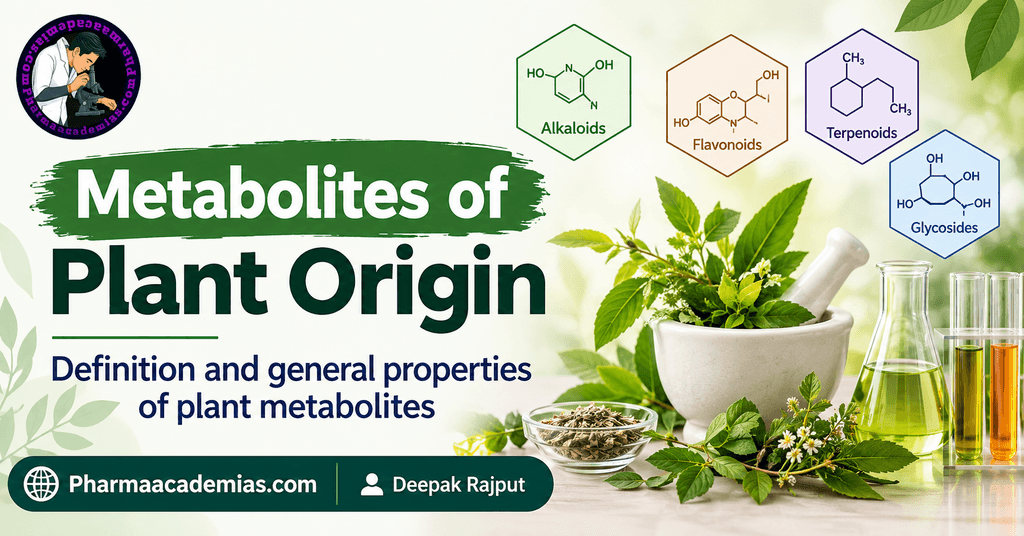
Plant metabolites can be broadly divided into primary metabolites and secondary metabolites.
3. Primary Metabolites
Primary metabolites are compounds that are directly involved in the normal growth, development, reproduction, and basic physiological processes of plants.
They are generally present in most plants because they are essential for maintaining life processes.
Important examples
- Carbohydrates – glucose, fructose, starch, cellulose
- Proteins
- Amino acids
- Lipids and fatty acids
- Nucleic acids
- Organic acids
Functions
Primary metabolites are involved in:
- Production and storage of energy
- Formation of cellular structures
- Protein synthesis
- Growth and development
- Respiration
- Photosynthesis
- Reproduction
For example, glucose produced during photosynthesis can be used as an energy source, while carbohydrates such as cellulose contribute to the structural framework of plants.
4. Secondary Metabolites
Secondary metabolites are compounds produced through specialized metabolic pathways. They are not generally required for the basic processes of growth and development, but they have important roles in the plant’s survival and interaction with its environment.
They are particularly important in pharmacognosy and pharmaceutical sciences because many secondary metabolites possess significant biological and therapeutic activities.
Major groups of secondary metabolites
- Alkaloids
- Glycosides
- Flavonoids
- Tannins
- Terpenoids
- Steroids
- Saponins
- Phenolic compounds
- Volatile oils
- Resins
Examples
- Morphine – alkaloid obtained from opium
- Quinine – alkaloid obtained from Cinchona
- Atropine – tropane alkaloid
- Digoxin – cardiac glycoside
- Menthol – monoterpene
- Eugenol – phenolic compound
- Diosgenin – steroidal sapogenin
5. General Properties of Plant Metabolites
Plant metabolites possess a wide range of physical, chemical, and biological properties. Their properties depend mainly on their chemical structure and the plant in which they occur.
5.1 Structural and Chemical Diversity: One of the most important characteristics of plant metabolites is their great chemical diversity.They may range from simple molecules such as organic acids to highly complex compounds such as alkaloids, glycosides, and terpenoids.
Different metabolites may contain different functional groups and elements such as:
- Carbon
- Hydrogen
- Oxygen
- Nitrogen
- Sulphur
- Phosphorus
This structural diversity is responsible for the wide range of biological activities shown by plant metabolites.
5.2 Distribution in Different Plant Parts: Plant metabolites are not uniformly distributed throughout the plant.A particular compound may be concentrated in a specific plant part.
For example:
- Alkaloids may be present in leaves, roots, seeds, or bark.
- Volatile oils are commonly present in flowers, leaves, fruits, or seeds.
- Some glycosides are found mainly in leaves or seeds.
- Tannins may occur in bark, leaves, fruits, and other tissues.
Therefore, the correct plant part is important when medicinal plants are collected for pharmaceutical use.
5.3 Variation in Concentration: The concentration of a particular metabolite may vary considerably.
The amount of metabolite can be influenced by:
- Species and variety of plant
- Age of the plant
- Stage of growth
- Season of collection
- Geographical location
- Soil conditions
- Temperature
- Light
- Water availability
- Humidity
- Presence of pests and diseases
Because of these variations, medicinal plants collected from different locations or at different times may show differences in their chemical composition.
5.4 Solubility: Different plant metabolites show different solubility properties.Some compounds dissolve readily in water, whereas others are more soluble in alcohol or organic solvents.
For example:
- Some sugars and salts are highly water-soluble.
- Many lipids and terpenoids are more soluble in organic solvents.
- The solubility of alkaloids can change depending on whether they are present as free bases or salts.
Solubility is an important property during the extraction, separation, purification, and identification of plant metabolites.
5.5 Biological and Pharmacological Activity: Many plant metabolites show significant biological activity.
Depending on their chemical structure, they may exhibit:
- Antimicrobial activity
- Antioxidant activity
- Anti-inflammatory activity
- Analgesic activity
- Anticancer activity
- Antidiabetic activity
- Cardiovascular activity
- Antimalarial activity
- CNS activity
For example, quinine has antimalarial activity, while morphine possesses potent analgesic activity.
This pharmacological activity makes plant metabolites valuable sources for drug development and pharmaceutical research.
5.6 Role in Plant Defence: Many secondary metabolites act as natural defence chemicals. Plants cannot move away from predators, insects, or pathogens. Therefore, they produce chemical substances that help protect them.
These metabolites may:
- Repel insects
- Prevent herbivores from eating the plant
- Inhibit the growth of microorganisms
- Protect against fungal infections
- Reduce damage caused by environmental stress
For example, some alkaloids and phenolic compounds can have antifeedant or antimicrobial effects.
5.7 Taste and Odour: Certain metabolites are responsible for the characteristic taste and odour of medicinal plants.
Some may produce:
- Bitter taste
- Sweet taste
- Astringent taste
- Pungent taste
- Aromatic odour
Examples:
Alkaloids → often bitter
Tannins → astringent
Volatile oils → characteristic aroma
These properties are sometimes useful during the organoleptic evaluation of crude drugs.
5.8 Volatility: Some plant metabolites are volatile and can easily evaporate at room temperature or on mild heating.Such compounds are commonly found in volatile or essential oils.
Examples include:
- Menthol
- Camphor
- Eugenol
- Thymol
Volatile compounds are often responsible for the characteristic fragrance of plants.
5.9 Toxicity: Plant metabolites are not always beneficial. Some may produce toxic effects when consumed in large amounts or when used incorrectly.
Examples include certain:
- Alkaloids
- Cardiac glycosides
- Cyanogenic compounds
- Terpenoids
Therefore, medicinal plants must be properly identified, collected, processed, standardized, and tested before pharmaceutical use.
6. Factors Affecting Formation of Plant Metabolites
The production of metabolites is a dynamic process and can be affected by several factors.
1. Genetic factors: Different plant species have different genetic characteristics. Therefore, two species may produce completely different metabolites.
2. Environmental conditions: Factors such as temperature, sunlight, rainfall, humidity, soil composition, and altitude can affect metabolite production.
3. Age of the plant: The concentration of some metabolites changes as the plant develops from a young stage to maturity.
4. Season: Certain metabolites are produced in greater quantities during specific seasons.
5. Plant part: Roots, leaves, flowers, fruits, seeds, and bark may contain different types and concentrations of metabolites.
6. Stress
Environmental stresses such as:
- Drought
- High temperature
- Pathogen attack
- Insect attack
- Salinity
may alter the production of secondary metabolites.
7. Importance of Plant Metabolites in Pharmacy
Plant metabolites have a major role in the pharmaceutical and healthcare fields.
A. Source of active drugs
Some plant metabolites are directly used as medicinal agents.
For example:
- Morphine → analgesic
- Quinine → antimalarial
- Digoxin → cardiac drug
B. Drug discovery: Plant metabolites provide natural molecules that can be studied as lead compounds for the development of new medicines.
C. Quality control: Specific metabolites can be used as chemical markers for identification and standardization of medicinal plants.
D. Evaluation of crude drugs: The presence or absence of particular metabolites can help in determining the identity, quality, and purity of a crude drug.
E. Herbal medicines: Many traditional and modern herbal preparations contain combinations of plant metabolites that contribute to their biological effects.
8. Primary and Secondary Metabolites – Comparison
| Feature | Primary Metabolites | Secondary Metabolites |
| Main role | Growth and normal physiological functions | Defence, adaptation and ecological interactions |
| Necessity | Essential for basic life processes | Generally not directly essential for basic growth |
| Distribution | Usually widely distributed | Often restricted to particular species or tissues |
| Production | Associated with basic metabolism | Often produced through specialized pathways |
| Examples | Carbohydrates, proteins, amino acids, lipids | Alkaloids, flavonoids, tannins, terpenoids, glycosides |
| Pharmaceutical importance | Nutritional and structural importance | Major source of pharmacologically active natural products |
9. Important Examples of Plant Metabolites
| Metabolite/Class | Plant source/example | Major significance |
| Morphine | Opium poppy | Analgesic |
| Quinine | Cinchona | Antimalarial |
| Atropine | Atropa/Belladonna-type sources | Anticholinergic |
| Digoxin | Digitalis | Cardiac activity |
| Menthol | Peppermint | Cooling sensation and medicinal use |
| Eugenol | Clove | Dental and antimicrobial applications |
| Diosgenin | Dioscorea | Steroid drug precursor |
| Rutin | Various plants | Flavonoid with antioxidant activity |
| Tannins | Various barks, leaves, fruits | Astringent properties |
Conclusion
Plant metabolites are an important group of naturally occurring chemical substances produced during the metabolic activities of plants. They include both primary metabolites, which are essential for growth and normal physiological functions, and secondary metabolites, which have important roles in defence, adaptation, and interaction with the environment.
From the pharmaceutical point of view, secondary metabolites are particularly significant because they provide a large number of biologically active natural compounds. Their chemical diversity, pharmacological activities, and ability to serve as lead molecules make plants an important source for drug discovery, development, and pharmaceutical research.
Editorial Note
This article has been carefully researched and written by Deepak Rajput with a focus on accuracy, clarity, and evidence-based healthcare information. Pharmaacademias.com