
Active Listening Questioning Techniques and Empathy in Healthcare Communication: Active listening, questioning techniques, and empathy are important communication skills in healthcare that help professionals understand patients, collect accurate information, identify their needs, and respond with care, respect, and understanding. These skills help build trust and a positive relationship between the patient and healthcare provider.
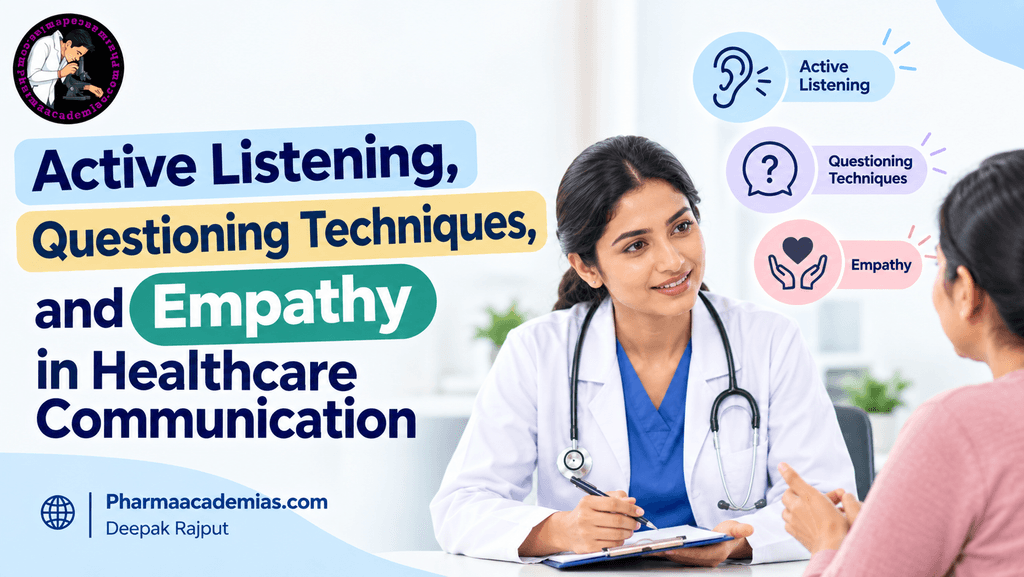
Effective communication in healthcare is not only about giving information. Healthcare professionals must also listen carefully, ask appropriate questions, and understand the patient’s feelings.
Three important skills are:
- Active Listening
- Questioning Techniques
- Empathy
Active Listening Questioning Techniques and Empathy in Healthcare Communication
1. Active Listening
Active listening means listening to the patient carefully and attentively, understanding what they are saying, and showing that you are interested in their concerns.
It is more than simply hearing words. It involves understanding the patient’s words, emotions, andnon-verbal signals.
Simple Definition
Active listening = Listen + Understand + Respond appropriately
Important Elements of Active Listening
1. Give Full Attention
Focus completely on the patient while they are speaking.
Avoid:
- Using your phone
- Unnecessary interruptions
- Looking away repeatedly
- Doing unrelated work
2. Maintain Appropriate Eye Contact
Appropriate eye contact shows that you are paying attention. However, continuous staring should be avoided.
3. Do Not Interrupt
Allow the patient to complete their statement before responding.
Example: If a patient says, “I stopped taking the medicine because…” allow them to explain the reason.
4. Use Verbal Encouragement
Small responses can encourage the patient to continue.
Examples:
- “I understand.”
- “Okay.”
- “Please continue.”
- “I see.”
5. Observe Non-Verbal Communication
Pay attention to:
- Facial expressions
- Body posture
- Tone of voice
- Gestures
- Signs of anxiety or discomfort
6. Clarify Information
If something is unclear, ask for clarification.
Example: “You said the pain gets worse at night. Can you tell me how often this happens?”
7. Summarize and Confirm
At the end, briefly summarize what the patient said to make sure you understood correctly.
Example: “So, you have been taking the medicine once daily instead of twice daily because it causes stomach discomfort. Is that correct?”
Importance of Active Listening in Healthcare
Active listening helps to:
- Understand the patient’s symptoms.
- Identify medication-related problems.
- Build trust.
- Reduce misunderstandings.
- Improve patient satisfaction.
- Improve medication adherence.
- Identify patient concerns.
- Improve patient safety.
2. Questioning Techniques
Questioning techniques are methods used by healthcare professionals to ask questions in a way that helps them obtain accurate, complete, and useful information from patients.
Good questioning is especially important during:
- Patient history taking
- Patient counselling
- Medication review
- Clinical interviews
- Pharmacy consultations
Types of Questions
A. Open-Ended Questions
Open-ended questions allow the patient to give a detailed answer rather than simply saying “yes” or “no.”
They often begin with:
What, How, When, Where, Why, Tell me…
Examples
- “What problems are you experiencing?”
- “How are you taking this medicine?”
- “Tell me about your symptoms.”
- “How has this medicine affected you?”
Advantages
- Provides detailed information.
- Encourages the patient to speak.
- Helps understand the patient’s concerns and experience.
B. Closed-Ended Questions
Closed-ended questions usually require a short or specific answer, often “Yes/No” or a specific fact.
Examples
- “Are you taking this medicine?”
- “Do you have a fever?”
- “Did you take the medicine today?”
- “Are you allergic to penicillin?”
Advantages
Useful for obtaining:
- Specific information
- Quick confirmation
- Precise facts
Limitation
They may restrict the patient’s response.
C. Probing Questions
Probing questions are follow-up questions used to obtain more information about something the patient has already mentioned.
Example
Patient: “This medicine makes me uncomfortable.”
Pharmacist: “What kind of discomfort do you experience?”
Patient: “I feel nauseous.”
Pharmacist: “When does the nausea usually occur after taking the medicine?”
This helps obtain more detailed information.
D. Clarifying Questions
These questions are used when the patient’s statement is unclear or confusing.
Example
Patient: “I take the medicine sometimes.”
Healthcare professional:
“When you say sometimes, how many days in a week do you usually take it?”
This prevents misunderstanding.
E. Leading Questions
A leading question suggests a particular answer.
Example:
“Your headache is better now, isn’t it?”
This may influence the patient’s response.
In healthcare: Leading questions should generally be avoided, especially during history taking, because they may produce biased or inaccurate information.
Instead ask:
“How is your headache now?”
F. Reflective Questions
Reflective questioning involves responding to the patient’s statement in a way that encourages them to explain further.
Example:
Patient: “I’m worried about taking this medicine.”
Healthcare professional:
“You’re worried about taking the medicine. Can you tell me what concerns you?”
This encourages the patient to discuss their feelings.
3. Empathy
Empathy is the ability to understand and recognize another person’s feelings, concerns, and point of view, and respond in a supportive manner.
In healthcare, empathy means trying to understand what the patient is experiencing and how they feel.
Simple Definition
Empathy = Understanding the patient’s feelings and responding with care.
Empathy vs Sympathy
These two terms are often confused.
Empathy: You try to understand the person’s feelings.
Example: “I understand that you are worried about starting this new treatment.”
Sympathy: You feel sorry for someone’s situation.
Example: “I’m sorry that you are going through this.”
Easy Difference
Empathy → “I understand how this may feel.”
Sympathy → “I feel sorry for you.”
4. How to Show Empathy in Healthcare
1. Listen Carefully: Allow the patient to express their concerns without unnecessary interruption.
2. Acknowledge Feelings: Recognize what the patient is feeling.
Example: “It sounds like you are feeling anxious about the procedure.”
3. Use Supportive Language
Examples:
- “I understand your concern.”
- “It is understandable that you are worried.”
- “Let’s discuss your concerns.”
- “I am here to help.”
4. Avoid Judgment: Do not blame or criticize the patient.
Instead of:
“Why didn’t you take your medicine?”
Say:
“Can you tell me what made it difficult to take your medicine regularly?”
5. Show Appropriate Non-Verbal Communication
Empathy can also be shown through:
- Appropriate eye contact
- Calm tone
- Open posture
- Patient facial expressions
- Giving the patient enough time
5. Importance of Empathy in Healthcare
Empathy helps to:
- Build trust.
- Improve the patient-healthcare professional relationship.
- Reduce patient anxiety.
- Encourage patients to share their concerns.
- Improve treatment cooperation.
- Improve medication adherence.
- Increase patient satisfaction.
- Support better communication.
6. Active Listening + Questioning + Empathy
These three skills work together.
Example
Patient: “I’m not taking my medicine regularly because it makes me feel dizzy.”
Active Listening: The pharmacist listens without interrupting.
Questioning
The pharmacist asks:
“When do you usually feel dizzy after taking the medicine?”
Empathy
The pharmacist responds:
“I understand that feeling dizzy can be uncomfortable and may make you worried about taking the medicine.”
This approach helps the pharmacist understand the problem, identify the patient’s concern, and provide appropriate counselling.
7. Quick Revision Table
| Skill | Meaning | Main Purpose |
| Active Listening | Listening carefully and understanding | Understand patient |
| Open-ended Question | Allows detailed answer | Gather information |
| Closed-ended Question | Requires specific answer | Confirm facts |
| Probing Question | Explores information further | Get more details |
| Clarifying Question | Removes confusion | Ensure correct understanding |
| Leading Question | Suggests an answer | Generally avoid |
| Empathy | Understanding patient’s feelings | Build trust and support |
Exam Memory Tricks
Active Listening
L – A – C – S
L = Listen carefully
A = Attention
C = Clarify
S = Summarize
Question Types
O – C – P – C – L
O = Open-ended
C = Closed-ended
P = Probing
C = Clarifying
L = Leading
One-Line Revision
Active listening → Understand what the patient says.
Questioning → Obtain accurate and complete information.
Empathy → Understand how the patient feels.
Editorial Note
This article has been carefully researched and written by Deepak Rajput with a focus on accuracy, clarity, and evidence-based healthcare information. Pharmaacademias.com