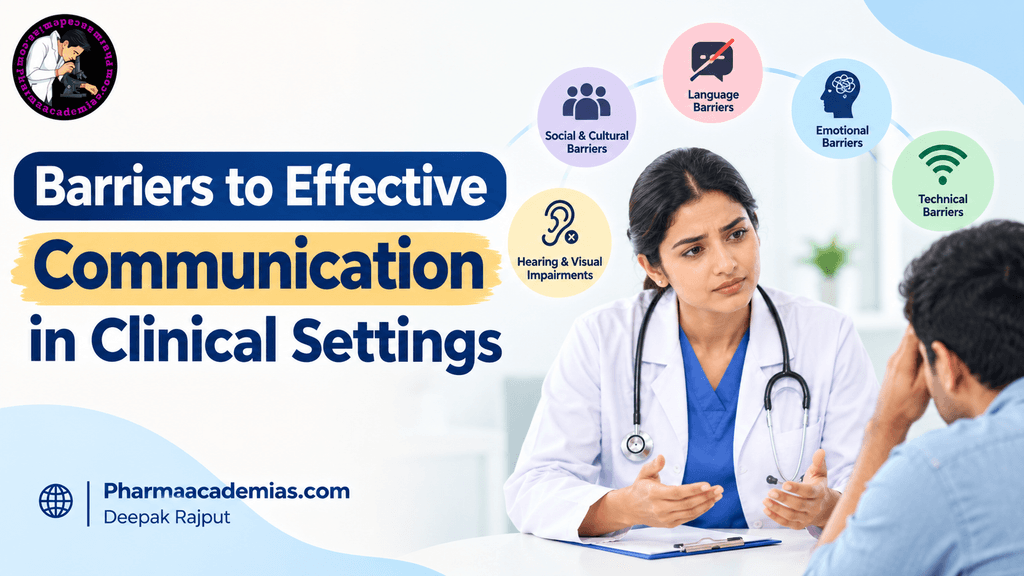
Barriers to Effective Communication in Clinical Settings: Barriers to effective communication are factors that prevent or disturb the clear exchange of information between patients and healthcare professionals.
Examples include language differences, medical jargon, noise, lack of attention, cultural differences, emotional stress, hearing problems, and poor listening skills.
1. Meaning of Barriers to Effective Communication in Clinical Settings
Barriers to communication are factors that prevent or disturb the proper exchange and understanding of information between patients, doctors, pharmacists, nurses, and other healthcare professionals.
In clinical settings, effective communication is very important because poor communication can lead to misunderstanding, medication errors, incorrect treatment, and poor patient outcomes.
2. Major Barriers to Communication
A. Language Barrier
A language barrier occurs when the healthcare professional and patient do not understand the same language properly.
Example: A patient speaks Hindi, but the healthcare professional explains everything in complex English.
Problems:
- Patient may misunderstand instructions.
- Important symptoms may not be communicated correctly.
- Medication errors may occur.
Solution: Use simple language or a qualified interpreter when required.
B. Use of Medical Jargon
Medical jargon means technical medical terms that may be difficult for patients to understand.
Example: Instead of saying “Take this medicine after food,” saying “Administer the medication postprandially.” The patient may not understand the term postprandially.
Solution: Use simple, clear, patient-friendly language.
C. Physical Barriers
Physical factors can interfere with communication.
Examples:
- Noise
- Poor lighting
- Lack of privacy
- Long distance
- Crowded clinical environment
- Poor telephone connection
Example: A pharmacist gives medicine instructions while many people are talking nearby.
Solution:Provide a quiet and private environment whenever possible.
D. Hearing and Speech Problems
Patients may have:
- Hearing impairment
- Speech difficulties
- Voice problems
These conditions can make communication difficult.
Solution:
- Speak clearly.
- Face the patient while speaking.
- Use written information or visual aids when appropriate.
- Give the patient sufficient time to respond.
E. Psychological and Emotional Barriers
A patient’s emotional condition can affect communication.
Examples:
- Fear
- Anxiety
- Stress
- Anger
- Depression
- Embarrassment
Example: A patient who is very anxious may not remember the instructions given by the pharmacist.
Solution:
- Be calm and supportive.
- Listen patiently.
- Show empathy.
- Give important information slowly and clearly.
F. Cultural Barriers
Different cultures may have different:
- Beliefs
- Values
- Customs
- Health practices
- Attitudes toward illness and treatment
These differences can affect communication.
Example: A patient’s cultural beliefs may influence their acceptance of a particular treatment.
Solution: Healthcare professionals should show cultural sensitivity and respect.
G. Lack of Attention or Poor Listening
Communication is not only about speaking. Active listening is also important.
A healthcare professional may fail to listen properly because of:
- Work pressure
- Distractions
- Lack of interest
- Multitasking
- Time pressure
Result: Important patient information may be missed.
Solution:
- Listen actively.
- Avoid unnecessary interruptions.
- Maintain appropriate eye contact.
- Clarify doubts.
H. Time Constraints
Healthcare professionals may have limited time because of:
- Large number of patients
- Emergency situations
- Heavy workload
- Staff shortages
This can result in rushed communication.
Result: Patients may not get enough opportunity to ask questions.
Solution: Focus on the most important information first and confirm patient understanding.
I. Information Overload
Giving too much information at once can confuse the patient.
Example: A patient is given several medicines and receives complicated instructions for every medicine at the same time.
Solution:
- Give information step-by-step.
- Prioritize important instructions.
- Provide written instructions when appropriate.
- Ask the patient to repeat important instructions.
J. Lack of Feedback
If the healthcare professional does not check whether the patient has understood the information, misunderstanding may remain unnoticed.
Example: The pharmacist explains how to use an inhaler but does not ask the patient to demonstrate it.
Solution:Use feedback and teach-back methods.
Teach-back: Ask the patient to explain the instructions in their own words.
K. Environmental Barriers
The clinical environment can also affect communication.
Examples:
- Noise
- Poor ventilation
- Crowding
- Lack of privacy
- Frequent interruptions
These factors may reduce concentration and confidentiality.
L. Technology-Related Barriers
These are particularly important in
Examples:
- Poor internet connection
- Audio/video problems
- Lack of digital skills
- Device problems
- Technical interruptions
Solution:
- Check the technology before consultation.
- Use a reliable connection.
- Have an alternative communication method when possible.
M. Attitudinal Barriers
The attitude of either the patient or healthcare professional can interfere with communication.
Examples:
- Lack of respect
- Lack of empathy
- Judgmental behavior
- Overconfidence
- Negative attitude
- Not taking the patient’s concerns seriously
Solution:
Healthcare professionals should demonstrate:
- Respect
- Empathy
- Patience
- Professionalism
- Non-judgmental behavior
3. Effects of Poor Communication in Clinical Settings
Poor communication can result in:
- Medication errors
- Incorrect understanding of treatment
- Poor medication adherence
- Delayed diagnosis
- Patient dissatisfaction
- Loss of trust
- Reduced patient safety
- Poor coordination among healthcare professionals
- Increased risk of adverse events
- Poor treatment outcomes
4. How to Overcome Communication Barriers
Healthcare professionals should:
- Use simple and clear language.
- Avoid unnecessary medical jargon.
- Listen actively.
- Show empathy and respect.
- Maintain appropriate eye contact.
- Give patients enough time to speak.
- Encourage questions.
- Use interpreters when necessary.
- Use written instructions and visual aids.
- Maintain privacy.
- Confirm understanding using the teach-back method.
- Provide important information in a logical order.
- Minimize environmental distractions.
- Use technology properly during telehealth.
Quick Revision Table
| Barrier | Example | Solution |
| Language | Patient doesn’t understand the language | Use simple language/interpreter |
| Medical jargon | Difficult medical terms | Use common words |
| Physical | Noise, crowding | Quiet/private environment |
| Hearing/Speech | Hearing impairment | Speak clearly/use written information |
| Psychological | Fear, anxiety | Empathy and reassurance |
| Cultural | Different beliefs | Cultural sensitivity |
| Poor listening | Professional doesn’t listen | Active listening |
| Time constraint | Rushed consultation | Prioritize important information |
| Information overload | Too many instructions | Give information step-by-step |
| Lack of feedback | Understanding not checked | Teach-back |
| Technology | Poor internet | Check technology/use alternatives |
| Attitudinal | Judgmental behavior | Respect and professionalism |
Exam Memory Trick
Remember the major barriers as:
L – M – P – H – P – C – L – T – I – F – T – A
L = Language
M = Medical jargon
P = Physical
H = Hearing/Speech
P = Psychological
C = Cultural
L = Listening
T = Time
I = Information overload
F = Feedback
T = Technology
A = Attitude
Most important exam point: In clinical communication, barriers can affect patient safety, especially when they cause misunderstanding of medicines, diagnosis, or treatment instructions.
Editorial Note
This article has been carefully researched and written by Deepak Rajput with a focus on accuracy, clarity, and evidence-based healthcare information. Pharmaacademias.com