
Oral Rehydration Salt (ORS) is a scientifically formulated mixture of electrolytes and glucose used to prevent and treat dehydration caused by diarrhea, vomiting, excessive sweating, fever, and other conditions associated with fluid and electrolyte loss. ORS is considered one of the most important medical discoveries of the 20th century because it has significantly reduced mortality associated with diarrheal diseases, especially in children. Pharmaacademias.com
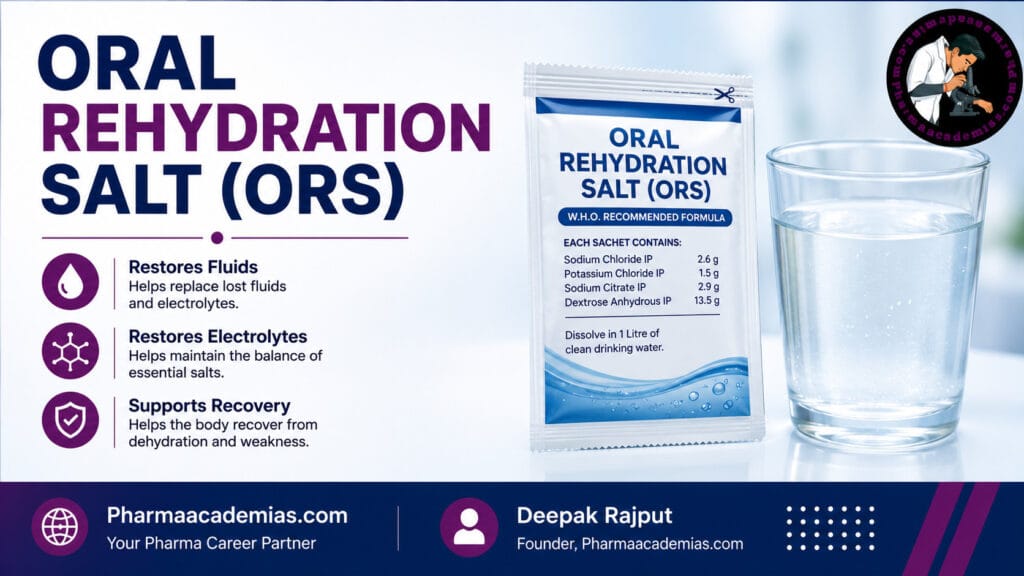
ORS works by replacing lost fluids and essential electrolytes such as sodium, potassium, and chloride while promoting efficient absorption of water from the intestine. It is recommended by the World Health Organization (WHO) and United Nations Children’s Fund (UNICEF) as the first-line treatment for mild to moderate dehydration.
Oral Rehydration Salt
Oral Rehydration Salt (ORS) is a balanced mixture of electrolytes and glucose dissolved in clean drinking water and administered orally to restore fluid and electrolyte balance in dehydrated individuals.
Composition of WHO Recommended Reduced-Osmolarity ORS
The currently recommended WHO ORS formulation contains:
| Component | Amount (g/L) |
| Sodium Chloride (NaCl) | 2.6 g |
| Glucose (Anhydrous) | 13.5 g |
| Potassium Chloride (KCl) | 1.5 g |
| Trisodium Citrate Dihydrate | 2.9 g |
Electrolyte Concentration
| Electrolyte | Concentration (mmol/L) |
| Sodium (Na⁺) | 75 |
| Potassium (K⁺) | 20 |
| Chloride (Cl⁻) | 65 |
| Citrate | 10 |
| Glucose | 75 |
Total Osmolarity = 245 mOsm/L
Principle of ORS Therapy
The effectiveness of ORS is based on the sodium-glucose co-transport mechanism present in the intestinal mucosa.
Even during severe diarrhea, the intestine retains the ability to absorb sodium when glucose is present. Glucose facilitates the transport of sodium across the intestinal epithelium, and water follows passively through osmotic forces. This mechanism enables rapid rehydration and correction of electrolyte losses.
Mechanism
- Glucose and sodium are absorbed together through intestinal transport proteins.
- Water follows sodium into the bloodstream by osmosis.
- Potassium replenishes intracellular losses.
- Citrate helps correct metabolic acidosis associated with diarrhea.
Functions of Components of ORS
1. Sodium Chloride (NaCl)
Functions
- Replaces sodium lost during diarrhea and vomiting.
- Maintains extracellular fluid volume.
- Prevents hyponatremia.
- Supports nerve impulse transmission and muscle function.
2. Glucose
Functions
- Enhances sodium and water absorption.
- Provides a small source of energy.
- Facilitates intestinal rehydration through sodium-glucose co-transport.
3. Potassium Chloride (KCl)
Functions
- Replaces potassium lost in stool.
- Maintains intracellular fluid balance.
- Supports normal muscle contraction and cardiac function.
- Prevents hypokalemia.
4. Trisodium Citrate
Functions
- Corrects metabolic acidosis.
- Improves electrolyte balance.
- Enhances intestinal absorption of water and electrolytes.
Indications of ORS
ORS is indicated in:
Acute Diarrhea: Most common indication, particularly in children.
Gastroenteritis: Prevents dehydration resulting from infectious diarrhea.
Vomiting: Helps replace lost fluids and electrolytes.
Cholera: Used along with appropriate antimicrobial therapy.
Heat Exhaustion and Excessive Sweating: Replaces fluid and electrolyte losses.
Mild to Moderate Dehydration: Effective for dehydration due to various causes.
Advantages of ORS
Safe and Effective: Can be administered at home and in healthcare settings.
Low Cost: Affordable and accessible worldwide.
Reduces Mortality: Has dramatically reduced deaths from diarrheal diseases.
Easy Administration: Requires no specialized equipment.
Rapid Rehydration: Restores fluid and electrolyte balance efficiently.
Prevents Hospitalization: Many cases of dehydration can be managed without intravenous therapy.
Preparation of ORS Solution
Standard Procedure
- Wash hands thoroughly.
- Take one ORS sachet.
- Dissolve the entire contents in 1 liter of clean drinking water.
- Stir until completely dissolved.
- Use within 24 hours.
- Discard any unused solution after 24 hours.
Important Precautions
- Do not boil after preparation.
- Do not add extra sugar or salt.
- Prepare exactly according to instructions.
- Use clean and safe drinking water.
Administration of ORS
Children
- Give small frequent sips using a spoon or cup.
- Continue breastfeeding during treatment.
Adults
- Drink frequently according to thirst and degree of dehydration.
WHO Recommendations
After each loose stool:
| Age Group | ORS Amount |
| < 2 years | 50–100 mL |
| 2–10 years | 100–200 mL |
| >10 years and adults | As much as desired |
Side Effects
ORS is generally very safe.
Occasionally:
- Mild nausea
- Vomiting (if consumed too rapidly)
- Temporary abdominal fullness
Serious adverse effects are rare when prepared correctly.
Contraindications
ORS may not be sufficient alone in:
- Severe dehydration requiring intravenous fluids.
- Intestinal obstruction.
- Persistent uncontrollable vomiting.
- Severe shock.
- Altered consciousness preventing oral intake.
Clinical Importance of ORS
ORS is regarded as one of the most successful public health interventions worldwide. Since its introduction, millions of lives have been saved from dehydration-related deaths, particularly among children under five years of age. The therapy is simple, inexpensive, effective, and forms the cornerstone of diarrheal disease management globally.
Conclusion
Oral Rehydration Salt (ORS) is a balanced electrolyte-glucose solution used for the prevention and treatment of dehydration caused by diarrhea, vomiting, and excessive fluid loss. Its effectiveness is based on the sodium-glucose co-transport mechanism, which promotes rapid absorption of water and electrolytes from the intestine. ORS contains sodium chloride, potassium chloride, glucose, and trisodium citrate, each playing a vital role in restoring fluid and electrolyte balance. Due to its safety, affordability, and life-saving potential, ORS remains an essential component of modern healthcare and public health programs worldwide.
This article has been carefully researched and written by Deepak Rajput with a focus on accuracy, clarity, and evidence-based healthcare information.