Functions of major physiological ions: Electrolytes are substances that dissociate into positively charged ions (cations) and negatively charged ions (anions) when dissolved in water. These ions are essential for maintaining various physiological processes in the body, including fluid balance, nerve impulse transmission, muscle contraction, acid-base regulation, and cellular metabolism. Electrolytes are distributed differently between the intracellular fluid (ICF) and extracellular fluid (ECF), creating concentration gradients that are crucial for normal body function. Pharmaacademias.com
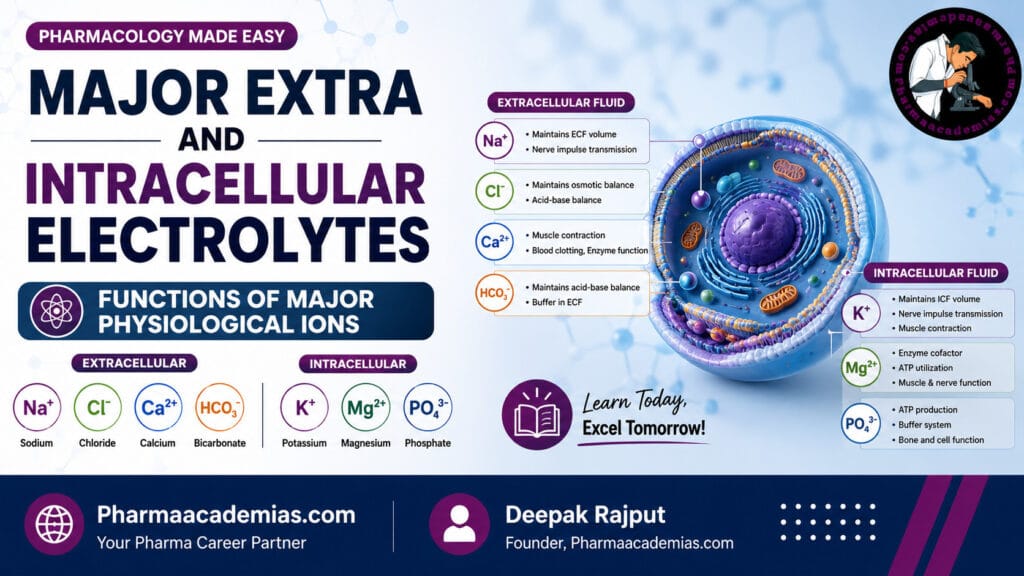
The human body contains approximately 60% water, which is divided into intracellular fluid (about two-thirds) and extracellular fluid (about one-third). The electrolyte composition of these compartments differs significantly, allowing cells to perform specialized functions and maintain homeostasis.
Functions of major physiological ions
Major Extracellular Electrolytes
Extracellular fluid includes plasma, interstitial fluid, and lymph. The principal electrolytes found in this compartment are sodium, chloride, bicarbonate, and calcium.
1. Sodium (Na⁺)
Sodium is the most abundant cation in the extracellular fluid and plays a vital role in maintaining osmotic pressure and fluid balance. The normal plasma sodium concentration ranges from 135–145 mEq/L.
Functions of Sodium
Maintenance of Fluid Balance: Sodium is the primary determinant of extracellular fluid volume. It regulates the movement of water between body compartments through osmosis. Changes in sodium concentration directly influence hydration status and blood volume.
Regulation of Blood Pressure: By controlling extracellular fluid volume, sodium significantly affects blood pressure. Increased sodium retention leads to water retention and elevated blood pressure.
Nerve Impulse Transmission: Sodium ions are essential for generating and propagating action potentials in neurons. Rapid influx of sodium into nerve cells initiates electrical impulses.
Muscle Contraction: Sodium contributes to the electrical activity necessary for skeletal, cardiac, and smooth muscle contraction.
Acid-Base Balance: Sodium participates in maintaining acid-base equilibrium through interactions with bicarbonate and phosphate buffering systems.
2. Chloride (Cl⁻)
Chloride is the major extracellular anion and usually accompanies sodium. Normal plasma chloride concentration ranges from 98–106 mEq/L.
Functions of Chloride
Osmotic Pressure Regulation: Chloride helps maintain osmotic pressure and fluid distribution in extracellular spaces.
Acid-Base Balance: Chloride participates in maintaining electrical neutrality and acid-base balance through the chloride shift mechanism in red blood cells.
Formation of Gastric Acid: Chloride ions combine with hydrogen ions to form hydrochloric acid (HCl) in the stomach, which is essential for digestion.
Carbon Dioxide Transport: Chloride exchange across red blood cell membranes facilitates carbon dioxide transport from tissues to lungs.
3. Bicarbonate (HCO₃⁻)
Bicarbonate is the second most important extracellular anion and serves as the primary buffer in blood.
Functions of Bicarbonate
Maintenance of Acid-Base Balance: The bicarbonate buffer system is the body’s most important extracellular buffering mechanism, maintaining blood pH within the narrow range of 7.35–7.45.
Carbon Dioxide Transport: Bicarbonate facilitates transport of carbon dioxide from tissues to lungs, where it is converted back to CO₂ and exhaled.
Prevention of Acidosis and Alkalosis: By neutralizing excess acids or bases, bicarbonate prevents dangerous fluctuations in blood pH.
4. Calcium (Ca²⁺)
Although most calcium is stored in bones and teeth, extracellular calcium plays critical physiological roles. Normal serum calcium concentration is approximately 8.5–10.5 mg/dL.
Functions of Calcium
Muscle Contraction: Calcium initiates contraction in skeletal, smooth, and cardiac muscles by interacting with contractile proteins.
Blood Clotting: Calcium is an essential cofactor in several steps of the coagulation cascade.
Nerve Transmission: Calcium regulates neurotransmitter release at synapses.
Bone and Teeth Formation: Calcium provides structural strength to bones and teeth.
Enzyme Activation: Many enzymes require calcium as a cofactor for optimal activity.
Major Intracellular Electrolytes
The intracellular fluid contains high concentrations of potassium, magnesium, phosphate, and proteins.
1. Potassium (K⁺)
Potassium is the principal intracellular cation, with approximately 98% of total body potassium located inside cells. Normal plasma potassium concentration is 3.5–5.0 mEq/L.
Functions of Potassium
Maintenance of Cell Membrane Potential: Potassium is crucial for establishing resting membrane potential in nerve and muscle cells.
Nerve Impulse Transmission: Potassium movement out of cells helps repolarize cell membranes after action potentials.
Muscle Function: Potassium is necessary for normal skeletal, smooth, and cardiac muscle contraction.
Protein Synthesis: Potassium supports intracellular enzymatic reactions involved in protein synthesis.
Carbohydrate Metabolism: Potassium assists in glucose uptake and glycogen synthesis.
Regulation of Acid-Base Balance: Potassium exchanges with hydrogen ions between cells and extracellular fluid, helping maintain pH homeostasis.
2. Magnesium (Mg²⁺)
Magnesium is the second most abundant intracellular cation after potassium and is involved in numerous biochemical reactions.
Functions of Magnesium
Enzyme Cofactor: Magnesium acts as a cofactor for more than 300 enzymatic reactions, including those involved in energy production.
ATP Metabolism: Most intracellular ATP exists as a magnesium-ATP complex, which is necessary for energy utilization.
Neuromuscular Function: Magnesium regulates nerve impulse transmission and muscle excitability.
Protein and DNA Synthesis: Magnesium is essential for nucleic acid synthesis and protein formation.
Cardiac Function: It helps maintain normal cardiac rhythm and electrical stability.
3. Phosphate (PO₄³⁻)
Phosphate is the major intracellular anion and exists in various forms within cells.
Functions of Phosphate
Energy Storage and Transfer: Phosphate is a key component of ATP, ADP, and AMP, which are essential for cellular energy transfer.
Bone and Teeth Mineralization: Phosphate combines with calcium to form hydroxyapatite crystals that strengthen bones and teeth.
Acid-Base Buffering: Intracellular phosphate acts as an important buffer system.
Cell Membrane Structure: Phospholipids containing phosphate form the structural framework of cell membranes.
Genetic Material Formation: Phosphate is a component of DNA and RNA molecules.
4. Intracellular Proteins
Proteins carry negative charges and function as intracellular anions.
Functions of Intracellular Proteins
Maintenance of Osmotic Pressure: Proteins help regulate intracellular osmotic balance and water distribution.
Structural Support: They provide structural integrity to cells and tissues.
Enzymatic Activity: Many proteins function as enzymes that catalyze biochemical reactions.
Transport Functions: Proteins transport ions, nutrients, and metabolites within cells.
Buffering Action: Proteins contribute significantly to intracellular acid-base regulation.
Functions of Major Physiological Ions
| Ion | Primary Location | Major Physiological Functions |
| Sodium (Na⁺) | Extracellular | Fluid balance, blood pressure regulation, nerve conduction, muscle contraction |
| Potassium (K⁺) | Intracellular | Membrane potential maintenance, nerve transmission, muscle function |
| Calcium (Ca²⁺) | Extracellular | Muscle contraction, blood clotting, neurotransmitter release, bone formation |
| Magnesium (Mg²⁺) | Intracellular | Enzyme activation, ATP metabolism, protein synthesis |
| Chloride (Cl⁻) | Extracellular | Osmotic balance, acid-base regulation, gastric acid formation |
| Bicarbonate (HCO₃⁻) | Extracellular | Blood buffering, acid-base balance, carbon dioxide transport |
| Phosphate (PO₄³⁻) | Intracellular | Energy metabolism, bone formation, buffering, nucleic acid synthesis |
Importance of Electrolyte Balance
The maintenance of electrolyte balance is essential for survival. Disturbances in electrolyte concentrations can lead to severe physiological consequences:
- Hyponatremia may cause confusion, seizures, and cerebral edema.
- Hypernatremia can result in dehydration and neurological impairment.
- Hypokalemia may lead to muscle weakness and cardiac arrhythmias.
- Hyperkalemia can cause life-threatening cardiac conduction abnormalities.
- Hypocalcemia may produce muscle spasms and tetany.
- Hypercalcemia can result in kidney stones, cardiac dysfunction, and neurological symptoms.
- Hypomagnesemia may cause neuromuscular irritability and arrhythmias.
- Hypophosphatemia can impair energy metabolism and muscle function.
Conclusion
Electrolytes are indispensable components of human physiology. Sodium, chloride, bicarbonate, and calcium are the major extracellular electrolytes, whereas potassium, magnesium, phosphate, and intracellular proteins predominate within cells. These physiological ions regulate fluid and electrolyte balance, acid-base homeostasis, nerve impulse transmission, muscle contraction, enzyme activity, and energy metabolism. The precise regulation of electrolyte concentrations is therefore essential for maintaining normal cellular function and overall health.
This article has been carefully researched and written by Deepak Rajput with a focus on accuracy, clarity, and evidence-based healthcare information.