
Limit Test for Lead: In pharmaceutical analysis, maintaining the purity and safety of pharmaceutical substances is extremely important because impurities present even in trace quantities may produce harmful physiological effects. Among the various toxic metallic impurities, lead is considered one of the most hazardous because of its cumulative toxicity and damaging effects on multiple organ systems. Lead contamination may affect the nervous system, kidneys, blood, liver, and reproductive organs. Long-term exposure to lead can cause serious health complications including anemia, neurological disorders, developmental abnormalities, and chronic toxicity. Therefore, pharmaceutical substances must be carefully examined to ensure that lead impurities remain within permissible pharmacopoeial limits.
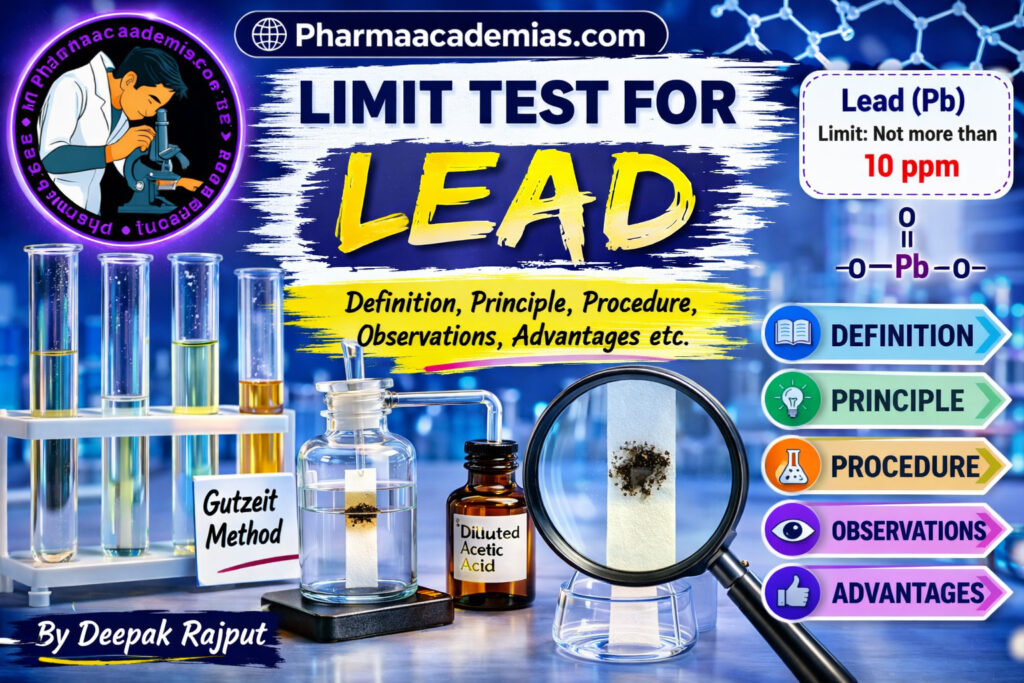
The limit test for lead is a semi-quantitative analytical procedure used to detect and control small quantities of lead impurities in pharmaceutical substances. The test is generally based on the reaction of lead ions with dithizone, producing a colored lead-dithizonate complex that can be compared visually with a standard lead solution containing a known amount of lead impurity.
The intensity of the color produced depends upon the concentration of lead present in the sample. The test does not determine the exact amount of lead present but indicates whether the lead impurity is within the acceptable pharmacopoeial limit.
Definition of Limit Test for Lead
The limit test for lead may be defined as a semi-quantitative analytical test used to detect and control trace quantities of lead impurities in pharmaceutical substances by comparing the intensity of color produced with that of a standard lead solution under specified experimental conditions.
The purpose of the test is to ensure that lead contamination does not exceed toxicologically acceptable limits.
Principle of the Limit Test for Lead
The principle of the limit test for lead is based on the reaction between lead ions and dithizone in alkaline medium, resulting in the formation of a colored lead-dithizonate complex.
Lead ions react with dithizone to produce a red or pink-colored complex that is soluble in chloroform or carbon tetrachloride.
The intensity of the color developed is proportional to the amount of lead present in the sample.
The color produced by the test solution is compared visually with that produced by a standard lead solution containing a known quantity of lead.
If the color intensity of the test solution is not greater than that of the standard solution, the sample passes the test.
Chemical Reaction Involved
Lead ions react with dithizone to form a colored lead-dithizonate complex.
The simplified reaction may be represented as:
Pb2+ + Dithizone → Lead-Dithizonate Complex
The resulting complex produces a characteristic red or pink coloration.
The intensity of this coloration corresponds approximately to the concentration of lead impurity present in the sample.
Sources of Lead Impurities
Lead impurities may enter pharmaceutical substances from several sources during manufacturing, storage, or handling.
Common sources include:
- Contaminated raw materials
- Water used during manufacturing
- Corrosion of equipment
- Metallic containers
- Environmental pollution
- Industrial contamination
- Reagents and chemicals
Lead contamination may also arise from dust, old pipes, paints, and improper storage conditions.
Certain natural products, mineral salts, and herbal materials are especially susceptible to heavy metal contamination including lead.
Importance of the Limit Test for Lead
The limit test for lead is extremely important because lead is highly toxic even at low concentrations.
Excessive lead exposure may cause:
- Neurological disorders
- Kidney damage
- Anemia
- Hypertension
- Liver dysfunction
- Developmental abnormalities in children
- Reproductive toxicity
Lead is considered a cumulative poison because it gradually accumulates in bones and tissues over time.
Therefore, strict monitoring of lead impurities is essential for pharmaceutical safety and regulatory compliance.
Reagents Used in the Limit Test for Lead
Several important reagents are required for performing the test accurately.
Dithizone Solution: Dithizone is the principal reagent used in the test.It reacts with lead ions to form a colored lead-dithizonate complex.Dithizone is usually dissolved in chloroform or carbon tetrachloride because the colored complex is soluble in organic solvents.
Ammonium Citrate: Ammonium citrate acts as a masking agent and helps prevent interference from other metallic ions.It forms complexes with metals other than lead, thereby improving the specificity of the test.
Hydroxylamine Hydrochloride: Hydroxylamine hydrochloride acts as a reducing agent and prevents oxidation of dithizone during the reaction.It improves the stability and sensitivity of the test.
Potassium Cyanide: Potassium cyanide masks interfering metallic ions that may otherwise react with dithizone.This improves selectivity for lead detection.Because potassium cyanide is highly toxic, it must be handled carefully.
Ammonia Solution: Ammonia provides the alkaline medium necessary for proper complex formation between lead and dithizone.
Standard Lead Solution: A standard lead solution containing a known amount of lead impurity is prepared for comparison with the test solution.The standard is generally prepared using lead nitrate or another suitable lead compound.
Chloroform: Chloroform is used as the organic solvent for extraction of the colored lead-dithizonate complex.The complex dissolves in the chloroform layer and produces a visible red or pink color.
Apparatus Used
The apparatus commonly used includes:
- Nessler cylinders
- Separating funnels
- Pipettes
- Volumetric flasks
- Measuring cylinders
Separating funnels are especially important because the colored lead complex is extracted into an organic solvent layer.
Procedure for the Limit Test for Lead
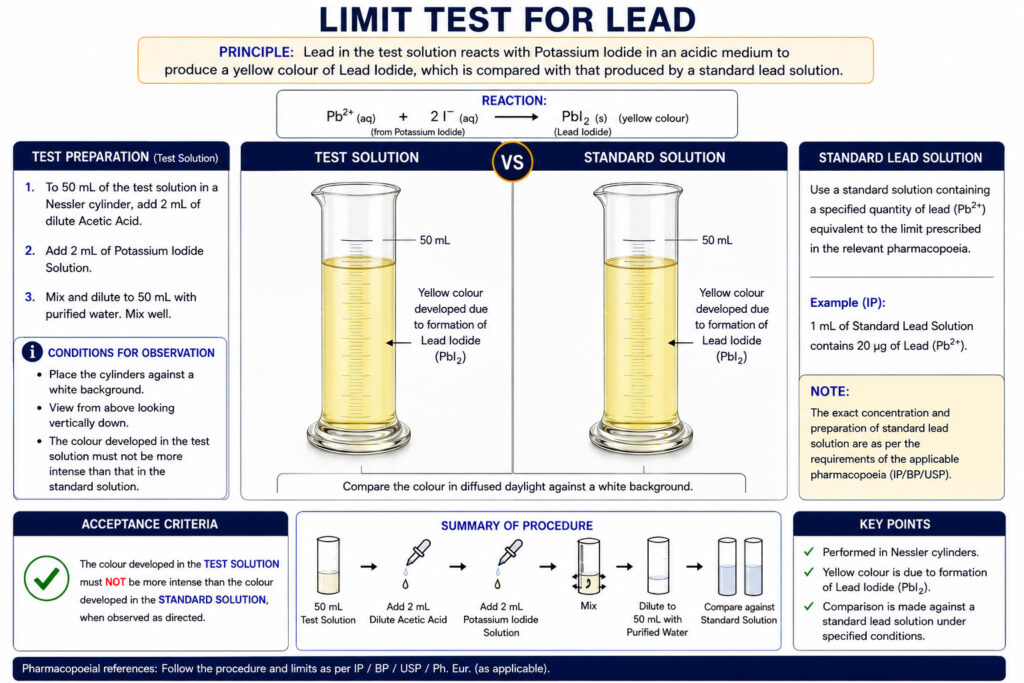
In the procedure, the pharmaceutical sample is dissolved in water or another suitable solvent.
Ammonium citrate, hydroxylamine hydrochloride, potassium cyanide, and ammonia solution are added to the test solution under specified conditions.
Dithizone solution dissolved in chloroform is then added, and the mixture is shaken thoroughly in a separating funnel.
Lead ions present in the sample react with dithizone and form a red-colored lead-dithizonate complex that is extracted into the chloroform layer.
Simultaneously, a standard lead solution containing the prescribed amount of lead impurity is treated in the same manner.
The intensity of the color developed in the organic layer of the test solution is compared visually with that of the standard solution.
If the color intensity of the test solution is not greater than that of the standard solution, the sample passes the test.
Role of Various Reagents
Each reagent performs a specific function in the test.
Dithizone: Forms colored complex with lead ions
Ammonium Citrate: Masks interfering metallic ions
Hydroxylamine Hydrochloride: Prevents oxidation of dithizone
Potassium Cyanide: Eliminates interference from other metals
Ammonia: Provides alkaline medium
Chloroform: Extracts colored lead complex
Observation in the Test
The principal observation is the intensity of the red or pink coloration produced in the chloroform layer.
Two outcomes are possible.
Pass Condition: If the color intensity of the test solution is less than or equal to the standard solution, the sample passes the test.
Fail Condition: If the color intensity of the test solution is greater than the standard solution, the sample fails because lead impurities exceed permissible limits.
Interpretation of Results
The limit test for lead is comparative and semi-quantitative in nature.
The test indicates whether:
- Lead impurities are within acceptable pharmacopoeial limits
or - Lead impurities exceed prescribed standards
Careful visual comparison under identical lighting conditions is necessary for accurate interpretation.
Precautions in the Limit Test for Lead
Several precautions are necessary to obtain reliable results.
All glassware should be thoroughly cleaned and free from lead contamination. Reagents should be freshly prepared, and distilled water free from heavy metal contamination should be used.
The pH of the solution should be properly maintained because improper pH may affect complex formation.
Potassium cyanide should be handled with extreme care because of its toxicity.
Both test and standard solutions should be treated under identical conditions including reagent concentration, shaking time, and temperature.
Color comparison should be carried out under uniform lighting conditions.
Advantages of the Limit Test for Lead
The limit test for lead possesses several advantages.
The method is relatively simple, economical, and suitable for routine pharmaceutical quality control. It is sensitive enough to detect small amounts of lead impurities.
The test does not require highly sophisticated instrumentation and is useful for rapid screening purposes.
Limitations of the Test
Despite its usefulness, the test has certain limitations.
The method is semi-quantitative and depends upon visual comparison, which may vary between observers.
Certain metallic ions may interfere if not adequately masked. The use of toxic reagents such as potassium cyanide also presents safety concerns.
Modern instrumental techniques such as atomic absorption spectroscopy and inductively coupled plasma mass spectrometry provide more accurate and sensitive results than classical limit tests.
Pharmaceutical Applications of the Limit Test for Lead
The limit test for lead is widely used in pharmaceutical analysis for testing:
- Pharmaceutical raw materials
- Inorganic chemicals
- Excipients
- Water used in manufacturing
- Herbal preparations
- Mineral salts
The test is commonly applied to substances susceptible to heavy metal contamination.
Routine lead testing helps ensure pharmaceutical purity and patient safety.
Regulatory Importance
Official pharmacopoeias such as:
- Indian Pharmacopoeia Commission
- United States Pharmacopeial Convention
- British Pharmacopoeia Commission
include official procedures and permissible limits for lead impurities.
International regulatory authorities also impose strict limits on lead because of its toxicological significance.
Compliance with these standards is essential for:
- Drug approval
- Pharmaceutical quality assurance
- Patient safety
- Regulatory compliance
Difference Between Limit Test and Quantitative Estimation
The limit test differs from quantitative analysis because it only determines whether lead impurities remain within prescribed limits.
It does not measure the exact concentration of lead present in the sample.
The method is simpler, faster, and more economical than advanced instrumental analytical techniques, making it suitable for routine quality control testing.
Conclusion
The limit test for lead is an important semi-quantitative analytical procedure used in pharmaceutical analysis to detect and control lead impurities within acceptable pharmacopoeial limits. The test is based on the formation of a colored lead-dithizonate complex when lead ions react with dithizone in alkaline medium.
Lead impurities may arise from raw materials, manufacturing equipment, water, environmental contamination, or reagents. Because lead is highly toxic and cumulative in nature, strict monitoring of lead impurities is essential for pharmaceutical safety and regulatory compliance.
The test provides a simple, sensitive, and economical method for routine impurity analysis and is officially included in pharmacopoeias such as the Indian Pharmacopoeia Commission, United States Pharmacopeial Convention, and British Pharmacopoeia Commission.
Therefore, the limit test for lead plays a vital role in pharmaceutical quality assurance by ensuring the purity, safety, stability, and regulatory compliance of pharmaceutical substances and medicinal products.