
Limit Test for Arsenic: In pharmaceutical analysis, the purity of pharmaceutical substances is of utmost importance because impurities present even in trace amounts may produce harmful effects on human health. Among various toxic impurities, arsenic is considered one of the most dangerous because of its highly poisonous nature and cumulative toxic effects. Arsenic contamination in pharmaceutical substances may lead to severe toxicity affecting the skin, liver, kidneys, nervous system, and cardiovascular system. Long-term exposure to arsenic is also associated with carcinogenic effects. Therefore, pharmaceutical substances must be carefully tested to ensure that arsenic impurities remain within permissible pharmacopoeial limits.

The limit test for arsenic is a semi-quantitative analytical procedure used to detect and control minute quantities of arsenic impurities present in pharmaceutical substances. The test is commonly based on the Gutzeit method, in which arsenic present in the sample is converted into arsine gas. The arsine gas reacts with mercuric chloride paper to produce a yellow to brown stain, the intensity of which is compared with that produced by a standard arsenic solution containing a known amount of arsenic impurity.
The test does not determine the exact quantity of arsenic present but indicates whether the arsenic impurity is within the acceptable pharmacopoeial limit.
Definition of Limit Test for Arsenic
The limit test for arsenic may be defined as a semi-quantitative analytical test used to detect and control trace quantities of arsenic impurities in pharmaceutical substances by comparing the stain produced with a standard arsenic solution under specified conditions.
The test ensures that arsenic contamination remains below toxic and pharmacopoeially prescribed levels.
Principle of the Limit Test for Arsenic
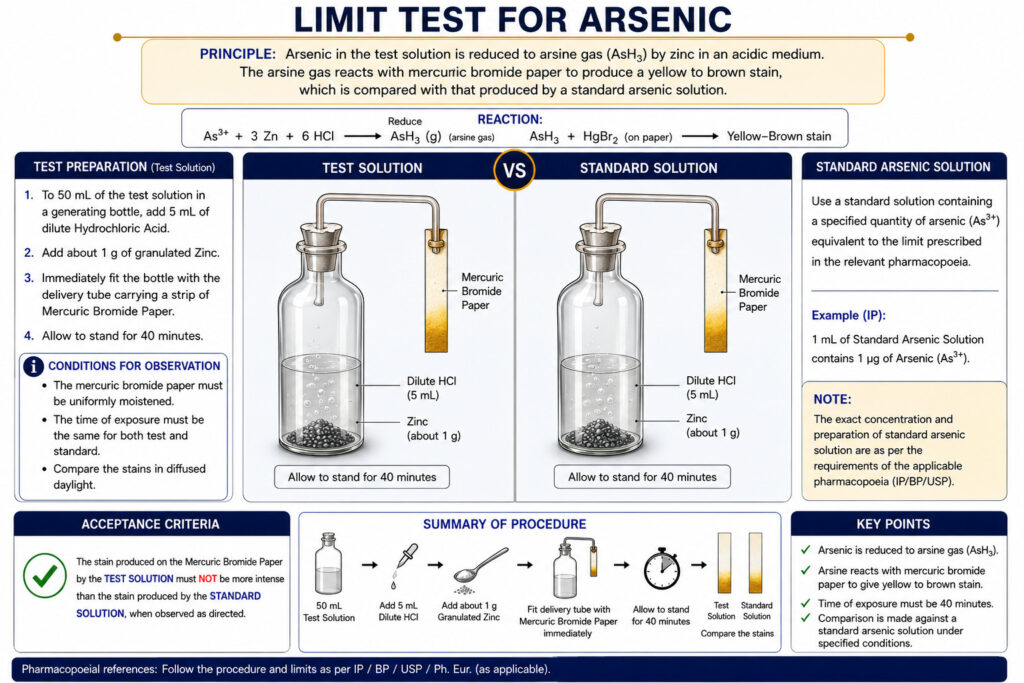
The principle of the limit test for arsenic is based on the conversion of arsenic compounds into arsine gas (AsH3) by the action of nascent hydrogen generated from zinc and acid. The arsine gas produced reacts with mercuric chloride paper to form a yellow or brown-colored stain.
The intensity of the stain is proportional to the amount of arsenic present in the sample.
The stain produced by the test solution is compared visually with the stain produced by a standard arsenic solution containing a known quantity of arsenic.
If the stain produced by the test solution is not darker than the standard stain, the sample passes the test.
Chemical Reactions Involved
Initially, nascent hydrogen is generated by the reaction between zinc and hydrochloric acid.
Zn + 2HCl → ZnCl2 + 2 [H]
The nascent hydrogen then reduces arsenic compounds to arsine gas.
As2O3 + 12[H] → 2AsH3 + 3H2O
The arsine gas reacts with mercuric chloride paper to produce a yellow or brown stain.
AsH3 + HgCl2 → Yellow/Brown Stain
The intensity of the stain corresponds approximately to the concentration of arsenic present.
Sources of Arsenic Impurities
Arsenic impurities may enter pharmaceutical substances from various sources during manufacturing, processing, or storage.
Common sources include:
- Contaminated raw materials
- Sulphuric acid and hydrochloric acid used during synthesis
- Water used in manufacturing
- Metallic equipment
- Environmental contamination
- Mineral-derived substances
- Glass containers and chemicals
Natural products and mineral salts are especially susceptible to arsenic contamination because arsenic commonly occurs in nature along with other minerals.
Importance of the Limit Test for Arsenic
The limit test for arsenic is extremely important because arsenic is highly toxic even at very low concentrations.
Excessive arsenic exposure may cause:
- Gastrointestinal irritation
- Liver damage
- Kidney toxicity
- Neurological disorders
- Skin lesions
- Cardiovascular complications
- Cancer
Arsenic is considered a cumulative poison because it gradually accumulates in body tissues over prolonged exposure.
Therefore, strict monitoring of arsenic impurities is essential for pharmaceutical safety and regulatory compliance.
Apparatus Used in the Limit Test for Arsenic
The apparatus commonly used is known as the Gutzeit apparatus.
It generally consists of:
- A wide-mouthed generating bottle
- A glass tube
- Cotton plug
- Mercuric chloride paper
- Rubber stopper
The apparatus is specially designed to generate arsine gas and direct it toward the mercuric chloride paper for stain development.
Reagents Used in the Limit Test for Arsenic
Several important reagents are required for performing the test accurately.
Zinc: Arsenic-free zinc granules are used to generate nascent hydrogen in the presence of hydrochloric acid. The nascent hydrogen reduces arsenic compounds to arsine gas.
Hydrochloric Acid: Hydrochloric acid reacts with zinc to generate nascent hydrogen required for arsine formation. The acid should be arsenic-free to avoid false-positive results.
Potassium Iodide: Potassium iodide helps reduce pentavalent arsenic compounds to trivalent arsenic, which is more readily converted into arsine gas.
Stannous Chloride: Stannous chloride acts as an additional reducing agent and enhances conversion of arsenic into arsine gas.
Mercuric Chloride Paper: Mercuric chloride paper is used for detection of arsine gas. When arsine gas comes into contact with the paper, a yellow to brown stain develops.
Lead Acetate Cotton: Lead acetate cotton is used to absorb hydrogen sulfide gas that may otherwise interfere with the test. Hydrogen sulfide can react with mercuric chloride paper and produce misleading stains.
Standard Arsenic Solution: A standard arsenic solution containing a known quantity of arsenic impurity is prepared for comparison with the test solution.
Procedure for the Limit Test for Arsenic
In the procedure, the specified quantity of the pharmaceutical sample is placed into the Gutzeit generator bottle.
Hydrochloric acid, potassium iodide, and stannous chloride are added to reduce arsenic compounds into the appropriate oxidation state.
Arsenic-free zinc granules are then added to generate nascent hydrogen.
The nascent hydrogen converts arsenic compounds into arsine gas.
The arsine gas produced passes through a plug of lead acetate cotton, which removes interfering hydrogen sulfide gas, and finally reaches the mercuric chloride paper fixed at the top of the apparatus.
A yellow or brown stain develops on the mercuric chloride paper.
Simultaneously, a standard arsenic solution containing the prescribed amount of arsenic is treated under identical conditions.
After a specified period, usually about forty minutes, the intensity of the stain produced by the test solution is compared visually with that of the standard solution.
If the test stain is not darker than the standard stain, the sample passes the test.
Role of Various Reagents
Each reagent used in the test performs a specific function.
Zinc: Generates nascent hydrogen
Hydrochloric Acid: Reacts with zinc to produce nascent hydrogen
Potassium Iodide: Reduces pentavalent arsenic to trivalent arsenic
Stannous Chloride: Enhances reduction process
Lead Acetate Cotton: Removes interfering hydrogen sulfide gas
Mercuric Chloride Paper: Detects arsine gas by stain formation
Observation in the Test
The principal observation is the intensity of the yellow or brown stain produced on mercuric chloride paper.
Two outcomes are possible.
Pass Condition: If the stain produced by the test solution is lighter than or equal to the standard stain, the sample passes the test.
Fail Condition: If the stain produced by the test solution is darker than the standard stain, the sample fails because arsenic impurities exceed permissible limits.
Interpretation of Results
The limit test for arsenic is comparative and semi-quantitative in nature.
It indicates whether:
- Arsenic impurities are within acceptable pharmacopoeial limits
or - Arsenic impurities exceed official standards
Careful visual comparison under identical lighting conditions is necessary for accurate interpretation.
Precautions in the Limit Test for Arsenic
Several precautions are necessary to ensure reliable and accurate results.
All reagents used must be arsenic-free. Glassware should be thoroughly cleaned to avoid contamination.
The apparatus must be airtight because leakage of arsine gas may produce inaccurate results.
Mercuric chloride paper should be freshly prepared and protected from moisture and contamination.
Lead acetate cotton should be properly placed to remove hydrogen sulfide interference.
The test should be performed in a well-ventilated area because arsine gas is highly toxic.
Advantages of the Limit Test for Arsenic
The limit test for arsenic possesses several advantages.
The procedure is relatively simple, sensitive, economical, and suitable for detecting minute quantities of arsenic impurities.
It is widely used in pharmaceutical quality control laboratories because it does not require highly sophisticated instrumentation.
The test is particularly valuable for routine screening purposes.
Limitations of the Test
Despite its usefulness, the test has certain limitations.
The method is semi-quantitative and depends on visual comparison of stain intensity, which may vary between observers.
Certain substances may interfere with arsine generation or stain formation.
The test also involves handling toxic arsine gas, requiring careful safety precautions.
Modern instrumental techniques such as atomic absorption spectroscopy and inductively coupled plasma mass spectrometry are more accurate and sensitive than the classical limit test.
Pharmaceutical Applications of the Limit Test for Arsenic
The limit test for arsenic is widely used in pharmaceutical analysis for testing:
- Pharmaceutical raw materials
- Inorganic chemicals
- Excipients
- Mineral salts
- Water used in manufacturing
- Herbal preparations
The test is commonly applied to substances such as:
- Calcium salts
- Magnesium compounds
- Sodium bicarbonate
- Iron preparations
- Pharmaceutical-grade chemicals
Routine arsenic testing helps ensure pharmaceutical purity and patient safety.
Regulatory Importance
Official pharmacopoeias such as:
- Indian Pharmacopoeia Commission
- United States Pharmacopeial Convention
- British Pharmacopoeia Commission
include official procedures and permissible limits for arsenic impurities.
International regulatory agencies also impose strict arsenic limits because of its toxicological significance.
Compliance with these standards is essential for:
- Drug approval
- Pharmaceutical quality assurance
- Patient safety
- Regulatory compliance
Difference Between Limit Test and Quantitative Analysis
The limit test differs from quantitative estimation because it only determines whether arsenic impurities remain within permissible limits.
It does not provide the exact concentration of arsenic present in the sample.
The test is simpler, quicker, and more economical than advanced instrumental methods, making it suitable for routine quality control testing.
Conclusion
The limit test for arsenic is an important semi-quantitative analytical procedure used in pharmaceutical analysis to detect and control arsenic impurities within acceptable pharmacopoeial limits. The test is based on the conversion of arsenic compounds into arsine gas, which reacts with mercuric chloride paper to produce a yellow or brown stain.
Arsenic impurities may arise from raw materials, manufacturing processes, environmental contamination, or reagents. Because arsenic is highly toxic and carcinogenic, strict monitoring of arsenic impurities is essential for pharmaceutical safety and regulatory compliance.
The test provides a simple, sensitive, and economical method for routine impurity analysis and is officially included in pharmacopoeias such as the Indian Pharmacopoeia Commission, United States Pharmacopeial Convention, and British Pharmacopoeia Commission.
Therefore, the limit test for arsenic plays a vital role in pharmaceutical quality assurance by ensuring the purity, safety, and regulatory compliance of pharmaceutical substances and medicinal products.