
Diseases of Bones and Joints: Bones and joints are essential components of the musculoskeletal system that provide support, protection, movement, and stability to the human body. Healthy bones maintain body structure, while joints allow smooth and coordinated movement. Various diseases can affect bones and joints due to aging, infections, nutritional deficiencies, autoimmune disorders, metabolic abnormalities, trauma, or genetic factors. These conditions often lead to pain, inflammation, stiffness, deformity, reduced mobility, and decreased quality of life. Pharmaacademais.com
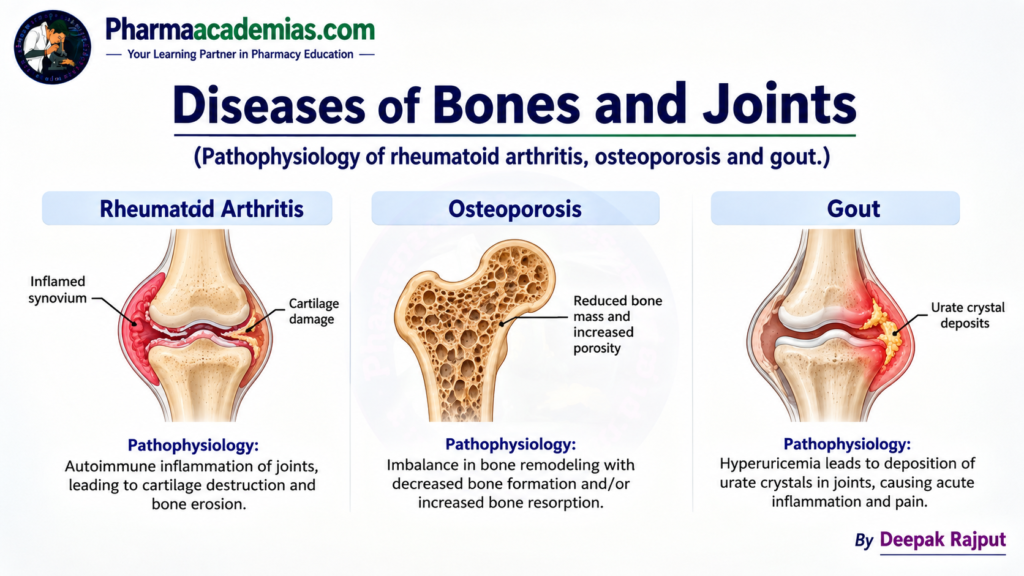
Bone diseases mainly affect the structure, strength, and metabolism of bones, whereas joint diseases involve inflammation, degeneration, or damage to the joint tissues. Early diagnosis and appropriate treatment are important to prevent complications such as fractures, deformities, and permanent disability.
Common Diseases of Bones
Several diseases can affect the bones by weakening their structure or interfering with normal bone metabolism.
Osteoporosis: Osteoporosis is a metabolic bone disease characterized by a reduction in bone mass and deterioration of bone microarchitecture, making bones fragile and susceptible to fractures. It commonly affects elderly individuals, particularly postmenopausal women.
Osteomalacia: Osteomalacia is a condition in adults caused by inadequate mineralization of bone, usually due to vitamin D deficiency. The bones become soft, resulting in bone pain, muscle weakness, and an increased risk of fractures.
Rickets: Rickets is the childhood form of osteomalacia. It occurs because of vitamin D, calcium, or phosphate deficiency and results in weak bones, skeletal deformities, delayed growth, and bowed legs.
Paget’s Disease of Bone: Paget’s disease is a chronic disorder of bone remodeling in which excessive bone resorption is followed by abnormal bone formation. The newly formed bone is enlarged but structurally weak and prone to deformity and fractures.
Osteomyelitis: Osteomyelitis is an infection of the bone caused mainly by bacteria, especially Staphylococcus aureus. It leads to inflammation, severe pain, fever, swelling, and destruction of bone tissue if left untreated.
Bone Tumors: Bone tumors may be benign or malignant. Primary malignant bone tumors include osteosarcoma, chondrosarcoma, and Ewing sarcoma. Metastatic cancers from the breast, prostate, or lungs may also spread to bones.
Common Diseases of Joints: Joint diseases mainly affect the articular cartilage, synovial membrane, ligaments, or surrounding tissues.
Osteoarthritis: Osteoarthritis is the most common degenerative joint disease. It results from gradual wear and tear of articular cartilage, causing pain, stiffness, reduced mobility, and joint deformity.
Rheumatoid Arthritis: Rheumatoid arthritis is a chronic autoimmune inflammatory disease that mainly affects synovial joints. It causes persistent inflammation, joint destruction, deformity, and disability if not adequately treated.
Gout: Gout is a metabolic disorder caused by excessive accumulation of uric acid crystals within joints. It produces sudden episodes of severe joint pain, redness, swelling, and inflammation.
Septic Arthritis: Septic arthritis is a bacterial infection of a joint that causes rapid inflammation and destruction of cartilage. Immediate treatment is necessary to prevent permanent joint damage.
Ankylosing Spondylitis: Ankylosing spondylitis is a chronic inflammatory disease affecting mainly the spine and sacroiliac joints. It causes stiffness, pain, and progressive fusion of vertebrae.
Pathophysiology of Rheumatoid Arthritis
Rheumatoid arthritis (RA) is a chronic systemic autoimmune disease characterized by persistent inflammation of synovial joints. It primarily affects small joints of the hands and feet but may also involve larger joints and extra-articular organs such as the lungs, heart, eyes, and blood vessels.
The exact cause of rheumatoid arthritis remains unknown, but both genetic susceptibility and environmental factors contribute to disease development. Genetic factors such as HLA-DR4 and HLA-DR1 increase susceptibility, while environmental triggers such as smoking, infections, and hormonal influences may initiate the disease.
Mechanism of Disease
The disease begins when the immune system mistakenly recognizes components of the synovial membrane as foreign. Activated T lymphocytes stimulate macrophages and B lymphocytes, leading to the production of inflammatory cytokines such as tumor necrosis factor-alpha (TNF-α), interleukin-1 (IL-1), and interleukin-6 (IL-6).
B lymphocytes produce rheumatoid factor (RF) and anti-cyclic citrullinated peptide (anti-CCP) antibodies, which contribute to chronic inflammation.
The persistent inflammatory response causes the synovial membrane to become thickened and highly vascular. This abnormal inflammatory tissue is called pannus.
The pannus gradually invades and destroys:
- Articular cartilage
- Subchondral bone
- Ligaments
- Tendons
- Joint capsule
As the disease progresses, repeated cycles of inflammation result in cartilage erosion, bone destruction, joint deformity, and eventual loss of joint function.
Clinical Features
Patients typically experience:
- Symmetrical joint pain.
- Morning stiffness lasting more than one hour.
- Swollen and tender joints.
- Reduced range of motion.
- Progressive joint deformities such as ulnar deviation and swan-neck deformity.
- Fatigue, low-grade fever, and weight loss.
Without treatment, rheumatoid arthritis may result in permanent disability.
Pathophysiology of Osteoporosis
Osteoporosis is a systemic metabolic bone disease characterized by decreased bone mineral density and deterioration of bone microarchitecture, resulting in fragile bones and an increased risk of fractures.
Normally, bone undergoes continuous remodeling through a balance between:
- Osteoclasts, which resorb bone.
- Osteoblasts, which form new bone.
In osteoporosis, bone resorption exceeds bone formation, leading to progressive bone loss.
Causes
Several factors contribute to osteoporosis, including:
- Aging.
- Estrogen deficiency after menopause.
- Calcium deficiency.
- Vitamin D deficiency.
- Physical inactivity.
- Smoking and excessive alcohol consumption.
- Long-term corticosteroid therapy.
- Endocrine disorders such as hyperthyroidism.
Mechanism of Disease
Estrogen normally inhibits osteoclast activity. After menopause, estrogen levels decline significantly, resulting in increased osteoclast activation.
Activated osteoclasts remove bone tissue faster than osteoblasts can replace it. Consequently:
- Trabecular bone becomes thin and disconnected.
- Cortical bone becomes porous.
- Bone mineral density decreases.
- Bone strength declines.
Eventually, even minor trauma may produce fractures.
The most commonly affected bones include:
- Vertebrae.
- Hip (femoral neck).
- Distal radius (Colles’ fracture).
Clinical Features
Osteoporosis often remains asymptomatic until a fracture occurs.
Common manifestations include:
- Fragility fractures.
- Back pain due to vertebral compression fractures.
- Loss of height.
- Kyphosis (“dowager’s hump”).
- Reduced mobility.
Pathophysiology of Gout
Gout is a metabolic inflammatory disease caused by hyperuricemia, resulting in deposition of monosodium urate crystals within joints and surrounding tissues.
Uric acid is the end product of purine metabolism. Normally, it is dissolved in blood and excreted by the kidneys.
Hyperuricemia develops due to:
- Excessive production of uric acid.
- Reduced renal excretion of uric acid.
- High-purine diet.
- Alcohol consumption.
- Chronic kidney disease.
- Certain medications such as diuretics.
Mechanism of Disease
When serum uric acid concentration exceeds its solubility limit, monosodium urate crystals begin to form.
These crystals are deposited in:
- Synovial fluid.
- Articular cartilage.
- Tendons.
- Soft tissues.
The deposited crystals are recognized as foreign particles by immune cells.
Neutrophils and macrophages attempt to engulf the crystals, activating the NLRP3 inflammasome and releasing inflammatory cytokines, particularly interleukin-1β (IL-1β).
This intense inflammatory response produces:
- Sudden severe pain.
- Redness.
- Swelling.
- Warmth.
- Tenderness.
Repeated attacks eventually lead to:
- Chronic joint damage.
- Bone erosion.
- Formation of tophi, which are deposits of urate crystals in soft tissues.
The first metatarsophalangeal joint of the great toe is most commonly affected, a condition known as podagra.
Clinical Features
Patients typically present with:
- Sudden onset of severe joint pain.
- Red, swollen, and warm joint.
- Extreme tenderness.
- Fever in some cases.
- Recurrent attacks affecting multiple joints.
- Tophi in chronic disease.
- Kidney stones due to uric acid deposition.
Comparison of Rheumatoid Arthritis, Osteoporosis, and Gout
| Feature | Rheumatoid Arthritis | Osteoporosis | Gout |
| Nature of Disease | Autoimmune inflammatory disease | Metabolic bone disease | Metabolic inflammatory disease |
| Primary Tissue Affected | Synovial joints | Bone | Joints |
| Main Cause | Autoimmune destruction | Increased bone resorption | Hyperuricemia and urate crystal deposition |
| Major Cells Involved | T cells, B cells, macrophages | Osteoclasts and osteoblasts | Neutrophils and macrophages |
| Major Mediators | TNF-α, IL-1, IL-6 | RANKL-mediated osteoclast activation | IL-1β and inflammatory cytokines |
| Common Symptoms | Joint pain, swelling, stiffness | Fragility fractures, back pain | Sudden severe joint pain, redness, swelling |
| Characteristic Feature | Pannus formation and joint erosion | Reduced bone density | Monosodium urate crystal deposition |
Conclusion
Diseases of bones and joints are major causes of pain, disability, and reduced quality of life worldwide. Rheumatoid arthritis is an autoimmune disease that causes chronic inflammation of the synovial membrane, leading to cartilage destruction and joint deformity. Osteoporosis is a metabolic bone disorder characterized by decreased bone density and increased fracture risk due to excessive bone resorption. Gout is an inflammatory condition caused by the deposition of monosodium urate crystals in joints as a result of hyperuricemia. Understanding the pathophysiology of these disorders is essential for early diagnosis, appropriate treatment, prevention of complications, and improvement of patient outcomes.
Editorial Note
This article has been carefully researched and written by Deepak Rajput with a focus on accuracy, clarity, and evidence-based healthcare information.