Complexometric Titrations: Complexometric titration is a type of volumetric analysis in which a metal ion reacts with a suitable complexing agent to form a stable, soluble and usually water-soluble coordination complex.
The most commonly used complexing agent is EDTA (Ethylenediaminetetraacetic acid).
General reaction
Mn+ + Y4− → MY(n−4)−
Where:
- Mⁿ⁺ = metal ion
- Y⁴⁻ = EDTA ion
- MY = metal–EDTA complex
EDTA generally reacts with metal ions in a 1:1 molar ratio, irrespective of the charge on the metal ion.
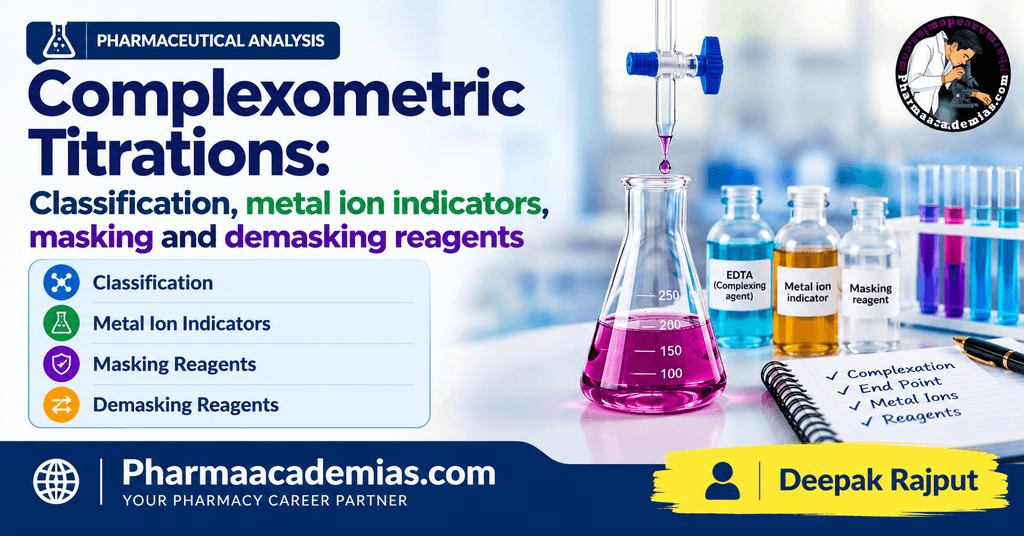
1. Classification of Complexometric Titrations
Complexometric titrations can be classified into four main types:
A. Direct Titration
In direct titration, the metal ion is directly titrated with a standard solution of EDTA.
Procedure:
- The metal-containing solution is taken in a flask.
- Suitable buffer is added to maintain the required pH.
- A suitable metal ion indicator is added.
- The solution is titrated directly with standard EDTA.
- The colour change indicates the endpoint.
Example: Estimation of Ca²⁺ and Mg²⁺ using EDTA.
B. Back Titration
In back titration, an excess known amount of EDTA is first added to the metal ion solution. The unreacted EDTA is then titrated with a standard solution of another metal ion.
Used when:
- The metal–EDTA reaction is slow.
- No suitable indicator is available.
- The metal ion precipitates at the required pH.
- The metal ion reacts with EDTA only under special conditions.
Example: Determination of certain metal ions such as Al³⁺.
C. Replacement or Displacement Titration
In this method, the metal ion being determined displaces another metal ion from its EDTA complex.
For example:
M2+ + MgY2− → MY2− + Mg2+
The released Mg²⁺ can then be titrated with standard EDTA.
Used when:
The metal ion does not give a satisfactory endpoint with a metal ion indicator.
D. Indirect Titration
Indirect titration is used for substances that do not react directly with EDTA.
The substance is first reacted with a suitable metal ion, and the amount of metal ion involved is then determined by complexometric titration.
Example: Determination of some anions by precipitation with a metal ion followed by EDTA titration.
2. Metal Ion Indicators
Definition
Metal ion indicators are organic dyes that form coloured complexes with metal ions. They are used to detect the endpoint in complexometric titrations.
The indicator should form a less stable complex with the metal ion than EDTA does.
At the beginning:
M + Indicator → M-Indicator
The metal–indicator complex has one colour.
When EDTA is added, it binds the metal ion more strongly:
M-Indicator + EDTA → M-EDTA + Indicator
The free indicator has a different colour, producing the endpoint colour change.
Properties of a good metal ion indicator
A good metal ion indicator should:
- Give a sharp colour change at the endpoint.
- Form a sufficiently stable complex with the metal ion.
- The metal–indicator complex should be less stable than the metal–EDTA complex.
- The indicator should be stable under the titration conditions.
- Its colour should be sufficiently intense for easy detection.
- It should work at the required pH.
Important metal ion indicators
| Indicator | Common use | Colour change |
| Eriochrome Black T (EBT) | Ca²⁺ + Mg²⁺ | Wine red → Blue |
| Murexide | Ca²⁺ | Pink → Purple/Blue |
| Xylenol Orange | Various metal ions | Yellow → Red/Violet |
| Calcon | Ca²⁺ | Pink/Red → Blue |
| Patton–Reeder indicator | Ca²⁺ | Pink → Blue |
Eriochrome Black T
Eriochrome Black T (EBT) is one of the most important indicators used in complexometric titration.
For estimation of Ca²⁺ and Mg²⁺ at approximately pH 10:
- Metal–indicator complex → wine red
- Free indicator → blue
Therefore, the endpoint is:
Wine red → Blue
3. Masking Reagents
A masking reagent is a reagent that reacts with an interfering metal ion and prevents that metal ion from reacting with the titrant.
Thus, masking removes the interference of unwanted metal ions during complexometric titration.
Principle
Suppose the solution contains:
- Desired metal ion = M
- Interfering metal ion = X
A masking reagent reacts with X:
X + Masking reagent → X-Mask
The masked X can no longer react significantly with EDTA, allowing selective determination of M.
Examples
| Masking reagent | Metal ion commonly masked |
| Cyanide (CN⁻) | Cu²⁺, Zn²⁺, Cd²⁺, Ni²⁺, Co²⁺ |
| Fluoride (F⁻) | Al³⁺, Fe³⁺ |
| Triethanolamine | Fe³⁺, Al³⁺ and some other ions |
| Tartrate/Citrate | Some metal ions depending on conditions |
Note: Cyanide is highly toxic and is handled only under appropriate laboratory safety procedures.
4. Demasking Reagents
A demasking reagent is a reagent that releases a previously masked metal ion from its complex so that the metal ion can subsequently react with EDTA.
Principle
First, an interfering metal ion is masked:
M + Masking reagent → M-Mask
Later, a demasking reagent is added:
M-Mask + Demasking reagent → M + products
The released metal ion can then be determined separately.
Importance of demasking
Demasking is useful when two or more metal ions are present in the same solution and need to be determined selectively.
Masking vs Demasking
| Feature | Masking | Demasking |
| Meaning | Prevents a metal ion from reacting with EDTA | Releases a previously masked metal ion |
| Purpose | Eliminate interference | Allow selective determination |
| Action | Forms a stable complex with interfering ion | Breaks or removes the masking effect |
| Result | Metal ion becomes unavailable for titration | Metal ion becomes available for titration |
Applications of Complexometric Titrations
Complexometric titrations are widely used for the determination of:
- Calcium
- Magnesium
- Zinc
- Copper
- Nickel
- Cobalt
- Aluminium
- Iron
- Other metal ions
They are important in pharmaceutical analysis, water analysis, quality control, and chemical analysis.
Quick Revision
Complexometric titration = Metal ion + Complexing agent → Stable complex
- Most common titrant: EDTA
- Common indicator: Eriochrome Black T
- EBT endpoint: Wine red → Blue
- Main types: Direct, Back, Replacement/Displacement, Indirect
- Masking: Hides/prevents interfering metal ion from reacting
- Demasking: Releases the masked metal ion
- EDTA reaction: Usually 1:1 with metal ions
Editorial Note
This article has been carefully researched and written by Deepak Rajput with a focus on accuracy, clarity, and evidence-based healthcare information. Pharmaacademias.com